R&D Engineer Resume Examples: free ATS score and gap list
Write an R&D Engineer Resume That Proves You Can Take a Concept to a Working Build
By Mustafa Tarabya, founder of CVBooster · Published · Updated
R&D engineer resume examples, a sample project-led work history, the keywords hiring managers filter on, and a full writing guide.
Sample resumes for a r&d engineer
The same r&d engineer content laid out in three CVBooster templates, so you can see what the finished document looks like before you write a word.
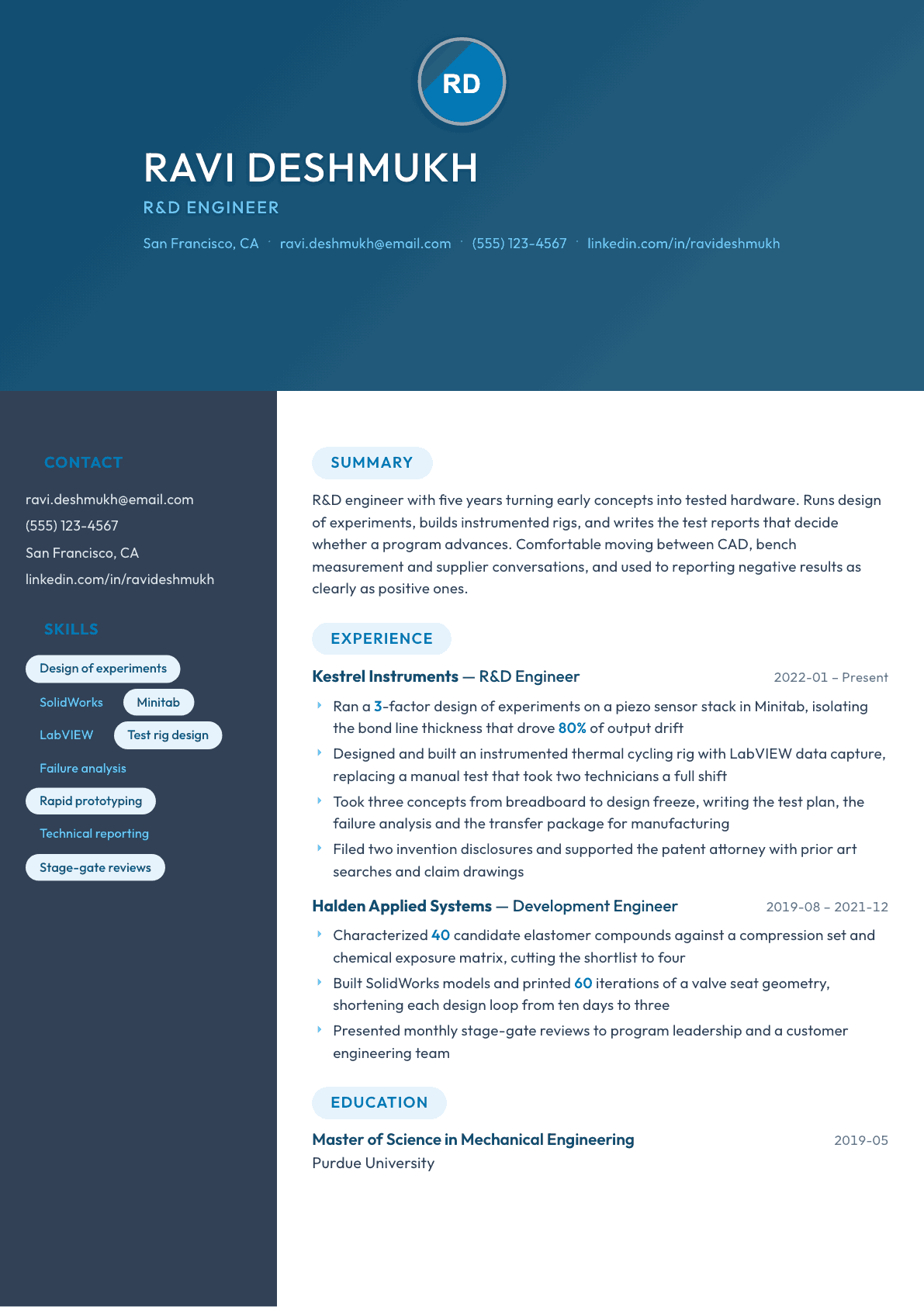
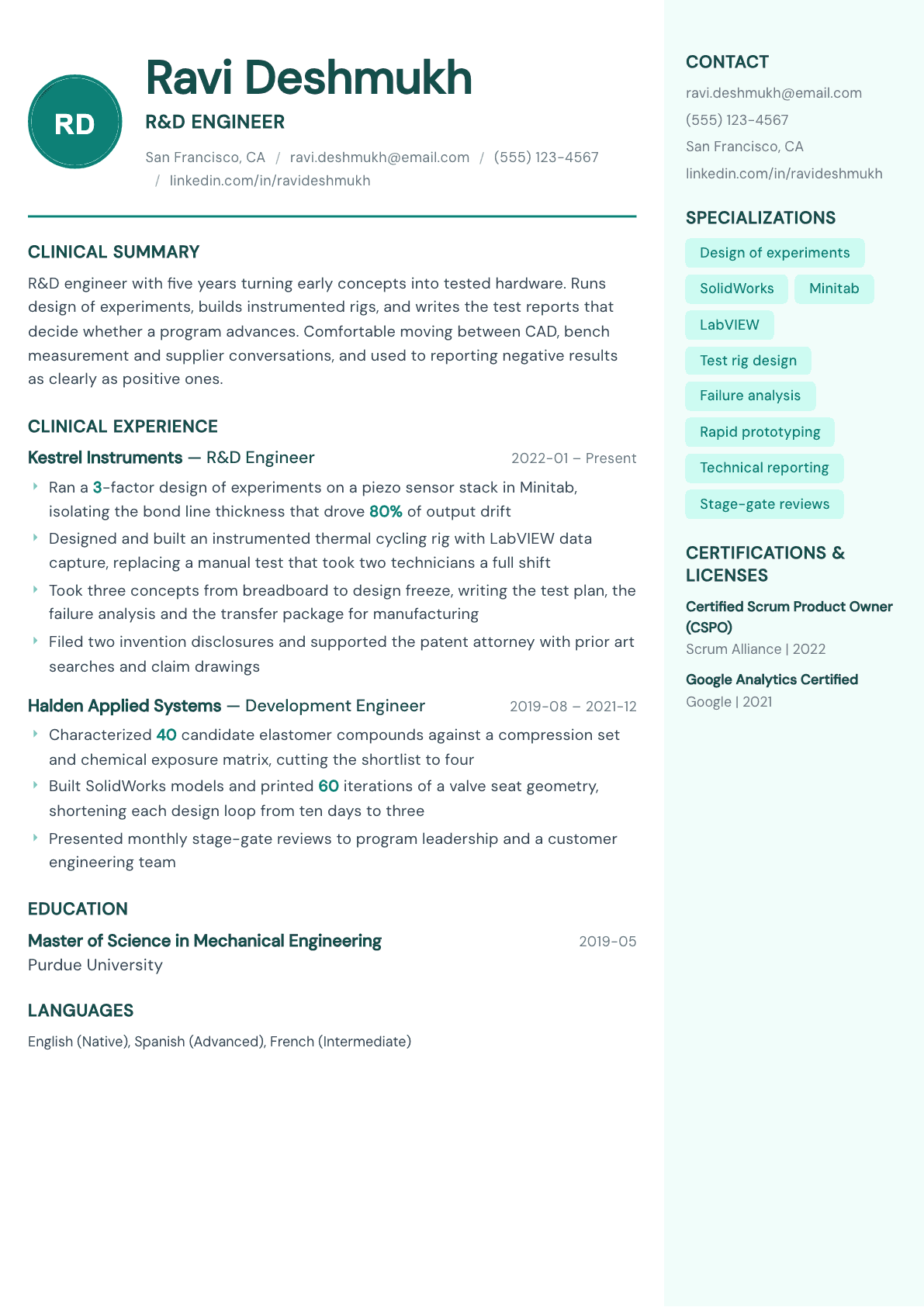
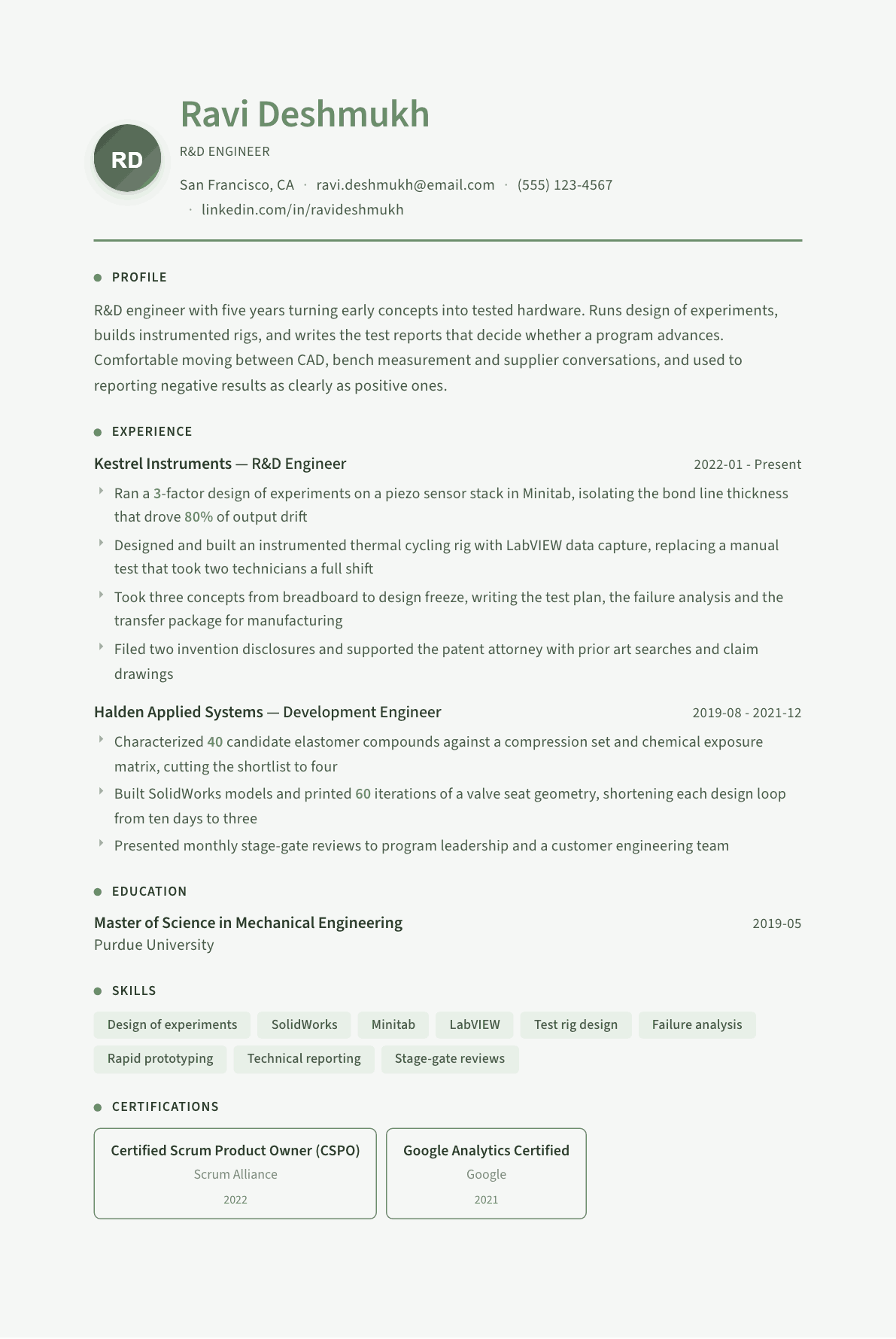
Example R&D Engineer summary
R&D engineer with five years of concept-to-prototype work in precision instruments and sealing systems. Runs structured design of experiments, builds instrumented test rigs, and writes the reports that decide whether a program advances to the next gate. Holds two invention disclosures and has transferred three designs into volume manufacturing. Looking for an advanced development role with ownership of a full product line.
Skills to list on a R&D Engineer resume
- Design of experiments
- Prototype development
- Test plan authoring
- Failure mode and effects analysis
- SolidWorks
- CATIA
- MATLAB
- Minitab
- LabVIEW
- Data acquisition
- Tolerance analysis
- Materials selection
- Stage-gate process
- Patent disclosure
- Design for manufacturing
- Root cause analysis
What actually gets this resume read
- Organize your experience around projects rather than duties, and name the phase you owned from concept through design freeze.
- State what happened to each project: it went to production, it was stopped at a gate, or it became a patent filing.
- Name your statistical method by name, whether that is design of experiments, response surface work, or Weibull life analysis.
- List the instruments you personally operated, because a hiring manager reads that as bench credibility rather than desk work.
- Include patents and disclosures with the application or grant number so a recruiter can verify them without asking you.
- Keep a short section for the transfer work you did with manufacturing, since that is what separates R&D from a lab role.
How to write a r&d engineer resume
An R&D engineer resume is judged on a question no other engineering resume has to answer: what did you learn, and what happened to the thing you built. Development managers read past the tool list looking for evidence that you can hold a program through the messy middle, where the first prototype fails and the schedule has not moved.
The two readers are a technical recruiter filtering on instruments, software and degree level, and an advanced development manager who wants to know whether you designed the experiment or merely ran someone else's. A resume built from job duties satisfies the first and loses the second.
What follows is the section order a development group expects, three summaries pitched at different stages of an R&D career, before and after bullets drawn from bench work, and the questions engineers ask when their best projects were stopped at a gate.
Format: project blocks, not duty lists
Keep reverse chronological order, then break each job into two or three named project blocks. Under each block, give the objective in one line, then bullets for what you designed, measured and concluded. A recruiter can still scan the dates, and the manager gets the structure a development review would use.
One page holds a first R&D role. Two pages is normal once you have patents, publications and several programs behind you. Put a short credentials line under your name with degree level and professional registration, because advanced development groups still screen on graduate coursework.
- Header: name, degree abbreviation, city and state, phone, email, and a link line if you have public patents.
- Sections: summary, technical skills, experience by project, patents and publications, education.
- A doctoral candidate moves education and research above industry experience until the first full role is complete.
Summary: domain, phase, and the method you bring
Three lines. Name the physical domain you work in, the development phases you have owned, and the analytical method you are strongest in. An R&D group hires for a gap, and that gap is usually a technique: structured design of experiments, accelerated life testing, tolerance analysis, or instrumented rig work.
Avoid the word innovative. Every applicant to a development role claims it, and none of them are believed. Say instead that you took three concepts from breadboard to design freeze, and let the reader draw the conclusion.
Experience: the experiment, the result, and where it went
Each project block needs three things a manager can check. First, what you built or characterized, in enough detail to be real: the rig, the sample count, the factor space. Second, what the data said. Third, the decision the data drove, whether that was a design freeze, a supplier change, or a program stop.
Negative results belong on the resume. An engineer who writes that a candidate material failed the compression set matrix and was removed from the shortlist demonstrates exactly the discipline development leadership is buying. Hiding the failures leaves a resume of vague successes that reads as unearned.
Include the transfer work. R&D roles that never touch manufacturing are rare, and design for manufacturing conversations, pilot builds and the handover package are the bullets that separate a development engineer from a lab assistant.
Patents, publications and internal reports
Give patents their own section with the title, the number if granted, and your position in the inventor list. Filed applications count and should say filed. Do not pad the section with disclosures that were never submitted, because a patent attorney at the hiring company can look up everything you claim in minutes.
Peer reviewed papers and conference presentations go under the same heading, cited plainly with the venue. If most of your writing was internal, say how many formal test reports you authored instead, since technical writing volume is a real signal in a development group.
Skills: methods first, then software, then hardware
Split the block into three lines. Methods covers design of experiments, response surface methodology, Weibull analysis, tolerance stack analysis and finite element work. Software covers your CAD system, your statistics package, and your data acquisition environment. Hardware lists the instruments you personally operated and calibrated.
The hardware line matters more than engineers expect. Naming a specific instrument, a bus analyzer, a universal testing machine, an environmental chamber, tells a manager you have run the bench yourself and can build the next rig without help.
R&D Engineer resume summary examples
New graduate
Mechanical engineering graduate with a two-year thesis on fatigue in additively manufactured brackets, including 120 coupon tests and Weibull life fitting. Skilled in SolidWorks, Minitab and LabVIEW data capture. Seeking an entry R&D engineer role in advanced product development.
Five years in
R&D engineer with five years in precision instruments, taking three concepts from breadboard through design freeze and into pilot build. Runs structured design of experiments, designs instrumented thermal and vibration rigs, and writes the reports that decide stage-gate outcomes. Two invention disclosures filed.
Principal development engineer
Principal R&D engineer with twelve years across sensing and sealing technologies, leading small development teams and owning the technical case at stage-gate reviews. Six granted patents, a portfolio of accelerated life test methods now used across two business units, and a record of transferring designs into volume manufacturing.
Work experience bullets: before and after
Before: Performed testing on prototypes.
After: Designed a 3-factor screening experiment across 48 prototype units, isolating bond line thickness as the driver behind 80% of output drift.
The factor count, sample size and named root cause turn a generic claim into a piece of engineering someone can question.
Before: Built test equipment for the lab.
After: Built an instrumented thermal cycling rig with LabVIEW acquisition and automated pass criteria, replacing a manual test that occupied two technicians for a full shift.
It names the tooling, the software and the labor the rig removed, which is how a manager values a fixture.
Before: Worked with suppliers on materials.
After: Screened 40 candidate elastomer compounds against a compression set and chemical exposure matrix with three suppliers, reducing the shortlist to four for design verification.
A screening funnel with counts at both ends shows method, where the original bullet only shows contact.
Before: Helped move a design into production.
After: Wrote the manufacturing transfer package for a valve assembly, including tolerance analysis, process capability targets and a pilot build plan run over two weeks with the plant team.
Naming the artifacts proves the handover happened rather than that you attended the meetings.
Before: Contributed to patents.
After: Filed two invention disclosures on sensor mounting geometry and supported the prior art search and claim drawings that took one through to a granted patent.
The specific subject and the stage reached make the claim checkable, which is the point of a patent line.
Hard skills
- Design of experiments
- Response surface methodology
- Prototype and rig design
- Accelerated life testing
- Failure mode and effects analysis
- Tolerance stack analysis
- Finite element analysis
- SolidWorks and CATIA
- MATLAB and Python
- Minitab
- LabVIEW data acquisition
- Design for manufacturing
- Technical report writing
- Patent disclosure preparation
Soft skills
- Framing an ambiguous problem
- Reporting negative results plainly
- Cross-functional influence
- Stage-gate presentation
- Mentoring technicians
- Balancing rigor against schedule
Certifications worth listing
- Fundamentals of Engineering (FE) (NCEES)
- Professional Engineer (PE) (NCEES and state licensing boards)
- Certified Six Sigma Black Belt (CSSBB) (American Society for Quality)
- Certified Reliability Engineer (American Society for Quality)
Mistakes that cost r&d engineer candidates the interview
- Listing tools without a single experiment, which leaves a manager unable to tell design work from operating a machine someone else built.
- Claiming innovation as an adjective instead of naming a concept you carried to design freeze.
- Dropping every project that was stopped at a gate, so the resume looks like an unbroken run of wins nobody believes.
- Padding a patent section with disclosures that were never filed, which is checked in minutes and ends the application.
- Writing bullets that stop at the measurement and never state the decision the data drove.
- Ignoring the manufacturing transfer work, which is what distinguishes an R&D engineer from a test technician on paper.
R&D Engineer resume questions
How do I put failed projects on an R&D engineer resume?
Write them as decisions rather than losses. State the hypothesis, the test that disproved it, and the recommendation that closed the program. Development managers hire people who kill weak concepts early, so a well-argued stop is a stronger bullet than a vague success.
Do I need a graduate degree for an R&D engineer role?
Many advanced development postings ask for a master or doctoral degree, but a bachelor with strong bench and design of experiments work competes well for product development roles. If you hold a graduate degree, name your thesis topic, because it functions as your first project block.
Should I list patents that are still pending?
Yes, marked as filed with the application number and your position in the inventor list. Pending applications are public once published and are easy to verify. Never list an internal disclosure as a patent, since the distinction is obvious to anyone who works with a patent attorney.
How technical should the resume be if a recruiter reads it first?
Keep the summary and skills block readable by a recruiter, using the terms from the posting, then let the project blocks carry the depth. The recruiter matches keywords in the top third, and the hiring engineer reads the detail underneath without needing it simplified.
What if my R&D work is confidential?
Describe the engineering without the product. Name the physical domain, the method, the instrument and the scale, then state the outcome generically as a design freeze, a supplier decision or a program stop. Never disclose customer names or specifications you signed an agreement to protect.
Related resume examples
- Materials Engineer Resume example
- Research Scientist Resume example
- Design Engineer Resume example
- Test Engineer Resume example
- Mechanical Engineer Resume example
- Supplier Quality Engineer Resume example