Materials Engineer Resume Examples: the lines they read
Forge a Materials Engineer Resume Built to Last
By Mustafa Tarabya, founder of CVBooster · Published · Updated
Create a materials engineer resume highlighting materials selection, failure analysis, and characterization expertise with technical depth and measurable outcomes.
Sample resumes for a materials engineer
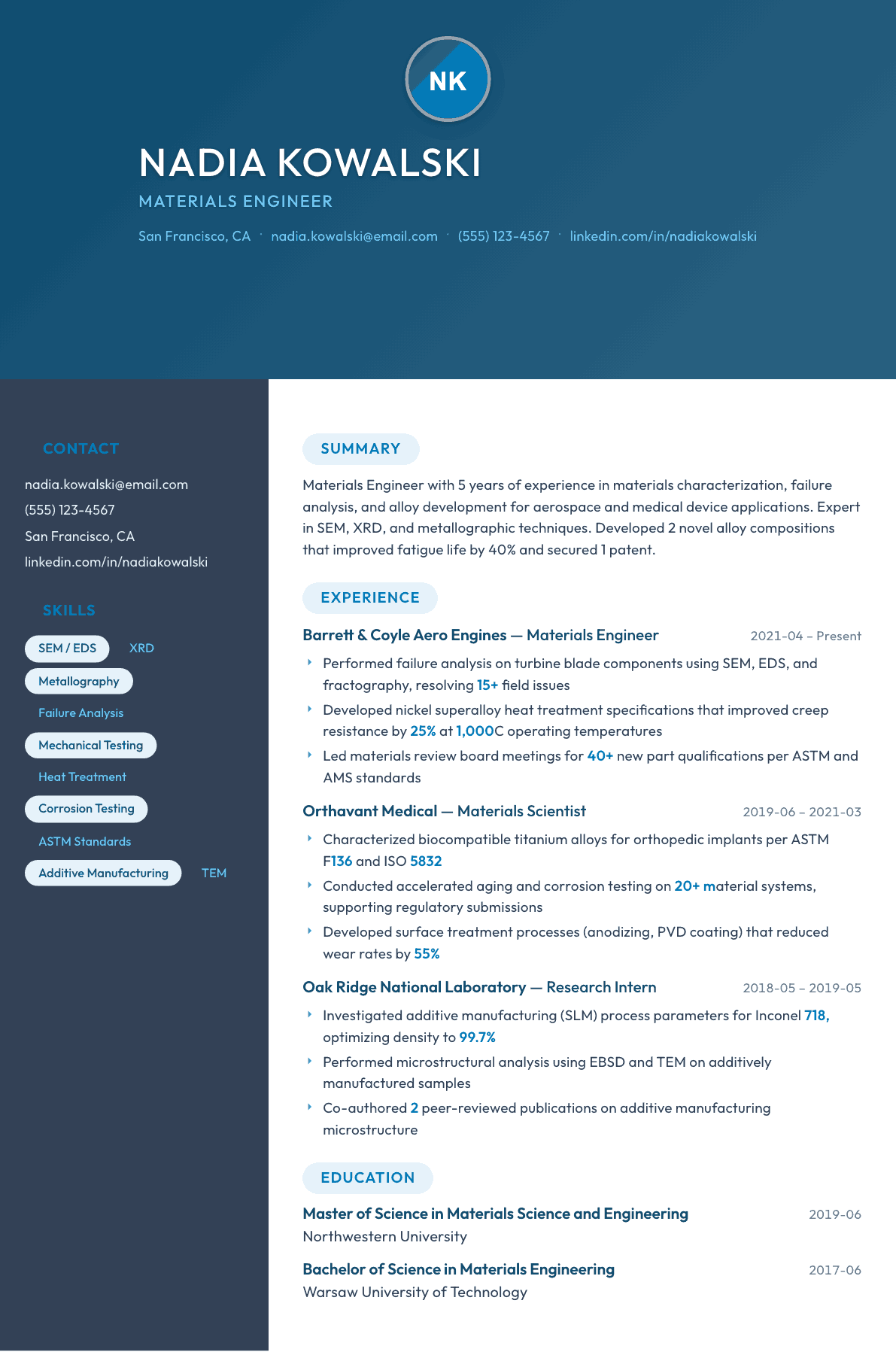
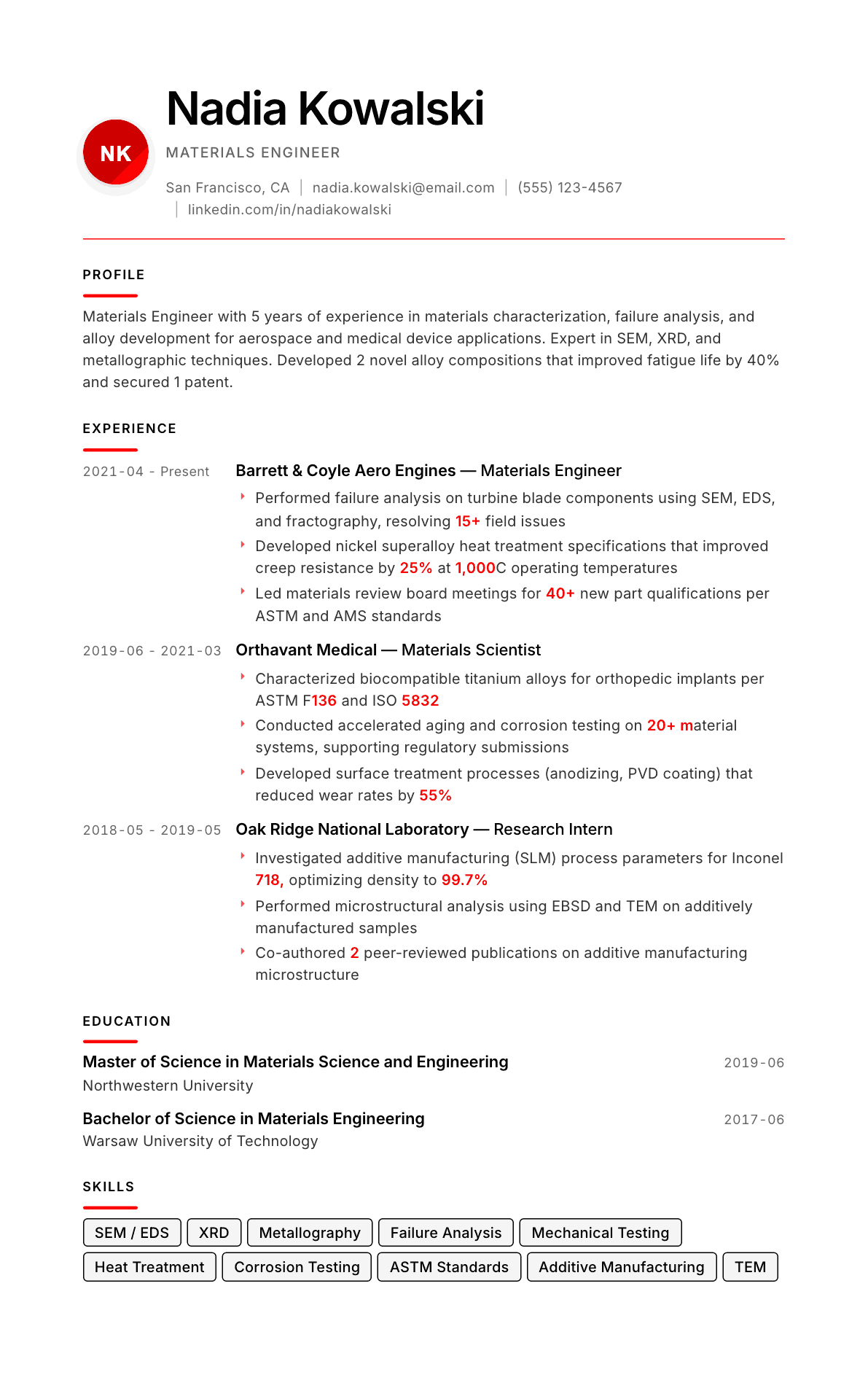
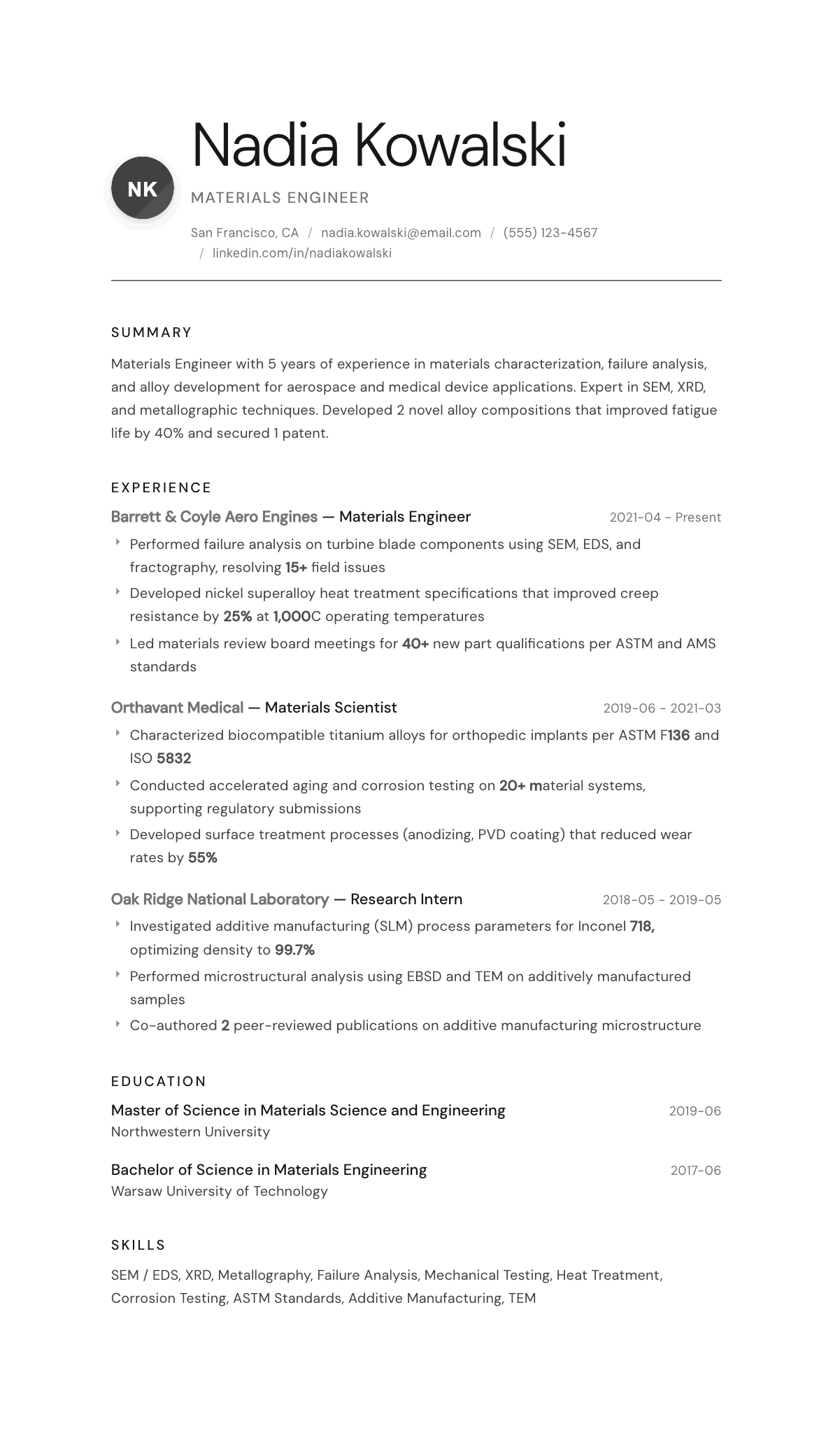
The same materials engineer content laid out in three CVBooster templates, so you can see what the finished document looks like before you write a word.
Example Materials Engineer summary
Materials Engineer with 5 years of experience in failure analysis, alloy development, and materials characterization for aerospace and medical applications. Expert in SEM, XRD, and metallographic techniques with deep knowledge of ASTM and AMS standards. Developed novel alloy compositions improving fatigue life by 40% with 1 patent secured.
Skills to list on a Materials Engineer resume
- SEM / EDS
- TEM
- XRD
- Metallography
- Failure Analysis
- Mechanical Testing
- Heat Treatment
- Corrosion Analysis
- Additive Manufacturing
- ASTM Standards
- AMS Standards
- Polymer Characterization
- Composite Materials
- Surface Engineering
- Materials Selection
What actually gets this resume read
- Highlight characterization techniques: SEM, TEM, XRD, DSC, DMA, FTIR, metallography.
- Specify materials you work with: metals, polymers, ceramics, composites, biomaterials.
- Reference testing standards: ASTM, AMS, ISO, NADCAP, MIL specifications.
- Include failure analysis methodologies: fractography, root cause analysis, corrosion analysis.
- Quantify outcomes: fatigue life improvements, weight savings, defect reductions, patents.
- Mention additive manufacturing, surface engineering, or computational materials science if applicable.
How to write a materials engineer resume
Materials engineering resumes are read by someone with a broken part on their desk or a qualification they cannot close. The question they are answering is narrow: does this candidate know the material class we use, can they run or interpret the characterization that explains what happened, and can they write it up so a customer or a regulator accepts it.
That means the material class is the single most important fact on your page. Nickel superalloys, aluminum and titanium, steels and heat treatment, polymers and elastomers, composites, ceramics, coatings, semiconductor thin films and battery materials are effectively separate professions. A generic materials science summary forces the reader to guess, and guessing usually ends with a rejection.
This guide covers how to order the sections, how to write characterization and failure analysis so it reads as interpretation rather than instrument time, summaries at three career stages, and the questions materials engineers ask when moving between aerospace, medical device, electronics and energy work.
Format: material class up front, techniques in their own block
Single column, reverse chronological, two pages once you have projects worth listing. Put a characterization and testing block directly under the summary. That block is the first thing a materials manager scans, and hiding a technique inside a job from four years ago means it will not be found.
If you hold patents or publications, give them a short block near the end rather than embedding them in job bullets. One line each with the title and status is enough on a resume; the full list belongs on a curriculum vitae for research positions.
- Header: name, city and state, phone, email, and professional registration if you hold one.
- Order: summary, characterization and testing, experience, projects or patents, education, certifications.
- Name the material system in every job heading or opening line, not just in the summary.
Summary: material system, application, and what you are hired to do
Three facts: the materials, the industry, and the function. Failure analysis, materials selection and qualification, process and heat treatment development, coatings and surface engineering, or new alloy and formulation development are distinct functions that different teams hire for separately.
Add the specification framework you have worked to, since the paperwork differs sharply by industry. Aerospace runs on aerospace material specifications and testing standards. Medical device runs on biocompatibility and implant material standards. Automotive and consumer products run on their own supplier requirements and restricted substance rules.
Experience: the failure, the evidence, the conclusion
Failure analysis bullets should read like a short investigation. State the component and the observed failure, the techniques you applied, the mechanism you concluded, and what changed as a result. Fatigue initiating at a machining mark, intergranular attack from a heat treatment excursion, stress corrosion cracking from a chloride environment, or delamination from moisture uptake are the kinds of conclusions that show you can actually close a case.
Characterization bullets must show interpretation. Anyone can list scanning electron microscopy. The engineer a manager wants can look at a fracture surface and distinguish beach marks from dimpled overload, read an energy dispersive spectrum without over claiming the light elements, index a diffraction pattern, and know when a cross section is misleading.
Qualification and development work should carry the specification and the acceptance criteria. Say what property target you had to hit, what you changed, and what the test data showed. Tensile and yield strength, elongation, fracture toughness, fatigue life, creep rupture, hardness, corrosion rate, glass transition temperature, thermal conductivity and dielectric properties are the currencies of this trade, and using them precisely is a competence signal in itself.
Mention the supply chain side if you have done it: writing material specifications, approving suppliers, auditing a heat treat or plating source, and dispositioning nonconforming material. Many materials engineering jobs are two thirds this work and applicants routinely leave it out.
Skills: characterization, mechanical testing, processing, data
Group them so a reader can scan. Microscopy and microanalysis first: optical metallography, scanning electron microscopy with energy dispersive spectroscopy, electron backscatter diffraction, transmission electron microscopy, X-ray diffraction, X-ray computed tomography. Then thermal and chemical analysis: differential scanning calorimetry, thermogravimetric analysis, dynamic mechanical analysis, Fourier transform infrared spectroscopy, and inductively coupled plasma methods.
Mechanical and environmental testing next: tensile and compression, fatigue, fracture toughness, creep, hardness across scales, impact, salt spray and electrochemical corrosion testing. Then processing: heat treatment, casting, forging, welding metallurgy, powder and additive processes, polymer compounding, and coating deposition.
Finish with data and specification skills. Statistical analysis for allowables and design of experiments, materials property databases, and the ability to read and write to a controlled specification. Simulation belongs here too if you use thermodynamic or process modeling tools.
Education, credentials and how to place research work
A degree in materials science and engineering, metallurgy, ceramic or polymer engineering is standard, and doctorates are common in development roles. If you hold one, state the material system of your thesis in a single clause, because that is what a hiring manager wants and the title alone rarely conveys it.
Credentials are fewer here than in other engineering fields and that is normal, so an empty certifications section is not a weakness. What does carry weight is nondestructive testing qualification, corrosion certification, or quality credentials if your role touches inspection and supplier control.
Materials Engineer resume summary examples
New graduate
Materials science graduate with an internship in a metallurgical laboratory and a senior project on the heat treatment response of a precipitation hardening stainless steel. Trained in metallographic preparation, hardness testing, optical microscopy and scanning electron microscopy. Prepared 40 cross sections and interpreted microstructure against specification requirements.
Four years in industry
Materials engineer supporting aluminum and titanium airframe hardware, running failure analysis and material qualification against aerospace material specifications. Closed 18 field investigations using fractography and electron microanalysis, and qualified two new forging suppliers. Reduced material review board dispositions on one part family by 35%.
Principal materials engineer
Principal materials engineer with 13 years across medical implants and additive manufacturing of titanium alloys. Owns materials selection, biocompatibility test strategy and process qualification for 3 product lines, holds 2 granted patents, and chairs the materials review board for the site.
Work experience bullets: before and after
Before: Performed failure analysis on components using SEM.
After: Investigated cracked compressor blades with fractography and energy dispersive analysis, identified high cycle fatigue initiating at a sulfidation pit, and drove a coating specification change across the fleet.
The mechanism, the initiation site and the resulting specification change turn instrument use into a closed investigation.
Before: Tested materials to verify they met requirements.
After: Ran tensile, fracture toughness and salt fog testing on 5 candidate stainless grades against the customer specification, and recommended the grade that met corrosion requirements at a lower alloy cost.
Named property tests, a candidate set and a recommendation show engineering judgment rather than sample handling.
Before: Worked on heat treatment process improvements.
After: Designed a factorial experiment on solution and aging parameters for a nickel alloy, raised average creep rupture life by 22% at temperature, and issued the revised heat treatment specification to two suppliers.
A designed experiment, a property outcome and a released specification prove the improvement was implemented.
Before: Supported additive manufacturing development.
After: Characterized laser powder bed samples by porosity fraction, electron backscatter texture and tensile response across 12 parameter sets, and defined the build window that held density above 99.5%.
Naming the measured responses and the resulting process window shows you delivered a usable answer, not just data.
Before: Helped suppliers meet material requirements.
After: Audited a heat treat supplier against pyrometry requirements, found uncontrolled furnace uniformity, and worked through a corrective action that restored approval before the production line ran short.
The specific audit finding and the recovered supply position make supplier work concrete and consequential.
Hard skills
- Failure analysis and fractography
- Optical metallography and sample preparation
- Scanning electron microscopy with EDS
- Electron backscatter diffraction
- X-ray diffraction and phase analysis
- Differential scanning calorimetry and thermogravimetric analysis
- Tensile, fatigue and fracture toughness testing
- Hardness and microhardness testing
- Corrosion testing and electrochemistry
- Heat treatment development
- Welding metallurgy
- Coatings and surface treatment
- Materials specification writing
- Design of experiments and statistical analysis
Soft skills
- Evidence-led argument
- Writing for non-specialist readers
- Supplier negotiation
- Patience with long test programs
- Cross-discipline collaboration with design
- Presenting to review boards
Certifications worth listing
- Nondestructive Testing Level II or Level III (American Society for Nondestructive Testing)
- Corrosion Technologist (Association for Materials Protection and Performance)
- Coating Inspector Program (Association for Materials Protection and Performance)
- Certified Quality Engineer (CQE) (American Society for Quality)
- Professional Engineer, Metallurgical or Materials (State licensing board, NCEES examination)
Mistakes that cost materials engineer candidates the interview
- Writing materials science in the summary without naming the material class, which leaves the reader unable to match you to their alloy, polymer or ceramic.
- Listing characterization instruments as though instrument access were the skill. The skill is interpretation, so show a conclusion you reached.
- Reporting test numbers without the standard or the acceptance criterion, which makes them unverifiable to anyone who works to specifications.
- Leaving out supplier and specification work, even though it is a large share of most industrial materials engineering jobs.
- Turning a doctorate into three paragraphs of thesis narrative. One clause naming the system and the technique set is enough on a resume.
- Overstating light element results from energy dispersive analysis or claiming quantitative accuracy the method does not support. Technical interviewers probe exactly this.
Materials Engineer resume questions
How specific should I be about the alloys or polymers I have worked with?
Very specific. Name the families and the representative grades, since a hiring manager screens on whether you know their material system. Generic phrasing such as metals and plastics reads as a student resume regardless of how much experience sits behind it.
Do I need a PhD to work as a materials engineer?
No. Development and research roles often prefer one, but failure analysis, qualification, supplier engineering and production support are filled by bachelor and master level engineers. Emphasize hands-on characterization and closed investigations rather than academic depth.
How do I show failure analysis experience without breaching confidentiality?
Describe the component generically, the failure mechanism, the techniques used and the corrective outcome, while leaving out the customer name, the program and any proprietary composition. Interviewers expect that discipline and read it as a good sign.
Should a materials engineer list publications and patents?
Yes, but briefly on a resume. Give a short block with titles and status, and note whether a patent is filed or granted. Save the complete list for a curriculum vitae aimed at research laboratory or academic positions.
How do I move from metals into polymers or composites?
Lead with the transferable analysis: structure and property relationships, thermal analysis, mechanical testing and failure investigation all carry across. Then name any coursework, project or side work in the target class so the reader sees deliberate movement rather than a stretch application.
Related resume examples
- Chemical Engineer Resume example
- Mechanical Engineer Resume example
- Quality Engineer Resume example
- Metallurgical Engineer Resume example
- Welding Engineer Resume example
- Thermal Engineer Resume example