Realtor Resume Examples: free score, then the gap list
Write a Realtor Resume That Wins the Listing Appointment
By Mustafa Tarabya, founder of CVBooster · Published · Updated
Realtor resume example, keyword list and writing guide covering listings taken, days on market, list-to-sale ratio and brokerage splits.
Sample resumes for a realtor
The same realtor content laid out in three CVBooster templates, so you can see what the finished document looks like before you write a word.
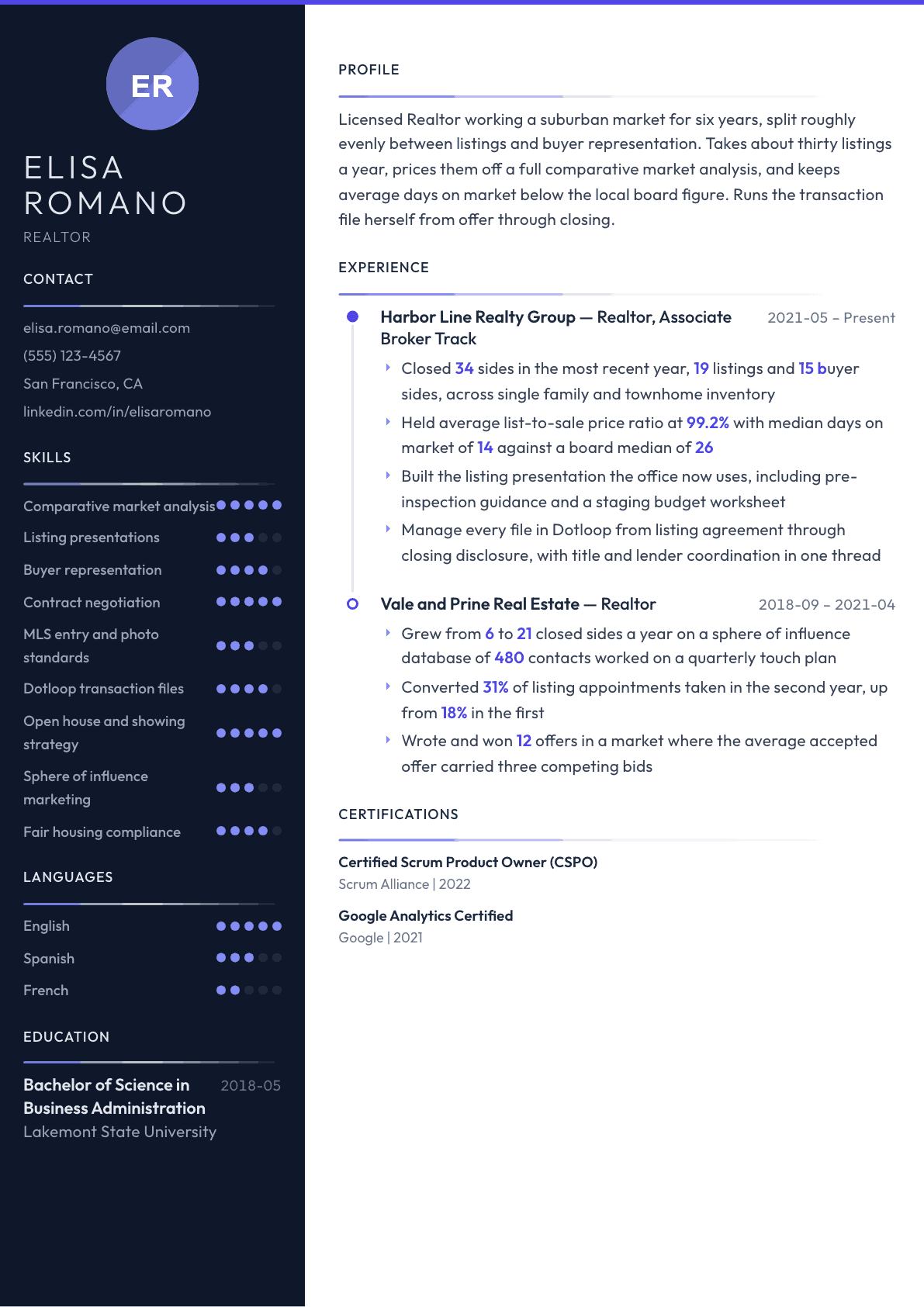
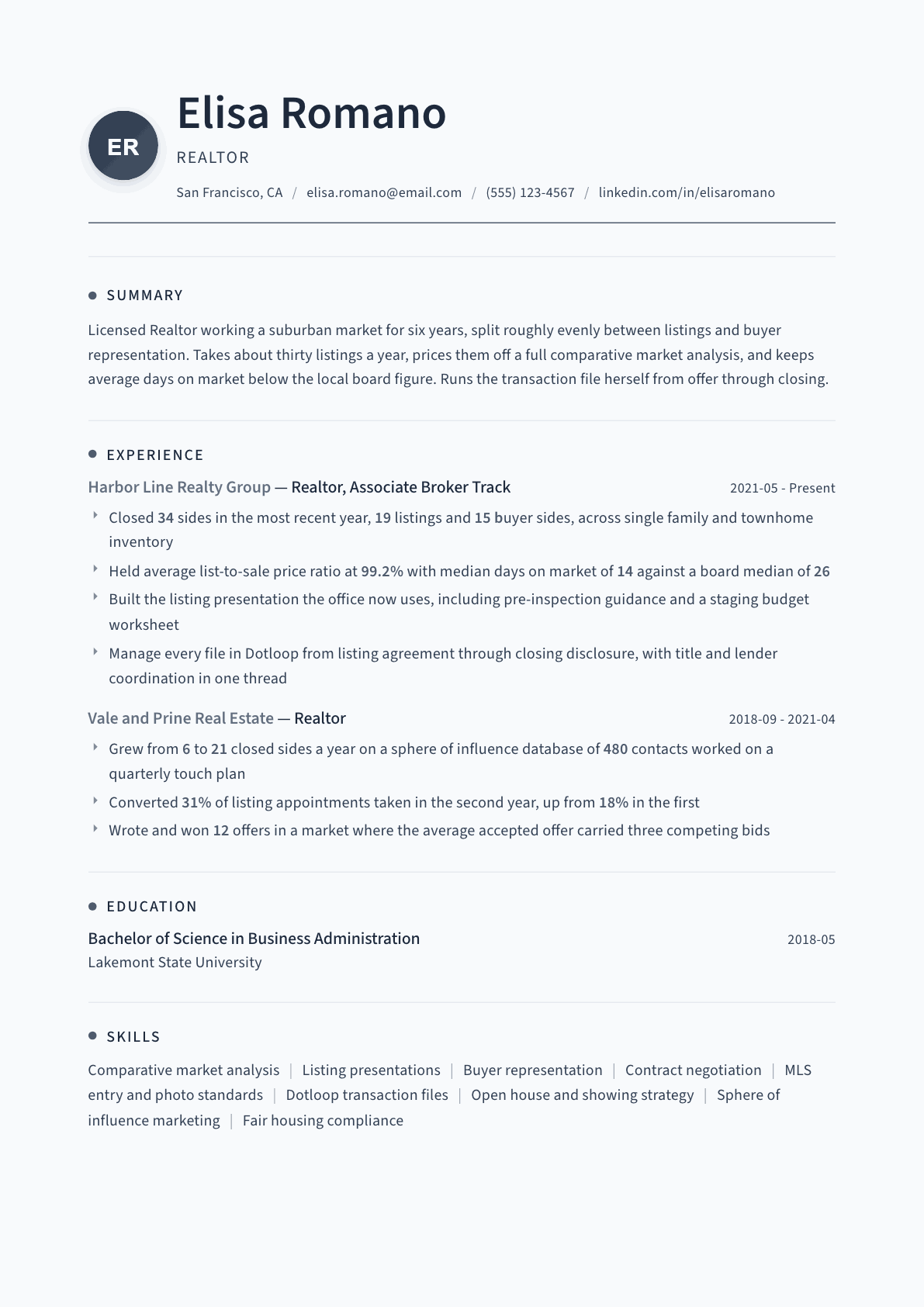
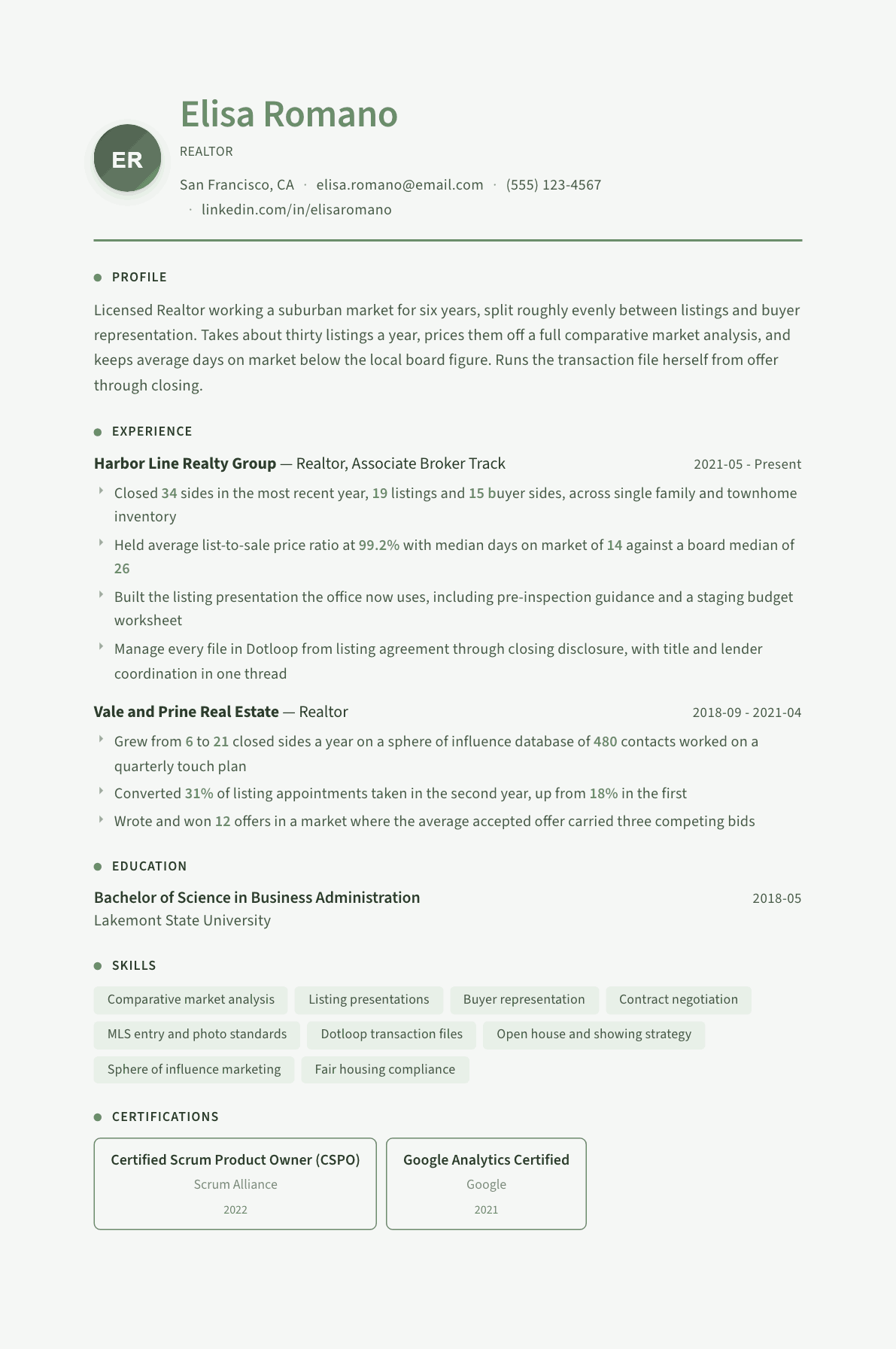
Example Realtor summary
Licensed Realtor with six years in a suburban market and thirty-four closed sides in the most recent year, weighted toward listings. Prices from a full comparative market analysis and holds list-to-sale ratio near ninety-nine percent with days on market well under the board median. Runs each file personally in Dotloop, from listing agreement through closing disclosure, and builds new business from a worked sphere rather than purchased leads.
Skills to list on a Realtor resume
- Comparative market analysis
- Listing appointment conversion
- Buyer consultation
- Purchase agreement drafting
- Multiple offer negotiation
- MLS data entry accuracy
- Property marketing and photography direction
- Open house management
- Sphere of influence database
- Geographic farming
- Transaction management software
- Title and escrow coordination
- Lender and appraisal follow-up
- Fair housing compliance
- Client relationship management systems
What actually gets this resume read
- Give closed sides for each year, split between listings and buyer representation, because brokers read those two numbers differently.
- Put your list-to-sale price ratio and days on market next to the local board figure so the numbers carry meaning.
- Name your state license number line, the board and MLS you belong to, and any Realtor designations you hold.
- Say which transaction management platform you work in, since a brokerage switch costs the office training time.
- Show how you generate business: sphere touches, geographic farm, open houses, referrals, or paid portal leads.
- Describe one negotiation you ran, with the competing offer count and the term that won it, not just the outcome.
- Keep a fair housing line on the page, and make sure no listing language on your resume could read as steering.
How to write a realtor resume
A managing broker reading a Realtor resume is doing arithmetic in her head. She wants to know how many sides you closed, how much of that came from listings you took yourself, and whether your production would survive a move to her office with her lead sources and her split. Almost none of that is visible on a resume that talks about passion for helping families find their dream home.
The other thing she is checking is risk. Every agent she signs puts her license behind their contracts, their disclosures and their advertising. So a Realtor resume that shows clean file work, a habit of meeting contingency deadlines and a working knowledge of fair housing language is worth more to her than one extra closing.
This guide covers the sections a broker reads, the production numbers that mean something to her, three summaries at different career stages, before and after bullets, and the questions agents ask when they rewrite the page after a few years of practice.
Format: production block first, license and board memberships right behind it
Reverse chronological, one page for most agents, two once you have a decade of production or a team behind you. The unusual move that works for a Realtor is a short production block directly under the summary: a small table of closed sides by year, split between listing and buyer representation. A broker will find that block in three seconds and read the rest of the page afterward.
Below it, put your license and affiliations together: state license and the state that issued it, your local board, the MLS you have access to, and any designations you have earned. Those lines cost you four short rows and answer a set of questions the broker would otherwise have to ask at the interview.
- Header for an agent: name, the market or county you work, phone, email, and a link line for your listing portfolio.
- Production block: closed sides by year, listing sides against buyer sides, and volume expressed in units rather than dollars.
- License and affiliations: state license, local association of Realtors, MLS access, and designations such as ABR or GRI.
- A newly licensed agent replaces the production block with pre-license course work, mentorship structure and any transactions shadowed.
Summary: market, years, listing to buyer mix, one number that proves it
Three lines. Say the market you actually farm, the years licensed, whether your book leans listing or buyer side, and one production figure a broker can check against the MLS. An agent who writes that they are a dedicated professional committed to client satisfaction has described the entire membership roll of their association.
If your production is modest but your ratios are strong, lead with the ratios. A newer agent whose list-to-sale price ratio sits near the asking price and whose days on market run under the board median is telling a broker that the pricing conversation is already a strength, which is exactly what she wants to hear from someone she will be coaching.
Experience: sides, sources, and the negotiations you actually ran
Every brokerage you have worked names the office, the market covered and your role, whether that was solo agent, team member or team lead. Then bullets built on the four numbers a Realtor is judged by: closed sides, list-to-sale price ratio, days on market, and listing appointment conversion. Put each number next to the local comparison so a stranger to your market can read it.
Then show where business comes from. A broker treats a sphere-driven agent and a portal-lead agent as different hires, because one brings a database and the other brings a habit of paying for leads. Name the source mix plainly: sphere touches, a geographic farm and its size in homes, open houses, referral partners, or paid portal inquiries and your conversion on them.
Reserve at least one bullet for a negotiation. Name the number of competing offers, the term that carried the deal, and what you gave up to get it. Escalation clauses, appraisal gap coverage, a rent back after closing and a shortened inspection window are the tools of this trade, and an agent who can describe using one correctly sounds like someone who has been in the room.
File work, compliance and the things that keep a license clean
This is the section most agents skip and most brokers wish they would write. Say which transaction management platform you use and what you handle inside it: listing agreements, disclosure packages, earnest money receipts, contingency removals and the closing disclosure review. Add the deadline habit, such as clearing contingency dates a set number of days early rather than on the date itself.
Fair housing belongs here too, expressed as practice rather than as a course you sat through. Consistent screening of buyer qualification, advertising copy reviewed for language about neighborhoods and people, and referral of school and demographic questions to public sources are the concrete versions. A broker reading that knows your listing remarks will not create a problem she has to answer for.
Skills and keywords brokers and recruiters search
Recruiting searches and brokerage postings reuse the same vocabulary: comparative market analysis, listing presentation, buyer consultation, purchase agreement, multiple offer, days on market, closed sides, MLS, transaction management, sphere of influence. Put those words where the work is shown rather than in a decorative skills bar, and name your systems specifically, because software changes cost a new agent a week of production.
Designations are keywords as well as credentials. Accredited Buyer's Representative, Graduate Realtor Institute, Seniors Real Estate Specialist and Pricing Strategy Advisor all get typed into recruiter searches. Spell each one out once alongside its abbreviation so both versions are found.
Realtor resume summary examples
Newly licensed
Newly licensed Realtor in the north county market, mentored under a producing team through 9 shadowed transactions covering listing intake, showings and closing. Completed 180 hours of pre-license education plus the buyer representation course. Building a sphere database of 320 contacts on a quarterly touch plan.
Six years in
Realtor with six years in one suburban market and 34 closed sides last year, 19 of them listings taken personally. List-to-sale ratio of 99.2% and median days on market of 14 against a board median of 26. Converts about a third of listing appointments and runs every file to closing without a coordinator.
Team lead
Team lead running four agents and a coordinator through 96 closed sides in the past year, with 62 listing sides. Built the listing presentation and pricing model the team uses, holds GRI and ABR, and mentors newly licensed agents through their first ten transactions.
Work experience bullets: before and after
Before: Helped clients buy and sell homes in the local area.
After: Closed 34 sides in 2024 across the north county market, 19 listing sides and 15 buyer sides, in single family and townhome inventory priced between the starter and move up brackets.
Sides split by representation type and product tell a broker what your book is actually made of.
Before: Priced listings competitively and sold them quickly.
After: Held a 99.2% list-to-sale price ratio with median days on market of 14 against a board median of 26, pricing every listing from a comparative market analysis presented to the seller before signature.
Two ratios against the board benchmark turn a claim about pricing into something a broker can verify.
Before: Generated leads through networking and referrals.
After: Worked a 480 contact sphere on a quarterly touch plan and a 300 home geographic farm, producing 21 of 34 closings without portal leads and a 31% listing appointment conversion.
Naming the sources with sizes and conversion shows whether your production travels to a new brokerage.
Before: Negotiated offers on behalf of buyers.
After: Won 12 buyer offers in a market averaging three competing bids by pairing an escalation clause with appraisal gap language and a shortened inspection window agreed with the client in advance.
Named contract tools and a competing offer count show a negotiation you ran rather than one you watched.
Before: Handled paperwork and kept transactions on track.
After: Ran every file personally in Dotloop from listing agreement to closing disclosure, clearing contingency and deposit deadlines at least two days early across 34 closings with no compliance exception raised at file review.
The platform, the deadline habit and the audit outcome give a broker the risk answer she was looking for.
Hard skills
- Comparative market analysis
- Listing presentation and pricing strategy
- Buyer consultation and needs analysis
- Purchase agreement drafting
- Multiple offer and escalation strategy
- Inspection and appraisal response negotiation
- MLS entry and listing photography direction
- Transaction management platforms
- Title and escrow coordination
- Sphere of influence and farm marketing
- Open house planning
- Fair housing compliant advertising
Soft skills
- Delivering a pricing opinion a seller does not want to hear
- Holding a client steady through an inspection renegotiation
- Prospecting on a schedule when the pipeline already looks healthy
- Reading which of two buyers is actually ready to write
- Staying reachable across evenings and weekends without losing the calendar
Certifications worth listing
- Accredited Buyer's Representative (ABR) (Real Estate Buyer's Agent Council, National Association of REALTORS)
- Graduate, REALTOR Institute (GRI) (National Association of REALTORS)
- Pricing Strategy Advisor (PSA) (National Association of REALTORS)
- Seniors Real Estate Specialist (SRES) (National Association of REALTORS)
Mistakes that cost realtor candidates the interview
- Reporting volume in dollars only, which flatters agents in expensive markets and hides how many transactions you actually ran.
- Leaving out the listing to buyer split, so a broker cannot tell whether you can take a listing or only show houses.
- Quoting days on market with no board median beside it, which makes the number unreadable to anyone outside your area.
- Describing lead generation as networking instead of naming the sphere size, the farm and the conversion behind each source.
- Skipping file work and deadlines entirely, when compliance is the part of your practice that carries the broker's license.
- Listing a designation by initials alone, so a recruiter searching the full credential name never matches your resume.
Realtor resume questions
Do I need a resume as a Realtor when I am self employed?
Yes, whenever you change brokerages, join a team, apply for a referral network or pitch a builder for new construction listings. Those readers all want production history and file discipline in writing, and a listing presentation does not cover either one.
Should I put my sales volume in dollars on the page?
Lead with closed sides and give volume second if your market price band supports it. Sides are comparable between markets and price points, while a dollar figure mostly reports where you happen to work rather than how hard you worked.
What goes on a resume in a year when I closed almost nothing?
Show the activity that did happen: listing appointments taken, buyer consultations held, database size and touch cadence, education completed and any market condition that hit every agent around you. A thin year explained beats a gap a broker fills in with a worse guess.
How do I show teamwork if I have only ever worked solo?
Point at the transaction team you coordinate on every file: lender, title officer, inspector, appraiser, photographer and the other side's agent. Describe a deal you kept alive by managing that group, since that is the collaboration a broker cares about.
Should my resume mention the split I am on now?
No. Splits are a negotiation, and naming your current one sets the ceiling before the conversation starts. Show production, ratios and file quality instead, then discuss compensation once the broker has decided she wants you in the office.
Related resume examples
- Real Estate Agent Resume example
- Real Estate Sales Agent Resume example
- Real Estate Broker Resume example
- Leasing Agent Resume example
- Home Stager Resume example
- Real Estate Assistant Resume example