Home Stager Resume Examples: free ATS score and gap list
Build a Home Stager Resume That Sells Your Portfolio First
By Mustafa Tarabya, founder of CVBooster · Published · Updated
Home stager resume example, keyword list and writing guide covering vacant and occupied staging, inventory, days on market and agent referrals.
Sample resumes for a home stager
The same home stager content laid out in three CVBooster templates, so you can see what the finished document looks like before you write a word.
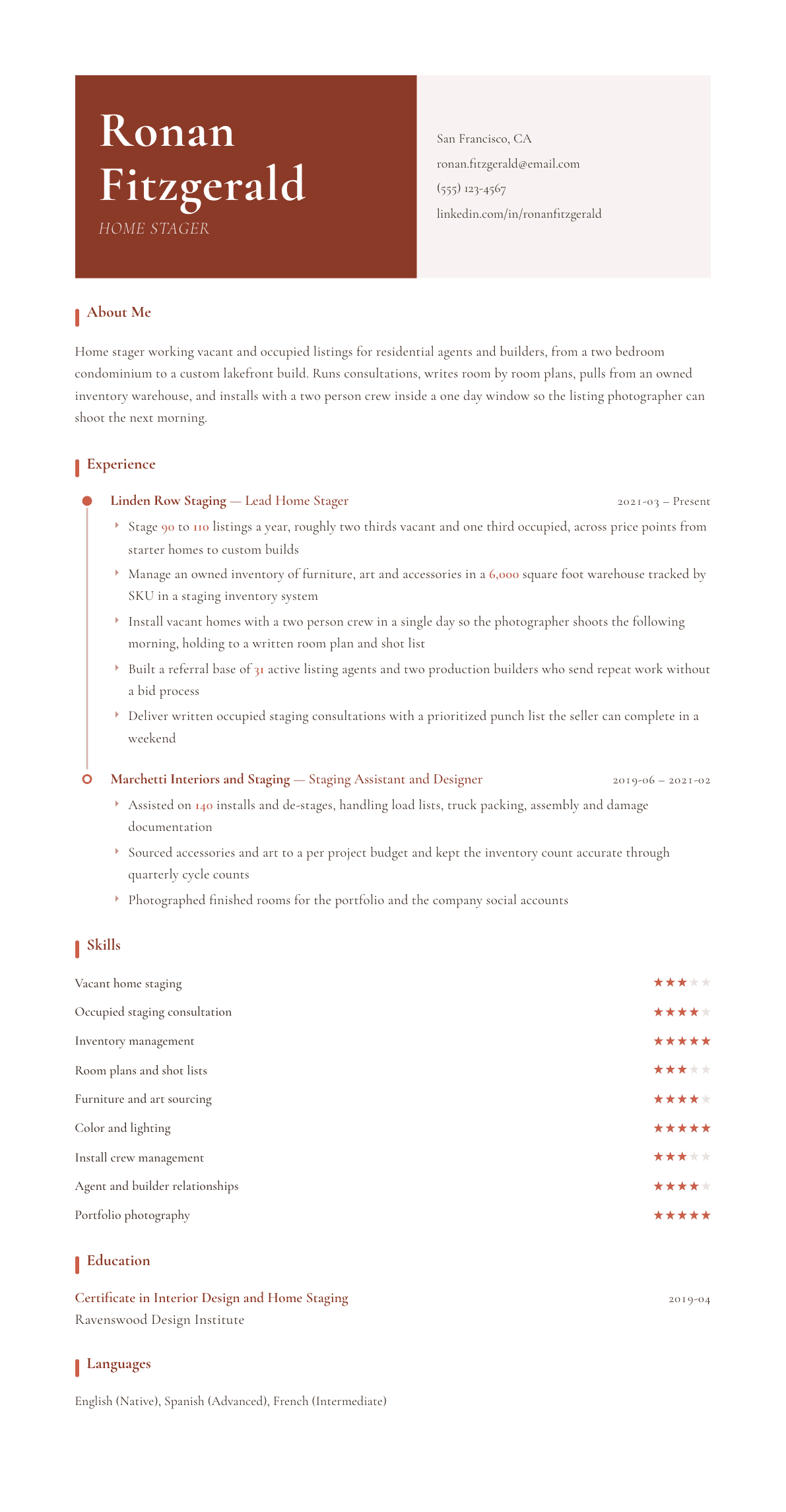
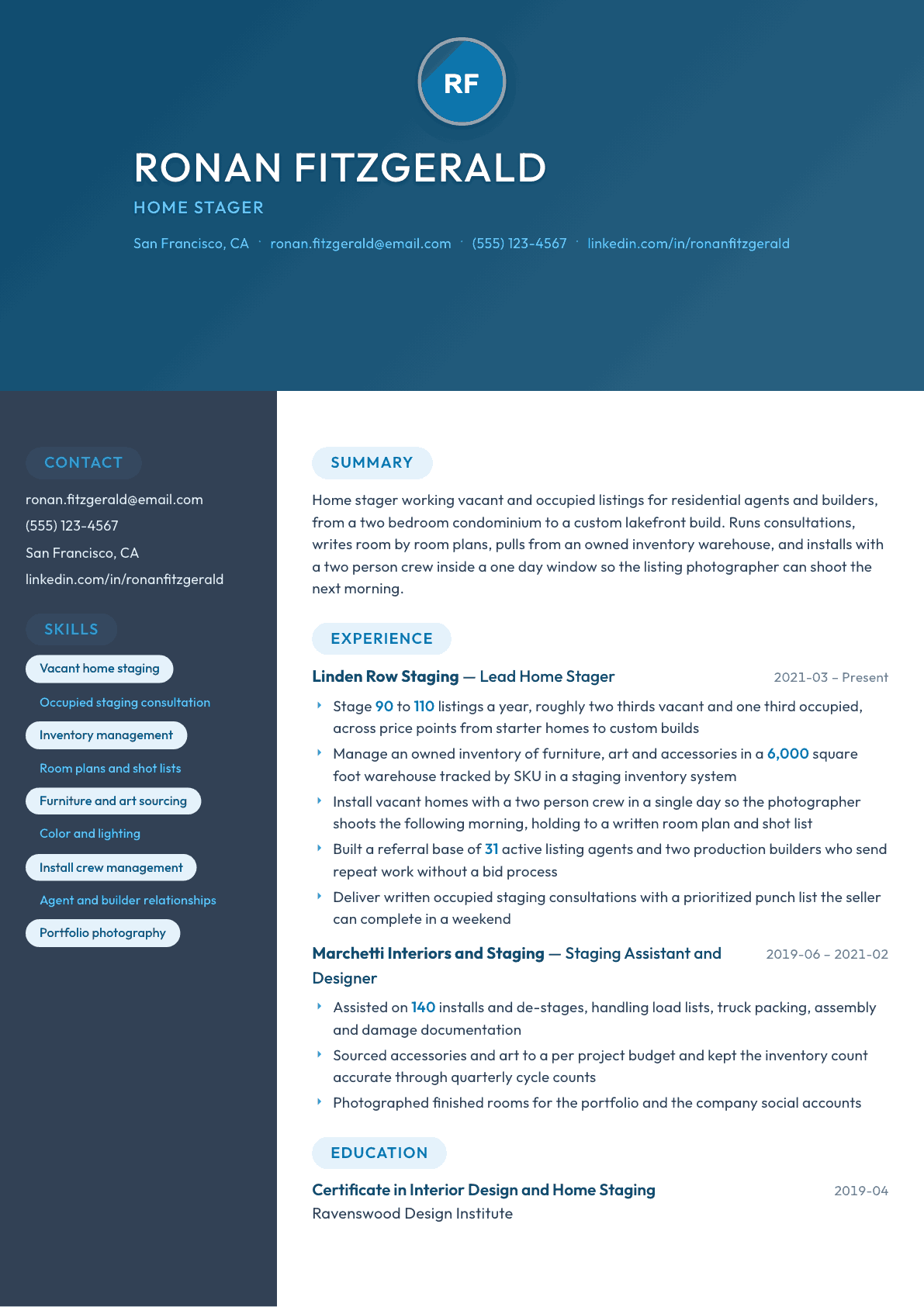
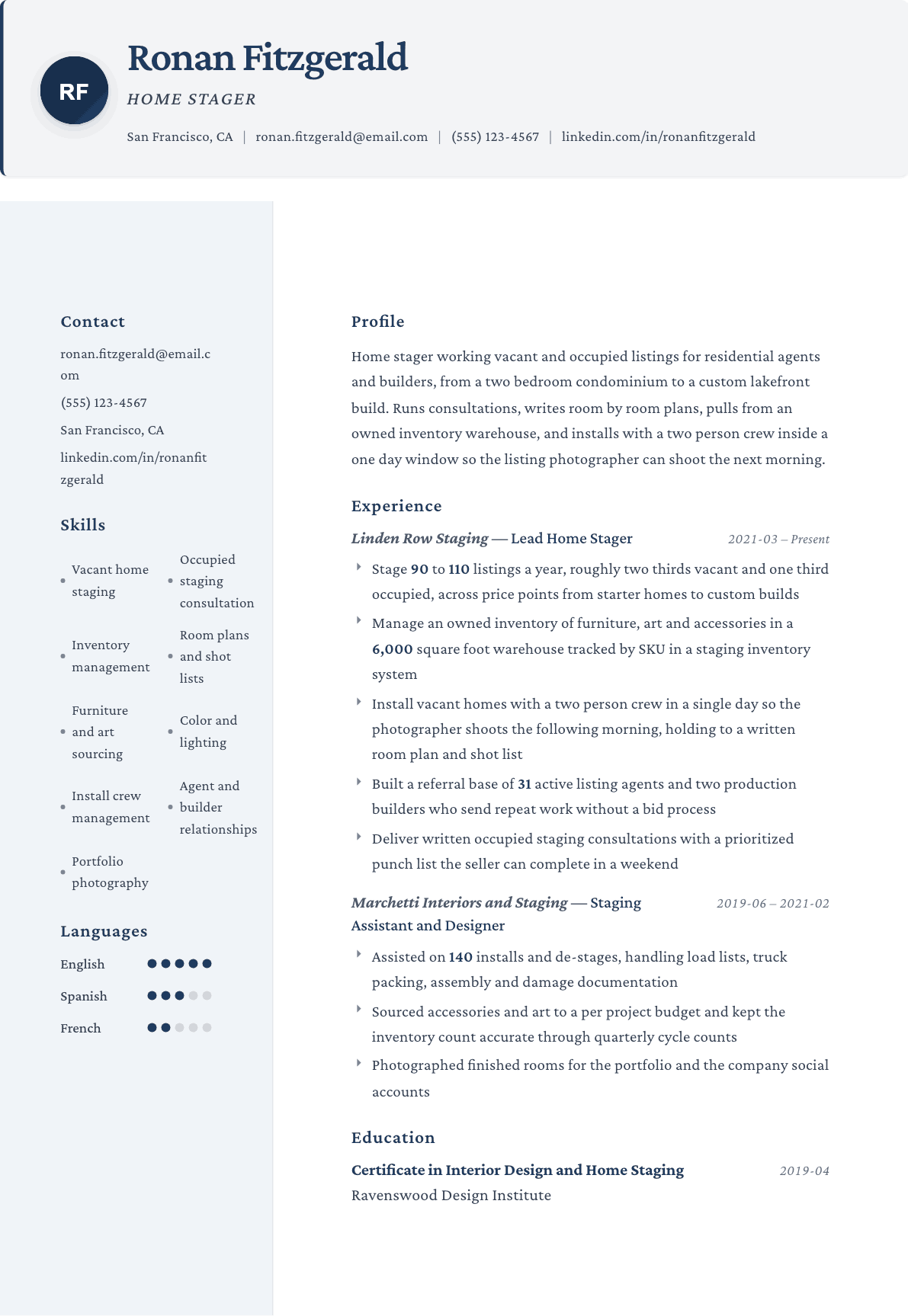
Example Home Stager summary
Home stager installing roughly one hundred listings a year for residential agents and production builders, split between vacant installs and occupied consultations. Works from an owned warehouse inventory tracked by SKU, writes a room by room plan and shot list before the truck loads, and completes vacant installs in one day so photography happens the next morning. Repeat work comes from a referral base of active listing agents rather than bids.
Skills to list on a Home Stager resume
- Vacant property staging
- Occupied home consultation
- Room by room staging plans
- Furniture and accessory sourcing
- Warehouse inventory control
- Load list and truck packing
- Install and de-stage crew leadership
- Color palette selection
- Lighting and window treatment
- Curb appeal improvement
- Listing photography coordination
- Client and agent consultation
- Project budgeting and quoting
- Damage documentation
- Portfolio and social content
What actually gets this resume read
- Lead with annual install volume and the vacant to occupied ratio, because those two numbers describe your whole operation.
- Say whether the inventory is owned, rented or the client's, since owning warehouse stock changes what a company is buying.
- Give your install turnaround against the photography date, which is the deadline every listing agent actually cares about.
- Name the agents and builders relationship count rather than individual names, and describe how repeat work comes in.
- Add a portfolio link line and keep the before and after pairs varied across price point and home style.
- Include your staging designation if you hold one, and name the issuing body so a hiring designer can verify it.
How to write a home stager resume
A home stager is hired on a portfolio, but the portfolio only gets opened if the resume survives thirty seconds. The staging company owner reading it wants to know install volume, whether you work vacant or occupied, whether the inventory is yours or theirs, and whether you can hold a one day install window when the listing photographer is booked for the next morning.
The weakest resumes in this field read like an interior design statement. Created beautiful spaces, transformed homes, developed cohesive design concepts. A staging owner cannot schedule any of that. What they can schedule is a stager who installs a three bedroom vacant in a day with a two person crew and never loses a load list.
This guide covers the section order a staging company reads, how to write about inventory and logistics, the difference between vacant and occupied work on paper, three summaries by level, and rewritten bullets that turn design language into operational proof.
Format: one page with a portfolio link at the top
Keep it to one page and put the portfolio link in the header, not buried at the bottom. Staging is judged visually, and the resume exists to earn the click. Make the link short, live and pointed at before and after pairs rather than a general design blog.
Do not stage the resume itself. Heavy graphics, script fonts and color blocks slow down a reader who is comparing eight candidates before a season starts, and they parse badly if the company uses any applicant tracking software.
- Header: name, city, phone, email, portfolio link, and whether you have your own vehicle and crew.
- Order the page summary, staging experience, project range, inventory and logistics, training and designation, software.
- New stagers put training and an install assistant record first, then the portfolio breadth.
Summary: volume, mix and turnaround
Open with annual install volume and the split between vacant installs and occupied consultations, because that ratio describes your whole operation. A stager doing mostly occupied consultations sells advice. A stager doing mostly vacant installs runs a warehouse and a truck.
Add the price range and home styles you have worked, from starter condominiums to custom builds. Then the turnaround promise: install complete before the photography appointment, which is the only deadline a listing agent genuinely cares about.
Experience: installs, inventory, crew, clients
Lead each role with volume and mix, then move into the machinery. Write the plan step honestly: a walkthrough, measurements, a room by room plan, a shot list built with the photographer in mind, and a load list that the warehouse pulls from. Owners hire the person who plans, because unplanned installs return to the warehouse with the wrong sofa.
Inventory deserves its own bullets. Say whether the stock is owned, rented from a supplier, or the client's own furniture rearranged. Give the warehouse size in square feet, how items are tracked, and how you keep counts honest through cycle counting. A stager who has never touched inventory control will lose a company money quietly.
Crew and truck logistics come next: crew size, install duration, de-stage turnaround after a closing, damage documentation and how you handle a same day rescheduled photographer. Client work closes it out: consultations delivered, referral relationships with listing agents and builders, and repeat work that arrives without a bid.
Occupied consultations: the deliverable, not the visit
An occupied staging consultation is a written product, and most resumes describe it as a visit. Say what the seller receives: a prioritized room by room punch list, a keep, store and remove instruction for the furniture already in the home, paint and lighting recommendations, and a realistic weekend of work rather than a renovation.
Note whether the consultation is billed separately, bundled by the listing agent, or a lead source for a full install. Staging companies think about consultations as a funnel, and a stager who understands that reads as a business partner rather than a contractor.
Training, designation and keywords
If you hold a staging designation, name it with the issuing organization so it can be verified. Interior design coursework, color theory training and any furniture or textile supplier certifications belong in the same block. Where you have none, lead with install count instead, which stagers respect more than a certificate anyway.
Vocabulary worth mirroring from postings: home staging, vacant staging, occupied staging, staging consultation, inventory management, load list, install and de-stage, curb appeal, listing photography, furniture rental, accessory sourcing and agent referrals.
Home Stager resume summary examples
Staging assistant
Staging assistant with two years on 140 installs and de-stages, handling load lists, truck packing, furniture assembly and damage documentation. Sources accessories to a per project budget, keeps warehouse counts accurate through quarterly cycle counts, and photographs finished rooms for the company portfolio.
Lead stager
Home stager installing 90 to 110 listings a year, roughly two thirds vacant and one third occupied, across starter homes through custom builds. Works from an owned inventory warehouse tracked by item, installs vacants in a single day with a two person crew, and holds 31 active agent referral relationships.
Staging business owner
Owner operator running a staging company with two install crews, a leased warehouse and a builder model home contract. Sets pricing and inventory strategy, hires and trains stagers on the room plan standard, and carries a repeat client base of listing agents and one production builder across two counties.
Work experience bullets: before and after
Before: Staged homes for real estate agents to help them sell faster.
After: Staged 90 to 110 listings a year for residential agents and two production builders, roughly two thirds vacant installs and one third occupied consultations across every price point in the market.
Volume, client type and the vacant to occupied split describe an operation rather than an intention.
Before: Managed the furniture and accessory inventory.
After: Managed an owned inventory of furniture, art and accessories in a 6,000 square foot warehouse, tracked by item in a staging inventory system and verified by quarterly cycle counts.
Warehouse size, tracking method and count discipline show inventory control instead of a storage room.
Before: Completed installations on schedule.
After: Installed vacant homes with a two person crew inside a single day so the listing photographer could shoot the next morning, working from a written room plan and shot list built before the truck was loaded.
Tying the install window to the photography date names the deadline the agent actually cares about.
Before: Gave sellers advice on preparing their homes.
After: Delivered written occupied staging consultations with a prioritized punch list, keep, store and remove instructions and a paint and lighting plan a seller could complete over a weekend.
Describing the written deliverable turns a friendly visit into a billable product.
Before: Built good relationships with real estate agents.
After: Built a referral base of 31 active listing agents and two production builders who send repeat staging work without a bid process, contributing the majority of annual bookings.
A count of active referral sources and the absence of bidding shows commercial value, not just rapport.
Hard skills
- Vacant property staging
- Occupied staging consultation
- Room by room staging plans
- Load list and truck packing
- Warehouse inventory control
- Furniture and accessory sourcing
- Furniture rental supplier management
- Install and de-stage crew leadership
- Color palette and finish selection
- Lighting and window treatment
- Curb appeal improvement
- Listing photography coordination
- Project quoting and budgeting
- Damage documentation and claims
Soft skills
- Working in an occupied home with tact
- Crew direction under a tight window
- Agent and builder relationship building
- Decisiveness on the floor
- Physical stamina across install days
- Handling seller attachment to their furniture
Certifications worth listing
- Accredited Staging Professional (ASP) (StagedHomes.com)
- Certified Staging Professional (CSP) (Certified Staging Professionals)
- Real Estate Staging Association Professional Member (Real Estate Staging Association)
Mistakes that cost home stager candidates the interview
- Writing design philosophy instead of install volume, which tells a staging owner nothing about your capacity.
- Omitting whether the inventory was owned, rented or the client's, when that single fact defines the job you actually did.
- Burying or leaving out the portfolio link, which is the only thing a staging company truly wants to see.
- Treating vacant and occupied work as one line, when they need different skills, crews and pricing.
- Skipping logistics such as truck, crew size and de-stage turnaround, which are the real constraints on the calendar.
- Filling the page with home styling adjectives that could describe any decorator with a mood board.
Home Stager resume questions
Do I need a design degree to work as a home stager?
No. Staging companies hire on install volume, reliability and portfolio quality more than credentials. Design coursework helps you talk about color, scale and lighting with confidence, but a stager who can run a vacant install in a day will be hired first.
How should I present my staging portfolio on a resume?
One short link in the header pointing at before and after pairs, organized by home type and price point. Ten strong varied projects beat forty similar rooms. Include at least one occupied project so a reader can see you work with a seller's existing furniture.
Should I put days on market or sale results on my resume?
Only if a client provided the figure and you can attribute it honestly. Staging is one of several factors in a sale, so a broad claim invites doubt. A specific line about a listing that sold after a re-stage, described as one contributing factor, reads as credible.
How do I move from staging assistant to lead stager?
Show that you planned rather than only carried. Room plans you drew, load lists you built, sourcing decisions you made within a budget, and installs you ran when the lead was unavailable are the evidence a company needs before handing over a truck and a crew.
What should a stager say about pricing and quoting?
Include it if you have owned it. Quoting a vacant install by room count and price tier, setting a monthly rental term for inventory, and pricing consultations separately all show business judgment that a company promoting into a lead role will value.
Related resume examples
- Interior Designer Resume example
- Real Estate Agent Resume example
- Realtor Resume example
- Interior Architect Resume example
- Real Estate Investor Resume example
- Home Inspector Resume example