Regulatory Analyst Resume Examples: the lines they read
Write a Regulatory Analyst Resume That Survives Legal Review
By Mustafa Tarabya, founder of CVBooster · Published · Updated
Regulatory analyst resume example with rulemaking, comment analysis and compliance keywords, plus a guide to writing evidence a hiring panel checks.
Sample resumes for a regulatory analyst
The same regulatory analyst content laid out in three CVBooster templates, so you can see what the finished document looks like before you write a word.
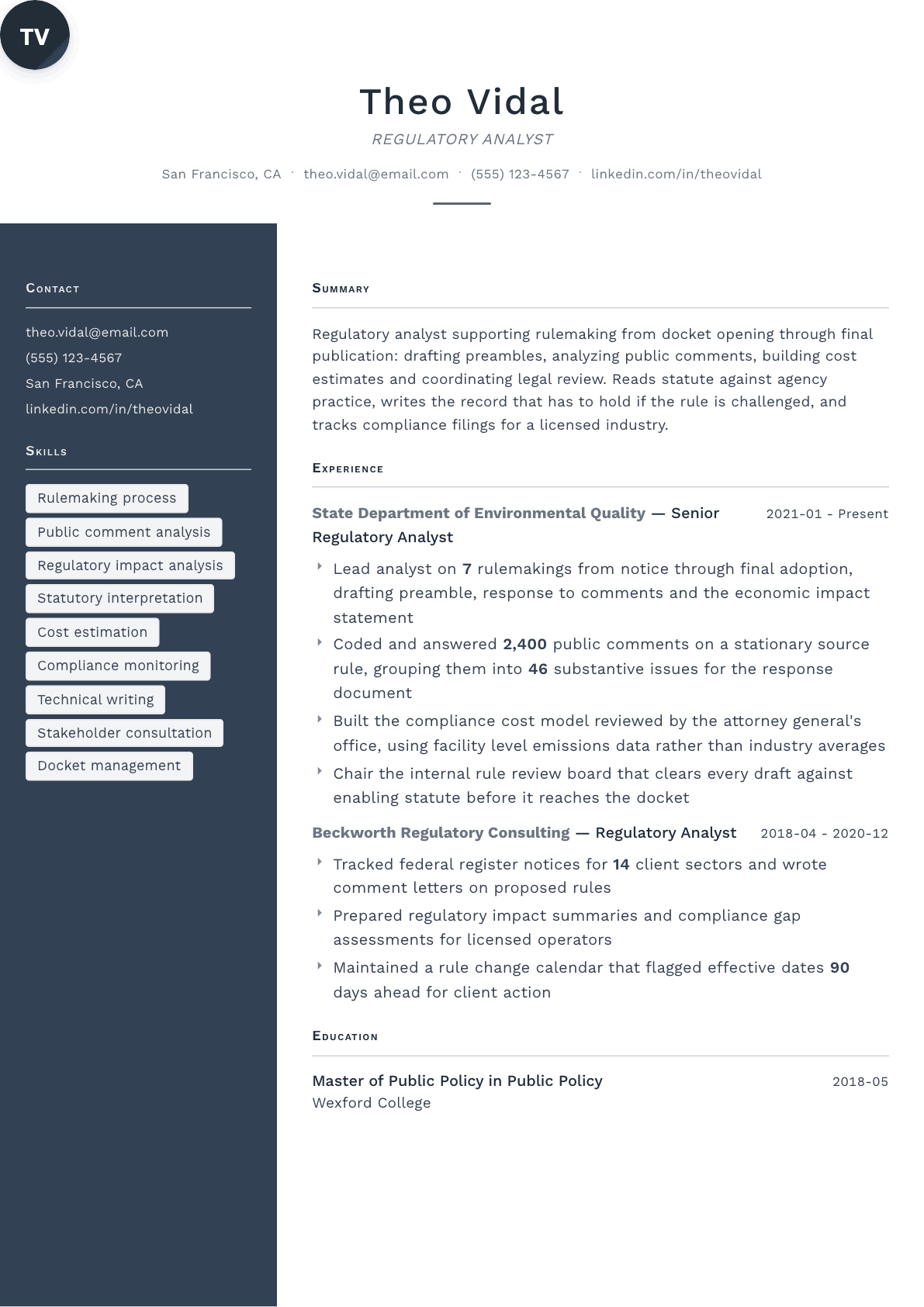
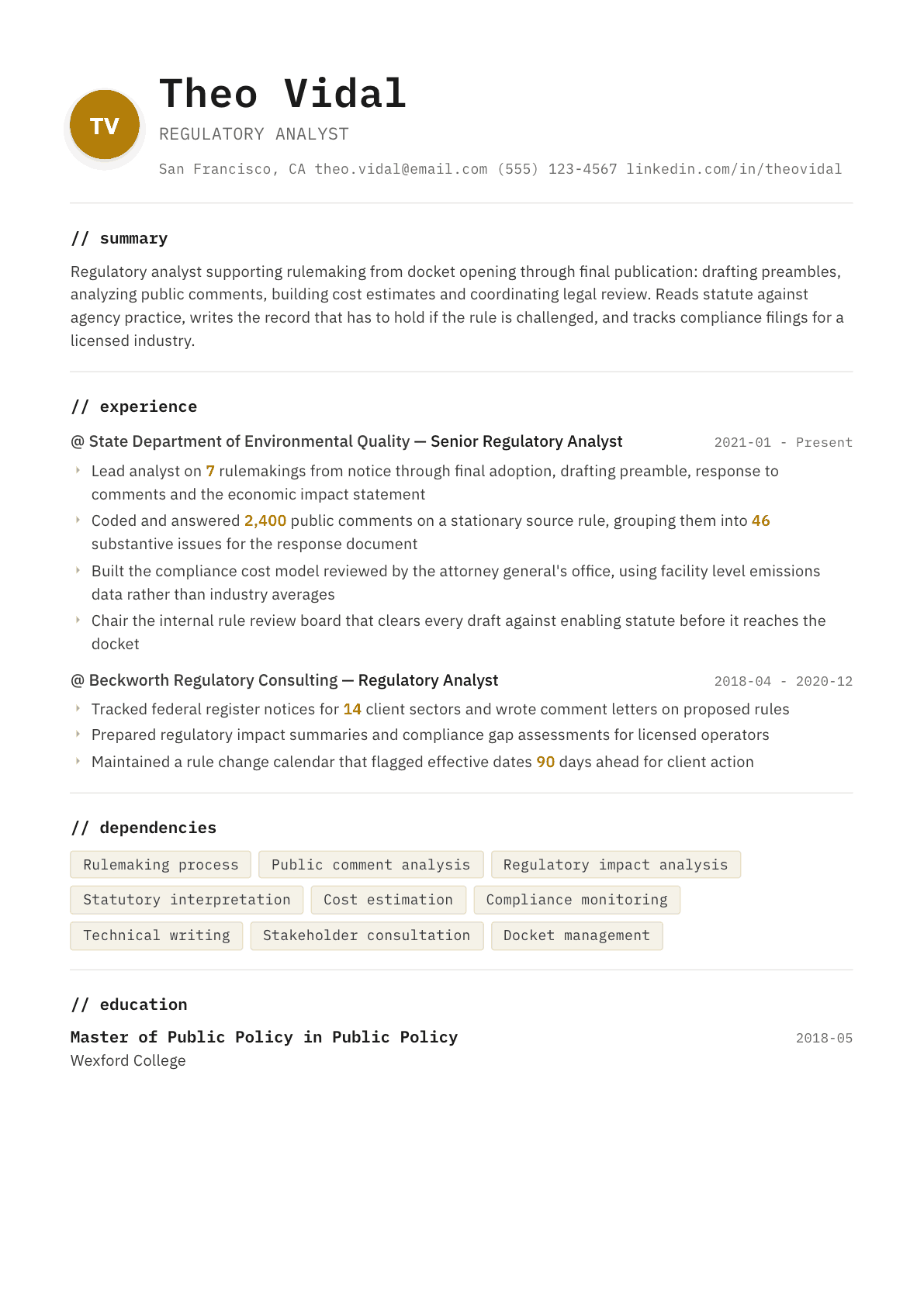
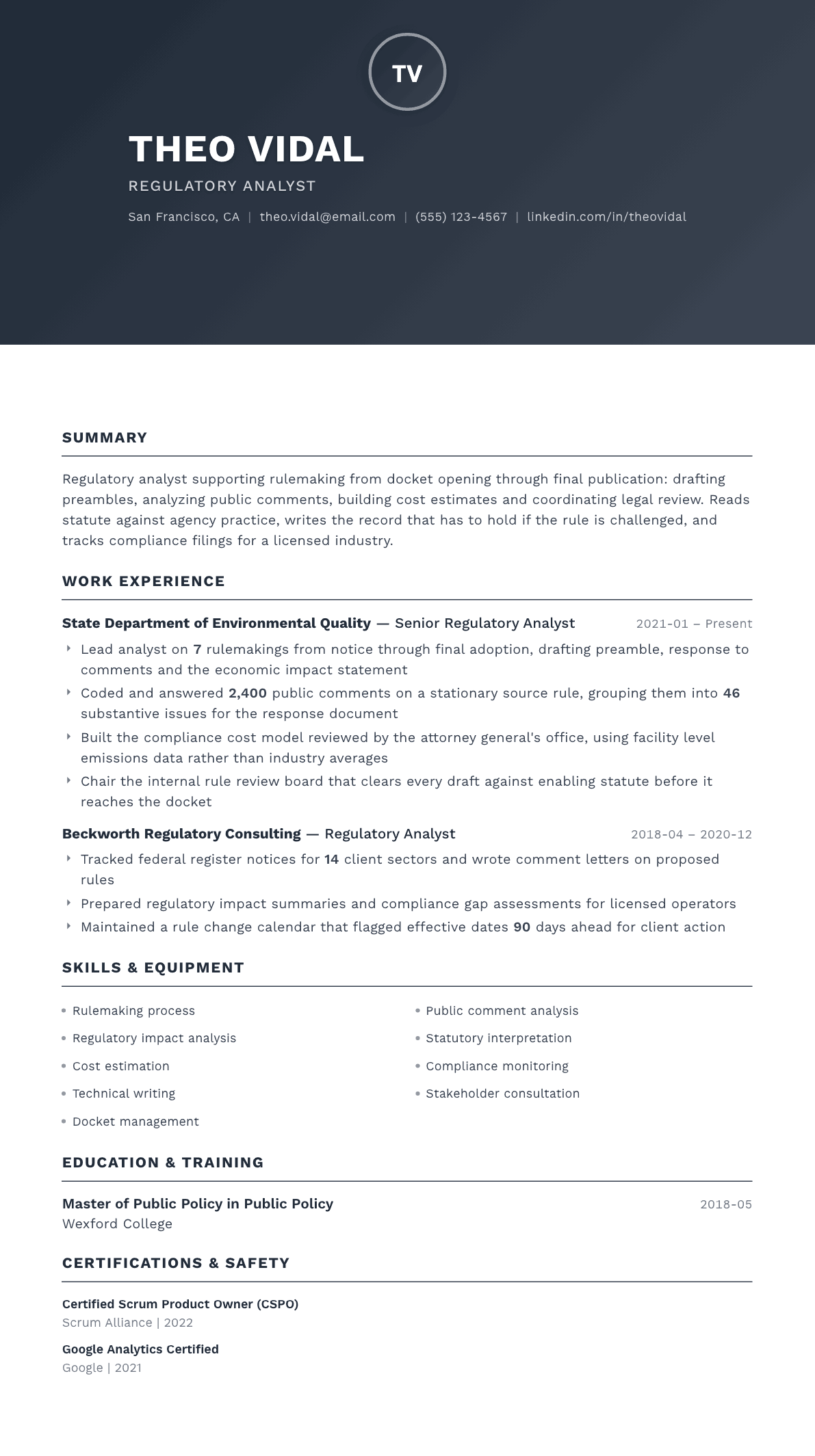
Example Regulatory Analyst summary
Regulatory analyst with six years taking rules from docket opening to final adoption, including regulatory text, preamble, response to comments and the economic impact statement. Coded thousands of public comments into a defensible issue structure, built compliance cost models from facility level data, and cleared drafts through counsel and a central review board. Master of Public Policy with a background in environmental and licensing programs.
Skills to list on a Regulatory Analyst resume
- Notice and comment rulemaking
- Regulatory text drafting
- Preamble and response to comments
- Public comment coding and analysis
- Regulatory impact analysis
- Cost and benefit estimation
- Statutory and legislative interpretation
- Compliance monitoring and reporting
- Docket and administrative record management
- Stakeholder and industry consultation
- Data analysis in Excel and SQL
- Legal research databases
- Guidance document development
- Enforcement referral support
- Plain language editing
What actually gets this resume read
- Name the rules you worked on by subject and stage, since a panel wants to know what you actually carried.
- Give comment volume and how you grouped comments into issues, because that is the real analytical work.
- Show whether you drafted regulatory text, the preamble, the impact analysis, or all three on a docket.
- State the statutes and program areas you know well, using the exact terms the posting uses for them.
- Describe your cost or benefit modeling method and the data source, not just that you produced estimates.
- Include the review chain you cleared: legal counsel, the agency head, and any central review office.
How to write a regulatory analyst resume
A regulatory analyst produces documents that have to survive two audiences: a public that will comment on them and a court that may eventually review them. The hiring manager knows this. She is not reading your resume for polish. She is reading it to work out whether you can build an administrative record that holds together when someone with a litigation budget attacks it.
Most applicants write around that. They say they "assisted with policy development and regulatory compliance," which could mean drafting rule text or filing paperwork. The gap between those two is the whole job. A manager wants to know which parts of a rulemaking you carried: the regulatory text, the preamble, the response to comments, the impact analysis, or the coordination that kept the docket on schedule.
This guide walks through the resume a regulatory office actually evaluates, with summaries for an entry analyst, a settled practitioner and a lead, before and after bullets from real rulemaking work, and the questions people ask when they move between agency, industry and consulting sides of this field.
Format: one page early, two once you have a docket history
Reverse chronological, single column, conventional headings. Regulatory work rewards clarity, and a resume that is hard to parse is an unhelpful sample of your writing. Keep the layout unremarkable so the content carries the page.
Once you have several rulemakings behind you, add a compact docket block listing them by subject and stage rather than by docket number. A reader who sees five rules taken from proposal to final adoption in three program areas understands your depth faster than any summary sentence could deliver it.
- Name line, then a single positioning line naming your program areas: environmental, financial, health, licensing or safety.
- Docket block: rule subject, your role, the stage you carried it to, and whether it was challenged after adoption.
- Experience entries lead with the agency or firm, the program office, and whether you sat inside the regulator or across from it.
- New analysts put policy coursework, comment letters written and any legislative or agency internship above unrelated work.
Summary: which side, which programs, which parts of a rule
Four lines. Say whether you have worked for the regulator, the regulated industry, or a consultancy serving one of them, because the three build different instincts and hiring managers screen on it. Name your program areas, the stages of rulemaking you have owned, and the analytical method you are strongest in.
If you are crossing sides, address it in the summary rather than hoping nobody notices. An industry analyst moving to an agency should say what carries over: knowledge of how the regulated party actually complies, which is the single most common blind spot in a rule written entirely from the inside.
Experience: rules carried, comments handled, records built
Each position opens with the office and its mandate. Then the bullets go rule by rule. Say what the rule addressed, what you drafted, how many comments arrived, how you organized them, and what changed between the proposal and the final version because of them. A response to comments document is where an administrative record is won or lost, and an analyst who has written one knows why.
Comment analysis deserves its own bullet with a number and a method. Thousands of comments are useless as a raw count. What matters is the structure you imposed on them: coding into substantive issues, separating form letters from unique submissions, identifying the comments that raise a legal defect rather than a preference, and tracking each issue to a written response.
Impact analysis is the other place to be concrete. Say what you estimated, what data source you used, and who reviewed it. An analyst who built a compliance cost model from facility level reporting rather than an industry average is describing a defensible method, and the difference between those two approaches is exactly what opposing counsel will probe.
Compliance, guidance and the work between rulemakings
Rules are episodic. Between them, regulatory analysts write guidance documents, review license and permit applications, handle interpretive questions from the regulated community, support enforcement referrals and track legislation that will force the next rule. Show that side, because a manager staffing a small office needs someone useful in the quiet months as well as during a proposal.
Be honest about the boundary with legal counsel. You are not the lawyer. What a manager wants is an analyst who reads statute carefully, spots where a draft exceeds the enabling authority, and raises it early instead of letting counsel discover it two days before publication. Write it that way and you sound like someone who has been through a late rewrite.
Skills, tools and the keywords a regulatory office screens on
The recurring vocabulary is narrow: notice and comment, proposed rule, final rule, preamble, response to comments, administrative record, regulatory impact analysis, cost and benefit estimation, enabling statute, guidance document, compliance monitoring, stakeholder consultation and effective date. Use each once in the place where the work is described.
Add a short tools line. Excel modeling, a statistical or query language you use for data work, the legal research database you rely on, the docket system you file in, and any text analysis tool you have used for comment coding. Regulatory offices are small and technical support is thin, so an analyst who can build her own analysis is worth more than one who has to request it.
Regulatory Analyst resume summary examples
First analyst role
Public policy graduate with an agency internship supporting two rulemakings, including comment intake and a literature review for the impact statement. Wrote three comment letters on proposed rules for a nonprofit, and built a legislative tracker covering four program areas. Seeking a regulatory analyst position in a state licensing or environmental office.
Five years in
Regulatory analyst with five years across a state environmental agency and a consultancy, drafting regulatory text, preambles and response to comments documents for six rulemakings. Coded 2,400 comments into 46 substantive issues on a stationary source rule, and built compliance cost estimates from facility level reporting data.
Lead analyst
Senior regulatory analyst leading rulemakings from docket opening through final adoption, chairing an internal review board that clears every draft against enabling statute. Owns the economic impact methodology used across the program office, coordinates with the attorney general's office, and mentors three analysts through their first proposals.
Work experience bullets: before and after
Before: Assisted with the development of new regulations.
After: Served as lead analyst on seven rulemakings from notice through final adoption, drafting the regulatory text, the preamble and the response to comments for each one.
Naming the specific documents you produced separates a drafter from someone who attended the meetings.
Before: Reviewed public comments on proposed rules.
After: Coded 2,400 public comments on a stationary source rule into 46 substantive issues, separated form submissions from unique ones, and tracked every issue to a written response in the final record.
The method and the traceability show you built a record rather than skimmed a pile of letters.
Before: Conducted cost analysis for proposed regulations.
After: Built the compliance cost model reviewed by the attorney general's office using facility level emissions reporting rather than industry averages, and documented every assumption in the docket.
The data source and the review chain are what make a cost estimate defensible if the rule is challenged.
Before: Monitored regulatory changes affecting clients.
After: Tracked federal register notices across fourteen client sectors, wrote comment letters on proposed rules, and maintained a change calendar flagging effective dates ninety days ahead of required action.
Scope, output and lead time turn passive monitoring into a service the client can plan around.
Before: Worked with legal staff on rule drafting.
After: Chaired the internal rule review board that clears each draft against its enabling statute before docket filing, catching authority and scope problems before counsel saw the package.
Owning a review step shows judgment about statutory limits rather than dependence on the legal office.
Hard skills
- Notice and comment rulemaking
- Regulatory text drafting
- Preamble and response to comments writing
- Public comment coding and issue analysis
- Regulatory impact analysis
- Cost and benefit estimation
- Statutory and legislative interpretation
- Administrative record management
- Guidance and interpretive document development
- Compliance monitoring and reporting
- Stakeholder and industry consultation
- Data analysis in Excel and SQL
- Legal research databases
Soft skills
- Precision under legal review
- Neutrality when stakeholders push hard
- Explaining technical rules to a lay audience
- Raising a statutory problem early rather than quietly
- Patience with a docket that runs for years
Certifications worth listing
- Regulatory Affairs Certification (RAC) (Regulatory Affairs Professionals Society)
- Certified Regulatory Compliance Manager (CRCM) (American Bankers Association)
Mistakes that cost regulatory analyst candidates the interview
- Writing "supported policy development" when the manager needs to know exactly which rulemaking documents you drafted.
- Reporting a comment count with no issue structure behind it, which is the analytical work the count is supposed to represent.
- Presenting cost estimates without naming the data source, leaving the reader unable to judge whether the model was defensible.
- Ignoring the quiet work of guidance documents, license reviews and interpretive responses that fills the space between proposals.
- Overstating your role relative to counsel, which any agency reader will test with a single interview question.
- Using industry shorthand on an agency application, or agency shorthand on an industry one, when the two vocabularies differ in small telling ways.
Regulatory Analyst resume questions
Do I need a law degree to work as a regulatory analyst?
No. Many analysts hold policy, economics, science or engineering degrees, and agencies staff legal review separately. What is expected is careful statutory reading, the discipline to document assumptions, and the judgment to route a legal question to counsel rather than answering it yourself.
How do I move from industry compliance into an agency role?
Lead with the parts that transfer: reading rules closely, building compliance evidence and commenting on proposals. Then show you understand the agency side by naming the record building steps, since compliance staff often see only the finished rule and not how it was assembled.
Which rulemakings should I list if I have worked on many?
Pick the ones closest to the posting's program area, plus any where you carried a rule from proposal to adoption. Depth beats breadth here, because a manager wants proof you have finished a docket rather than touched a dozen of them.
Should I mention a rule that was challenged in court?
Yes, if you can describe it factually. Say what your contribution was and what the record showed, without characterizing the outcome as a personal win or loss. Analysts who have been through litigation build better records afterward, and hiring managers know it.
How technical should the skills section be?
Technical enough to prove you can do your own analysis. Name the modeling you build in Excel, any query or statistical language you use, the research databases you work in, and the docket system you file through, rather than listing generic research and communication skills.
Related resume examples
- Policy Analyst Resume example
- Public Policy Analyst Resume example
- Compliance Officer Resume example
- Contract Specialist Government Resume example
- Policy Advisor Resume example
- Government Relations Manager Resume example