Sales Operations Manager Resume Examples: free ATS score
Build a Sales Operations Manager Resume That Runs the Engine
By Mustafa Tarabya, founder of CVBooster · Published · Updated
Create a systems-driven sales operations manager resume with CRM administration, pipeline analytics, and process optimization skills that revenue teams depend on.
Sample resumes for a sales operations manager
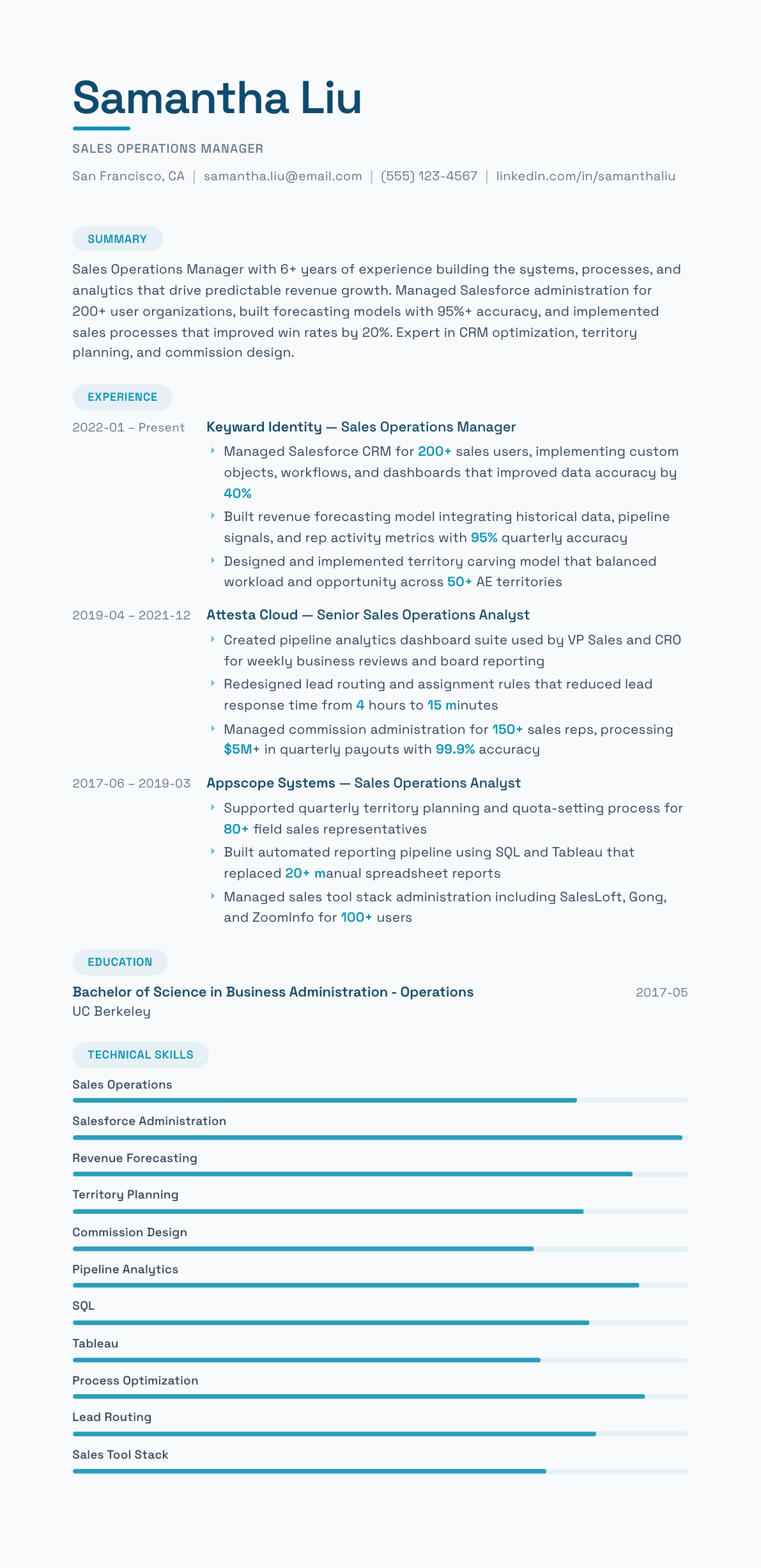
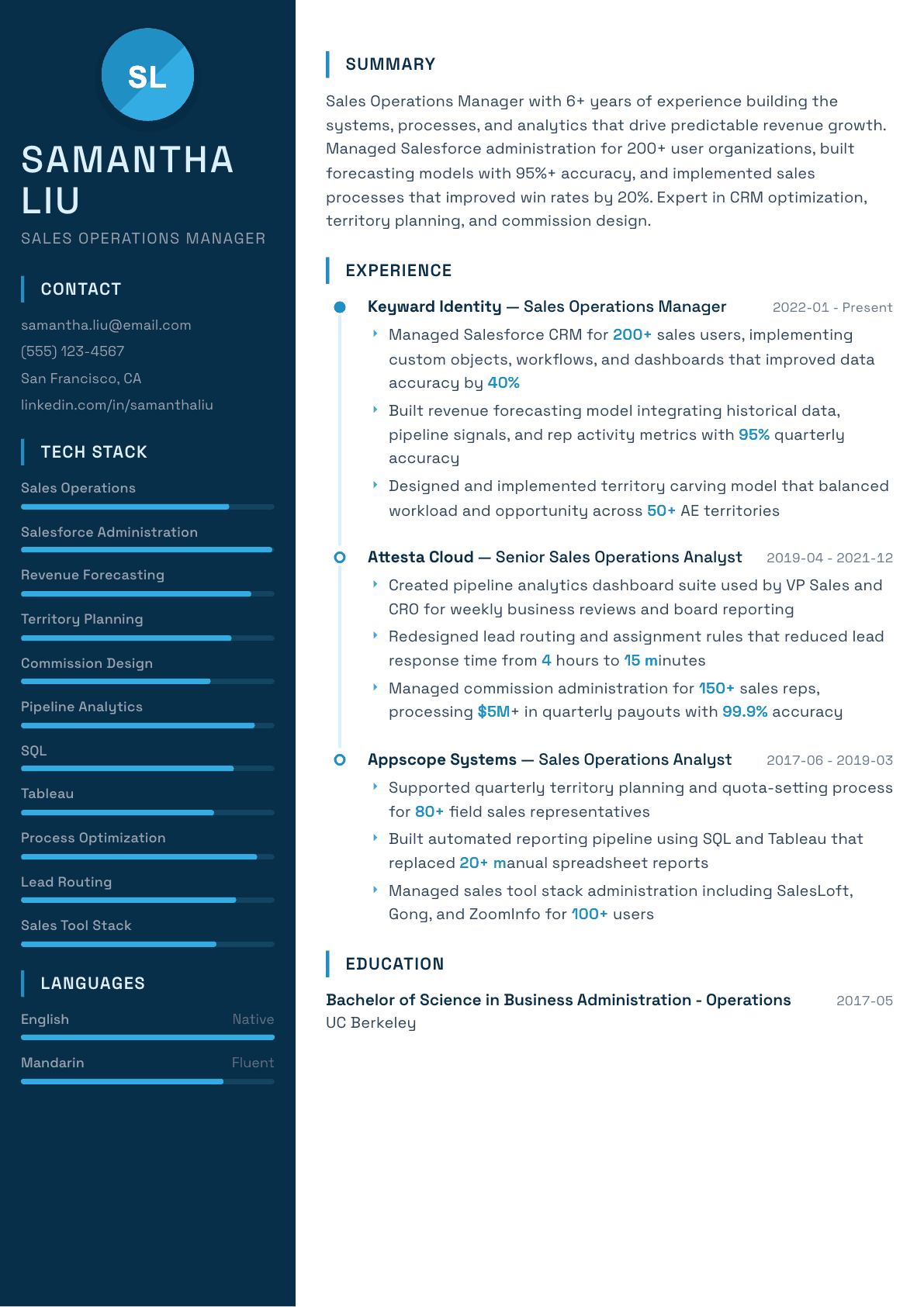
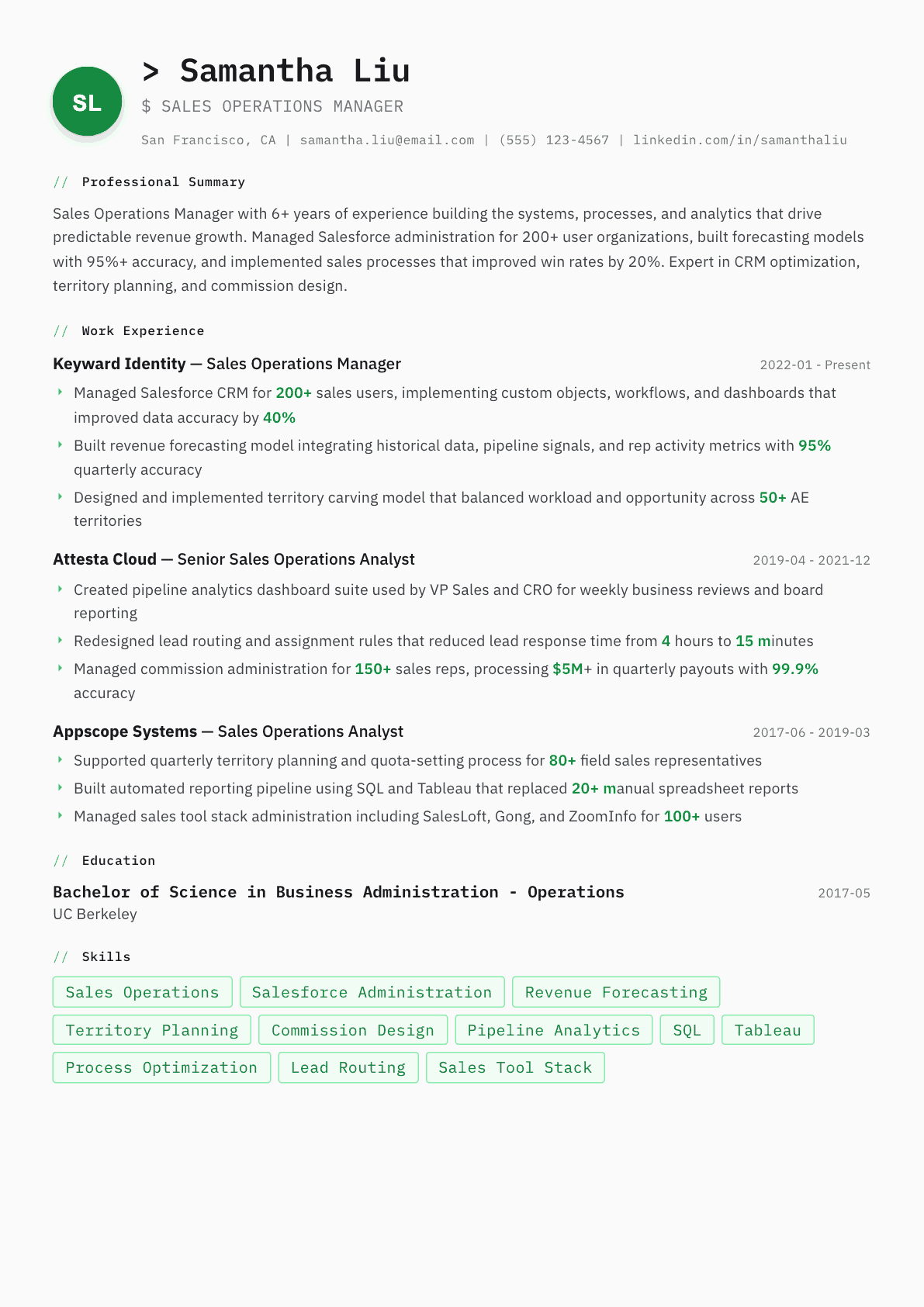
The same sales operations manager content laid out in three CVBooster templates, so you can see what the finished document looks like before you write a word.
Example Sales Operations Manager summary
Sales Operations Manager with 6 years building the systems behind predictable revenue. Administers Salesforce for 200+ users at Keyward Identity, runs a forecasting model that lands within 95% each quarter, and carved territory plans across 50+ AE patches. Strong in SQL, Tableau, lead routing, and commission design.
Skills to list on a Sales Operations Manager resume
- Sales Operations
- Salesforce Administration
- Revenue Forecasting
- Territory Planning
- Quota Setting
- Commission Design
- Pipeline Analytics
- SQL
- Tableau
- Excel
- Process Optimization
- Lead Routing
- Clari
- Sales Tool Stack Management
What actually gets this resume read
- Highlight CRM expertise: Salesforce administration, custom objects, workflows, reports, and dashboards.
- Quantify process improvements: lead response time reduction, forecast accuracy, and win rate improvements.
- Showcase analytics skills: SQL, Tableau, Excel, and the dashboards and reports you have built.
- Include territory planning and quota-setting experience -- these are high-impact sales ops responsibilities.
- Mention commission administration and design experience, as this is a critical and sensitive function.
- List sales tool stack managed: SalesLoft, Outreach, Gong, ZoomInfo, Clari, and others.
How to write a sales operations manager resume
Sales operations sits between the revenue team and the systems that report on it, and the resume has to prove both halves. A sales operations manager who can only administer a CRM gets screened as an admin. One who can only build slides gets screened as an analyst. The hire happens when the resume shows the person owning a process end to end: the data model underneath it, the workflow that runs on top, and the number the leadership team trusts because of it.
The reader is usually a director of revenue operations or a VP of Sales, and their first filter is scale and stack. How many seats did you administer, how many sellers were in the plan you built, what CRM, what BI layer, and did you touch quota, territory and commissions or only reporting? Those facts decide the shortlist before anyone reads a paragraph.
This guide sets out the section order that works for operations resumes, three summaries from an analyst stepping up to a team lead, before-and-after bullets, and the questions that come up when a technical operator has to describe process work on paper.
Format: scale first, projects second
Reverse chronological, one page under six years and two after. Under each role, open with a scope line: CRM seats supported, sellers in the plan, systems owned, and who you reported to. A line reading "Salesforce for 200 seats, quota and territory for 80 field reps, reporting into the VP of Revenue Operations" answers three screening questions at once.
Group your work by the process you owned rather than by the quarter it happened in. A reader scanning for territory and quota experience should find a bullet about territory and quota, not have to reconstruct it from four scattered project mentions.
- Header: name, city and state, phone, email, and the systems you own in one short line.
- Order: summary, systems and tools, experience, education, technical skills.
- Put SQL, the BI tool and the CRM certification where a keyword screen will hit them early.
Summary: the systems, the seats, the processes
Three or four lines. Name the CRM and whether you administered or only used it, the number of sellers your processes served, and which of the four core operations areas you own: forecasting, territory and quota, compensation, or pipeline analytics. Very few candidates own all four, and claiming all four without evidence invites a hostile interview.
If your background is analytics and you are moving into operations, say so and lead with the modeling work. If your background is enablement or sales itself, lead with the process you rebuilt, because that is the transferable half.
Experience: name the process, the mechanism, the trust it earned
The strongest operations bullets have three parts: the process that was broken, the mechanism you built, and the decision the business could then make. A lead routing rewrite is only interesting when the reader learns response time fell and which team stopped losing inbound leads because of it.
Be specific about forecasting. Say what the model consumed, how often it ran, who consumed the output, and how close it landed to actual. A forecast that survived a board review is a stronger signal than any dashboard count.
Compensation work deserves its own bullets because it is the highest-risk area in operations. Show the number of payees, the plan components you designed, the dispute rate or the accuracy you held, and whether you ran the calculation in a spreadsheet, in a commissions platform, or in a system you built.
Technical skills: prove the depth, not the exposure
Split the skills section into systems, analytics and process. Under systems, list Salesforce objects and features you actually configured: validation rules, flows, custom objects, permission sets, sandbox deployment. Under analytics, name SQL, the warehouse, and the BI tool with the kind of work you did in it. Under process, name territory design, quota setting, capacity planning, pipeline hygiene and renewals.
A skills line that reads Salesforce, SQL, Tableau, Excel tells a hiring operations leader nothing about depth. One that reads Salesforce administration including flows and validation rules, SQL against Snowflake, Tableau data source design, Excel modeling with Power Query is instantly readable.
Keywords an operations screen looks for
These postings repeat: revenue operations, CRM administration, forecast accuracy, pipeline hygiene, territory carving, quota setting, capacity planning, commission administration, lead routing, sales analytics, data governance and go-to-market systems. Mirror the exact phrasing of the posting once near the top and once in a bullet where a result is attached. The interviewer will ask you to walk through the process you named, so only claim what you can whiteboard.
Sales Operations Manager resume summary examples
Analyst stepping up
Sales analyst with three years supporting a 60-seat Salesforce org, moving into operations ownership. Built the weekly pipeline pack the VP of Sales uses, automated 20 spreadsheet reports into SQL and Tableau, and ran quota tracking for two segments. Salesforce Administrator certified.
Six years in operations
Sales Operations Manager owning Salesforce for 200 users, forecasting, and territory and quota for 80 field sellers. Built a weekly forecast model that landed within 5% of actual for eight quarters, and redesigned lead routing that cut response time from four hours to fifteen minutes.
Leading the operations team
Revenue operations leader managing three analysts and the full go-to-market stack across CRM, engagement, enrichment and BI. Owns annual territory carving and quota setting for 150 sellers, commission administration for the same population, and the forecast presented at quarterly board reviews.
Work experience bullets: before and after
Before: Managed Salesforce for the sales organization.
After: Administered Salesforce for 200 sellers: rebuilt the opportunity object with required stage-exit criteria, deployed 14 validation rules, and lifted stage data completeness to 96%.
It shows what was configured and what the configuration fixed, which distinguishes an owner from a ticket queue.
Before: Built dashboards and reports for sales leadership.
After: Replaced 20 manual weekly spreadsheets with a SQL and Tableau pipeline pack consumed by the VP of Sales and the CRO in Monday business reviews.
Naming the consumers and the meeting proves the reporting was adopted rather than merely built.
Before: Helped with quota and territory planning.
After: Designed an industry-based territory model for 50 account executives, balancing account count and open opportunity value, and ran the quota-setting cycle end to end with sales leadership.
The balancing criteria and the end-to-end ownership show judgment, not participation in someone else's planning cycle.
Before: Responsible for commissions each quarter.
After: Ran quarterly commission calculation for 150 payees across four plan types, holding dispute volume under ten cases per cycle and closing payouts within three business days of quarter end.
Payee count, plan complexity, dispute volume and cycle time are the exact risk measures a finance partner asks about.
Before: Improved sales forecasting.
After: Built a forecast model blending stage-weighted pipeline, rep activity signals and historical conversion, and published a weekly call sheet that held submitted commit within 5% of actual.
The inputs and the accuracy band make the forecast auditable instead of a claim about better numbers.
Hard skills
- Salesforce administration and configuration
- Revenue forecasting models
- Territory design and carving
- Quota setting and capacity planning
- Commission plan administration
- SQL and data warehousing
- Tableau and Power BI
- Advanced Excel and Power Query
- Lead routing and assignment rules
- Pipeline hygiene and stage governance
- Sales tool stack administration
- CRM data governance and deduplication
- Process documentation
Soft skills
- Translating leadership questions into data requests
- Saying no to one-off report requests
- Partnering with finance on plan design
- Change management with sellers
- Written process documentation
Certifications worth listing
- Salesforce Certified Administrator (Salesforce)
- Salesforce Certified Advanced Administrator (Salesforce)
- Salesforce Certified Platform App Builder (Salesforce)
- Tableau Certified Data Analyst (Tableau)
- HubSpot Revenue Operations Certification (HubSpot Academy)
Mistakes that cost sales operations manager candidates the interview
- Writing the resume as a list of tools with no process attached, which reads as an administrator rather than an operations owner.
- Leaving out seat counts and seller counts, so the reader cannot tell a 20-person startup team from a 500-seat enterprise org.
- Claiming forecasting ownership without naming the inputs, the cadence or the accuracy the model achieved.
- Describing dashboards by how many were built instead of which decisions they changed.
- Skipping compensation work because it feels administrative, when it is the area a hiring manager most needs covered.
- Using vague verbs like supported and assisted throughout, which hides whether you owned the system or filed tickets against it.
Sales Operations Manager resume questions
Should a sales operations manager resume include SQL and BI work?
Yes, and with detail. Say which warehouse you queried, what you built in the BI tool, and who used the output. Operations roles increasingly expect the person to answer a leadership question without waiting on a data team.
How do I show CRM depth without turning the resume into a Salesforce release note?
Pick the three configuration decisions that changed behavior: a required stage-exit rule, a routing rewrite, a custom object that replaced a spreadsheet. Give each one a result. Leave the routine administration to a single line in the skills section.
Is a Salesforce Administrator certification worth listing?
It helps, especially when the posting names Salesforce administration as a requirement, because it clears a screening question with no argument. It does not substitute for evidence that you designed a process, so keep it in the credentials block rather than the summary.
What if I worked in operations at a small company with no formal processes?
That is an advantage if you write it as building rather than maintaining. Say what did not exist before you arrived, what you stood up, and how the team ran differently afterward. Greenfield ownership is harder to find than experience inside a mature system.
Should I call myself sales operations or revenue operations?
Match the posting. If the job says revenue operations and you owned marketing handoff and renewals as well as sales systems, use that title in the summary and keep your official title on the job line so the history stays accurate.