Marketing Analyst Resume Examples: the lines they read
Create a Marketing Analyst Resume That Proves Your Impact
By Mustafa Tarabya, founder of CVBooster · Published · Updated
Build a data-centric marketing analyst resume with analytics expertise, attribution modeling, and ROI optimization skills that hiring managers value.
Sample resumes for a marketing analyst
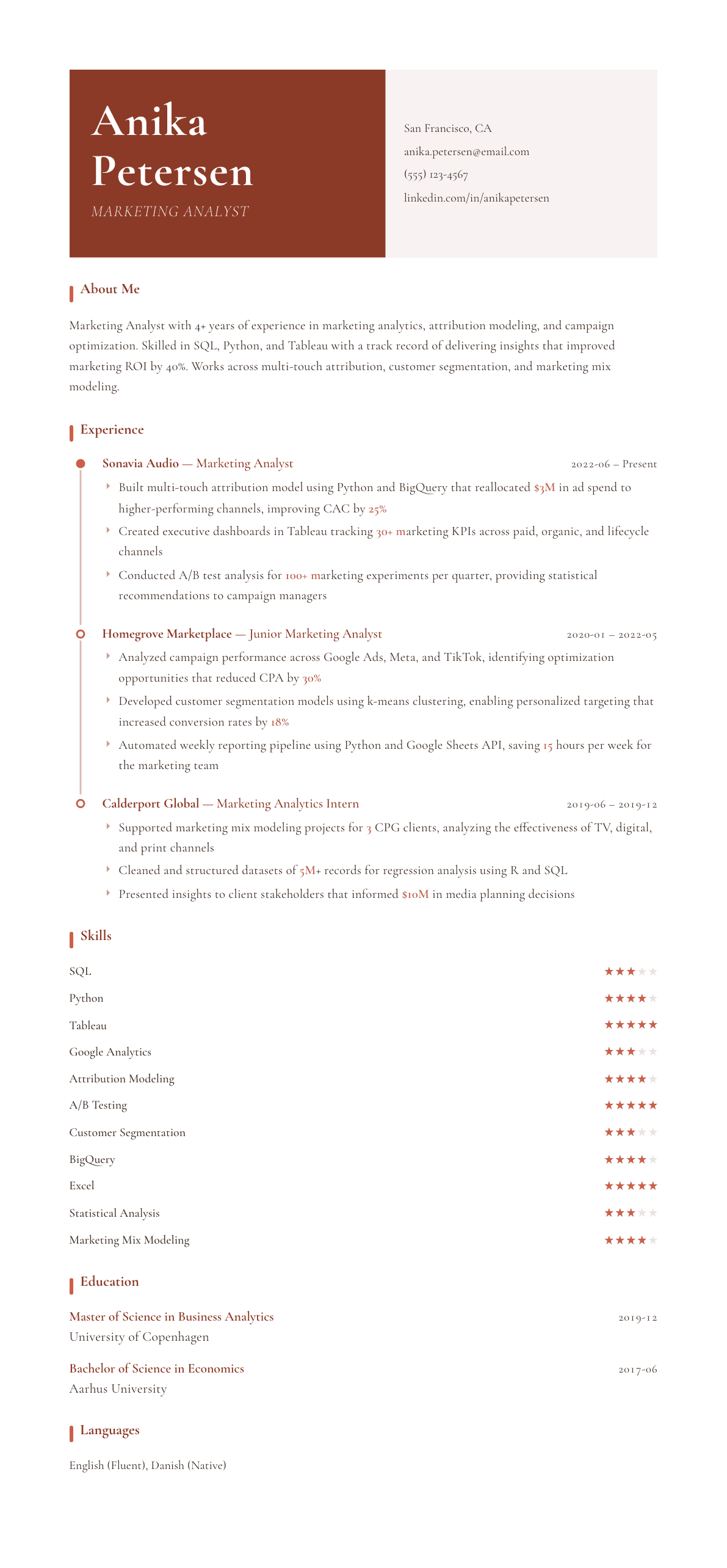
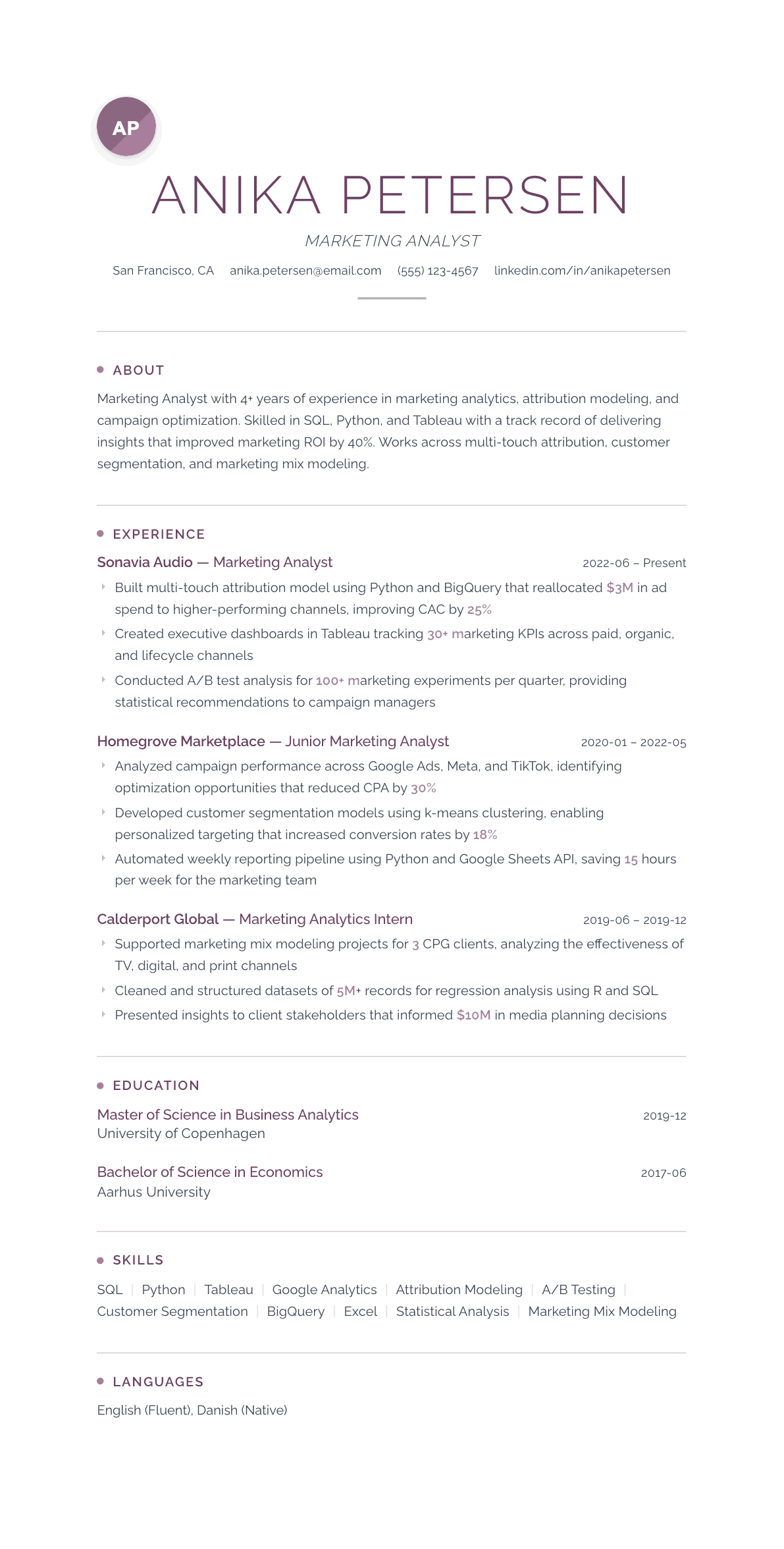
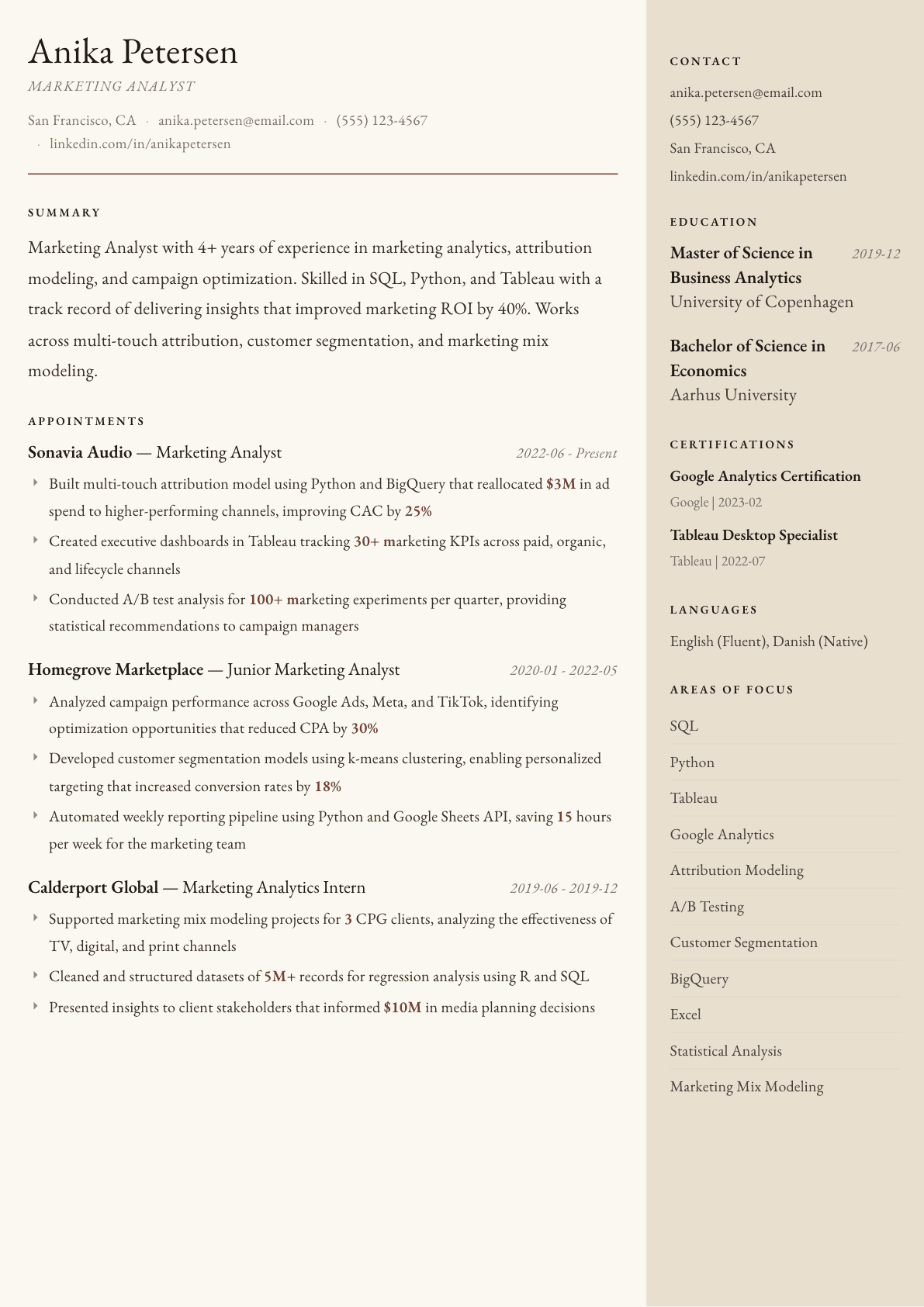
The same marketing analyst content laid out in three CVBooster templates, so you can see what the finished document looks like before you write a word.
Example Marketing Analyst summary
Marketing Analyst with 4 years turning campaign and channel data into growth decisions. Built a multi-touch attribution model that reallocated $3M in ad spend and improved CAC by 25%, and automated reporting that saved the team 15 hours a week. Works in SQL, Python, BigQuery and Tableau.
Skills to list on a Marketing Analyst resume
- Marketing Analytics
- SQL
- Python
- R
- Tableau
- Looker
- Google Analytics
- BigQuery
- Attribution Modeling
- A/B Testing
- Customer Segmentation
- Marketing Mix Modeling
- Statistical Analysis
- Data Visualization
- Excel
What actually gets this resume read
- Lead with quantified business impact: CAC reduction, ROAS improvements, revenue influenced by your analysis.
- List technical skills prominently: SQL, Python/R, Tableau/Looker, BigQuery, Excel.
- Showcase attribution and measurement expertise: multi-touch attribution, incrementality testing, marketing mix modeling.
- Demonstrate the ability to translate data into actionable recommendations for non-technical stakeholders.
- Include experience with specific ad platforms and analytics tools: Google Ads, Meta Ads Manager, Google Analytics.
How to write a marketing analyst resume
A marketing analyst resume is judged on one question: can this person get to a defensible number faster than the team can argue about it. The hiring manager is usually a director of growth or marketing operations who has three unreconciled dashboards, a paid media agency quoting platform-reported conversions, and a finance partner who does not accept platform-reported anything. Your resume has to show that you know the difference.
The two readers split the same way they do everywhere. A recruiter filters on SQL, the BI tool, the ad platforms and the years. The analytics lead reads your bullets for whether you understand attribution windows, holdout tests and the gap between a click-based conversion and an incremental one. Most rejected resumes list tools well and reasoning not at all.
This guide covers the section order analytics hiring uses, the modeling and testing vocabulary that separates a reporting analyst from a measurement analyst, three summaries at different career stages, before and after bullets, and the questions marketing analysts ask when they open a blank document.
Format: one page, technical skills visible above the fold
Reverse chronological, one page until you have roughly eight years, then two. Keep it a single column of plain text; marketing operations teams often run resumes through the same parsers the rest of the company uses, and a sidebar of tool logos parses as nothing.
The header should carry your city, your email, and a link to a portfolio or a public dashboard if you have one that does not leak employer data. A masked case study with real methodology beats a screenshot of a Tableau workbook with the numbers blurred out.
- Order: summary, technical skills, experience, projects if you are early, education.
- Name the warehouse and the BI layer in the skills line, not just the language: SQL on BigQuery, Looker, dbt.
- Keep every bullet on one line at normal margins so the reader never loses the metric at the end.
Summary: the channels you measured and the decision you changed
Two or three lines. State the channel mix you have owned, the stack you work in, and one measurement problem you solved. Growth leaders hire analysts to settle arguments about budget, so a summary that names the argument you settled reads as senior no matter your title.
Avoid the phrase data driven. Every analyst claims it and it survives no scrutiny. Say instead that you ran incrementality tests on paid social, or rebuilt the lead source mapping between the ad platforms and the CRM, and let the reader draw the conclusion.
Experience: model, method, decision, outcome
Each job needs the company type and the scale of the media you supported, because measurement work at a company spending on three channels is a different job from measurement at one running search, social, affiliate, retail media and connected television. A line like director-level support for paid search, paid social and lifecycle across two regions sets the context in seven words.
Then write bullets in a fixed shape: what you built, how you validated it, what changed as a result. A multi touch attribution model is not interesting on its own. A multi touch model that you validated against a geo holdout and that moved budget between two specific channels is.
Name the analysis type explicitly, because these are the ATS keywords and the interview topics at once: incrementality testing, geo lift, media mix modeling, cohort retention, propensity scoring, customer acquisition cost by cohort, marginal return curves, statistical significance on A and B tests. If you did the work, use the field term for it.
Include at least one bullet about the plumbing. Analysts who can fix a broken UTM taxonomy, deduplicate lead records, or rebuild an event schema are rarer than analysts who can build a chart, and marketing operations hiring managers know it.
Skills: language, warehouse, visualization, platforms
Group the section so a skimming reader sees four categories rather than a wall of nouns. Languages and querying come first, then the warehouse and transformation layer, then visualization, then the ad and analytics platforms themselves. A recruiter searching for a specific term finds it either way, and the analytics lead sees that you understand the stack has layers.
Be honest about depth. If you have written window functions and CTEs against a warehouse daily, SQL is a strength. If you have edited someone else's Python notebook twice, do not list Python next to it as though they are equal. Interview panels for this role ask you to write a query on the spot.
Proving the analysis was used
The weakest marketing analyst resumes describe outputs: dashboards built, reports automated, decks delivered. The strongest describe adoption. Say who used the model, how often, and what stopped happening because it existed. Reallocated budget, retired a channel, changed a bid strategy, killed a test that would have run another quarter without a stopping rule.
When the outcome is confidential or you cannot attribute it cleanly, describe the mechanism instead of inventing a figure. Built a marginal return curve per channel that the media planning meeting now uses to set weekly budget caps is verifiable in an interview and costs you nothing.
Keywords the screen is built from
Marketing analyst postings recycle a narrow vocabulary: attribution, incrementality, ROAS, CAC, LTV to CAC ratio, cohort analysis, funnel conversion, marketing mix modeling, A and B testing, segmentation, dashboarding, and the named tools. Mirror the exact phrases the posting uses once in your skills block and once inside a bullet where you actually did the thing. Repeating a term you cannot explain is worse than omitting it, because the first interview is usually a case study on exactly those terms.
Marketing Analyst resume summary examples
First analyst role
Marketing analyst with one year supporting paid search and email for a direct to consumer brand. Write SQL against BigQuery, maintain the weekly channel report in Looker Studio, and ran the analysis for 40 landing page tests. Economics degree with coursework in econometrics.
Four years in
Marketing analyst with four years across paid social, search and affiliate at a subscription business. Built the multi touch attribution model and validated it against geo holdouts, moving 18% of paid budget to the channels that survived the test. Daily SQL, dbt models, Tableau reporting.
Lead analyst
Senior marketing analyst and measurement lead with eight years in retail and subscription. Own media mix modeling, the incrementality testing calendar and channel level marginal return curves used to set quarterly budget. Built the analytics team from two people to five and rebuilt the UTM taxonomy across six regions.
Work experience bullets: before and after
Before: Built dashboards for the marketing team.
After: Built the Looker channel performance dashboard used in the Monday media meeting, replacing four hand maintained spreadsheets and cutting reporting prep from a full day to under an hour.
It names the tool, the ritual that adopted it, what it replaced and the time recovered, which turns a build into an outcome.
Before: Worked on attribution modeling.
After: Built a multi touch attribution model in Python on BigQuery, validated it against two geo holdout tests, and used the gap between modeled and incremental credit to reallocate 22% of paid social budget.
Validation against a holdout is the detail that separates an analyst who models from one who only reports, and the reallocation shows the model was trusted.
Before: Ran A/B tests for the marketing team.
After: Designed and read out 120 landing page and email tests per year, setting minimum detectable effect and sample size before launch and killing three tests that could not reach significance.
Stating the pre registration and the stopping decisions proves statistical discipline rather than test volume.
Before: Cleaned up marketing data.
After: Rebuilt the UTM taxonomy and lead source mapping between the ad platforms and Salesforce, cutting unattributed sessions from a third of traffic to under 4% and ending the monthly reconciliation dispute with finance.
Data plumbing is invisible unless you quantify the mess before and the argument it ended.
Before: Presented findings to stakeholders.
After: Presented quarterly channel efficiency reviews to the CMO and finance, translating marginal return curves into a recommended budget split that was adopted for the following two quarters.
Naming the audience and the decision that followed shows influence, where presented findings only shows that a meeting happened.
Hard skills
- SQL
- Python for analysis
- BigQuery
- dbt
- Tableau
- Looker
- Google Analytics 4
- Multi touch attribution
- Incrementality and geo lift testing
- Media mix modeling
- Cohort and retention analysis
- A and B test design
- Customer segmentation
- Google Ads and Meta Ads reporting APIs
Soft skills
- Translating models for non technical stakeholders
- Stakeholder pushback with evidence
- Scoping ambiguous questions
- Documentation of metric definitions
- Prioritizing requests against impact
Certifications worth listing
- Google Analytics Certification (Google Skillshop)
- Google Ads Measurement Certification (Google Skillshop)
- Tableau Certified Data Analyst (Tableau)
- Looker Business Analyst (Google Cloud)
- Meta Certified Marketing Science Professional (Meta Blueprint)
Mistakes that cost marketing analyst candidates the interview
- Listing every tool you have opened once, so the reader cannot tell which two you are actually strong in.
- Reporting platform reported conversions as if they were incremental, which any measurement lead will challenge in the first interview.
- Describing dashboards you built without naming who used them or what decision they changed.
- Leaving out the warehouse and transformation layer, so the reader assumes you only ever worked inside a BI tool.
- Claiming a lift figure with no method behind it, when the interview question is always how you measured it.
- Writing bullets about the marketing campaigns themselves rather than about your analysis of them.
- Omitting the data quality and taxonomy work, which is often the strongest differentiator in the pile.
Marketing Analyst resume questions
Do I need Python to get a marketing analyst job?
Not usually for a first role, where strong SQL and a BI tool carry most of the work. Python becomes close to expected once you are doing attribution modeling, media mix modeling or anything statistical, so list it only if you can defend a script you wrote.
How do I show impact when the results are confidential?
Describe the method and the decision instead of the raw figure. Saying that your marginal return analysis set the weekly budget caps for three channels is verifiable in conversation and does not disclose spend, which protects you and still shows the work mattered.
Should I include a portfolio on a marketing analyst resume?
Yes if you have one built on public or synthetic data that shows your reasoning, not just your charts. A short written case study with the question, the method, the caveats and the recommendation is far more persuasive to an analytics lead than a gallery of dashboard screenshots.
How do I move from a marketing coordinator role into analytics?
Lead the summary with the measurement work you already do, put the technical skills block directly under it, and rewrite your campaign bullets so each one ends in an analysis rather than an execution. Add one project section with a query heavy piece of work you can walk through.
Which metrics belong on a marketing analyst resume?
The ones your models moved: customer acquisition cost, return on ad spend, funnel conversion rate, retention by cohort, and share of budget reallocated. Avoid vanity numbers such as impressions or dashboard views, since they show volume of activity rather than quality of measurement.