Baseball Coach Resume Examples: the lines they read
Write a Baseball Coach Resume Programs Actually Read
By Mustafa Tarabya, founder of CVBooster · Published · Updated
Baseball coach resume sample with pitch count and hitting detail, field management duties, keywords and a full section by section guide.
Sample resumes for a baseball coach
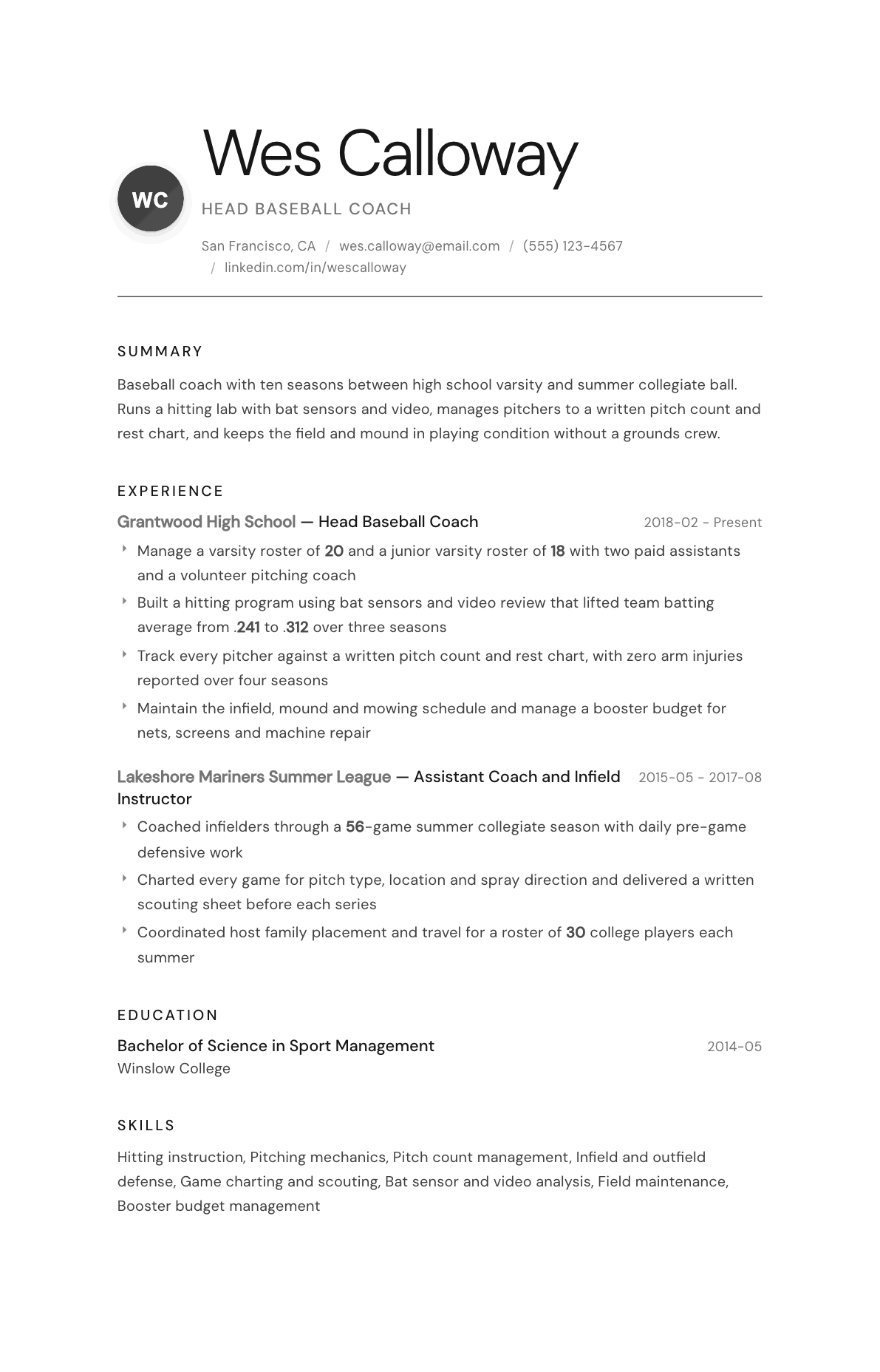
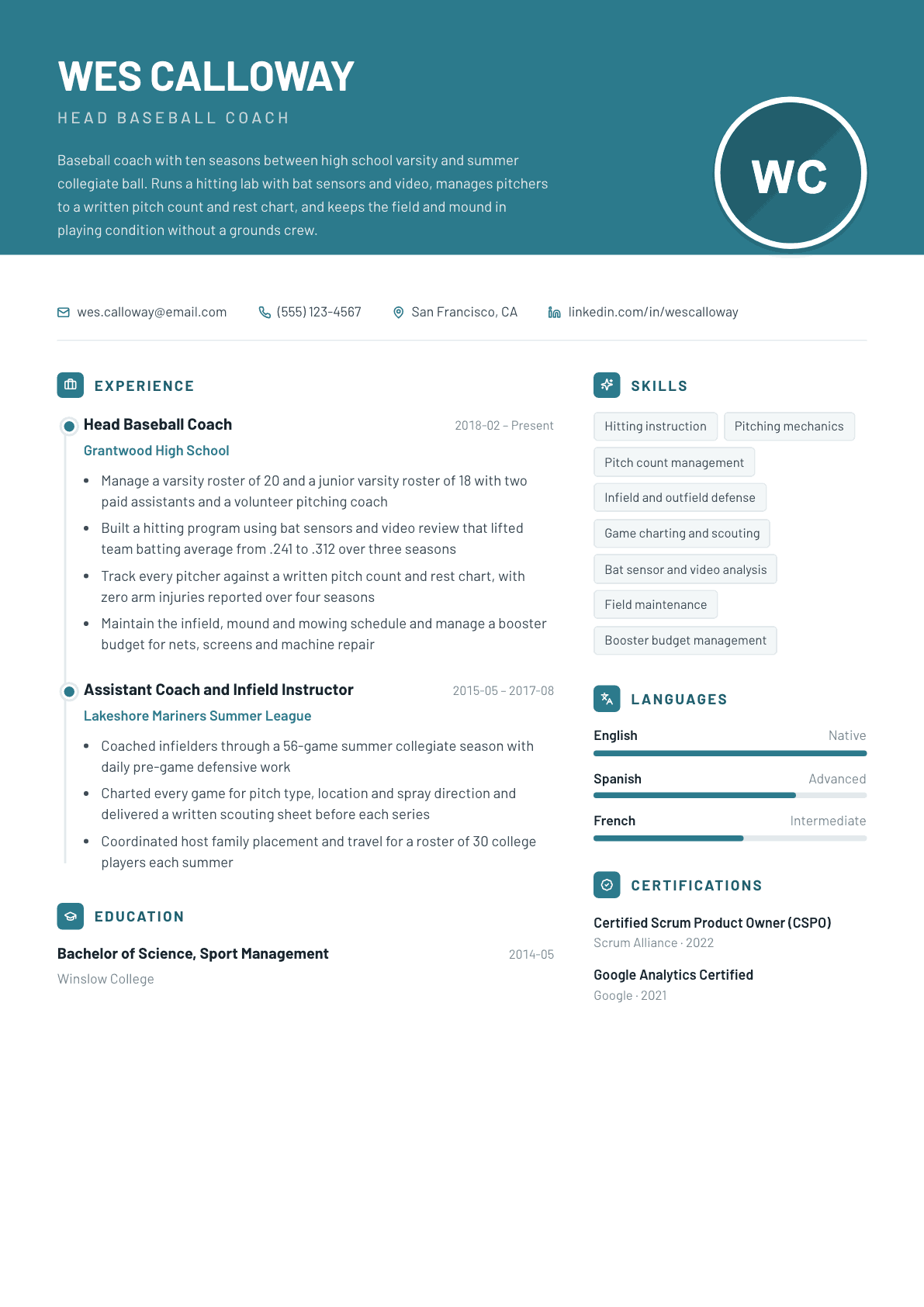
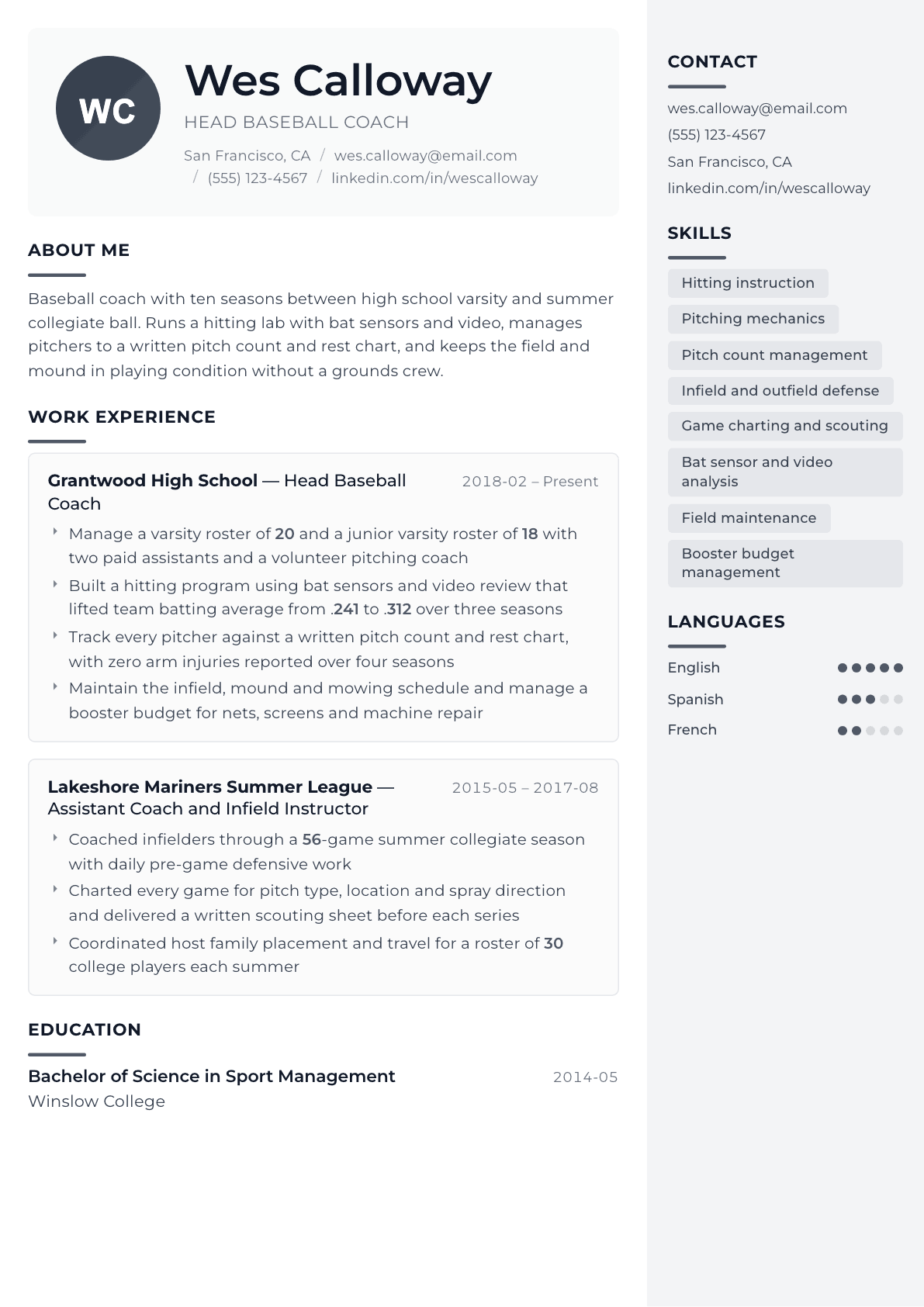
The same baseball coach content laid out in three CVBooster templates, so you can see what the finished document looks like before you write a word.
Example Baseball Coach summary
Baseball coach with ten seasons across high school varsity and summer collegiate rosters, including six as a head coach. Runs a hitting program built on bat sensors and video, manages arms against a written pitch count and rest chart, and charts every game for pitch type and spray direction. Maintains the field and the equipment budget, and is seeking a program that wants year round player development.
Skills to list on a Baseball Coach resume
- Hitting mechanics instruction
- Pitching development
- Pitch count and rest tracking
- Infield defense
- Outfield defense
- Catching instruction
- Baserunning and steal reads
- Game charting
- Radar and bat sensor analysis
- Lineup and rotation planning
- Field and mound maintenance
- Equipment inventory
- Booster and fundraising support
- College placement support
What actually gets this resume read
- Separate what you coach from what you manage: hitting, pitching, infield, and then the field, budget and schedule work.
- Give the record, conference finish and postseason result for each season instead of a single career summary line.
- Name the pitch count and rest rules you follow, since arm safety is the first question a parent or director asks.
- Show your measurement tools: bat sensors, radar, video, charting apps, and what changed in the numbers because of them.
- List field maintenance and equipment work openly, because small programs need a coach who can drag and line a field.
- Include summer league, showcase and college contact work, since placement is the outcome families judge you on.
How to write a baseball coach resume
Baseball is the sport where a hiring committee can check your work. Every at bat, inning and pitch is recorded somewhere, so a coach who writes only that he improved the team invites a reader to look up numbers that do not support the claim. Bring the numbers yourself and the resume becomes hard to argue with.
The second thing a director weighs is arm safety. Pitch counts, rest days and how you handle a kid who wants to throw on two days of rest are the questions that follow a baseball coach through every interview and every parent meeting. A resume that shows a written pitching policy answers the hardest question before it is asked.
Below is the structure a baseball program expects, summaries written for an assistant, a varsity head coach and a program director, five bullets rewritten from the versions coaches actually send, and answers to the practical questions that come up when applications open in the fall.
Format: coaching record, then instruction, then facility work
Use reverse chronological order and split the page into three visible parts: the coaching record, the instruction you deliver, and the facility and program work you handle. Baseball coaches are hired to do all three, and separating them stops the field maintenance from swallowing the player development.
List seasons rather than month ranges, because a baseball year runs from winter workouts through a summer league. Two pages is normal for a head coach with a summer collegiate or travel history alongside a school program.
- Header: name, city and state, phone, email, current coaching and first aid certification.
- Coaching record: season, team, level, record, conference finish, postseason round.
- Instruction block: hitting, pitching, catching, infield, outfield, baserunning, and the tools you teach with.
- Program block: field maintenance, budget, fundraising, equipment inventory, summer schedule.
Summary: level, seasons, specialty, safety policy
Four lines. The level you have coached, how many seasons, the area you are known for teaching, and the fact that you run written arm care rules. Naming a specialty is important because most staffs hire to fill a specific gap: a hitting guy, a pitching guy, an infield guy.
If you are moving from travel ball or summer collegiate into a school job, say it plainly and describe the transferable half: daily practice structure, player evaluation, parent communication and the recruiting relationships you already have.
Experience: what the team did and what the hitters did
Start each entry with roster sizes across levels and the staff you led or reported to, then the season result. After that come the team statistics you moved, because baseball supports them better than almost any school sport: team batting average, on base percentage, earned run average, fielding percentage, stolen base success, walks issued per seven innings.
Attach every statistic to the work that caused it. A batting average that climbed after you installed a daily tee and high tee routine with bat sensor feedback is a coaching story. The same number with no explanation is a coincidence, and a committee reads it as one.
Include the recruiting and placement work: showcase attendance, video sent to college staffs, players signed and at what level. In many communities that record is the single measure families use to judge a program.
Pitching management and player safety
Describe your pitch count and rest chart in concrete terms: the limit by age, the required rest days after a given count, how you track it in a game, and who has authority to pull an arm. Add the throwing program you use in the offseason and the arm care routine you run before practice.
Then cover the rest of the safety picture: catcher gear checks, screen and L-screen use in batting practice, heat protocols, and how you coordinate return to play with an athletic trainer. Programs have lost coaches over arm injuries, so a written policy on the resume carries real weight.
- Pitch count limits and rest days, and where the count is recorded during a game.
- Offseason throwing program and daily arm care sequence.
- Batting practice safety setup: screens, cage rules, machine maintenance.
- Injury communication chain with the athletic trainer and the family.
Charting, technology and instruction tools
Say what you measure and with what. Bat sensors, radar readings, video at high frame rate, spray charts, pitch type and location charts, and the app or sheet you keep them in. A committee wants to know whether player feedback in your program is opinion or evidence.
Then say how the data reaches the player. A hitter who receives an exit direction chart after every game is in a different program from a hitter who hears that he needs to stay back. Describe the loop: measure, show, drill, remeasure.
Keywords baseball postings repeat
School and club listings use a predictable vocabulary: player development, practice planning, hitting instruction, pitching development, field maintenance, equipment management, fundraising and student athlete supervision. Place the exact phrases once near the top and once in the body.
Keep the writing plain and short. Baseball resumes are often read in a dugout office between periods, and a line with a number in it survives that reading better than a paragraph about the love of the game.
Baseball Coach resume summary examples
First assistant job
Recent college player and second-year junior varsity assistant seeking a varsity infield and hitting job. Runs daily infield work, charts every varsity game for pitch type and location, and holds first aid and concussion certification. Available to coach the summer legion team as well.
Varsity head coach
Head baseball coach with six seasons leading a varsity and junior varsity program of 38 players. Built a hitting program on bat sensors and video that lifted team average from .241 to .312, manages arms against a written pitch count chart and maintains the field without a grounds crew.
Program director
Baseball program director with twelve seasons across high school and summer collegiate rosters, overseeing three teams, an indoor hitting facility and a staff of seven. Runs the arm care and pitch count policy, the college placement pipeline and an annual budget covering nets, machines and field materials.
Work experience bullets: before and after
Before: Improved the team hitting.
After: Raised team batting average from .241 to .312 over three seasons by installing a daily tee and high tee routine with bat sensor feedback and a weekly exit direction chart for each hitter.
The before and after average sits next to the routine and the feedback tool that produced it.
Before: Managed the pitching staff.
After: Tracked seven pitchers against a written count and rest chart every game, capped a starter at 95 pitches with four days rest, and finished four seasons with no reported arm injuries.
Specific limits and a safety outcome show a policy rather than an intention to be careful.
Before: Scouted opposing teams before games.
After: Charted every opponent for pitch type, location and spray direction and delivered a written scouting sheet with a defensive positioning card before each series.
The deliverable and its contents let a reader see what preparation looks like in your program.
Before: Took care of the field.
After: Maintained the infield skin, mound and mowing schedule through a spring season, rebuilt the mound twice and kept the field playable after rain with a tarp crew of eight players.
Concrete groundskeeping tasks matter to a small program with no facilities staff.
Before: Helped players play in college.
After: Placed eleven players in college programs across five seasons by editing video, writing evaluations for college staffs and attending two fall showcases with the roster each year.
Placement numbers plus the recruiting routine behind them read as a repeatable pipeline.
Hard skills
- Hitting mechanics instruction
- Pitching mechanics and bullpen design
- Pitch count and rest tracking
- Infield and outfield defensive systems
- Catching and blocking instruction
- Baserunning and steal reads
- Game charting and scouting sheets
- Bat sensor and radar interpretation
- Lineup and rotation planning
- Field, mound and tarp maintenance
- Equipment inventory and machine repair
- College placement and video editing
Soft skills
- Player accountability
- Calm in-game decision making
- Parent communication about playing time
- Assistant coach development
- Patience with slumping hitters
- Fundraising and community outreach
Certifications worth listing
- Fundamentals of Coaching (National Federation of State High School Associations)
- Concussion in Sports (National Federation of State High School Associations)
- SafeSport Trained (U.S. Center for SafeSport)
- Adult First Aid, CPR and AED (American Red Cross)
Mistakes that cost baseball coach candidates the interview
- Writing about the love of the game instead of the statistics a baseball program can verify.
- Leaving out any pitching policy, which reads as carelessness in the sport where arm injuries end careers.
- Listing statistics with no explanation of the drill, routine or change that produced them.
- Treating field maintenance as beneath mention when small programs need a coach who can drag and line a field.
- Confusing travel ball attendance with player development and giving it half the page.
- Forgetting the summer schedule, which is where most high school players actually improve.
- Sending one resume to a head coach opening and a hitting coach opening without changing the specialty line.
Baseball Coach resume questions
What statistics should a baseball coach put on a resume?
Team batting average, on base percentage, earned run average and fielding percentage, each shown before and after your tenure. Individual player statistics belong only when they illustrate development you can describe in a drill or routine.
How do I describe pitch count management on a coaching resume?
Give the limit, the rest days it triggers and where the count is recorded during a game. Add the offseason throwing program you run. Directors and parents both want to see that arm care is a written rule and not a judgment call in the seventh inning.
Does travel and summer baseball coaching count as real experience?
Yes, and it often carries more games than a school season. Show the game count, the roster size, the level of competition and the recruiting exposure you handled, because that combination is precisely what a school program cannot deliver alone.
Should I include field maintenance and fundraising duties?
Absolutely, in their own short block. Most school baseball programs have no grounds crew and a thin budget, so a coach who can rebuild a mound, service a pitching machine and run a fundraiser is solving three problems at once.
How long should a baseball coaching resume be?
One page for an assistant with a couple of seasons, two pages for a head coach carrying a record block, an instruction block and program duties. Cut the playing career first when the page runs long, since it is the least predictive part.
Related resume examples
- Sports Coach Resume example
- Athletic Trainer Resume example
- Assistant Coach Resume example
- Head Coach Resume example
- Basketball Coach Resume example
- Football Coach Resume example