Referee Resume Examples: free score, then the gap list
Write a Referee Resume That Earns Bigger Assignments
By Mustafa Tarabya, founder of CVBooster · Published · Updated
Referee resume examples with certification levels, game volume, assignor references and the keywords league coordinators scan for first.
Sample resumes for a referee
The same referee content laid out in three CVBooster templates, so you can see what the finished document looks like before you write a word.
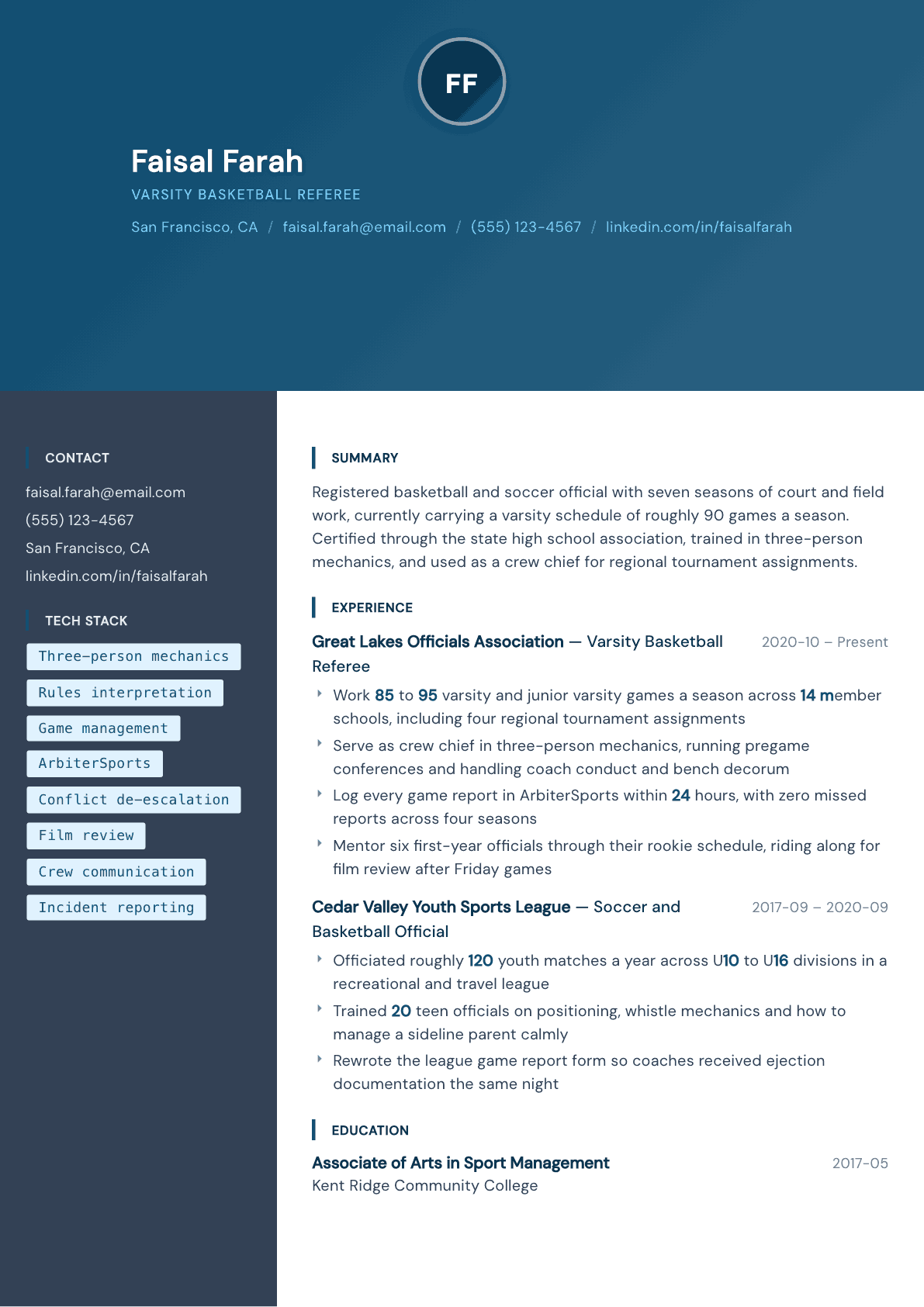
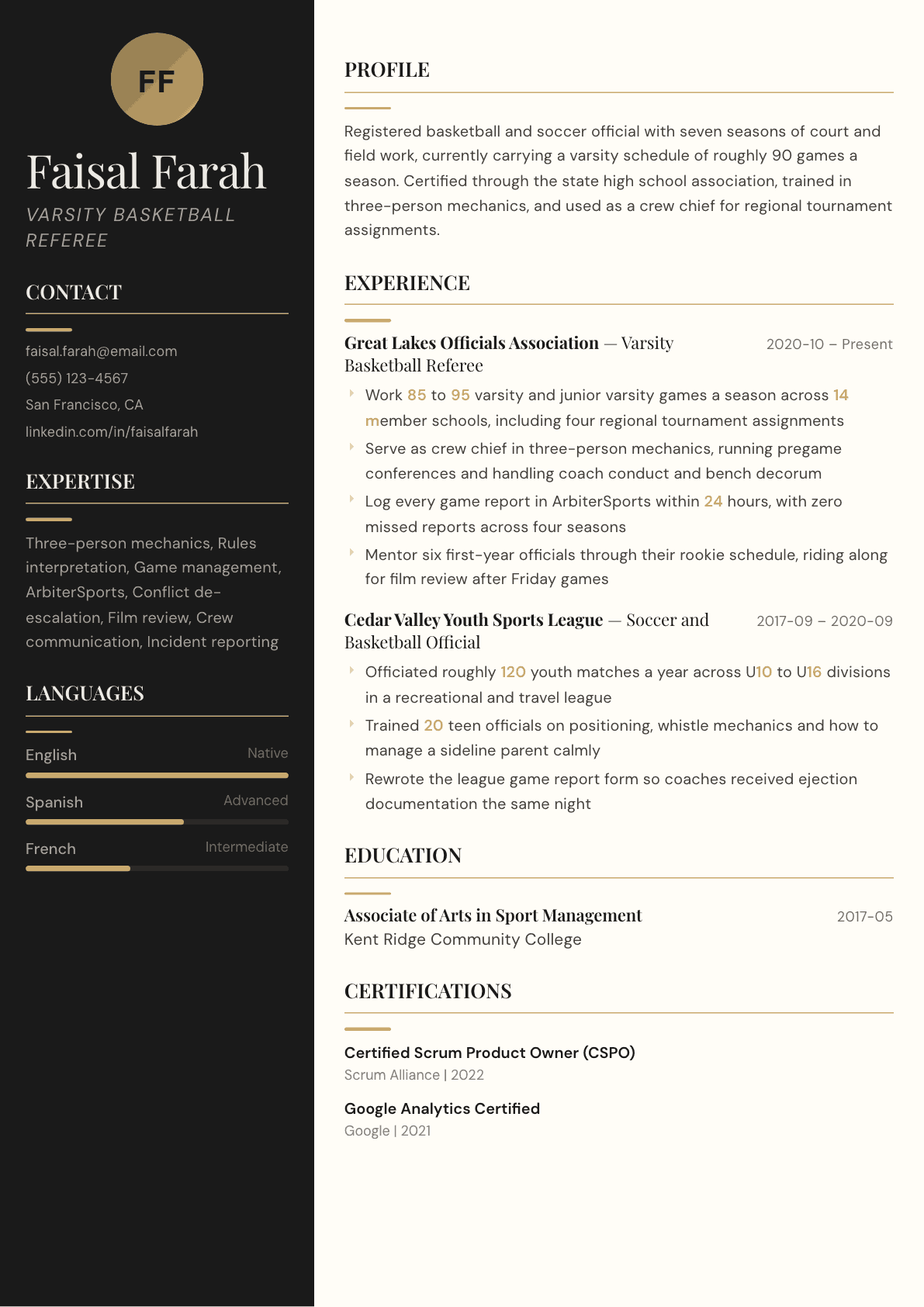
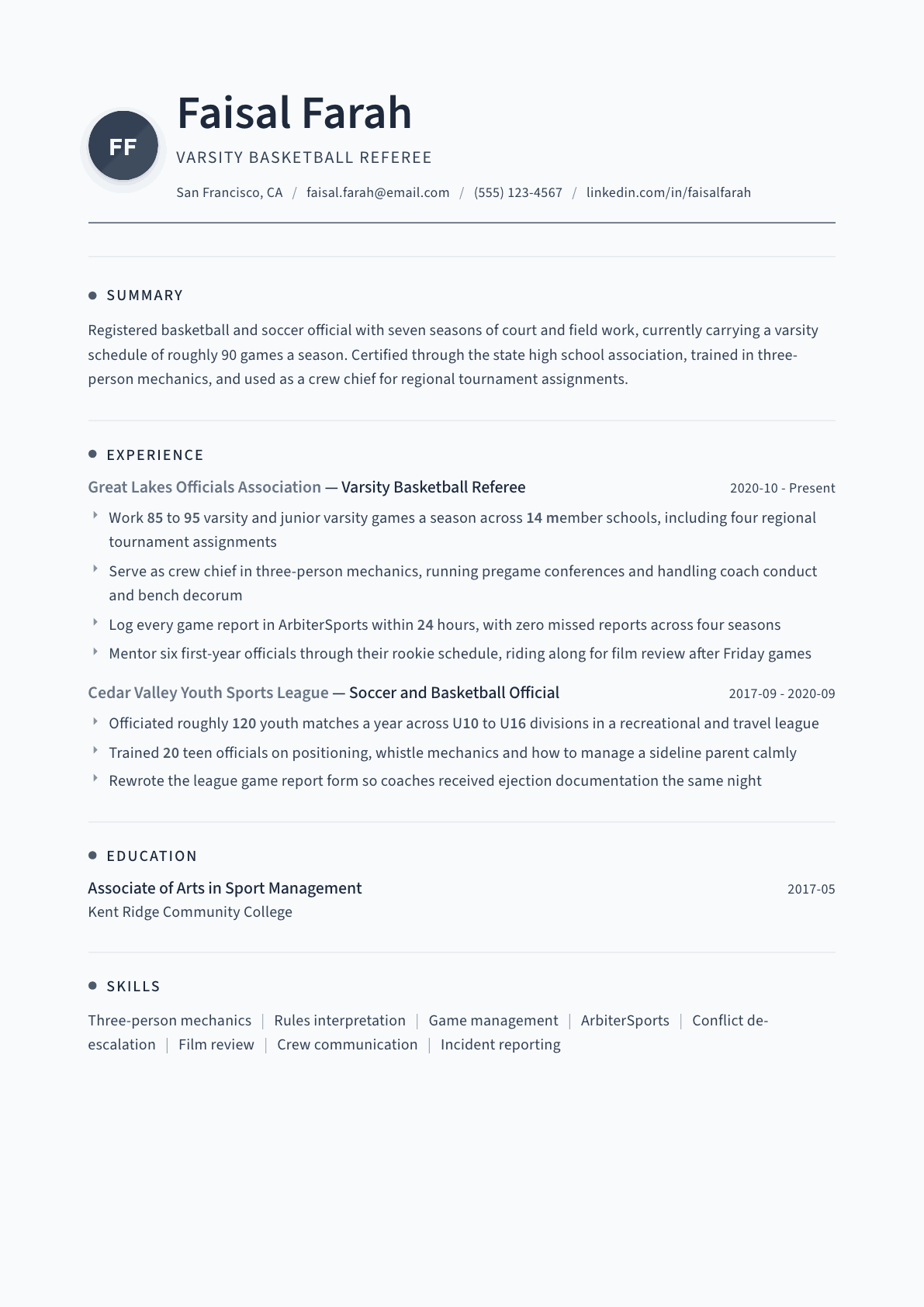
Example Referee summary
Registered high school referee with seven seasons of basketball and soccer, working 90 varsity and junior varsity games a year and serving as crew chief for regional tournaments. Certified through the state association, trained in three-person mechanics, and trusted to mentor first-year officials through their rookie schedules. Looking for a college conference assignment list.
Skills to list on a Referee resume
- Rules interpretation
- Three-person mechanics
- Two-person mechanics
- Game management
- Crew chief leadership
- Pregame conference
- Conflict de-escalation
- Incident and ejection reporting
- ArbiterSports
- Film and video review
- Clock and scorer table management
- Player safety enforcement
- Tournament officiating
- New official mentoring
What actually gets this resume read
- Name every sport, level and mechanic you work, because assignors filter by level before they read a single bullet.
- Give a game count per season instead of a date range, since volume is what proves you can hold a varsity schedule.
- List your registration or certification number and the sanctioning body, along with the season it stays current through.
- Show crew chief or referee-position work separately from wing and line assignments, because those are different jobs.
- Mention the assignment platform you use, whether ArbiterSports, RefTown or a conference portal, so schedulers know you are reachable.
- Put tournament, playoff and state finals assignments in their own short block, since those are earned rather than scheduled.
- Include the clinics and rules meetings you attended each year, because most associations require them to stay eligible.
How to write a referee resume
Nobody hires a referee the way they hire an accountant. The person reading your resume is usually an assignor, a conference coordinator or an association board member, and what they need to know is narrow: what level you are certified to work, how many games you carried last season, whether you show up, and whether anyone has had to clean up after you. Everything else on the page is decoration.
That is why a referee resume fails when it is written like an office resume. Long paragraphs about teamwork and integrity tell an assignor nothing. A single line that reads "state registered, varsity basketball, three-person mechanics, 92 games last season, four regional tournament assignments" answers four of his questions at once and gets your name onto a schedule.
This guide covers the sections an assignor actually reads, in the order they read them, with example summaries for a first-year official, a working varsity official and a crew chief, before and after bullets, and the questions officials ask when they try to move up a level.
Format: registration block first, one page until you work college
Put a registration and certification block directly under your contact details, before any job history. It should carry the sanctioning body, your registration number, the sports and levels you are approved for, and the season it runs through. An assignor who cannot verify you in ten seconds moves to the next file.
Keep it to one page while you are working high school and below. Officials who work college or multiple sanctioning bodies earn a second page, and that page is where tournament history and clinic attendance live.
- Registration block: sanctioning body, registration number, sports, approved level, current through season.
- Assignment platform handle so a coordinator can find you: ArbiterSports, RefTown or the conference portal.
- Availability line naming your travel radius and the nights you can take a game.
- Background check and concussion training status, since most state associations gate assignments on both.
Summary: sport, level, games per season, crew position
Three lines. Name the sports you work, the highest level you are approved for, the number of games you carried last season, and the crew position you take. Referee, umpire, wing, line judge and crew chief are different jobs and an assignor is filling specific slots.
If you are trying to move up, say so plainly and name what you have already done at the higher level. An official who has worked a college scrimmage, a preseason jamboree or a summer league at that speed should say it, because that is the evidence a coordinator uses to justify a first assignment.
Experience: seasons, game counts and the assignments you were given
List by association or league rather than by employer, since that is how officiating work is organized. Under each one, give the seasons, the sports, the levels and the game count. Volume matters more than tenure: a person who works one hundred games a year for three seasons has seen far more than someone who works ten games a year for a decade.
Then write bullets about the parts of the job that separate officials. Crew chief duty, pregame conferences, handling coach conduct, ejections and the reports that follow them, clock and table management, protest situations, weather and lightning suspensions. These are the moments an assignor is quietly asking about when he reads your page.
Tournament and postseason work belongs in its own short block. Those assignments are earned through evaluation, not signed up for, so bury them inside a paragraph and you waste the strongest signal you have.
Training, evaluation and mentoring
Associations require rules meetings and clinics to stay eligible, so list them by year with the sanctioning body. Add any camp you attended, any evaluator who observed you, and any score or rating you were given if the association publishes one.
Mentoring is the fastest path from working games to running a chapter. If you have taken rookies through their first season, run film review after Friday nights, or taught the mechanics session at a preseason clinic, put it on the page with numbers attached.
- Annual rules meetings and clinics, listed with the association that delivered them.
- Camps attended and the level worked at each one, including scrimmage and jamboree assignments.
- Observations and evaluations received, with the evaluator role rather than a raw score.
- Rookies mentored and the mechanics topics you taught at chapter meetings.
Keywords an assignor or coordinator scans for
The vocabulary is specific and it repeats: registered official, mechanics, crew chief, pregame conference, game management, rules interpretation, incident report, ejection report, tournament assignment, and the sport plus level combination. Use the exact wording your association uses, because a coordinator often searches a spreadsheet or a platform database rather than reading files one by one.
Add the platform name and your availability. Officials get dropped from lists for being unreachable far more often than for poor judgment on the floor.
Referee resume summary examples
First-year official
Newly registered basketball official who worked 38 middle school and freshman games in a first season, plus a summer league schedule of 20 games. Trained in two-person mechanics, completed the state rules clinic, and cleared the association background check and concussion module.
Fourth season, varsity approved
Varsity approved basketball and soccer official carrying 90 games a season across a 14-school conference, with two district tournament assignments in the last two seasons. Works three-person mechanics, files every game report within 24 hours, and attends both the fall and winter rules clinics.
Crew chief
Crew chief with eleven seasons and 900 varsity games worked, assigned to regional and state quarterfinal rounds in five of the last six seasons. Runs pregame conferences, handles coach conduct and ejection documentation, and mentors first-year officials through the association rookie program.
Work experience bullets: before and after
Before: Officiated high school basketball games.
After: Worked 92 varsity and junior varsity basketball games across a 14-school conference, including four regional tournament assignments earned on evaluation.
The count, the level and the tournament assignments turn an activity into a record an assignor can act on.
Before: Enforced the rules of the game fairly.
After: Called games in three-person mechanics as crew chief, running pregame conferences on coverage areas, shot clock protocol and bench decorum.
Naming the mechanics and the crew chief duties shows what you do before the whistle, which is where games are actually managed.
Before: Handled difficult coaches and players.
After: Managed 6 coach conduct situations and 2 ejections in a season, documenting each in the association report system the same night with video timestamps.
The specific count and the documentation habit prove composure and paperwork discipline instead of claiming both.
Before: Helped new referees learn the job.
After: Mentored 6 first-year officials through their rookie schedule, riding along to film review after Friday games and covering positioning and whistle timing.
The reader sees the structure of the mentoring, not just that mentoring happened.
Before: Used the online scheduling system.
After: Accepted and confirmed assignments in ArbiterSports within one day of posting across four seasons, with no turnbacks after the schedule was released.
Reliability is the trait assignors care about most, and turnbacks are how they measure it.
Hard skills
- Rules interpretation
- Three-person mechanics
- Two-person mechanics
- Pregame conference
- Crew chief duties
- Game and clock management
- Ejection and incident reporting
- ArbiterSports assignment platform
- Video and film review
- Tournament officiating
- Player safety enforcement
- Concussion protocol
Soft skills
- Composure under pressure
- Clear signaling and voice command
- Coach communication
- Crew coordination
- Consistency across a game
- Mentoring new officials
Certifications worth listing
- Concussion in Sports course (National Federation of State High School Associations)
- Heat Illness Prevention course (National Federation of State High School Associations)
- Heartsaver First Aid CPR AED (American Heart Association)
Mistakes that cost referee candidates the interview
- Leaving out the game count, which forces an assignor to guess whether you can carry a full varsity schedule.
- Listing years registered instead of levels approved, when level is the only field that decides your assignments.
- Writing about fairness and integrity in paragraphs rather than showing mechanics, crew position and tournament history.
- Hiding postseason assignments inside a job description instead of giving them their own block.
- Skipping the assignment platform and availability radius, which is how coordinators decide who to call first.
- Padding the page with unrelated work history while the registration and certification block sits at the bottom.
Referee resume questions
Does a referee even need a resume?
Yes, once you want assignments beyond the recreational level. College conference coordinators, tournament directors and association boards all ask for a one-page officiating history before they add you to a list or an evaluation cycle.
How do I show game volume without a formal employer?
List the association or league as the entity, give the seasons worked, then state games per season by sport and level. Assignors read association names as employers because that is how officiating assignments are actually distributed.
Should I list ejections and incident reports?
List the fact that you handle and file them, not the individual incidents. Showing that you document conduct situations the same night tells a coordinator you protect the association from disputes that arrive a week later.
How do I move from high school to college officiating?
Name every camp attended, every evaluator who watched you, and any scrimmage, jamboree or summer league work at the higher speed. College coordinators recruit from camps, so a resume that lists camp history reads as someone already in the pipeline.
What goes in an officiating resume if I work more than one sport?
Group by sport, with the level, the mechanics and the games per season under each. Multi-sport officials are valuable because they fill schedules year round, so make the second sport a heading rather than a footnote.
Related resume examples
- Sports Coach Resume example
- Athletic Trainer Resume example
- Basketball Coach Resume example
- Sports Analyst Resume example
- Swim Coach Resume example
- Esports Player Resume example