Esports Player Resume Examples: the lines they read
Build an Esports Player Resume Orgs Will Actually Read
By Mustafa Tarabya, founder of CVBooster · Published · Updated
Esports player resume examples with roster, tournament and scrim keywords, plus a guide to placements, VOD review and streaming obligations.
Sample resumes for a esports player
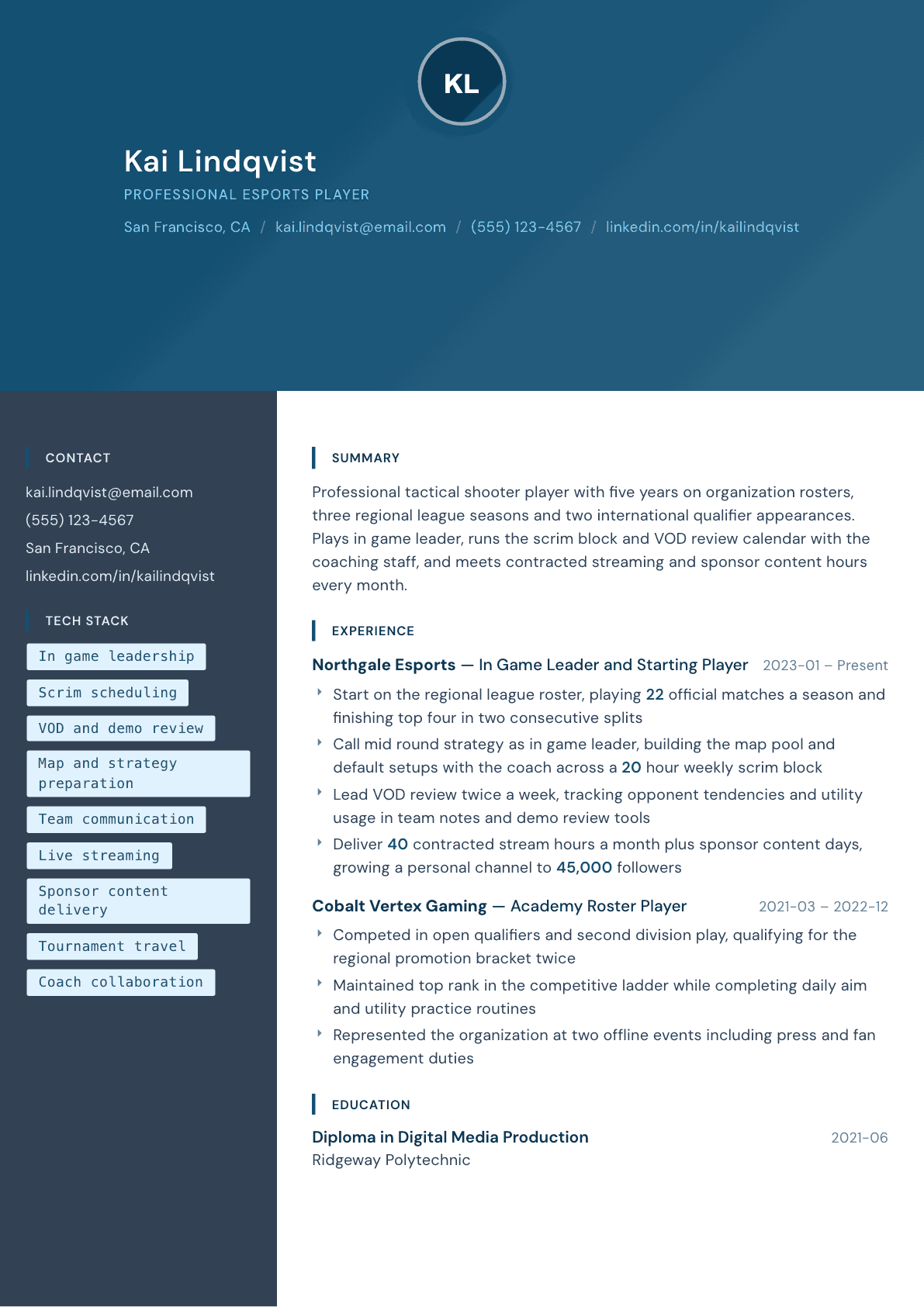
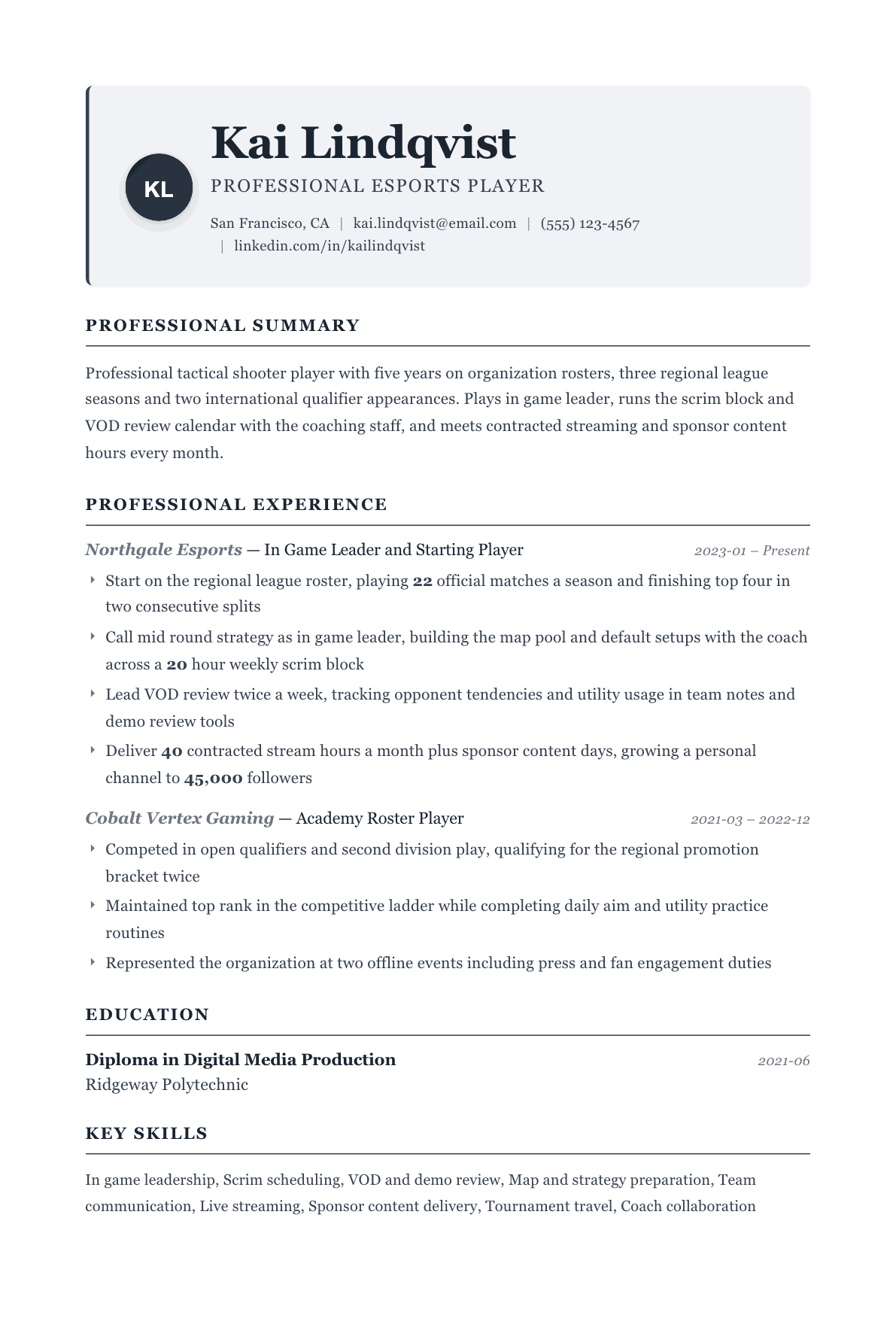
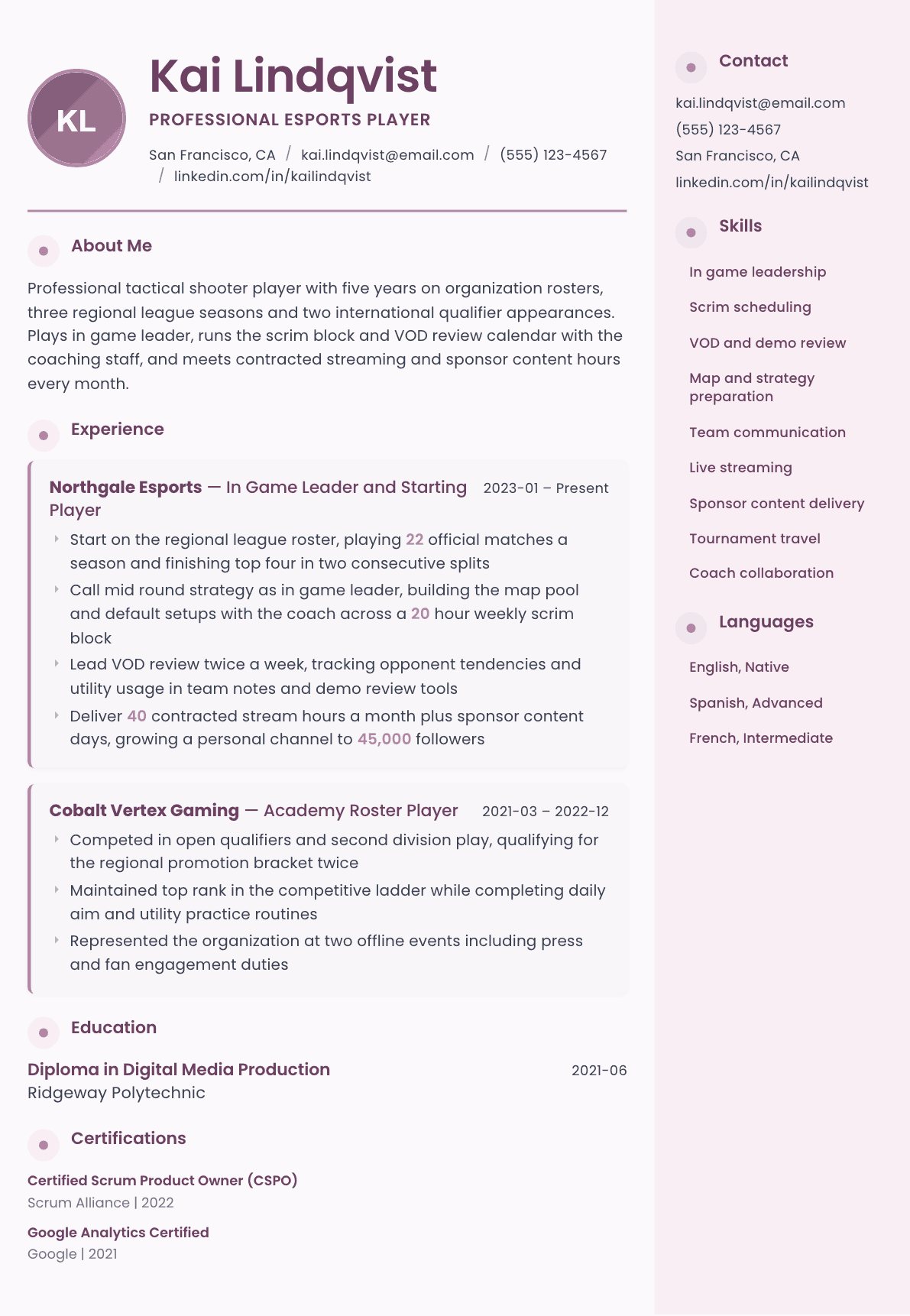
The same esports player content laid out in three CVBooster templates, so you can see what the finished document looks like before you write a word.
Example Esports Player summary
Professional esports player with five years on organization rosters, three regional league seasons and two international qualifier runs. Plays in game leader, builds the map pool with the coaching staff, runs a twenty hour weekly scrim block and twice weekly VOD review, and meets contracted stream hours and sponsor content days every month.
Skills to list on a Esports Player resume
- In game leadership and mid round calling
- Map pool and strategy preparation
- VOD and demo review
- Scrim block scheduling
- Team communication and callouts
- Aim and mechanics practice routines
- Opponent scouting notes
- Live streaming on Twitch
- Sponsor content and appearance duties
- Offline event and travel readiness
- Coach and analyst collaboration
- Roster and contract familiarity
What actually gets this resume read
- Put the game title, role and current rank near the top, because a manager filters rosters before reading anything else.
- List placements by event name and finish rather than vague claims, and keep the date of each result visible.
- Show the work behind results: scrim hours, VOD review cadence, individual practice routine and coach collaboration.
- Include streaming and sponsor obligations, since organizations pay for content hours as much as for match play.
- Name your handle and link the match history or team page, because verification is instant in this field and expected.
- Add offline event experience, media duties and travel, which separate a league starter from a ladder grinder.
How to write a esports player resume
A competitive gaming organization does not hire off a resume in the way an office does, but it does read one. The general manager weighing a roster spot has a scouting document, a coach with an opinion and a contract to justify to ownership. Your page is what turns a name in a spreadsheet into a candidate: the game, the role, the current rank, the placements, and whether you show up for the parts of the job that are not the match.
That last part decides most roster decisions between players of similar mechanical level. Scrim attendance, VOD review discipline, willingness to change a role, behavior in voice comms and reliability on contracted stream hours are what a coach asks about when he calls your former teammates. A resume that shows only results is answering the easy half of the question.
This guide covers what an organization reads, how to write placements so they can be verified in seconds, how to present the streaming and sponsor obligations that pay part of your salary, and where a competitive career transfers when the roster spot ends. It includes sample summaries at three stages, rewritten bullets and the questions players ask most.
Format: game, role and rank in the first two lines
One page. The reader is a manager or coach on a phone between scrim blocks, and the header has to answer the sorting question immediately: which game, which in game role, which region and which rank or rating right now.
Put your handle next to your legal name and link the profiles that verify everything else: a match history page, a team page on a results wiki, your ladder profile and your stream. Verification is instant in this field and expected, so a page without links reads as a page with something to hide.
- Header: name, handle, region, game title, in game role, current rank or rating, and verification links.
- Section order: summary, roster history, competitive results, content and sponsor obligations, skills, education.
- Keep the roster history separate from the results block, because an organization reads tenure and placement differently.
- If you are open to a coach, analyst or content role as well as a starting spot, say which and where.
Summary: role, tenure, level of competition, what you bring beyond aim
Four things in three lines. The role you play, how long you have been on paid rosters, the highest level you have competed at, and the responsibility you carry inside a team. In game leader, secondary caller, anchor, entry, support or flex are not interchangeable, and a roster is built around a specific hole.
Then the differentiator. Strategy preparation, opponent scouting, the ability to play three characters or agents at a starter level, or a reputation for keeping a team calm after a lost half. Those are the traits a coach cannot see in a highlight clip and is trying to find in a conversation.
Results: written so a manager can verify them in seconds
Each entry gets four elements: the event name as the organizer wrote it, the year, your team, and the finish. Top four in a regional split, qualified for an international closed qualifier, second in an online cup. Nothing else. A result without an event name is not a result, and a manager who cannot find it in one search will assume the worst.
Order by significance rather than strictly by date, and stop at six or eight entries. A long list of open cup placements from three years ago dilutes the two league finishes that would actually get you a trial.
Ranked ladder achievement belongs here too but separately and honestly. Peak rating, current rating, and the season it was reached. A player who lists a peak from four seasons ago without the current number is telling the manager exactly which one is worse.
- Give the organizer event name, the year, the team and the finish, in that order.
- Separate offline events from online ones, since organizations weigh them differently.
- State peak and current ladder rating with the season attached to each.
- Note role changes across teams, because versatility and instability look similar without the explanation.
The work behind the results: scrims, review and preparation
This is the section that separates a league starter from a ladder player, and almost nobody writes it. Give the scrim block: how many hours a week, over how many days, and who scheduled it. Give the review cadence: how often you watch demos or VODs, whether you lead the session, and what you track in team notes. Give the preparation: map pool or draft prep with the coach, opponent tendency notes, utility and setup work.
Add individual practice honestly. Aim and mechanics routines, custom games, review of your own deaths or misplays, and any work you do with an analyst. A coach reads this and learns whether you improve on purpose or by volume.
Then the professional behavior. Punctuality to scrims, comms discipline, response to a bench decision, willingness to switch roles when the roster needed it. These are the reference check questions, so answering them in advance on the page is not modesty, it is strategy.
Content, sponsors, and where the career goes next
Organizations pay for two things: match results and audience. Contracted stream hours, sponsor content days, appearance obligations at offline events, media availability and the channel you have built are all part of the deal, and a player who has consistently met them is easier to sign than one with a slightly better rating and a reputation for missing content commitments.
Give the numbers you own: stream hours delivered a month, channel followers, average concurrent viewers if it is a real figure, and the sponsor deliverables you have completed. Then keep a short block for the transition. Coaching, analysis, content creation, community management, event production and organization operations all hire former players, and listing the skills you already use in those areas costs one line and opens a second door.
Esports Player resume summary examples
Academy or amateur
Academy roster player and flex support in a tactical shooter, competing in open qualifiers and second division play for two seasons. Top rank on the competitive ladder each split, daily aim and utility routine, and two offline event appearances representing the organization at press and fan duties.
League starter
Professional esports player with five years on organization rosters, three regional league seasons and two international qualifier runs. Plays in game leader, builds the map pool with the coaching staff, runs a twenty hour weekly scrim block and twice weekly review, and meets contracted stream hours every month.
Veteran and captain
Veteran in game leader and team captain with eight years across four organizations, including two international championship appearances and a domestic title. Onboards new roster additions, leads strategy preparation with the analyst, and carries the largest personal audience on the current roster.
Work experience bullets: before and after
Before: Played for a professional esports team.
After: Started on the regional league roster for four consecutive splits, playing twenty two official matches a season and finishing top four in two of them.
Tenure, match volume and finishes tell a manager you held a starting spot rather than sat on a contract.
Before: Was the shot caller for my team.
After: Called mid round strategy as in game leader and built the map pool and default setups with the coach across a twenty hour weekly scrim block.
Naming the calling layer and the preparation work shows the role is a job with hours, not a title.
Before: Watched a lot of demos to improve.
After: Led VOD review twice a week, tracking opponent tendencies and utility usage in shared team notes that fed the following week of scrim scenarios.
A cadence, an output and a downstream use turn passive review into a preparation process you own.
Before: Streamed regularly and worked with sponsors.
After: Delivered forty contracted stream hours a month plus sponsor content days, and grew a personal channel to 45K followers while on the active roster.
Contracted hours met and an owned audience are the commercial half of a player contract, stated in numbers.
Before: Good communicator in game.
After: Kept comms structured through losing halves by limiting mid round chatter to callouts and running the tactical reset in the timeout rather than after it.
A specific communication practice under pressure is what a coach means by good comms, and it cannot be faked.
Hard skills
- In game leadership and mid round calling
- Map pool and draft preparation
- VOD and demo review
- Opponent scouting and tendency notes
- Scrim block scheduling and etiquette
- Aim and mechanics practice routines
- Role flexibility across characters or agents
- Live streaming on Twitch
- Sponsor content and appearance delivery
- Offline event and travel readiness
- Coach and analyst collaboration
- Contract and roster rule familiarity
Soft skills
- Comms discipline under pressure
- Accepting a bench or role change
- Tilt control after a lost half
- Onboarding new roster additions
- Punctuality across a long season
- Handling public criticism online
Mistakes that cost esports player candidates the interview
- Listing placements without the organizer event name, so a manager cannot verify a single result in one search.
- Showing a peak rating from several seasons ago while hiding the current one, which the reader assumes is worse.
- Writing only about results and never about scrim hours, review cadence or preparation with a coach.
- Omitting stream and sponsor obligations, when audience is half of what an organization is paying for.
- Padding the page with open cup finishes from years ago that dilute the two league placements that matter.
- Leaving out the handle and verification links, which is the fastest way to look like an inflated claim.
Esports Player resume questions
Does an esports player really need a resume?
Yes, once you are talking to organizations rather than picking up teammates from a ladder. A manager has to justify a roster spot internally, and a one page document with verifiable results, role and obligations is what he forwards to ownership.
How should I list tournament placements?
Event name as the organizer wrote it, year, team and finish, ordered by significance and capped at six to eight entries. Separate offline results from online ones, since organizations weigh a stage appearance far more heavily.
Should I include my rank on the resume?
Yes, both current and peak, each with the season it was reached. Rank is the fastest mechanical signal a coach has. Listing only a peak from an old season invites the assumption that your current form is much lower.
What if my competitive career is ending?
Add a short block naming the adjacent path you want: coaching, analysis, content, community management, event production or team operations. Then list the skills you already use there, such as review sessions led, strategy documents written or sponsor deliverables managed.
How much does streaming matter to an organization?
A great deal, because sponsorship revenue depends on it. Contracted stream hours delivered, an owned audience and a clean record on content days can decide between two players with similar in game ability, so state the numbers you actually control.
Related resume examples
- Professional Athlete Resume example
- Game Designer Resume example
- Social Media Manager Resume example
- Sports Coach Resume example
- Video Editor Resume example
- Head Coach Resume example