Help Desk Analyst Resume Examples: the lines they read
Write an IT Helpdesk Resume That Lands Your First Support Role
By Mustafa Tarabya, founder of CVBooster · Published · Updated
An IT helpdesk and service desk resume sample for Tier 1 and first IT jobs, with helpdesk skills, ticket volume, ITIL terms, tools and certifications.
Sample resumes for a help desk analyst
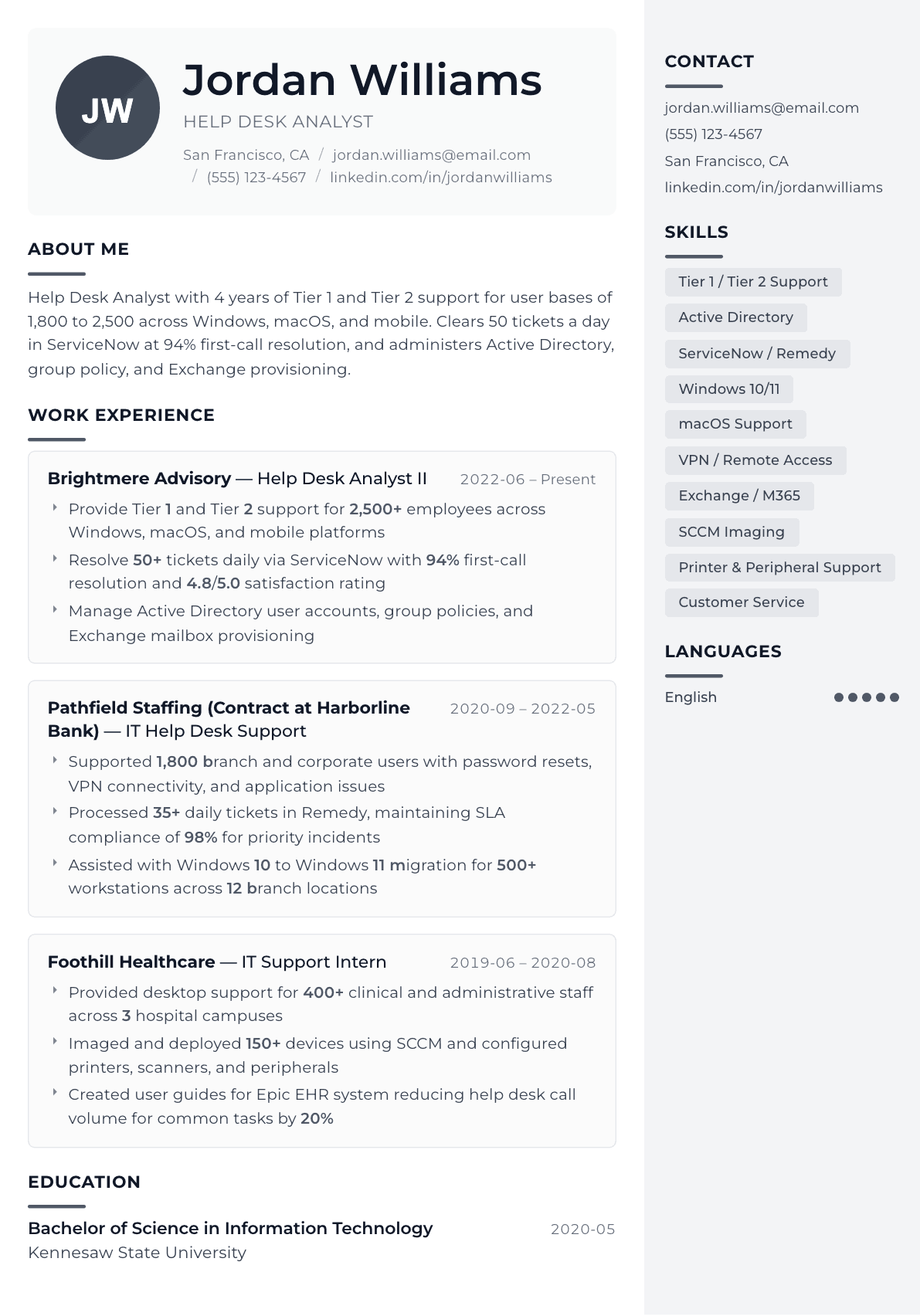
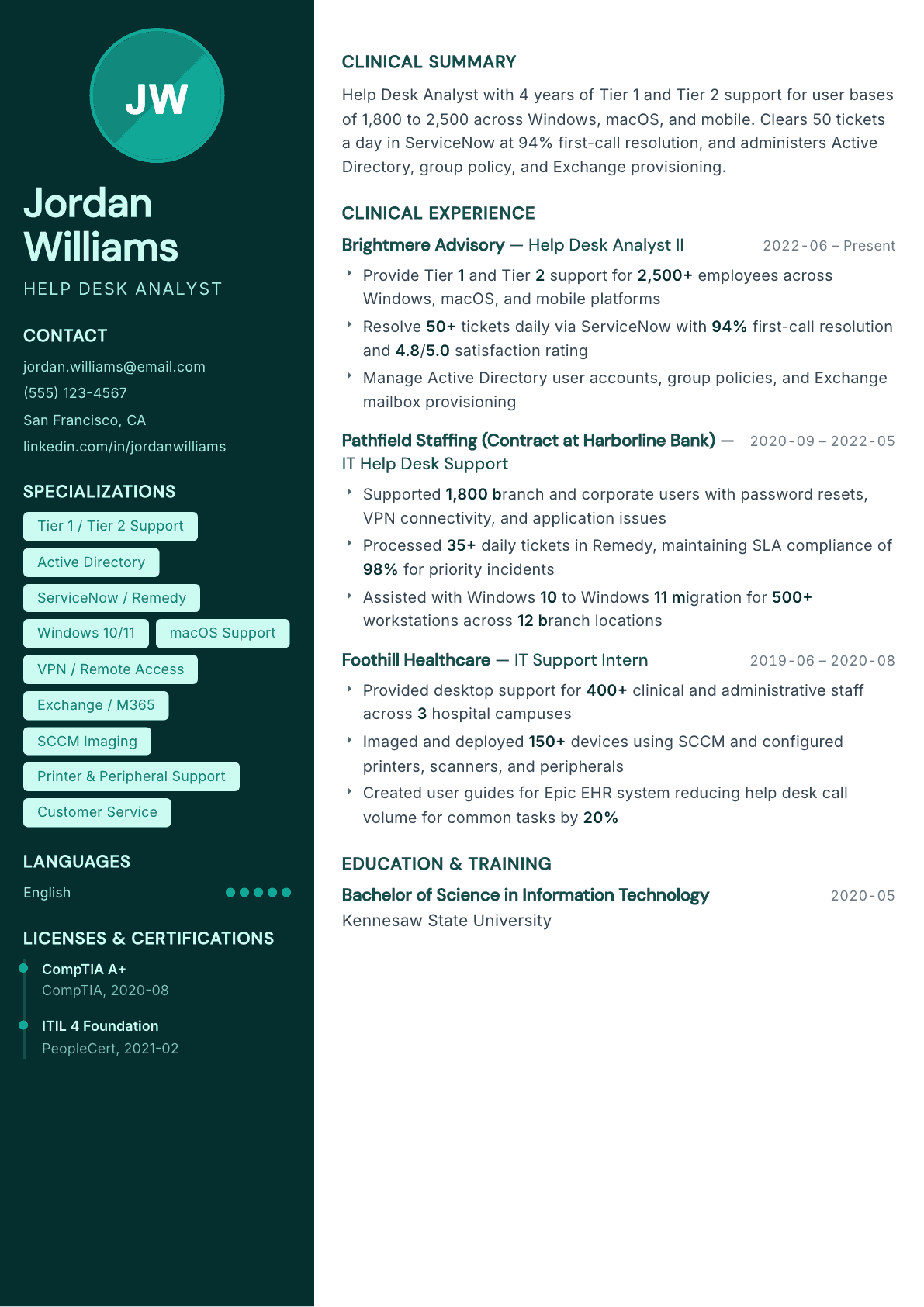
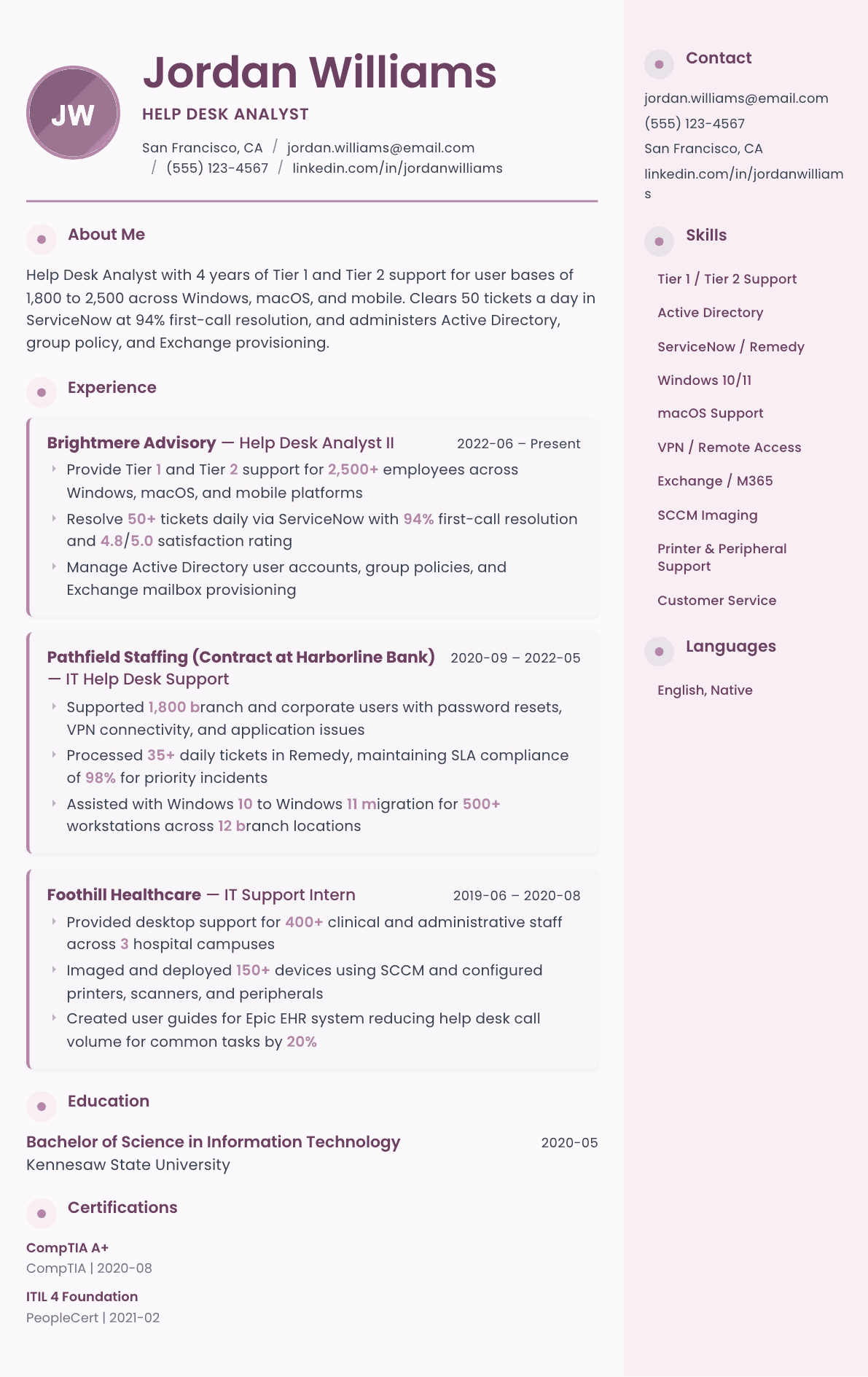
The same help desk analyst content laid out in three CVBooster templates, so you can see what the finished document looks like before you write a word.
Example Help Desk Analyst summary
Help Desk Analyst with 4 years of experience supporting 2,000+ users with Tier 1/2 troubleshooting. Maintains 94% first-call resolution and 4.8/5.0 satisfaction rating while managing 50+ daily tickets in ServiceNow.
Skills to list on a Help Desk Analyst resume
- Tier 1 & Tier 2 Support
- Active Directory / Group Policy
- ServiceNow / Jira / Remedy
- Windows 10/11 / macOS
- VPN & Remote Access
- Microsoft 365 / Exchange
- SCCM / Intune
- Printer & Peripheral Setup
- Password Reset / MFA
- Customer Service
- Ticket Triage
- ITIL Framework
What actually gets this resume read
- List the number of end users you support to quantify the scope of your role.
- Include ticket volume and resolution metrics such as daily tickets, FCR rate, and CSAT scores.
- Mention ITSM tools by name: ServiceNow, Jira, Remedy, Freshdesk, or Zendesk.
- Highlight any migration or deployment projects that show initiative beyond ticket work.
- Keep certifications prominent. CompTIA A+, ITIL, and Microsoft certs are essential for career growth.
How to write a help desk analyst resume
A help desk analyst resume is the front door to an IT career, which is exactly why the pile is enormous and mostly interchangeable. The service desk lead reading it has a specific worry: can this person take a queue on Monday, close tickets without breaking anything, and talk to an angry director without making it worse. Your resume answers that with ticket volume, resolution rates, the tools you have actually logged into, and the account work you were trusted to perform.
The strongest differentiator on an entry level IT resume is not the degree. It is naming the ticketing system, the identity platform and the endpoint management tool by name, because those are the three things a new analyst either knows or spends six weeks learning at the employer's expense.
This guide covers the layout, the metrics a service desk manager checks, how to write experience when your only support work was retail or a campus lab, and the questions people ask when they are trying to turn a support job into a systems administration career. If the posting says service desk analyst or IT service desk technician, the same page works as an IT service desk resume: change the title line and mirror the ITIL language the posting uses, such as incident, request and service level.
IT helpdesk resume sample: a complete Tier 1 entry
This IT helpdesk resume sample is for a Tier 1 analyst with two years on an IT help desk, in the order a service desk lead reads it: summary, technical skills, certifications, experience. Swap in your own tools and numbers. If you could not explain a figure in the interview, leave it out.
Summary: IT help desk analyst with two years of Tier 1 support for 900 users across three offices. Closes 30 to 40 tickets a day in ServiceNow, manages Active Directory accounts and Microsoft 365 licenses, and writes the knowledge base articles the rest of the desk uses.
Technical skills: Windows 11, macOS, Active Directory, Microsoft 365 and Exchange Online, Intune, ServiceNow, VPN and MFA troubleshooting, printer and peripheral setup. Certifications: CompTIA A+, ITIL 4 Foundation.
Second sample, for someone one step earlier. An example of a help desk resume for someone with no IT job yet trades ticket counts for proof: the certification, a home lab, and the customer job where you handled a queue. An IT help desk lead reads that combination as someone who can be trained in weeks, not months.
Summary: CompTIA A+ certified IT support candidate with three years of retail customer service. Runs a home lab with a Windows Server domain, Active Directory, DNS and DHCP on three virtual machines. Seeking a Tier 1 helpdesk support role.
Its strongest lines. Home lab: built a Windows Server domain, joined two client machines, created users and groups, and applied group policy for password rules and drive mapping. Handled the store's weekend returns and complaints queue, logging every case in the store system. Certifications: CompTIA A+, Google IT Support Professional Certificate.
Service desk resume sample. Larger organizations and managed service providers call the same job a service desk analyst, and their postings use ITIL vocabulary: incidents and service requests, priority levels, SLAs, first contact resolution, major incident handover and knowledge management. Keep the first sample above, change the title line to Service Desk Analyst, and write the volume in those terms, for example: Logged and resolved 35 incidents and service requests a day in ServiceNow against P3 and P4 SLAs, and raised major incidents to the on call team with a complete timeline.
The experience entry for the first sample, Help Desk Analyst, Northgate Credit Union, reads as the bullets below.
- Resolve 30 to 40 phone, chat and email tickets a day for 900 users, inside the desk's four hour response target.
- Create, disable and update Active Directory accounts and Microsoft 365 licenses for every new starter and leaver.
- Reset passwords and MFA devices, fix VPN and Outlook faults, and escalate network and server issues to Tier 2 with complete notes.
- Imaged and deployed 120 laptops through Intune during a hardware refresh.
- Wrote 15 knowledge base articles for the most common printer, VPN and mailbox requests.
Format: one page, technical skills high on the page
One page, reverse chronological, no exceptions until you have five years in. Service desk hiring moves fast and often runs through a keyword screen, so put a technical skills block directly under the summary rather than at the bottom. That is where the recruiter looks for Active Directory, the ticketing platform and the operating systems before deciding whether to read the experience section at all.
Group the skills block so it can be scanned: operating systems, directory and identity, ticketing, endpoint management, networking basics, and hardware. A wall of forty comma separated tools reads as a checklist copied from a job posting, which is usually what it is.
On a helpdesk resume, the skills a desk lead looks for first are the ones that close tickets without escalation: password and MFA resets, account creation and removal, mailbox and license changes, VPN and Wi-Fi faults, printer queues, and laptop imaging. Put those in plain words next to the tools you did them in, then add the people skills that show in the bullets, such as calm phone manner, clear ticket notes and explaining a fix to someone who is not technical.
- Header: name, city and state, phone, email, and a link line if you keep a homelab or documentation portfolio.
- Order: summary, technical skills, certifications, experience, education. Certifications move above skills once you hold two or more.
- Every job needs the supported user population and the ticket volume, because those set your scale.
Service desk resume summary: tiers, user count and the queue you carried
Say which tiers you worked, how many end users you supported, the daily ticket count, and the resolution or satisfaction figure you were measured on. A service desk manager staffing a queue is doing arithmetic while she reads, and a summary that gives her the numbers saves her the trouble.
If you are new to IT, replace the tier language with what you can prove: the certification you hold, the platforms you have administered in a lab, and the customer facing job where you handled volume. Do not claim tiers you have never worked, because the interview will find it in ten minutes.
IT service desk resume summary, written out: Service desk analyst with three years on a Tier 1 and Tier 2 queue supporting about 1,200 users across two offices. Works incidents and requests in ServiceNow against agreed response times, resets accounts in Active Directory and Entra ID, and hands tickets to the desktop and network teams with notes they do not have to reopen. ITIL 4 Foundation and CompTIA A+.
Experience: tickets, accounts, and the projects you were pulled into
Lead each job with scale: how many users, across how many sites, on which platforms. Then the queue work: daily tickets, first contact resolution, the service level agreement you were held to, and the categories you owned. Password resets and mailbox permissions are real work, so write them precisely rather than hiding them behind vague phrasing.
The bullets that separate one analyst from another are the ones about account and device lifecycle. Creating users in Active Directory, applying group policy, provisioning mailboxes, enrolling devices, imaging and deploying hardware, and running a migration wave are all tasks a service desk lead can map onto her own backlog.
Add one bullet per job on documentation. Analysts who write knowledge base articles reduce the volume everyone else has to carry, and hiring managers notice because it is rare.
- Ticket volume per day or per week, with the system it was tracked in.
- First contact resolution or service level compliance, with the target you were measured against.
- Account and access work: directory objects, group membership, mailbox and license provisioning.
- One project: a migration wave, a hardware refresh, an imaging rollout, a knowledge base build.
Certifications: what actually moves you out of the resume pile
For a first IT job, a foundational hardware and operating systems certification plus a service management foundation certificate is the combination that gets interviews, because together they say you know the machines and you know how a ticket queue is supposed to work. Put the credential name, the issuing body and the year earned, and never list a certification you are studying for as if it were held. Write it as in progress with the exam date if you want the credit.
Once you are targeting a second job, a cloud or endpoint administration associate credential is the one that signals you are trying to leave the phones rather than settle into them.
Making a career change look deliberate
Retail, hospitality and call center work are the most common backgrounds for a new analyst, and they are useful evidence when written for an IT reader. Point at the transferable core: handling a queue of people who are all annoyed, working a script without sounding scripted, escalating without dumping, and closing a conversation with the customer knowing what happens next.
Then give the technical proof somewhere the reader will believe it. A homelab entry with a directory domain, a hypervisor and a few virtual machines you actually broke and repaired is worth more than a line claiming familiarity with enterprise systems you have never touched.
Help Desk Analyst resume summary examples
First IT role
Recent IT graduate with a CompTIA A+ credential and two years in a campus computer lab supporting 400 students on Windows and macOS. Built a home lab running Active Directory, DNS and DHCP across four virtual machines. Seeking a Tier 1 help desk analyst position.
Two years on the desk
Help Desk Analyst supporting 1,800 branch and corporate users with password resets, VPN connectivity and application faults. Handles 35 tickets a day in the ticketing queue at 98% service level compliance, and supported a Windows upgrade across 500 workstations in 12 locations.
Tier 2 and queue lead
Help Desk Analyst with four years across Tier 1 and Tier 2 for 2,500 employees on Windows, macOS and mobile. Closes 50 tickets a day at 94% first contact resolution, owns Active Directory and mailbox provisioning, and mentors three junior analysts on the escalation path.
Work experience bullets: before and after
Before: Answered calls and helped users with computer problems.
After: Handled 50 inbound calls and chats a day for 2,500 users across Windows, macOS and mobile, resolving 94% at first contact without escalation.
Volume, user population, platforms and a resolution rate let a service desk lead size the queue you already carry.
Before: Used Active Directory for user accounts.
After: Created and disabled Active Directory accounts for onboarding and offboarding, managed security group membership, and provisioned Exchange mailboxes and licenses under a same-day service target.
Naming the lifecycle tasks proves account work rather than a tool you once opened.
Before: Helped with the Windows upgrade project.
After: Supported a Windows 11 migration for 500 workstations across 12 branch sites, handling pre-upgrade inventory, user data backup and post-upgrade application fixes.
The scale and the three phases show what you did on the project instead of that you were nearby.
Before: Wrote documentation for common issues.
After: Authored 20 knowledge base articles for the top recurring incident categories, cutting repeat tickets on printer and VPN faults by a fifth over two quarters.
A count plus an effect turns documentation from a chore into a measurable reduction in queue load.
Before: Set up computers for new employees.
After: Imaged and deployed 150 laptops and desktops using the endpoint management console, then configured printers, peripherals and department software to a standard build checklist.
The tooling and the standard build show a repeatable process rather than one-off desk setups.
Hard skills
- Tier 1 and Tier 2 support
- Active Directory user and group administration
- ServiceNow and Remedy ticketing
- Windows 10 and Windows 11 troubleshooting
- macOS support
- Microsoft 365 and Exchange administration
- VPN and remote access troubleshooting
- Endpoint imaging and deployment
- Printer and peripheral configuration
- Multi-factor authentication and password policy
- Remote desktop and screen sharing tools
- Knowledge base authoring
- Incident and service request workflow
Soft skills
- Plain language explanation
- Queue prioritization
- Patience with repeat callers
- Clean escalation notes
- Following a script without sounding scripted
- Asking the second question
Certifications worth listing
- CompTIA A+ (CompTIA)
- CompTIA Network+ (CompTIA)
- ITIL 4 Foundation (PeopleCert)
- Microsoft Certified: Endpoint Administrator Associate (Microsoft)
- Google IT Support Professional Certificate (Google)
- HDI Support Center Analyst (HDI)
Mistakes that cost help desk analyst candidates the interview
- Listing every technology you have heard of. A skills block full of enterprise platforms you cannot discuss becomes an interview trap rather than an advantage.
- Omitting ticket volume and user counts, which leaves the reader unable to tell a two-person office from a national service desk.
- Writing certifications you are studying for as if you already hold them. Mark them in progress with the exam date.
- Hiding the ticketing system. If the posting names one and you have used it, it belongs in the summary, not the last line of the page.
- Describing customer service in generic terms when the background is retail or a call center, instead of translating it into queue handling and escalation.
- Skipping the account lifecycle work because it feels basic. Onboarding and offboarding accuracy is one of the first things a manager asks about.
Help Desk Analyst resume questions
Can I get a help desk analyst job with no IT work experience?
Yes, and it is the most common way people enter the field. Combine a foundational hardware and operating systems certification with a documented home lab and any job where you handled a queue of people, then write both in the technical language the posting uses.
What should an IT help desk resume include?
A short summary with users supported and tickets per day, a grouped technical skills block, certifications, and experience bullets that name the ticketing system, the account work and one project. The help desk sample resume above follows that order, and the first IT job version shows what replaces ticket counts.
Is a service desk resume different from a help desk resume?
The work is the same and the vocabulary shifts. Service desk postings speak ITIL: incidents, service requests, SLAs and first contact resolution, so match the title and use those words. Quote only the ticket numbers you can defend; a volume per shift with the system named beats a resolution percentage nobody gave you.
How do I show I want to move beyond the help desk?
Put the project work in front of the queue work in at least one job, add the cloud or endpoint administration credential you are pursuing, and name the tasks that touch infrastructure such as group policy, imaging pipelines and migration waves.
What skills should go on a helpdesk resume?
Name the tools and the tasks together: Active Directory account work, Microsoft 365 and mailbox changes, MFA and VPN troubleshooting, a ticketing system such as ServiceNow, and laptop imaging. Add one or two people skills you can prove in a bullet, such as ticket notes that let Tier 2 act without calling you back. A home lab counts as evidence for an entry level helpdesk resume.
Related resume examples
- Technical Support Specialist Resume example
- Support Engineer Resume example
- Live Chat Agent Resume example
- Help Desk Technician Resume example
- Technical Support Representative Resume example
- Customer Support Specialist Resume example