Chef de Partie Resume Examples: the lines they read
Chef de Partie Resume Built Around Your Section
By Mustafa Tarabya, founder of CVBooster · Published · Updated
Chef de partie resume example with section, brigade and cover detail, the skills head chefs look for, and a step by step writing guide.
Sample resumes for a chef de partie
The same chef de partie content laid out in three CVBooster templates, so you can see what the finished document looks like before you write a word.
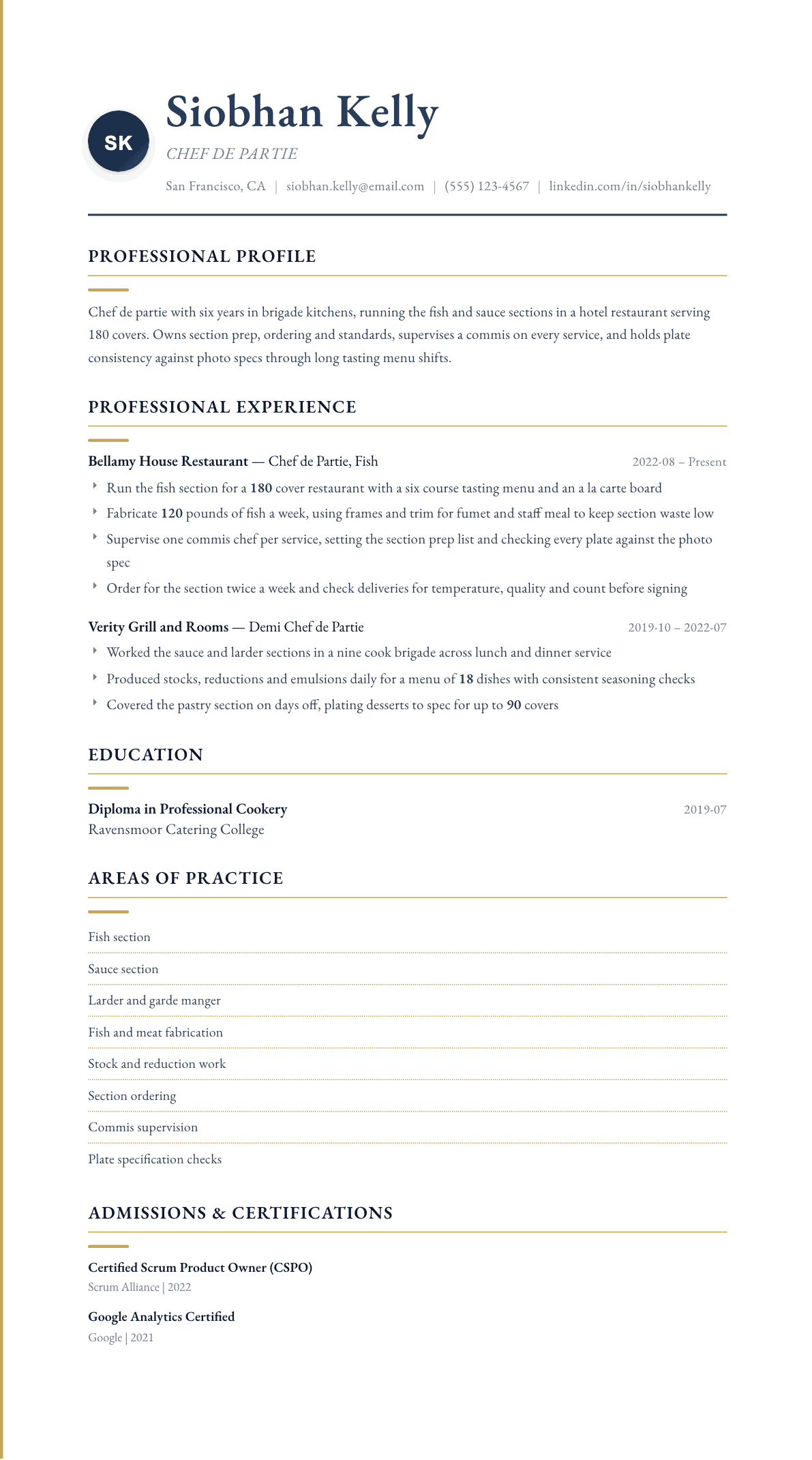
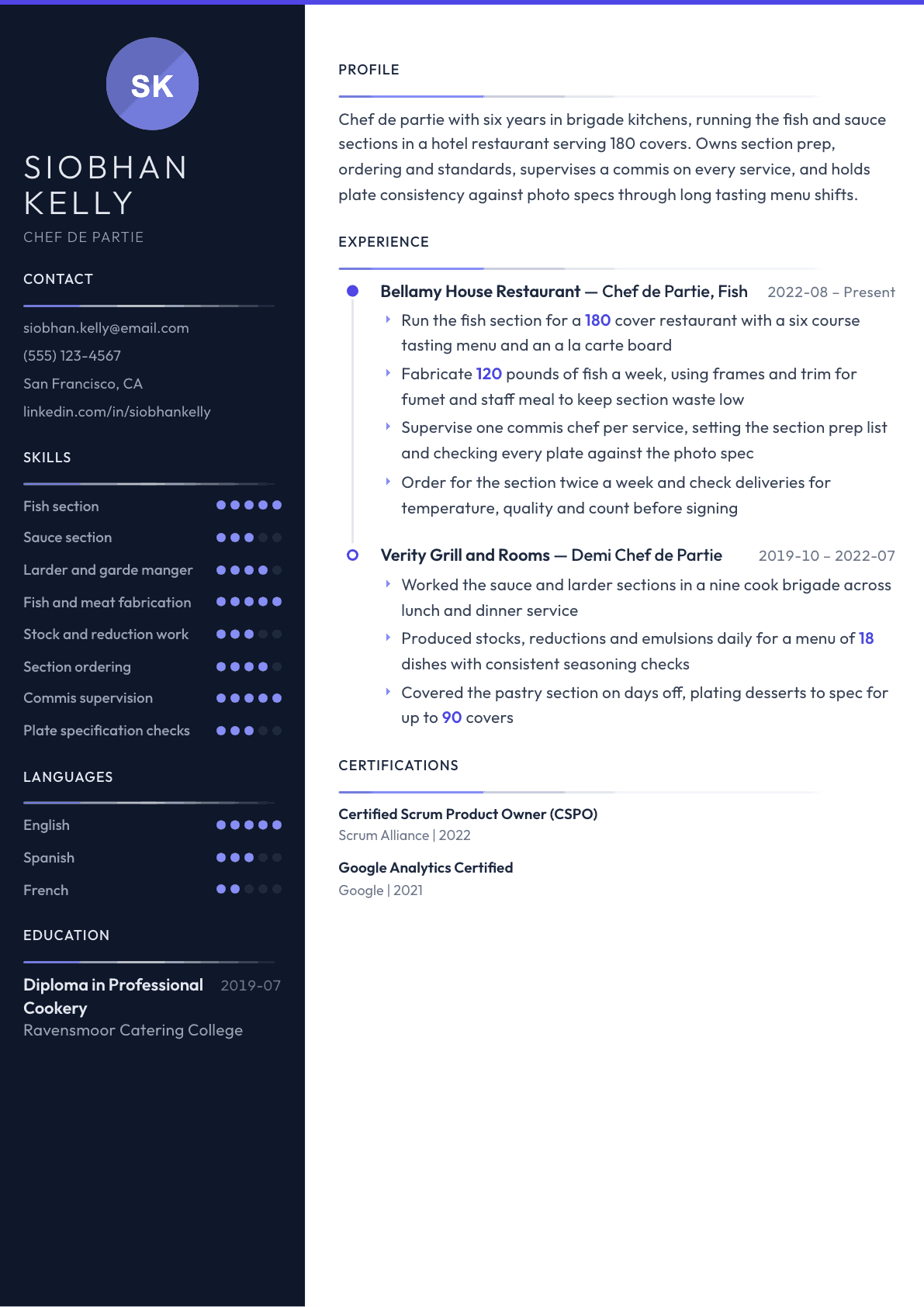
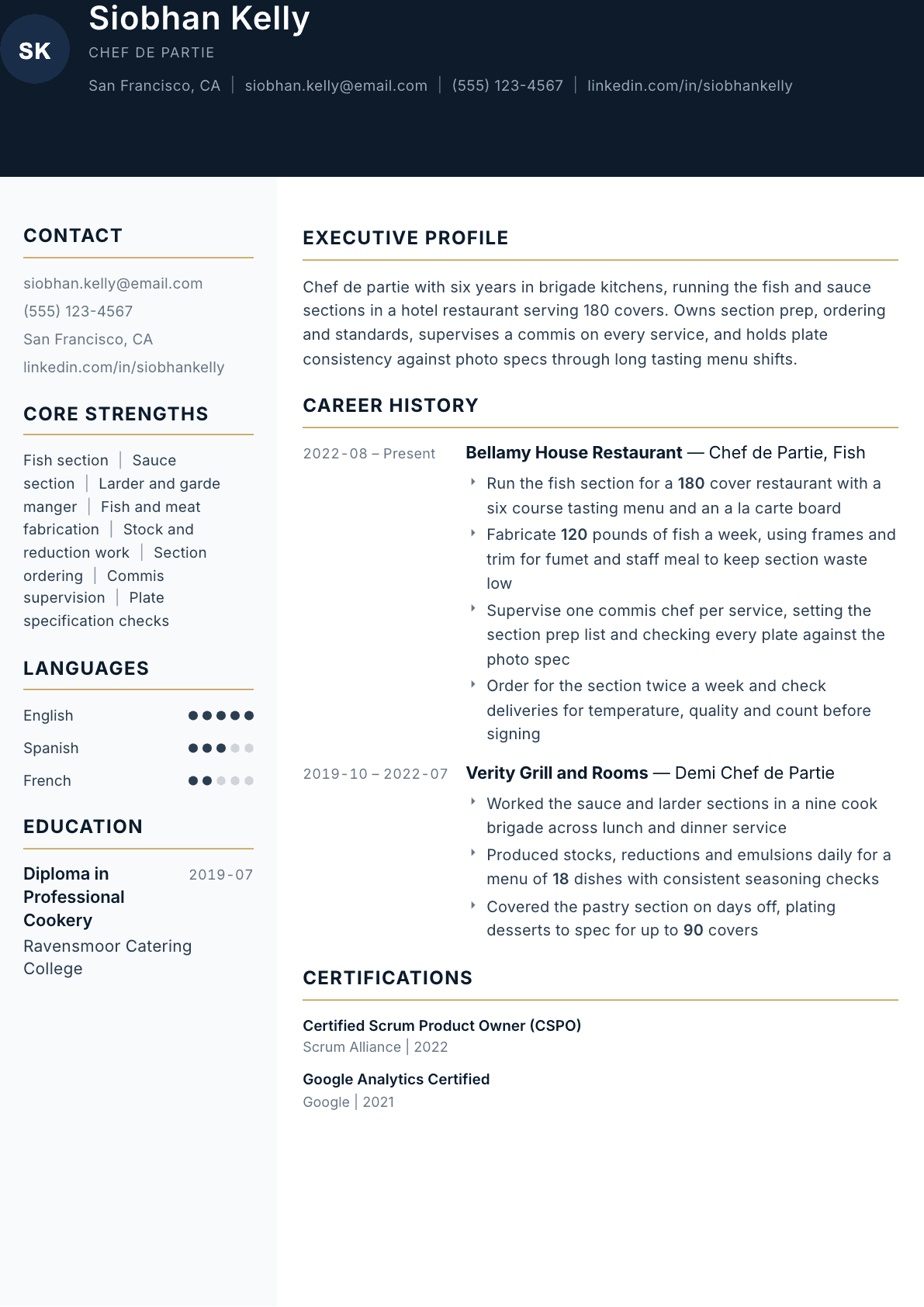
Example Chef de Partie summary
Chef de partie with five years in brigade kitchens running fish and sauce sections through 180 cover services. Fabricates whole fish weekly and uses frames for fumet, writes the section prep list, and orders twice a week against agreed specs. Supervises a commis every service and checks every plate against the photo standard on both tasting menu and a la carte.
Skills to list on a Chef de Partie resume
- Section management
- Fish and meat fabrication
- Sauce and stock production
- Garde manger
- Entremetier
- Pastry section cover
- Mise en place planning
- Section ordering and receiving
- Commis supervision
- Plate specification adherence
- Tasting menu execution
- Food safety and HACCP
- Waste and yield control
- Kitchen communication
What actually gets this resume read
- Name your section first: fish, sauce, larder, entremetier or pastry, because a brigade kitchen hires by section.
- Give the brigade size and the cover count so a head chef can picture the kitchen you came from.
- Say whether you supervise a commis or demi chef, since that is what separates a chef de partie from a line cook.
- Show that you own section ordering, prep lists and waste, not only the cooking during service.
- Mention the menu format, such as a la carte, tasting menu or banquet, because each demands different section discipline.
- Include fabrication volumes and how you use trim, which tells a chef you protect food cost without being asked.
How to write a chef de partie resume
A brigade kitchen does not hire a cook. It hires a section. When a head chef posts a chef de partie position, there is an empty fish station or an empty sauce station behind it, and the first thing he does with an application is look for the word that matches. If your section is not visible in the first two lines, the page is competing on general enthusiasm against candidates who named theirs.
The second thing that gets checked is whether you run the section or merely work on it. A chef de partie owns the prep list, the ordering, the waste and the standard, and usually supervises a commis or a demi through every service. That responsibility is the whole difference between the role and a line cook position, and it is the part applicants most often forget to write down.
This guide sets out how to build the page around your section: the format, the summary, the experience bullets that show ownership rather than attendance, the skills split between craft and section management, and the questions that come up when moving between menu formats or into a sous role.
Format: one page, section in the title line
One page for most chefs de partie, two only if you have several brigades and a long menu record. Single column, reverse chronological, plain type. The reader is a head chef or a sous, and the page should be legible in the thirty seconds between a delivery and a prep list.
Write the job title with the section attached: Chef de Partie, Fish. Do the same for earlier roles, such as Demi Chef de Partie, Sauce and Larder. That single habit puts the keyword the chef is scanning for into the strongest position on the page.
- Header: name, city and state, phone, email, food safety credential, right to work if relevant.
- Order: summary, experience, skills, education, certifications.
- Name the sections in the title lines, then again in the skills block.
Summary: section, brigade size, covers, menu format
Four facts in about three sentences. The section or sections you run, the size of the brigade, the covers per service, and the menu format. A tasting menu of six courses, an a la carte board and a banquet program each demand different section discipline, and a chef will read the format to judge whether your habits transfer.
Then add the ownership line: section prep list, section ordering, and supervision of a commis. That sentence is what distinguishes a chef de partie summary from a line cook summary, and leaving it out costs the interview even when the experience is there.
Experience: what you own between services, not only during them
Open each role with the kitchen, the brigade size, the covers and the menu format, then write bullets across the four responsibilities that define the position.
Production during service: what you fire, at what volume, to what standard. Fabrication and prep: the weight of fish or meat you break down, the stocks, reductions and emulsions you produce daily, and how you use frames and trim so the section wastes little. Section management: writing the prep list, ordering twice a week, checking deliveries for temperature, quality and count before signing, and holding the section to a photo spec. Supervision: how many commis or demi chefs you set up, check and correct through a service.
Cover for other sections is worth its own line. A chef de partie who can hold pastry on a day off, or step onto larder when someone is out, is the person a head chef builds a schedule around, and that flexibility rarely appears on applications that only describe one station.
Skills: craft first, then the section discipline
The craft block lists sections and techniques: fish section, sauce section, larder and garde manger, entremetier, pastry cover, fish and meat fabrication, stock and reduction work, emulsions, tasting menu execution. Be specific about the techniques you can produce alone and consistently, because a trail shift will test exactly that.
The discipline block lists section management: mise en place planning, section ordering and receiving, commis supervision, plate specification adherence, waste and yield control, food safety and temperature logs. That second block is the one a head chef reads to decide whether you can be left with a station on a night he is not there.
- Sections by name, in the order you would want to be hired for them.
- Fabrication volumes, since weight broken down per week is the clearest measure of a section.
- Menu formats you have executed: a la carte, tasting, banquet, brunch, room service.
Education, certification, and the step to sous
Professional cookery qualifications belong on the page with the college, the credential and the field. Add a food safety certification by its real program name, and any American Culinary Federation certification you genuinely hold, with the level named. Anything you cannot evidence should stay off, because a brigade kitchen is a small world and claims get checked in a phone call.
To argue for a junior sous or sous position, add the responsibilities that reach beyond your own section: covering the pass, writing prep sheets for more than one station, training commis chefs through a menu change, running ordering for a category rather than a section, and standing in for the sous on days off. Those bullets change what the page is applying for without changing a single fact in it.
Chef de Partie resume summary examples
Commis moving up
Commis chef of two years in a nine cook brigade, working larder and covering sauce, producing stocks and dressings daily for an 18 dish menu. Ready for a chef de partie section, already writing the larder prep list and checking deliveries against the order sheet each morning.
Section chef
Chef de partie with five years in brigade kitchens running fish and sauce sections through 180 cover services. Fabricates whole fish weekly and uses frames for fumet, writes the section prep list, and orders twice a week against agreed specs. Supervises a commis every service and checks every plate against the photo standard.
Senior chef de partie
Senior chef de partie with six years across hotel and restaurant brigades, running the fish section for a six course tasting menu and an a la carte board at 180 covers. Breaks down 120 pounds of fish a week, supervises a commis on every service, and covers pastry and entremetier when the rota requires it.
Work experience bullets: before and after
Before: Worked on the fish section during service.
After: Ran the fish section for a 180 cover restaurant serving a six course tasting menu alongside an a la carte board, firing both formats through the same service.
Section, covers and menu format together tell a chef exactly what kind of pressure you have held.
Before: Prepared fish for the kitchen.
After: Fabricated 120 pounds of fish a week, using frames and trim for fumet and staff meal so section waste stayed low against the order sheet.
A weekly weight plus the use of trim shows both technique and food cost awareness.
Before: Supervised a junior member of the kitchen team.
After: Supervised one commis chef per service, setting the section prep list, checking their mise en place before the first ticket and correcting plates against the photo spec.
Describing the supervision routine proves responsibility rather than the presence of a junior beside you.
Before: Ordered stock for the section.
After: Ordered for the section twice a week and checked every delivery for temperature, quality and count before signing, rejecting product that failed the spec.
Frequency and a receiving standard turn ordering into control over what reaches the section.
Before: Helped on other sections when needed.
After: Covered the pastry section on days off, plating desserts to spec for up to 90 covers, and stepped onto larder during holiday weeks without a handover gap.
Naming the sections and the volume makes flexibility a scheduling asset a head chef can rely on.
Hard skills
- Section management
- Fish and meat fabrication
- Sauce and stock production
- Garde manger and larder
- Entremetier
- Pastry section cover
- Mise en place planning
- Section ordering and receiving
- Commis supervision
- Plate specification adherence
- Tasting menu execution
- Food safety and HACCP
- Waste and yield control
Soft skills
- Kitchen communication
- Teaching a commis
- Consistency across long services
- Working to another chef standard
- Composure on a tasting menu
- Reliability on the rota
Certifications worth listing
- ServSafe Food Handler (National Restaurant Association)
- ServSafe Manager (National Restaurant Association)
- Certified Sous Chef (CSC) (American Culinary Federation)
- Certified Fundamentals Cook (CFC) (American Culinary Federation)
Mistakes that cost chef de partie candidates the interview
- Leaving the section out of the job title, when a brigade kitchen is hiring against one empty station.
- Writing about service only, which hides the prep list, ordering and waste control that define the role.
- Never mentioning the commis you supervise, the single fact that separates this position from a line cook job.
- Skipping brigade size and covers, so a head chef cannot picture the kitchen your habits came from.
- Omitting the menu format, when a tasting menu and a banquet program demand very different section discipline.
- Listing techniques you have watched rather than produced alone, which a trail service exposes within an hour.
Chef de Partie resume questions
What is the difference between a chef de partie and a line cook?
A chef de partie owns a section: its prep list, its ordering, its waste and its standard, and usually supervises a commis. A line cook works a station during service. Write the ownership and the supervision explicitly or the page reads as the second job.
Which section should I lead with?
The one the posting is trying to fill, if you can run it. Otherwise lead with your strongest and list the others directly underneath. Chefs scan for a section word first, so put it in the job title line rather than in a bullet.
Do I need a culinary qualification for a chef de partie role?
A professional cookery diploma helps, especially in hotels, but brigade kitchens weigh the sections you have run and the volumes you have produced more heavily. List the qualification, then let the fabrication weights and cover counts carry the argument.
How do I show that I can hold a tasting menu service?
Name the number of courses, the covers, and the plate specification you work to. Add anything about consistency over a long service, such as checking every plate against a photo standard, since a tasting menu is judged on repetition rather than peaks.
How do I move from chef de partie to sous chef?
Add the work that reaches past your section: covering the pass, writing prep sheets for other stations, training commis through a menu change, ordering for a whole category, and standing in for the sous on days off. Those bullets change the role the page applies for.
Related resume examples
- Chef Resume example
- Pastry Chef Resume example
- Sous Chef Resume example
- Line Cook Resume example
- Head Chef Resume example
- Prep Cook Resume example