Line Cook Resume Examples: free ATS score and gap list
Line Cook Resume Examples for Every Cooking Job
By Mustafa Tarabya, founder of CVBooster · Published · Updated
A line cook resume example written out in full, with the stations, covers and kitchen type chefs read first, plus summaries and bullets by level.
Sample resumes for a line cook
The same line cook content laid out in three CVBooster templates, so you can see what the finished document looks like before you write a word.
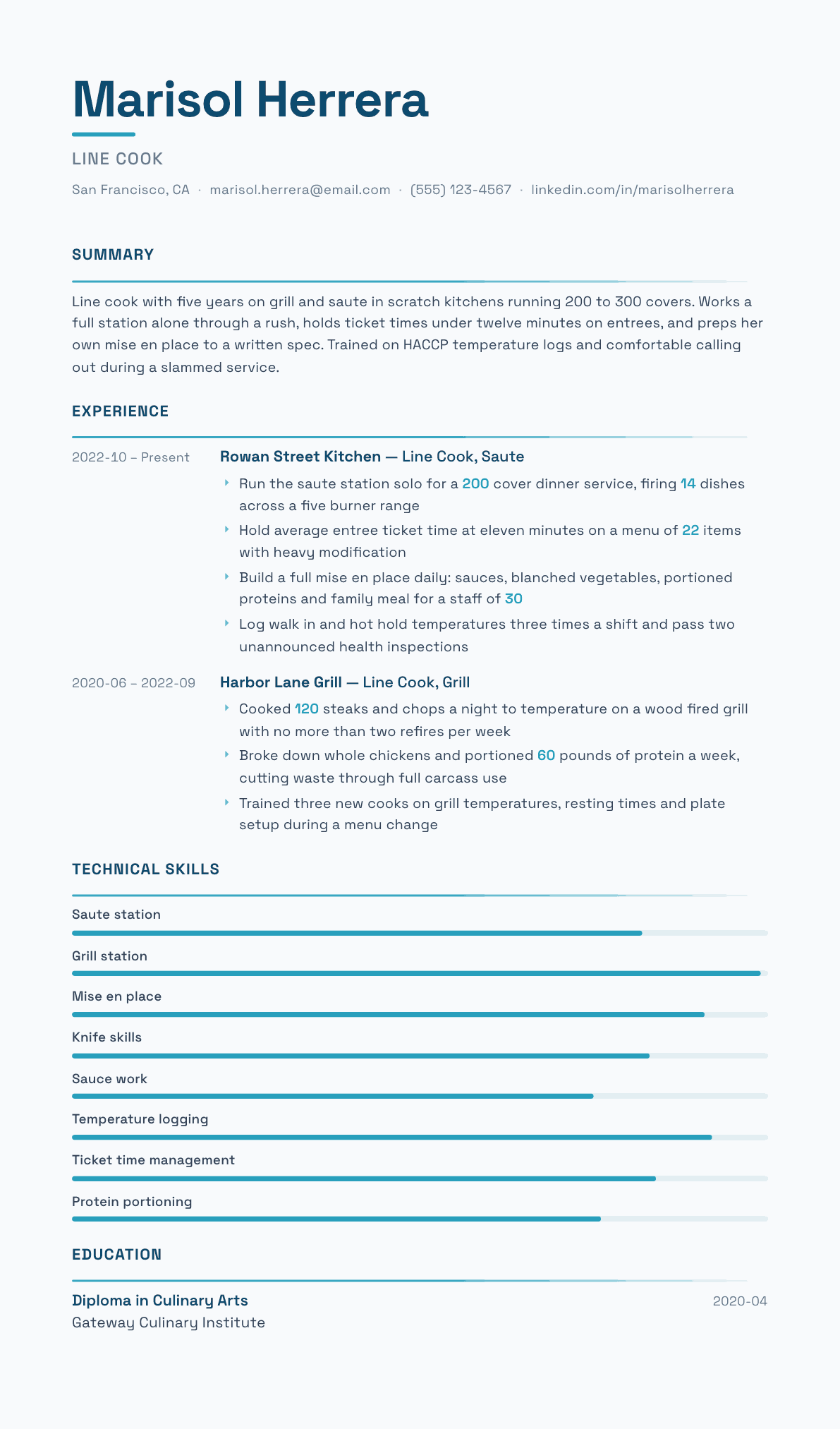
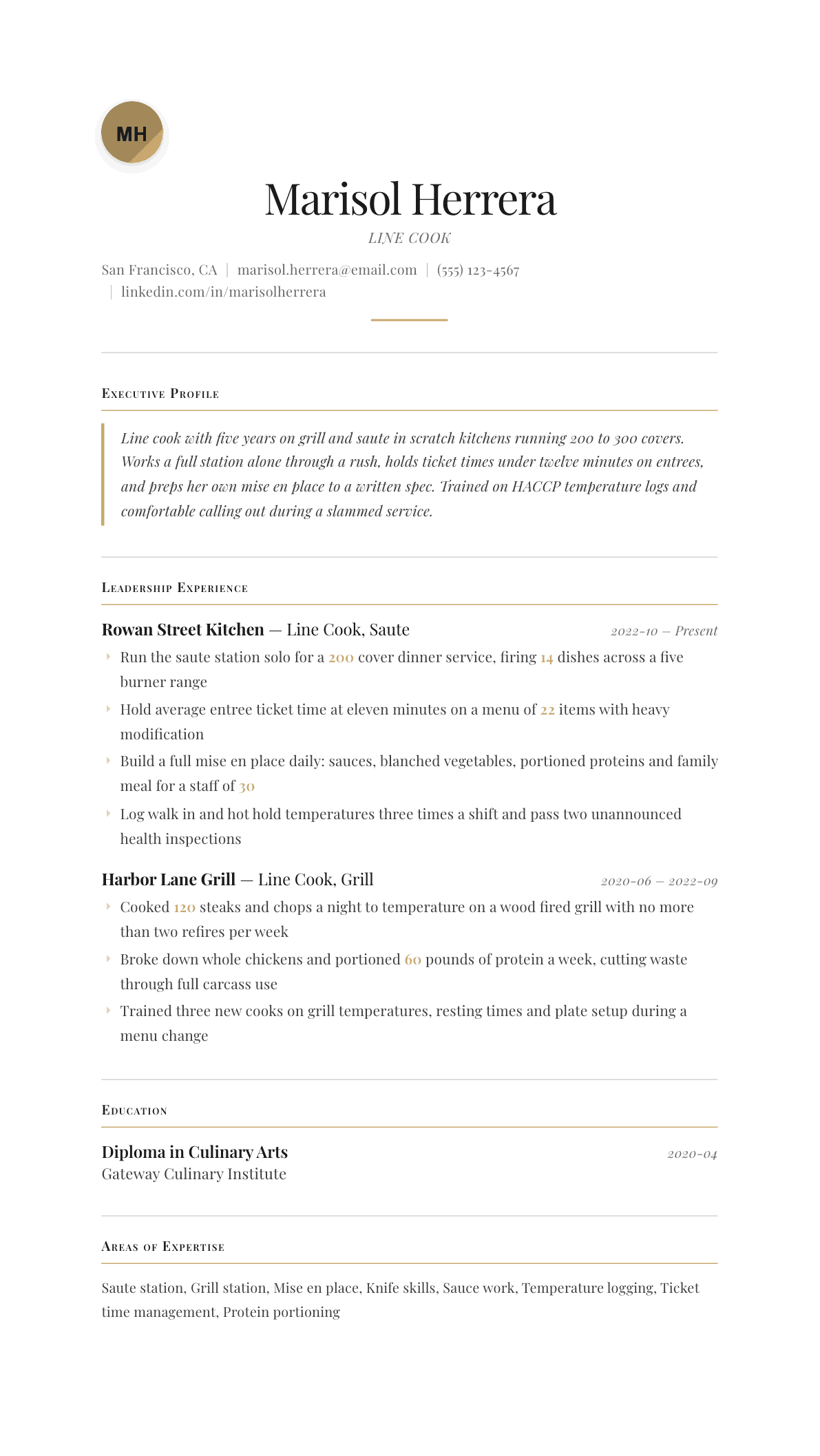
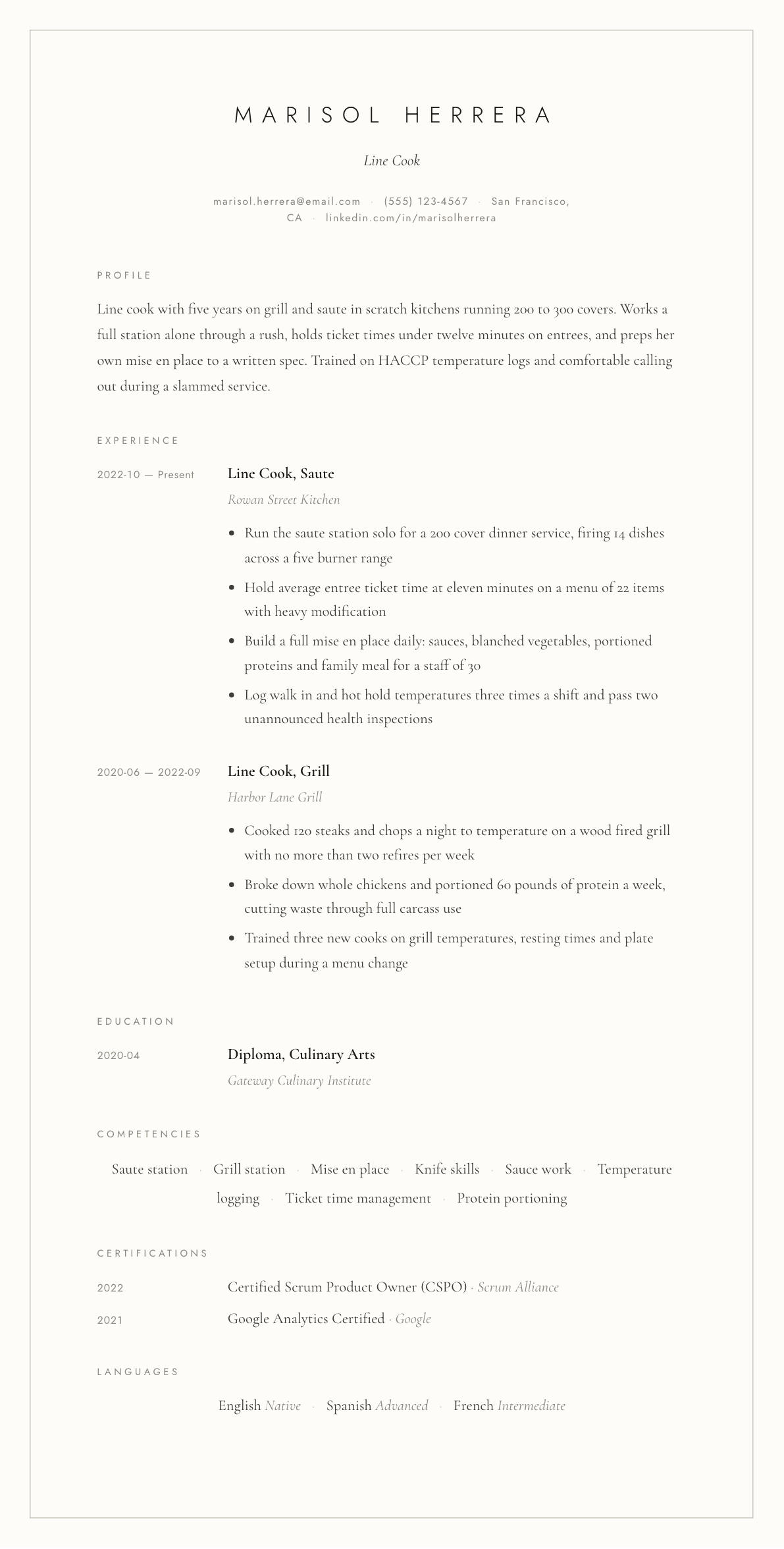
Example Line Cook summary
Line cook with four years on saute and grill in scratch kitchens serving 250 covers a night. Runs a full station alone through a rush, holds entree ticket times near eleven minutes, and builds every element of her own mise en place to spec. Trained on HACCP logs, comfortable with whole animal portioning, and has trained three cooks through a menu change.
Skills to list on a Line Cook resume
- Saute
- Grill
- Fry station
- Garde manger
- Mise en place
- Knife skills
- Butchery and portioning
- Sauce and stock production
- Ticket time management
- Food safety and HACCP
- Temperature logs
- Inventory and par prep
- Menu execution
- Station opening and closing
- Kitchen communication
What actually gets this resume read
- Name your stations by name: grill, saute, fry, garde manger, pantry. Chefs read that line before anything else.
- Give cover counts and ticket times, since those two numbers describe the pace of kitchen you can hold.
- Describe the cooking style and the menu, because a wood fire steakhouse and a pasta program hire for different hands.
- Show your prep discipline: quantities, spec sheets and what you build before service, not only what you fire during it.
- Include food safety training and temperature logging, which is the first thing a chef asks a new cook to own.
- If you have staged, done menu development or trained cooks, put it in, because that is how a line cook becomes a lead.
How to write a line cook resume
Chefs read a line cook resume in a specific order and it is not the order most applicants write it in. First the stations: grill, saute, fry, garde manger, pantry. Then the covers, because a cook who has held a station at three hundred is not the same hire as a cook who has held one at eighty. Then the kitchen style, since scratch cooking, a wood fired steakhouse and a high volume chain teach different hands. Only after all of that does anyone read a sentence about being passionate.
The trouble is that a line cook resume written as a list of duties looks identical to every other one. Prepared food to order, maintained a clean station, followed recipes. Every cook on the schedule does those things. What distinguishes you is the station you own alone through a rush, the ticket times you hold, the mise en place you build before service and the food safety work you handle without a reminder.
This guide takes the page apart section by section for a line cook, with summaries for three career stages, five bullet rewrites drawn from how cooks really phrase their work, and answers to the questions that come up when moving between kitchens or up to lead. The written out page doubles as a cook resume sample for prep, short order and banquet cook jobs, and as a model for any resume for cooking work: keep the order and change the stations.
Format: one page, stations named in the first two lines
One page for anything under eight years, single column, reverse chronological. Chefs read applications at the pass or on a phone in the office, and a designed layout with columns or icons reads as somebody who spends more time on documents than on a station.
Your job title lines should include the station: Line Cook, Saute reads better than Line Cook alone, because a chef staffing an open grill position is scanning for the word grill. Keep the header simple with your name, city, phone, email, availability and food safety certification.
- Header: name, city and state, phone, email, availability, food handler or manager certification.
- Order: summary, experience, skills, education, certifications.
- Put the station in every job title line, not only in the bullets.
Summary: stations, covers, ticket times
Three sentences at most. Name the stations you can run, the years, the cover volume and the kitchen style, then one operational number such as your average entree ticket time. A cook who writes that she runs saute solo at two hundred covers and holds entrees near eleven minutes has said something no adjective can replace.
If you are changing kitchen style, address it directly. A cook moving from a high volume chain to a scratch kitchen should name the scratch elements already in hand: butchery, stocks, sauces, house pasta, so the chef is not left assuming everything arrived frozen.
Experience: the station, the rush, and the prep behind it
Open each job with the kitchen and the volume. Scratch kitchen, 200 covers, four stations, a menu of twenty two items with heavy modification. Then write three to five bullets that describe what you carry during service and what you build before it.
The service bullets should be specific about equipment and load: firing fourteen dishes across a five burner range, cooking to temperature on a wood fired grill, holding ticket times on a heavily modified menu. The prep bullets should show your mise en place as a system rather than a chore: sauces, blanched vegetables, portioned proteins, staff meal for a team of thirty, all built to a spec that somebody else could follow.
Add one bullet on food safety. Temperature logs three times a shift, walk in organization, passing unannounced inspections. Chefs hand that responsibility to a new cook early and want to know it will come back done.
Skills: techniques and equipment, not adjectives
The skills block for a cook is a station and technique list: saute, grill, fry, garde manger, mise en place, knife skills, butchery and portioning, sauce and stock production, ticket time management, food safety and temperature logs, inventory and par prep, menu execution. Name equipment you can run cleanly, such as a combi oven, a plancha, an immersion circulator or a wood fired grill.
Skip the personality adjectives here. Working clean, working fast and taking direction are the price of entry in a kitchen, and claiming them in a list is weaker than showing them in a bullet about a rush you held alone.
- Stations first, since a chef hires against an open station.
- Techniques second: butchery, emulsions, stocks, pasta, bread, fermentation.
- Equipment third, and only the equipment you can run without supervision.
Education, certification, and the step up to lead
Culinary school belongs on the page with the institution, the credential and the field, but a chef weighs it below the kitchens you have worked in. If you have staged somewhere respected, include it with the length and what you worked on. Food safety credentials are real and worth listing by their program name: ServSafe Food Handler for most cooks, ServSafe Manager if you have taken it, and any state required card.
To argue for a lead or a junior sous role, add the bullets that go beyond your own station: training cooks through a menu change, writing prep sheets, ordering for a station, covering the expo window, running a station design change. Those are the responsibilities that separate a strong line cook from the next promotion, and they need to be written down rather than implied by tenure.
Line cook resume example and cook resume sample, written out
A cook line resume works when the chef can see your stations, your volume and your kitchen type before the third line. The line cook resume example below is a mid level cook with four years on the line, applying to a busier scratch kitchen, written as it would sit on the page. Change the stations, covers and restaurants to yours and keep the order.
The same layout works for any resume for cooking jobs, from a school or hospital cook to a short order cook in a diner. Swap the stations for the work that kitchen does, such as batch cooking to a menu cycle, tray line service or breakfast short order, and keep the numbers: meals or covers a shift, the equipment you run and the food safety record you keep.
Profile: Luis Ortega, Line Cook. Four years on the line in full service American and Italian kitchens, holding grill and saute stations alone through a 300 cover Saturday. Current food handler card, clean station and labeling habits, and comfortable training new cooks on grill.
- Current role, Line Cook, The Brick Oven Kitchen, two years: holds grill on weekends and saute midweek on a line of five; sets the grill par sheet and preps proteins for service.
- Plates 120 to 150 grill tickets on a busy night and keeps the window moving with the expo call.
- Butchers whole chickens and portions steaks to spec each morning and logs temperatures every shift.
- Trained three new cooks on grill; two now close the station alone.
- Earlier role, Prep and Fry Cook, Sunrise Diner, two years: opened the kitchen at 5 a.m., ran the fryer and flat top on breakfast and lunch.
- Skills: grill, saute, fry, flat top, knife work, butchery basics, sauces, station setup and breakdown, FIFO rotation.
- Certification: food handler card, current.
Line Cook resume summary examples
Out of culinary school
Culinary school graduate with a 400 hour externship on garde manger and fry in a hotel kitchen serving 150 covers. Comfortable with knife work, stocks and basic sauces, trained on temperature logs, and looking for a first full line position with a chef who teaches.
Four years on the line
Line cook with four years on saute and grill in scratch kitchens serving 250 covers a night. Runs a full station alone through a rush, holds entree ticket times near eleven minutes, and builds every element of her own mise en place to spec. Trained on HACCP logs and whole animal portioning.
Lead line cook
Lead line cook with seven years across wood fired grill and saute stations at 300 covers. Fires 14 dishes across a five burner range through a full service, writes the prep sheet for the station, trains new cooks through menu changes, and has passed two unannounced health inspections with no critical findings.
Work experience bullets: before and after
Before: Cooked food to order on the line.
After: Ran the saute station solo for a 200 cover dinner service, firing 14 dishes across a five burner range on a menu with heavy modification.
Station, cover count and dish load describe a workload a chef can compare against his own line.
Before: Worked quickly during busy service.
After: Held average entree ticket time at eleven minutes on a 22 item menu through weekend services with no expediter on the station.
A ticket time is the pace metric kitchens actually track, and it survives an interview question.
Before: Prepped ingredients before service.
After: Built a full daily mise en place of sauces, blanched vegetables and portioned proteins to written spec, plus family meal for a staff of 30.
Listing the components and the spec shows prep as a system somebody else could pick up.
Before: Followed food safety rules.
After: Logged walk in and hot hold temperatures three times a shift and organized the station by first in first out, contributing to two unannounced inspections passed.
A frequency and an outcome turn compliance from a claim into a record.
Before: Grilled steaks and other meats.
After: Cooked 120 steaks and chops a night to temperature on a wood fired grill with no more than two refires a week, and broke down whole chickens weekly for the menu.
Volume, accuracy and butchery together show both speed and skill rather than a job description.
Hard skills
- Saute station
- Grill station
- Fry station
- Garde manger
- Mise en place
- Knife skills
- Butchery and portioning
- Sauce and stock production
- Ticket time management
- Food safety and HACCP
- Temperature logging
- Inventory and par prep
- Menu execution
- Station opening and closing
Soft skills
- Kitchen communication
- Working clean under load
- Taking and giving direction
- Consistency across shifts
- Composure during a rush
- Willingness to train others
Certifications worth listing
- ServSafe Food Handler (National Restaurant Association)
- ServSafe Manager (National Restaurant Association)
- ServSafe Allergens (National Restaurant Association)
- Certified Fundamentals Cook (CFC) (American Culinary Federation)
Mistakes that cost line cook candidates the interview
- Leaving the station out of the job title, when the station is the first word a chef scans an application for.
- Writing prepared food to order and maintained a clean station, which describes every cook who has ever worked a line.
- Giving no cover count, so a chef cannot tell whether you have held a station at eighty or at three hundred.
- Skipping the prep work entirely and writing only about service, which hides half the job a cook is judged on.
- Listing culinary school above the kitchens you have worked in, when a chef weighs the kitchens more heavily.
- Naming equipment you have only watched somebody else run, which falls apart in the first trail shift.
- Ignoring food safety, the responsibility a chef hands a new cook first and checks most often.
Line Cook resume questions
What should a line cook put at the top of a resume?
The stations you can run, the years of experience, the cover volume and the kitchen style. A chef staffing an open grill position wants to see the word grill in the first two lines, not in the fourth bullet of a second job.
How do I write a resume for a cooking job?
Name the cooking you do in the first two lines: stations or kitchen type, years, and the covers or meals a shift. Then list each kitchen with the work you own, add your food handler card, and finish with a short skills line of techniques and equipment. Culinary school goes under education; the kitchens carry the argument.
How do I show that I can keep up during a rush?
Give an average ticket time, the number of dishes you fire from your station, and whether you hold that station alone. Those three facts describe pace precisely, while words like fast and efficient are on every application in the pile.
What does a good line cook resume example include?
Your stations, the covers or tickets you handle on a busy night, the kitchen type and the restaurants by name, then prep, butchery or sauce work you own and anyone you trained. Add your food handler card and keep it to one page with a short skills line of techniques and equipment.
How do I write a resume to move up to lead or junior sous?
Add the work outside your own station: training cooks through a menu change, writing prep sheets, ordering, covering expo, and passing inspections. Those bullets are what a chef reads to decide whether you can be responsible for other people.
Related resume examples
- Chef Resume example
- Executive Chef Resume example
- Prep Cook Resume example
- Sous Chef Resume example
- Food Runner Resume example
- Chef de Partie Resume example