IT Business Analyst Resume Examples: what gets the call
Build an IT Business Analyst Resume That Shows Requirements Work
By Mustafa Tarabya, founder of CVBooster · Published · Updated
An IT business analyst resume example with requirements, process mapping and stakeholder keywords, plus a practical writing guide.
Sample resumes for a it business analyst
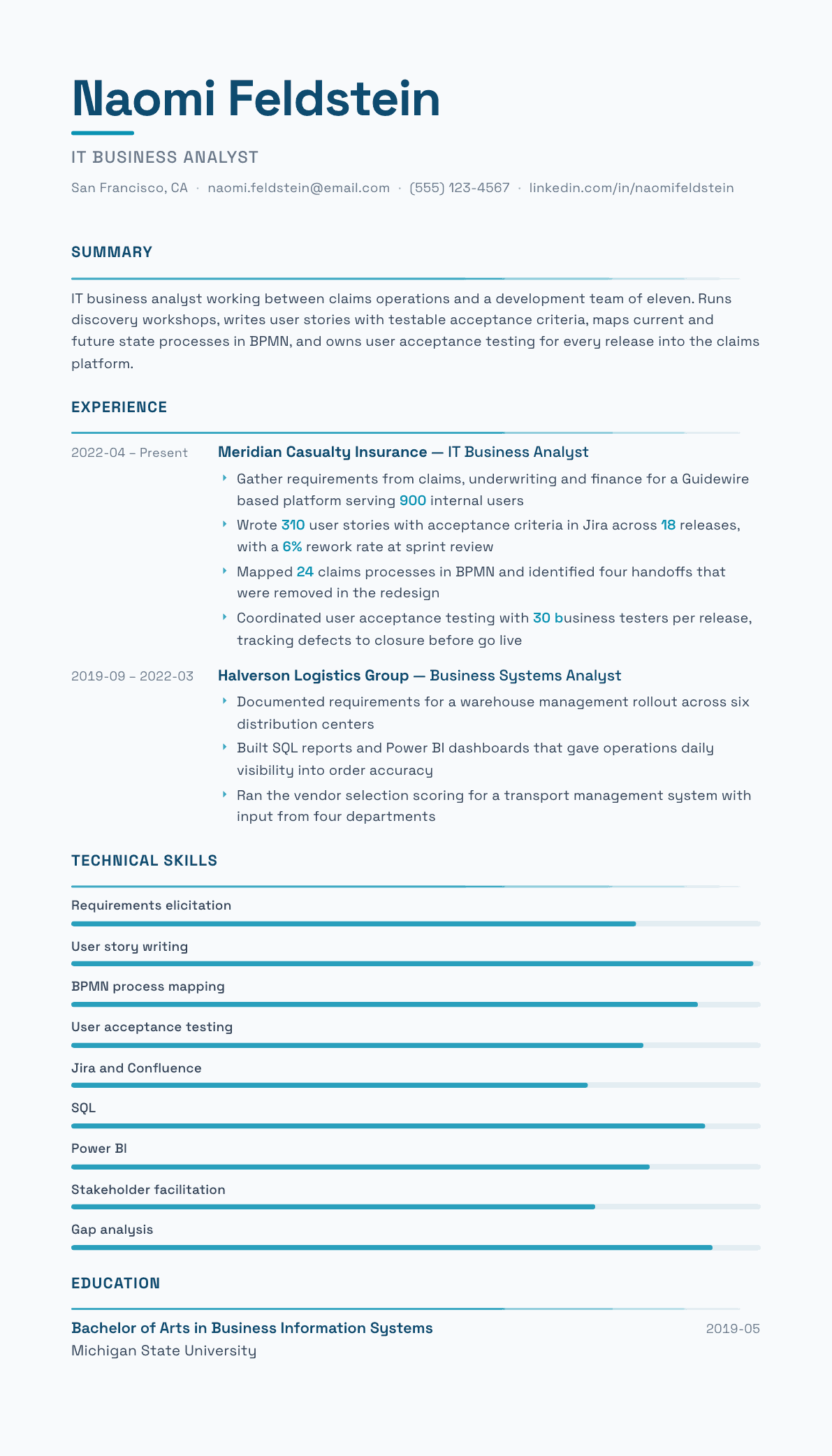
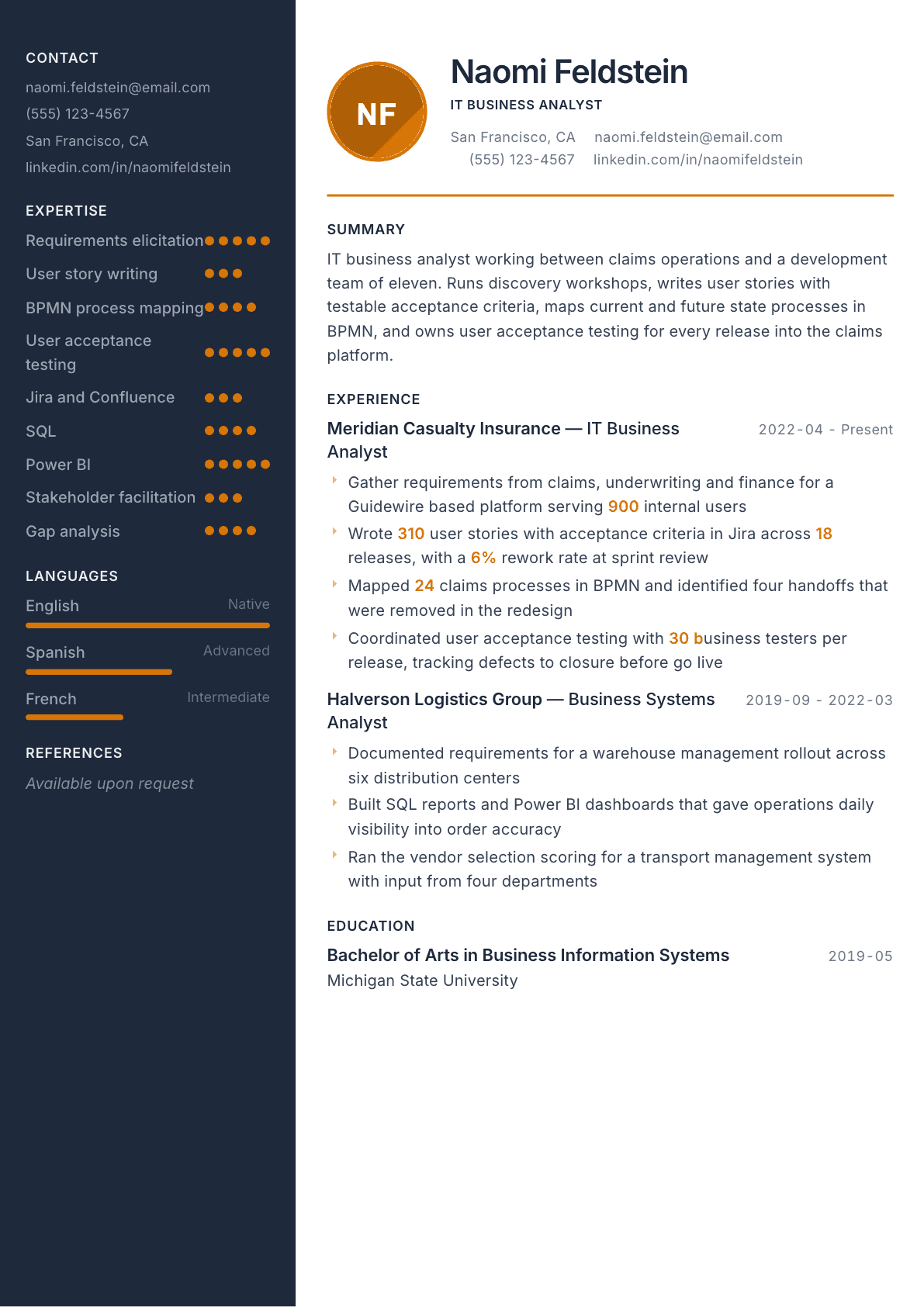
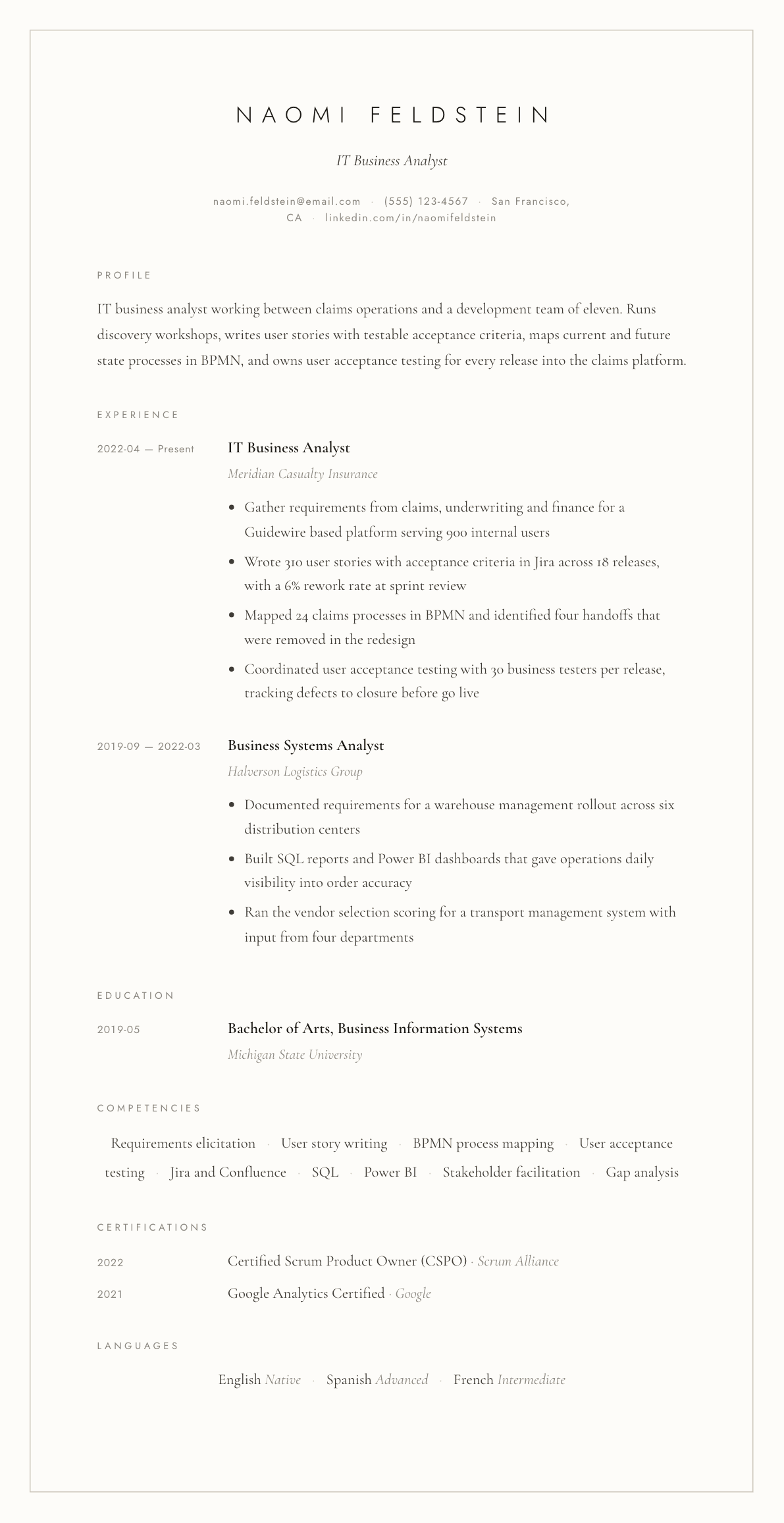
The same it business analyst content laid out in three CVBooster templates, so you can see what the finished document looks like before you write a word.
Example IT Business Analyst summary
IT business analyst with six years between business operations and delivery teams, currently supporting a claims platform used by 900 people. Wrote 310 Jira stories across 18 releases with a 6% rework rate, mapped 24 processes in BPMN, and ran user acceptance testing with 30 business testers per release. Seeking a lead analyst role on a platform modernization program.
Skills to list on a IT Business Analyst resume
- Requirements elicitation
- User story and acceptance criteria writing
- Process mapping with BPMN
- Gap and impact analysis
- User acceptance testing
- Jira and Confluence
- Agile and scrum ceremonies
- Stakeholder workshops
- SQL querying
- Power BI and reporting
- Data mapping and integration analysis
- Vendor evaluation
- Business case development
- Change and release coordination
What actually gets this resume read
- Say which business function you sat between and which technical team you wrote for, in that order.
- Quantify requirements work: stories written, releases supported, workshops run, and rework at sprint review.
- Name the notation and tools you use for process work, such as BPMN, Visio, Lucidchart or Confluence.
- Show user acceptance testing ownership, since that is the line between a business analyst and a note taker.
- Include the platform you supported, whether that is Salesforce, Workday, SAP, Guidewire or an internal system.
- Add a data bullet with SQL or a reporting tool, because analysts who can query their own answers get shortlisted.
How to write a it business analyst resume
The IT business analyst sits in the gap where projects usually fail. Operations knows what it needs and cannot express it in a form a developer can build. Engineering builds what was written and is surprised when the business rejects it at testing. The analyst is hired to close that gap, and the resume has to prove you have closed it before, on a real platform, with real people who disagreed.
The most common weak version of this resume is a list of ceremonies attended and documents produced. Gathered requirements, facilitated meetings, created documentation. None of that shows judgment. What shows judgment is a requirement you challenged, a process step you removed, a story that came back at sprint review and why it did not happen again.
This guide covers the section order delivery managers expect, how to quantify requirements and testing work honestly, three example summaries from a junior analyst to a lead, before and after bullets, and the questions analysts ask when they want to move onto a bigger platform or into product work.
Format: two pages once you have several platforms behind you
One page early, two pages once you have worked across more than one platform or domain. Reverse chronological, with a summary, a domain and platform block, then experience. The block names the business function you supported, the systems you worked on and the delivery method, since hiring managers filter on domain first and technique second.
Keep it single column and plain. Analyst roles are frequently recruited by generalist agencies whose parsing tools mangle two-column layouts, and the sections most likely to be scrambled are exactly the ones a delivery manager wants: dates, job titles and platform names.
- Header: name, city and state, phone, email, and whether you work onsite, hybrid or remote.
- Order: summary, domain and platform block, experience, certifications, education, tools.
- Name the delivery method honestly: scrum with two week sprints, kanban, or a staged plan with formal sign-off.
Summary: the two sides you sat between
Three lines that name both ends of the bridge. The business function on one side, claims, underwriting, finance, supply chain, clinical operations. The delivery team on the other, with its size and method. Then the platform. An analyst who worked between claims operations and an eleven person development team on an insurance platform is instantly placeable.
Add what you own beyond writing requirements. User acceptance testing coordination, data mapping for an integration, vendor evaluation, release readiness. Analysts who only capture requirements are the easiest to replace, and the ones who own testing or data are not.
Experience: requirements, process, testing, and what changed
Open each role with a scope line: the platform, the user population, the team you wrote for, and the delivery cadence. Then five or six bullets across four themes. Elicitation and story writing with counts and a quality measure. Process analysis with the current and future state. Testing ownership with tester numbers and defect handling. Data and integration work.
Use rework as your quality measure. Stories that come back at sprint review because the acceptance criteria were incomplete are the analyst equivalent of a failed control test. Quoting a low rework rate, or a reduction you drove, is far more persuasive than saying you wrote clear requirements.
For process work, always give both states. Twenty four claims processes mapped, four redundant handoffs identified, three removed in the redesign. A process map with no change attached is a document. A process map with a removed handoff is a result.
- Requirements: stories or specifications written, releases supported, workshops facilitated, rework at review.
- Process: processes mapped, notation used, handoffs or steps removed, cycle time before and after.
- Testing: test cases written, business testers coordinated, defects raised and closed before go live.
Data, integrations and the analyst work engineers respect
The analysts engineers trust are the ones who arrive with the data question already answered. Say what you can do yourself: write a query against the source system, profile a table for nulls and duplicates, build the field level mapping for an interface including transformations and error handling, and specify what happens when a message fails rather than only when it succeeds.
Reporting counts too. Dashboards you specified or built, the decision they supported, and who used them. An analyst who gave operations daily visibility into order accuracy has done something a stakeholder can describe from memory, which is the strongest kind of reference.
Certifications, tools and the keywords the filter wants
The business analysis credentials from the professional body carry weight in larger organizations, an agile credential helps where the team runs scrum, and a platform certification matters when the posting names that platform. Put them in a short block with the issuing body.
These postings recycle a stable vocabulary: requirements elicitation, user stories, acceptance criteria, process mapping, gap analysis, impact assessment, traceability, user acceptance testing, stakeholder management, backlog refinement, business case. Mirror the wording once in the summary and once inside a bullet where you can defend it, and name the specific tools: the tracker, the wiki, the diagramming tool, the reporting platform.
IT Business Analyst resume summary examples
Junior analyst
Junior business analyst with eighteen months supporting a warehouse management rollout across six distribution centers. Documented as-is processes, wrote user stories with a senior analyst reviewing acceptance criteria, and built the test case pack that operations used during acceptance. Comfortable with structured queries and process diagrams.
Analyst owning a platform area
IT business analyst working between claims operations and an eleven person development team on an insurance platform serving 900 internal users. Wrote 310 stories with acceptance criteria across 18 releases at a 6% rework rate, mapped 24 processes, and coordinated acceptance testing with 30 business testers per release.
Lead analyst on a program
Lead business analyst on an enterprise resource planning replacement, guiding three analysts across finance, procurement and supply chain workstreams. Owns the requirements traceability approach, chairs the design authority with the vendor, and resolved 40 open scope questions ahead of the second phase build.
Work experience bullets: before and after
Before: Gathered requirements from business stakeholders.
After: Ran discovery workshops with claims, underwriting and finance leads, converting the outcomes into 310 user stories with testable acceptance criteria across 18 releases at a 6% rework rate at sprint review.
Naming the stakeholders, the output volume and the rework measure turns elicitation into evidence of quality.
Before: Documented business processes.
After: Mapped 24 claims processes in BPMN with the operations leads, identified four redundant handoffs, and removed three of them in the redesign that went live with the second release.
Both states plus what was actually removed show analysis that changed something rather than a document that described it.
Before: Supported user acceptance testing.
After: Coordinated acceptance testing with 30 business testers per release, wrote the scenario pack, triaged 140 raised defects, and held the go live decision until the two blocking issues were closed.
Owning the scenario pack, the defect triage and the go live gate shows accountability rather than support.
Before: Worked with developers to clarify requirements.
After: Sat with the development team during refinement to define field level behavior, error handling and edge cases for the payment interface, which removed the ambiguity that had caused two failed releases.
Naming the interface and the ambiguity resolved shows technical fluency engineers can immediately verify.
Before: Created reports for the business.
After: Specified and built structured queries and dashboards that gave operations daily visibility into order accuracy by site, which replaced a weekly spreadsheet compiled by hand in three regions.
The audience, the frequency and the manual process replaced make the reporting work measurably useful.
Hard skills
- Requirements elicitation and workshop facilitation
- User story and acceptance criteria writing
- Process mapping in BPMN
- Current and future state analysis
- Gap and impact assessment
- Requirements traceability
- User acceptance test planning and coordination
- Data mapping and interface specification
- Structured query writing
- Dashboard and report specification
- Backlog refinement and sprint planning
- Vendor evaluation and scoring
- Business case development
Soft skills
- Listening past the stated request
- Facilitating a room that disagrees
- Writing that a developer and a manager both understand
- Holding scope without becoming an obstacle
- Building credibility with operations staff
- Negotiating priority between departments
Certifications worth listing
- Certified Business Analysis Professional (CBAP) (International Institute of Business Analysis)
- Entry Certificate in Business Analysis (ECBA) (International Institute of Business Analysis)
- PMI Professional in Business Analysis (PMI-PBA) (Project Management Institute)
- Professional Scrum Product Owner (Scrum.org)
- Certified ScrumMaster (Scrum Alliance)
- Salesforce Certified Administrator (Salesforce)
Mistakes that cost it business analyst candidates the interview
- Listing ceremonies attended and documents produced instead of decisions made and problems resolved.
- Leaving out the platform, which is the first thing a delivery manager searches for.
- Mapping processes with no before and after, so the reader sees documentation rather than analysis.
- Claiming acceptance testing involvement without saying who tested, how many defects, and who made the go live call.
- Describing yourself as a bridge between business and technology without a single example of a disagreement you resolved.
- Avoiding all technical detail, which makes engineers assume you will hand them ambiguity every sprint.
- Quoting story counts with no quality measure, which suggests volume with no evidence the stories were any good.
IT Business Analyst resume questions
What is the difference between a business analyst and an IT business analyst?
A general business analyst may work on process and commercial problems with no system involved. The IT variant is anchored to a platform: requirements become stories a development team builds, and the analyst owns data mapping, interface behavior and acceptance testing.
How technical does an IT business analyst need to be?
Technical enough to write a query, read an interface specification and describe error handling without help. You are not expected to build the solution, but an analyst who cannot inspect the data hands engineers ambiguity and loses credibility quickly.
Should I include the number of user stories I have written?
Yes, paired with a quality measure such as rework at sprint review or defects traced back to unclear criteria. Volume alone invites the reaction that anyone can write many stories badly, so give the reader both halves.
How do I move from business analyst to product owner?
Emphasize decisions rather than documentation: priorities you set, scope you cut, value cases you argued and outcomes you were measured on. Then state the target role in the summary, since these two titles are filtered separately by recruiters.
Do I need a business analysis certification?
It helps in large organizations and public sector hiring where credentials are scored, and it rarely decides anything in a technology company. A platform certification matching the posting is usually a stronger investment than a general analysis credential.
Related resume examples
- Business Analyst Resume example
- IT Project Manager Resume example
- Systems Analyst Resume example
- Product Analyst Resume example
- Product Owner Resume example
- SAP Consultant Resume example