Systems Engineer Resume Examples: the lines they read
Create a Systems Engineer Resume That Shows Requirements Ownership End to End
By Mustafa Tarabya, founder of CVBooster · Published · Updated
Systems engineer resume example with requirements, interface and verification work, plus the keywords and a step-by-step writing guide.
Sample resumes for a systems engineer
The same systems engineer content laid out in three CVBooster templates, so you can see what the finished document looks like before you write a word.
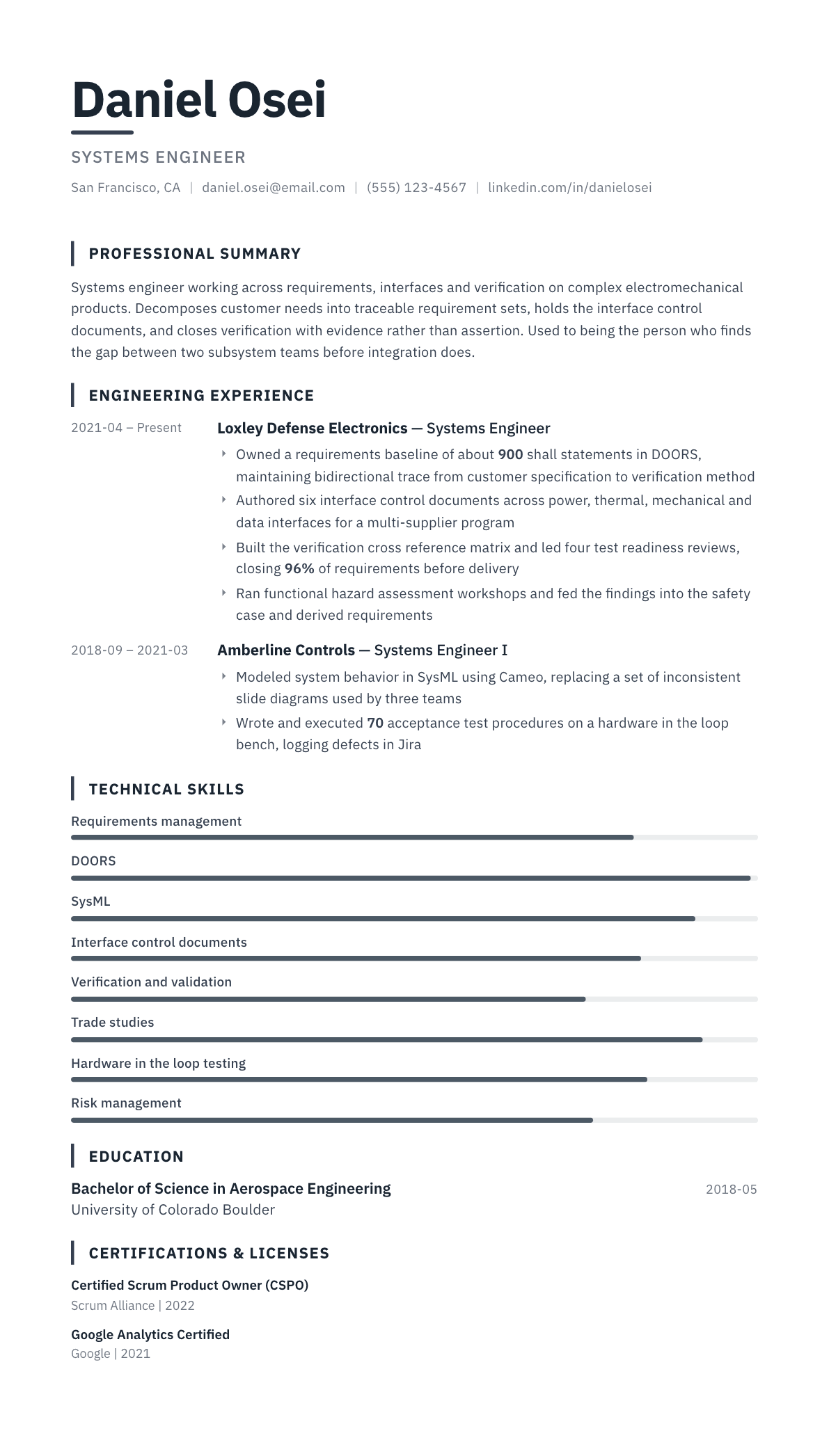
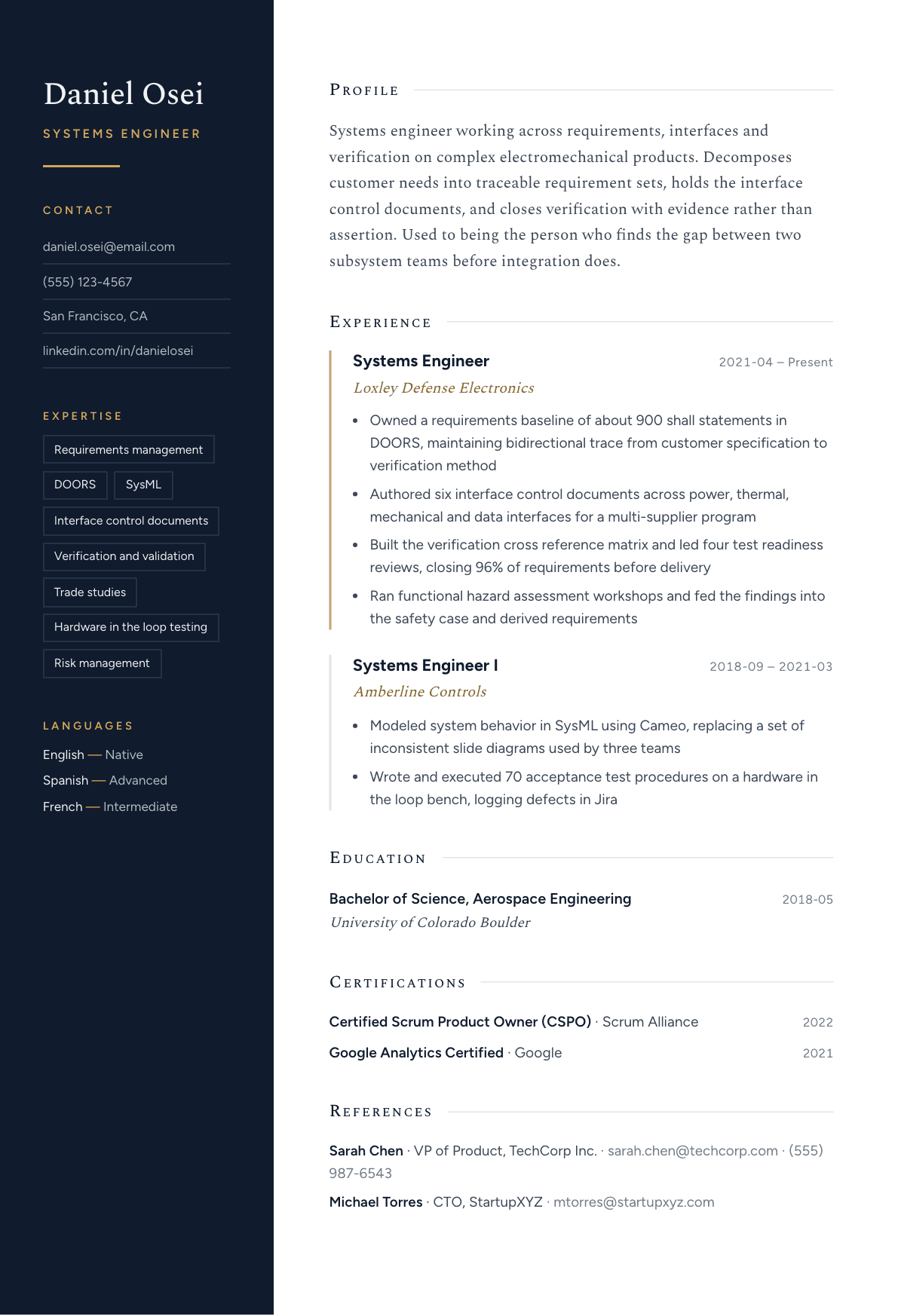
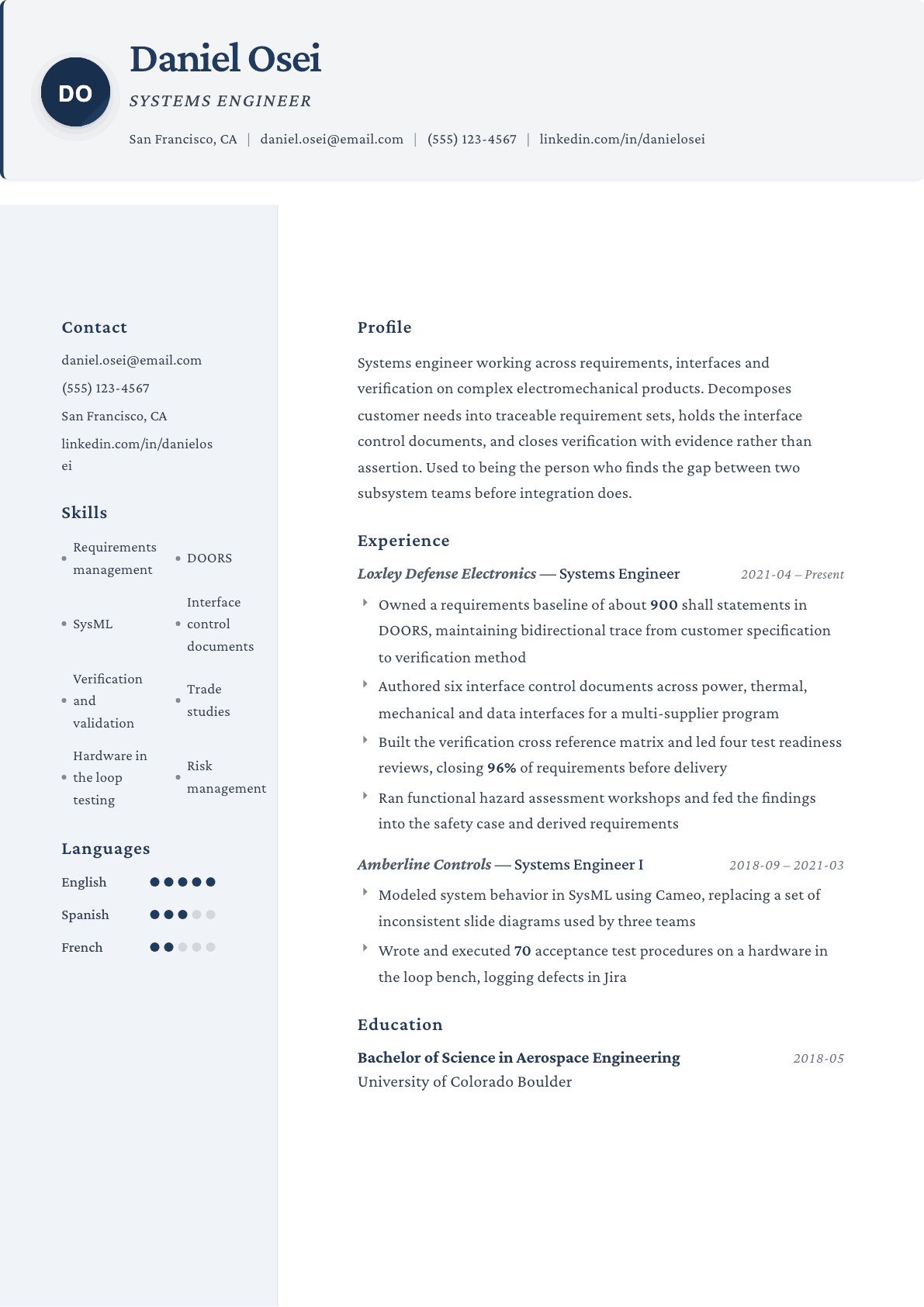
Example Systems Engineer summary
Systems engineer with seven years on multi-supplier electromechanical programs, owning requirements baselines, interface control documents and verification evidence. Comfortable in DOORS and in model based work with SysML, and experienced leading test readiness reviews to closure. Known for finding subsystem interface gaps before integration testing exposes them. Seeking a lead systems role with architecture ownership on a full product program.
Skills to list on a Systems Engineer resume
- Requirements decomposition
- DOORS
- Jama Connect
- SysML and MBSE
- Interface control documents
- Verification and validation
- Verification cross reference matrix
- Trade studies
- Functional hazard assessment
- Risk and opportunity management
- Configuration management
- Hardware in the loop testing
- Technical reviews
- Concept of operations
What actually gets this resume read
- Give the size of the requirements baseline you owned, because scope is the first thing a chief engineer looks for.
- Name your requirements tool explicitly, whether that is DOORS, Jama, Polarion or a model based approach in Cameo.
- Separate verification from validation in your bullets, since sloppy use of the two terms is noticed immediately.
- Describe at least one trade study with the alternatives compared and the criteria that decided the outcome.
- State your clearance status and its level if you have one, on its own line near the top of the resume.
- Show where you sat between subsystems, since the value of the role is the interfaces nobody else owns.
How to write a systems engineer resume
The systems engineer title covers two different jobs, and a resume that does not declare which one it means gets filtered by both. In aerospace, defense, medical devices and automotive, a systems engineer owns requirements, architecture, interfaces and verification. In many corporate IT departments the same words describe server and network administration. Say which you are in the first line.
This guide covers the requirements and architecture discipline. The chief engineer reading your file wants three things: the size of the baseline you owned, the tool you owned it in, and evidence that you closed verification with real artifacts rather than a status slide.
What follows is the section order these programs expect, summaries pitched at three levels, before and after bullets from requirements and interface work, and the questions engineers ask when their contribution lives inside a document nobody outside the program can read.
Format: declare the discipline, then size the scope
Put the word requirements, architecture or verification in your first sentence so a recruiter can separate you from an infrastructure administrator immediately. Then use reverse chronological order with a scope line under each job title covering the program, the domain and the baseline size.
Two pages is normal for a mid-career systems engineer because the artifact list is long. Keep it single column and avoid graphics, since defense and medical primes run strict parsers and your dates matter more than your layout.
- Header: name, city and state, phone, email, and clearance status on its own line when the work requires one.
- Sections: summary, clearance, technical skills, experience by program, education, certifications.
- Add a standards line naming the frameworks you have worked to, such as ISO 15288 or a customer systems engineering plan.
Summary: baseline size, tool, and the phase you own
Give a number. Owning a baseline of roughly nine hundred requirements on a multi-supplier program means something specific to a chief engineer, and it is a far better opening than a claim about cross-functional leadership. Follow it with the tool and the lifecycle phase you are strongest in.
Systems engineers get hired for a phase. Some programs need requirements decomposition at the front end, others need someone to drag verification to closure before a delivery. Name the phase you want, because a resume that reads as equally comfortable everywhere reads as committed nowhere.
Experience: requirements, interfaces, verification, in that order
For each program, write bullets in the order a lifecycle runs. What you decomposed, from what source. What interfaces you controlled and between whom. What verification method you assigned, and how much of the baseline you closed before delivery. That sequence is legible to any systems reader without a single explanatory sentence.
Interface control is where this role earns its keep, so give it detail. Six interface control documents across power, thermal, mechanical and data, spanning three suppliers, tells a manager you have been the person in the room when two subsystem leads disagreed and neither would move.
Be precise about verification and validation. Verification asks whether the system meets the requirement. Validation asks whether the requirement was the right one. Using the two terms loosely is the fastest way to lose a technical reader who otherwise liked the file.
Tools, models and trade studies
Name the requirements management tool without hedging: DOORS, DOORS Next, Jama Connect, Polarion, or a model based environment such as Cameo or Rhapsody. Teams migrating between tools still screen on the one they run today, and a candidate who lists four with no depth on any looks like a training case.
Include at least one trade study with the alternatives, the evaluation criteria and the decision. Trade studies are how a systems engineer demonstrates judgment under incomplete information, and they are the part of the job that cannot be automated away.
Reviews, risk and the artifacts that prove closure
List the formal reviews you led or supported by their real names: system requirements review, preliminary design review, critical design review, test readiness review. Say what you owned in each. Presenting the verification cross reference matrix at a test readiness review is a specific, checkable claim.
Risk work belongs here too. Naming the register you maintained, the number of items you carried, and one risk you retired with a concrete mitigation shows the discipline that separates a document maintainer from an engineer who moves a program.
Systems Engineer resume summary examples
New graduate
Aerospace engineering graduate with a capstone that produced a full requirements set, interface definition and verification matrix for a student launch vehicle payload. Trained in DOORS and SysML through coursework. Seeking an associate systems engineer role on a hardware program.
Five years in
Systems engineer owning a baseline of about 900 requirements in DOORS on a multi-supplier electromechanical program, with six interface control documents across power, thermal, mechanical and data. Built the verification cross reference matrix and closed 96% of requirements before delivery. Active clearance held.
Lead systems engineer
Lead systems engineer with thirteen years across defense electronics and medical devices, owning architecture, requirements and verification strategy on programs with five or more suppliers. Chairs interface working groups, mentors four engineers, and has taken three products through critical design review to qualification.
Work experience bullets: before and after
Before: Managed requirements for the program.
After: Owned a baseline of about 900 shall statements in DOORS, maintaining bidirectional trace from the customer specification down to the assigned verification method for each one.
Baseline size, tool and traceability direction are the three facts a chief engineer checks first.
Before: Wrote interface documents.
After: Authored six interface control documents covering power, thermal, mechanical and data interfaces across three supplier teams, and chaired the working group that closed the open items.
Naming the interface types and the supplier count shows the coordination load, which is the real content of the job.
Before: Supported verification activities.
After: Built the verification cross reference matrix, assigned inspection, analysis, demonstration or test to every requirement, and led four test readiness reviews to closure before delivery.
Listing the four verification methods proves you applied the discipline rather than tracked someone else applying it.
Before: Used SysML for modeling.
After: Modeled system behavior and structure in SysML using Cameo, replacing inconsistent slide diagrams that three subsystem teams had been maintaining separately.
The problem the model solved makes the tool experience meaningful instead of decorative.
Before: Participated in risk management.
After: Maintained a program risk register of 40 items, and retired the highest exposure item by qualifying a second source for a long lead connector ahead of the build.
A count plus one retired risk with its mitigation turns a process claim into an outcome.
Hard skills
- Requirements decomposition and authoring
- DOORS and DOORS Next
- Jama Connect and Polarion
- SysML and model based systems engineering
- Interface control documents
- Verification and validation planning
- Verification cross reference matrix
- Trade studies and analysis of alternatives
- Functional hazard assessment
- Concept of operations development
- Configuration management
- Risk and opportunity management
- Hardware in the loop testing
- Formal design review preparation
Soft skills
- Cross-subsystem negotiation
- Technical writing for review boards
- Working with incomplete customer input
- Chairing working groups
- Escalating an interface disagreement
- Mentoring junior engineers
Certifications worth listing
- Associate Systems Engineering Professional (ASEP) (INCOSE)
- Certified Systems Engineering Professional (CSEP) (INCOSE)
- Expert Systems Engineering Professional (ESEP) (INCOSE)
- Fundamentals of Engineering (FE) (NCEES)
- Project Management Professional (PMP) (Project Management Institute)
Mistakes that cost systems engineer candidates the interview
- Failing to say whether you do requirements engineering or server administration, which gets the file filtered out of both pipelines.
- Describing scope in adjectives rather than in the number of requirements, interfaces and suppliers you carried.
- Using verification and validation interchangeably, which tells a technical reader you learned the vocabulary rather than the discipline.
- Listing five requirements tools with no depth in any, so the reader assumes exposure through a training course.
- Omitting clearance status on programs that require one, which stalls the file while a recruiter chases the answer.
- Skipping trade studies entirely, leaving no evidence of engineering judgment under uncertainty.
Systems Engineer resume questions
How do I stop my resume being confused with an IT systems administrator?
Lead the summary with requirements, architecture or verification and name the industry domain in the same sentence. Then keep the skills block full of lifecycle vocabulary rather than operating systems. Recruiters sort these two populations on the first two lines of the file.
Do I need an INCOSE certification to get hired?
It is rarely mandatory, but the certified professional credential is a recognized filter on defense and aerospace postings and it signals you know the standard vocabulary. If you are early in the discipline, the associate level is a reasonable way to make the skill set legible.
How should I describe classified program work?
Describe the engineering at an unclassified level: the baseline size, the tool, the interface count, the review types and the verification methods. Leave out the platform, the customer and the performance figures. Approved public program names are usually acceptable, but check your security officer first.
Is model based systems engineering expected now?
It depends on the program. Many hardware organizations still run document-centric baselines in a requirements tool, while newer efforts run models in Cameo or Rhapsody. List both if you have both, and give the model work a concrete result so it does not read as tool familiarity alone.
How long should a systems engineer resume be?
One page early in your career and two pages once you have carried multiple programs through formal reviews. The artifact detail this discipline requires does not compress well, and a chief engineer would rather read a full second page than a summary that hides the scope.
Related resume examples
- Aerospace Engineer Resume example
- Quality Engineer Resume example
- Validation Engineer Resume example
- Avionics Engineer Resume example
- Commissioning Engineer Resume example
- Fire Protection Engineer Resume example