Avionics Engineer Resume Examples: the lines they read
Write an Avionics Engineer Resume That Survives a Certification Focused Screen
By Mustafa Tarabya, founder of CVBooster · Published · Updated
Avionics engineer resume example covering DO-178C, DO-254, bus architectures and certification evidence, with keywords and a writing guide.
Sample resumes for a avionics engineer
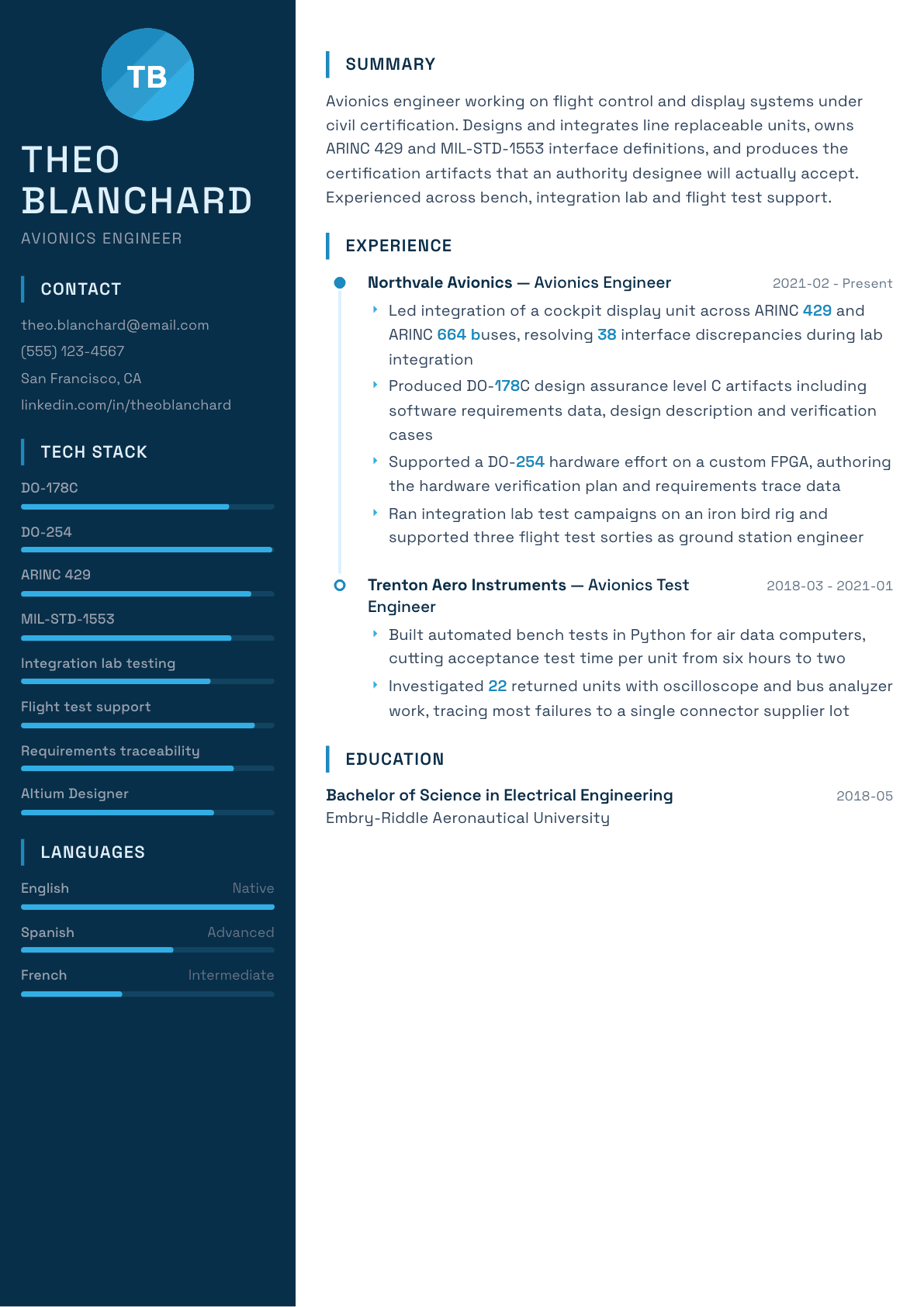
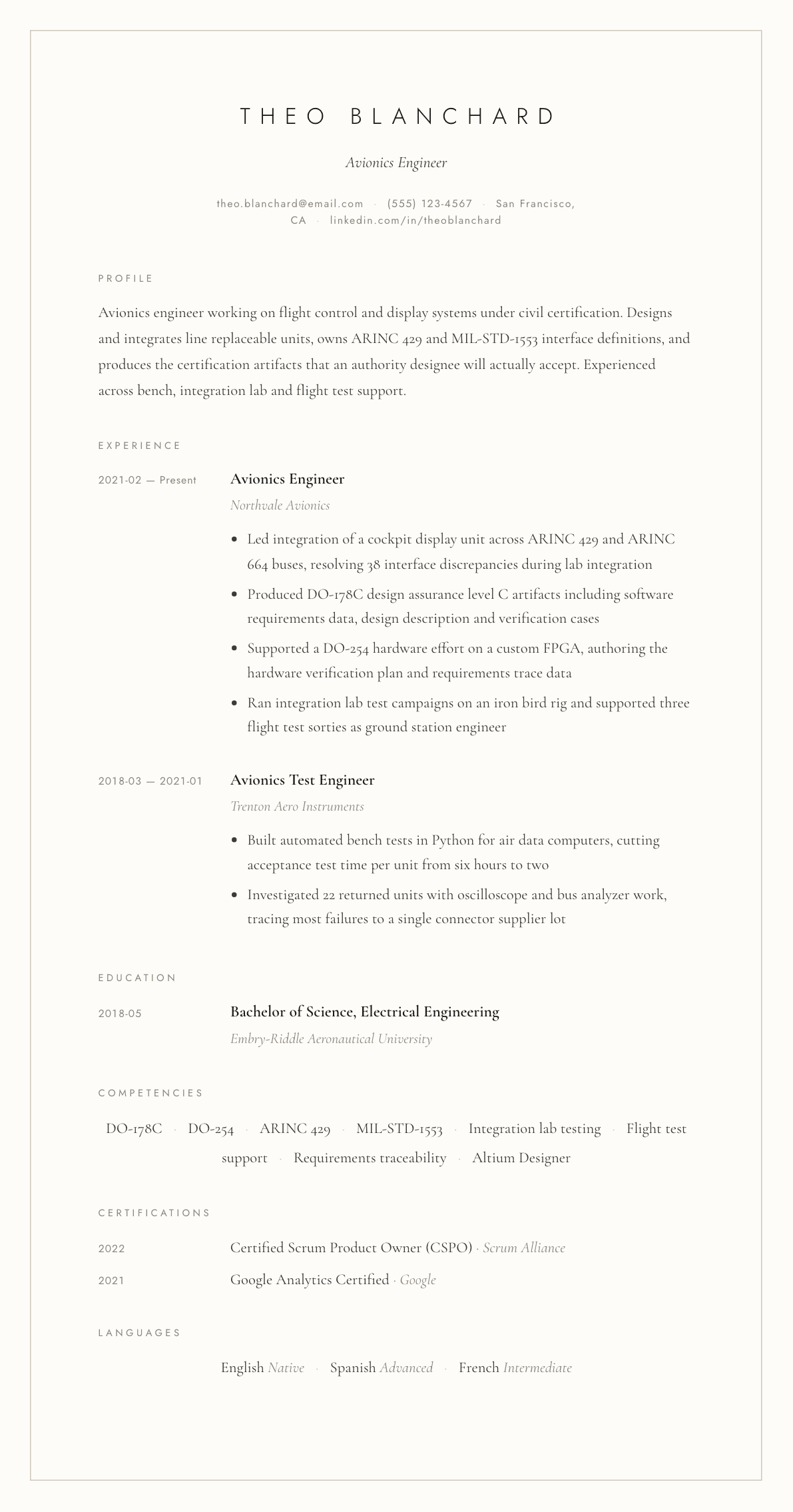
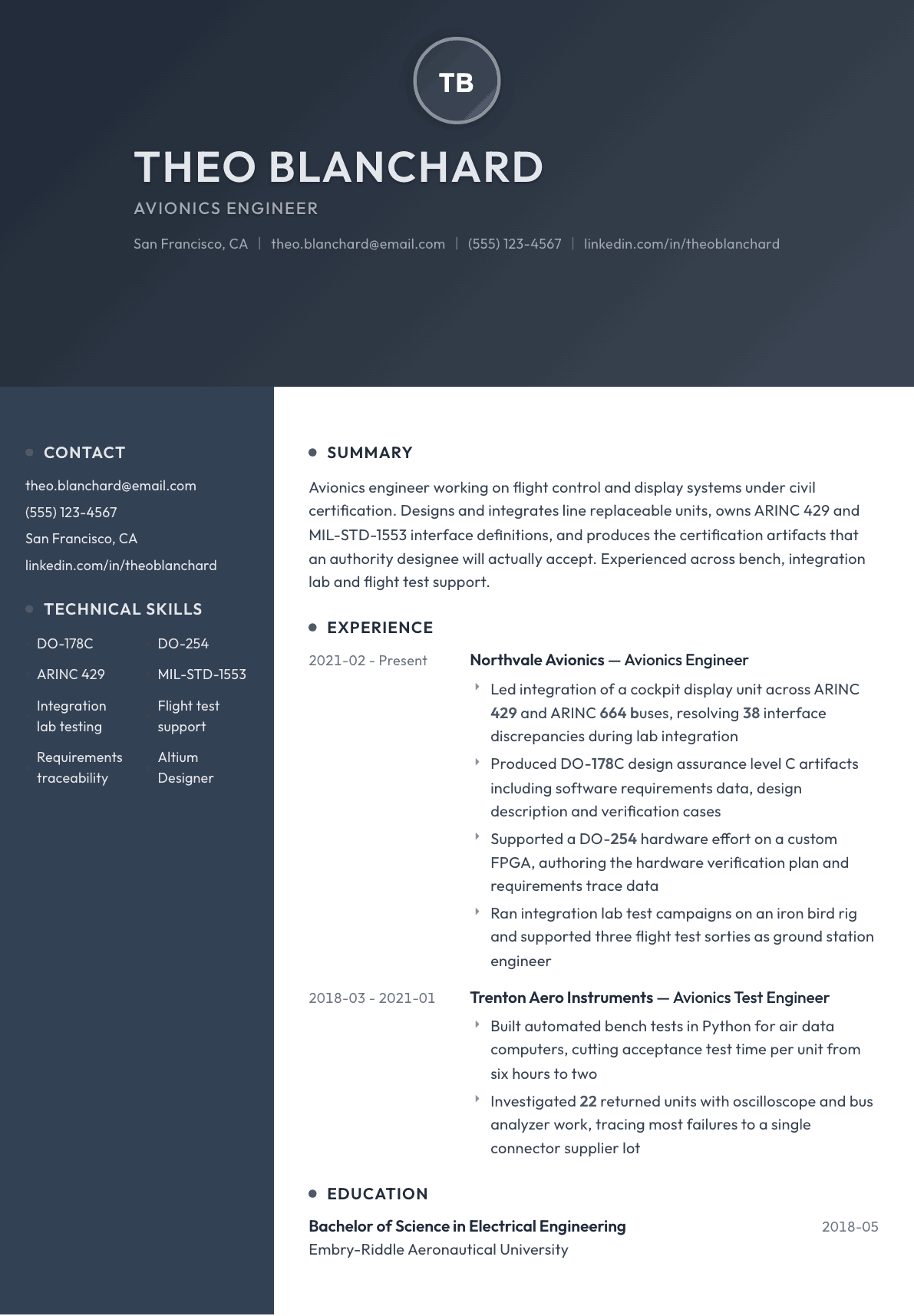
The same avionics engineer content laid out in three CVBooster templates, so you can see what the finished document looks like before you write a word.
Example Avionics Engineer summary
Avionics engineer with six years on flight control and cockpit display systems certified under DO-178C and DO-254. Owns bus interface definitions across ARINC 429 and ARINC 664, produces design assurance artifacts that pass authority review, and runs integration lab campaigns through to flight test support. Strong bench background in air data and display hardware. Seeking a lead avionics integration role on a transport category program.
Skills to list on a Avionics Engineer resume
- DO-178C
- DO-254
- DO-160 environmental qualification
- ARINC 429
- ARINC 664 AFDX
- MIL-STD-1553
- CAN bus
- Line replaceable unit integration
- Requirements traceability
- Integration lab and iron bird testing
- Flight test support
- Altium Designer
- VHDL
- Python test automation
- Failure reporting and corrective action
What actually gets this resume read
- Put the certification standards you have worked under near the top, with the design assurance levels you supported.
- Name the buses and protocols by their designation, because a screener searches for ARINC 429 or MIL-STD-1553 directly.
- Say whether your evidence went to a designated engineering representative, since that shows the work reached an authority.
- Distinguish lab integration from flight test support, as hiring teams staff those two activities separately.
- List your platform types, whether transport category, business aviation, rotorcraft or unmanned, in each job header.
- Keep export control and citizenship status visible if the posting requires it, and never overstate a clearance level.
How to write a avionics engineer resume
Avionics hiring is certification hiring. Before anyone reads about your circuit design or your integration lab campaigns, a screener checks whether you have worked under DO-178C or DO-254, at what design assurance level, and whether your artifacts ever reached an authority. A resume that buries those facts on page two gets sorted out before the technical reader sees it.
The second reader is a chief engineer or integration lead who wants to know which buses you have debugged, which platform category you know, and whether you have been in the lab at midnight with a bus analyzer or only in the requirements tool.
This guide sets out the order an avionics group expects to read, summaries for three stages of the career, before and after bullets from integration and test work, and the questions engineers ask when their program details are export controlled.
Format: certification block above the fold
Directly under the summary, put a short standards block listing the certification bases you have worked to and the design assurance levels you supported. DO-178C at level C, DO-254 at level B, DO-160 environmental qualification: three lines that answer the first three screening questions before the reader reaches your job history.
Then reverse chronological experience, with a scope line per job naming the platform category, the equipment type and your role in the certification effort. Keep the layout single column and plain, since primes and suppliers run parsers that mangle anything else.
- Header: name, city and state, phone, email, and citizenship or work authorization if export control applies.
- Sections: summary, certification standards, technical skills, experience, education, clearance if held.
- Add a platforms line naming transport category, business aviation, rotorcraft, unmanned or military types you have supported.
Summary: equipment, standard, level, phase
Four facts belong in the first two sentences: the avionics equipment you work on, the certification standard, the design assurance level, and whether you sit in design, integration, verification or flight test support. An avionics engineer who owns display integration and one who writes hardware verification plans for an FPGA are not interchangeable, and the summary decides which pile you land in.
Do not claim certification authority you did not hold. Saying that your artifacts were reviewed by a designated engineering representative is credible and specific. Saying you certified an aircraft is not, and the interviewer will unpick it in the first ten minutes.
Experience: buses, boxes and the lab
Name the buses in every relevant bullet. ARINC 429, ARINC 664, MIL-STD-1553, CAN and discrete interfaces are searched for as literal strings, and each one signals a different equipment world. Pair the bus with what you actually did: defined the interface, resolved discrepancies during integration, or wrote the analyzer scripts that found them.
Describe the boxes. A line replaceable unit has a form factor, a power budget, an environmental category and a supplier chain, and an engineer who has taken one through qualification writes about it differently from one who has read the specification. Give the equipment type, the integration environment and the campaign scale.
Separate bench work, integration lab work and flight test support. Aircraft programs staff those three activities with different people, and a candidate who has done all three should show it as three distinct capabilities rather than one blurred paragraph.
Certification artifacts, named individually
List the artifacts you personally authored. Software requirements data, design description, verification cases and procedures, traceability data, the hardware verification plan, the plan for hardware aspects of certification. These names are unambiguous to an avionics reader and are the strongest possible evidence that you did the work rather than supported someone who did.
Say where the artifacts went. Delivered to a designated engineering representative, submitted in a certification data package, or reviewed in a stage of involvement audit. That destination is what turns a document into certification evidence.
Skills: standards, protocols, tools, hardware
Group the skills block in four lines so a reader can find what they need. Standards covers the certification bases and any environmental or safety documents you have applied. Protocols covers the buses. Tools covers your schematic capture, hardware description language, requirements tool and test automation environment.
The hardware line should name real instruments: oscilloscopes, bus analyzers, environmental chambers, power supplies and the rig type you used, whether a systems integration bench or a full iron bird. Avionics managers hire people who have measured things, and that line is the proof.
Avionics Engineer resume summary examples
New graduate
Electrical engineering graduate with a senior project on a small unmanned aircraft flight computer, including CAN bus integration and a written verification plan. Coursework in embedded systems and digital design, plus a summer internship in avionics production test. Seeking an entry avionics engineer position.
Six years in
Avionics engineer working cockpit display and air data equipment under DO-178C at design assurance level C, with supporting DO-254 hardware work. Owns ARINC 429 and ARINC 664 interface definitions, runs integration lab campaigns, and has supported three flight test sorties as ground station engineer.
Lead avionics integration engineer
Lead avionics engineer with fourteen years on transport category and rotorcraft programs, owning integration strategy across flight control, display and navigation equipment. Has taken two line replaceable units from requirements through qualification and certification data submission, and mentors a team of five integration engineers.
Work experience bullets: before and after
Before: Worked on cockpit display integration.
After: Led integration of a cockpit display unit across ARINC 429 and ARINC 664 buses, resolving 38 interface discrepancies during lab integration and closing each one against the interface control document.
The named buses, discrepancy count and closure path are exactly what an integration lead needs to size your experience.
Before: Created certification documentation.
After: Produced DO-178C design assurance level C artifacts including software requirements data, design description and verification cases, delivered into the certification data package for authority review.
Naming the artifacts and their destination proves the work reached an authority instead of stopping in a folder.
Before: Tested avionics units on a bench.
After: Built automated bench acceptance tests in Python for air data computers, cutting the test time per unit from six hours to two while increasing measured parameter coverage.
A concrete before and after on test duration shows engineering value rather than task completion.
Before: Investigated field returns.
After: Investigated 22 returned units using oscilloscope and bus analyzer measurements, tracing the majority of failures to a single connector supplier lot and driving a corrective action with the vendor.
The instruments, the sample and the root cause make this a failure investigation rather than a support ticket.
Before: Supported flight testing.
After: Supported three flight test sorties as ground station engineer, monitoring live parameter telemetry, calling a test point abort on an anomalous air data reading, and writing the post-flight anomaly report.
A specific in-flight decision demonstrates the judgment a flight test role is actually hiring for.
Hard skills
- DO-178C software certification
- DO-254 airborne hardware certification
- DO-160 environmental qualification
- ARINC 429
- ARINC 664 AFDX
- MIL-STD-1553
- CAN bus and discrete interfaces
- Line replaceable unit integration
- Requirements traceability
- Systems integration lab and iron bird testing
- Flight test support and telemetry monitoring
- Altium Designer and schematic capture
- VHDL and FPGA verification
- Python test automation
- Failure reporting and corrective action
Soft skills
- Precision in written evidence
- Working with authority designees
- Lab troubleshooting under schedule pressure
- Coordinating with supplier engineering teams
- Anomaly reporting discipline
- Briefing flight test crews
Certifications worth listing
- Airframe and Powerplant (A&P) Mechanic Certificate (Federal Aviation Administration)
- FCC General Radiotelephone Operator License (Federal Communications Commission)
- Fundamentals of Engineering (FE) (NCEES)
- Certified Systems Engineering Professional (CSEP) (INCOSE)
Mistakes that cost avionics engineer candidates the interview
- Hiding the certification standards below the job history, so a screener filtering on DO-178C never reaches them.
- Naming a standard without the design assurance level, which leaves the hardest part of the work unquantified.
- Claiming to have certified an aircraft rather than describing the artifacts you authored and where they went.
- Leaving the buses out of the bullets, since protocol names are literal search terms in this field.
- Blurring bench, lab integration and flight test into one paragraph when programs staff those three separately.
- Overstating clearance level or omitting export control status, both of which stall an otherwise strong file.
Avionics Engineer resume questions
Do I need DO-178C experience to get an avionics engineer job?
For certified civil equipment it is close to mandatory, and postings screen for it directly. Military and unmanned work sometimes uses different bases. If you lack it, lead with bus integration, lab test and hardware depth, and name any process discipline you have applied to safety related equipment.
How do I write about export controlled programs?
Describe the engineering without the platform. Name the equipment class, the bus, the certification base, the level and the campaign scale, then state the outcome as a qualification or a data package delivery. Leave out customer names, performance figures and anything covered by your export compliance briefing.
Should an avionics engineer list a clearance on the resume?
Yes if you hold one, on its own line with the level and whether it is current. Never inflate it. Facility security officers verify status directly, and an inaccurate claim ends the process faster than having no clearance at all would have.
What is the difference between avionics engineering and avionics technician work?
A technician installs, tests and repairs equipment on aircraft or in production. An engineer defines requirements, designs the unit or its integration, and produces the certification evidence. If your background is technician side, show design and analysis work explicitly so the transition is visible on paper.
How much detail should I give about integration lab work?
Enough to prove you ran it. Name the rig type, the equipment under test, how many test campaigns you executed and one class of problem you found and closed. Integration lab depth is difficult to teach, so it deserves several lines rather than a passing mention.
Related resume examples
- Aerospace Engineer Resume example
- Electrical Engineer Resume example
- Systems Engineer Resume example
- Test Engineer Resume example
- Electronics Engineer Resume example
- Semiconductor Engineer Resume example