Commissioning Engineer Resume Examples: read this first
Build a Commissioning Engineer Resume That Shows Systems Handover
By Mustafa Tarabya, founder of CVBooster · Published · Updated
Commissioning engineer resume example with startup and testing bullets, systems completion keywords, and a guide to each resume section.
Sample resumes for a commissioning engineer
The same commissioning engineer content laid out in three CVBooster templates, so you can see what the finished document looks like before you write a word.
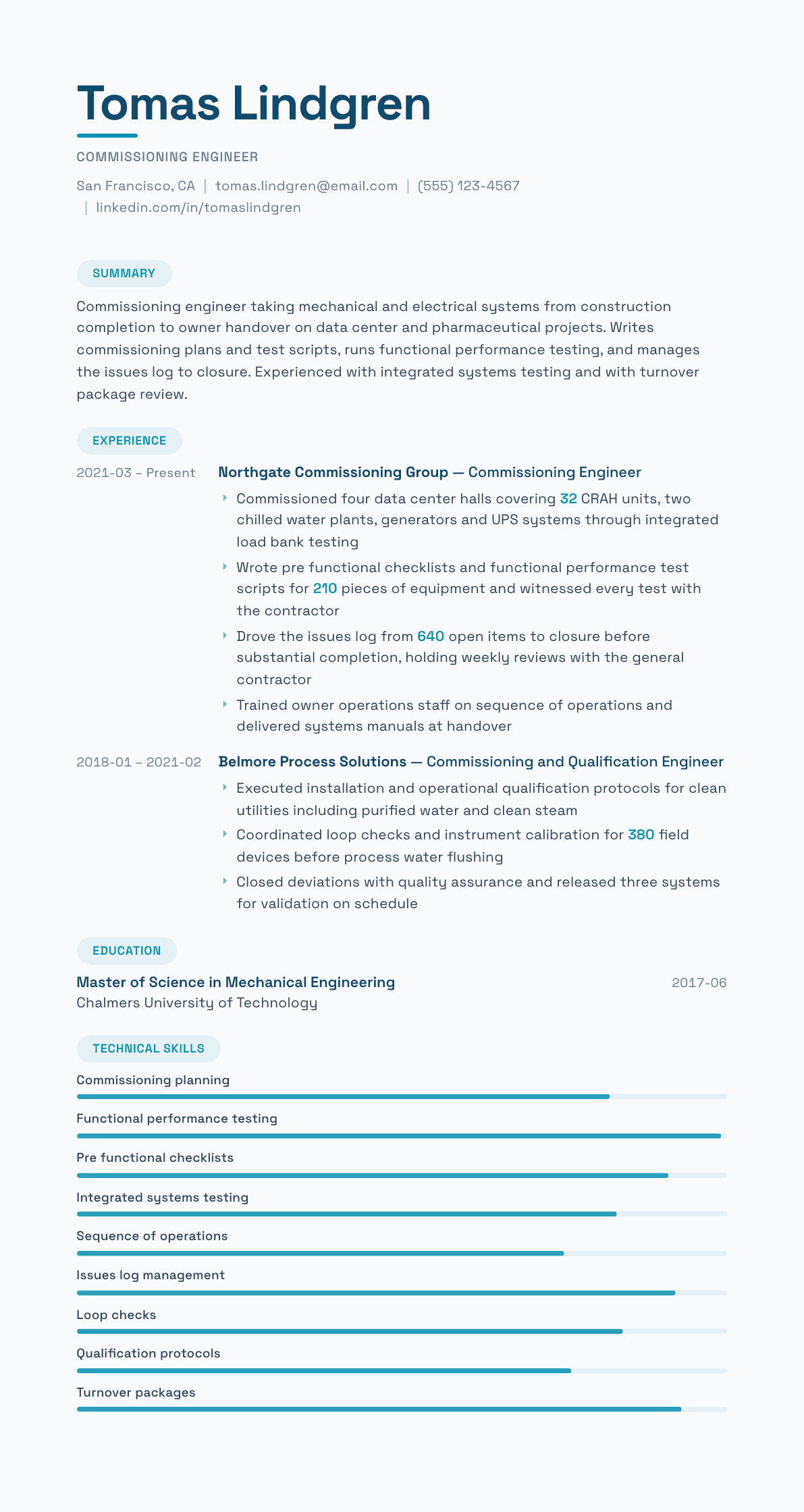
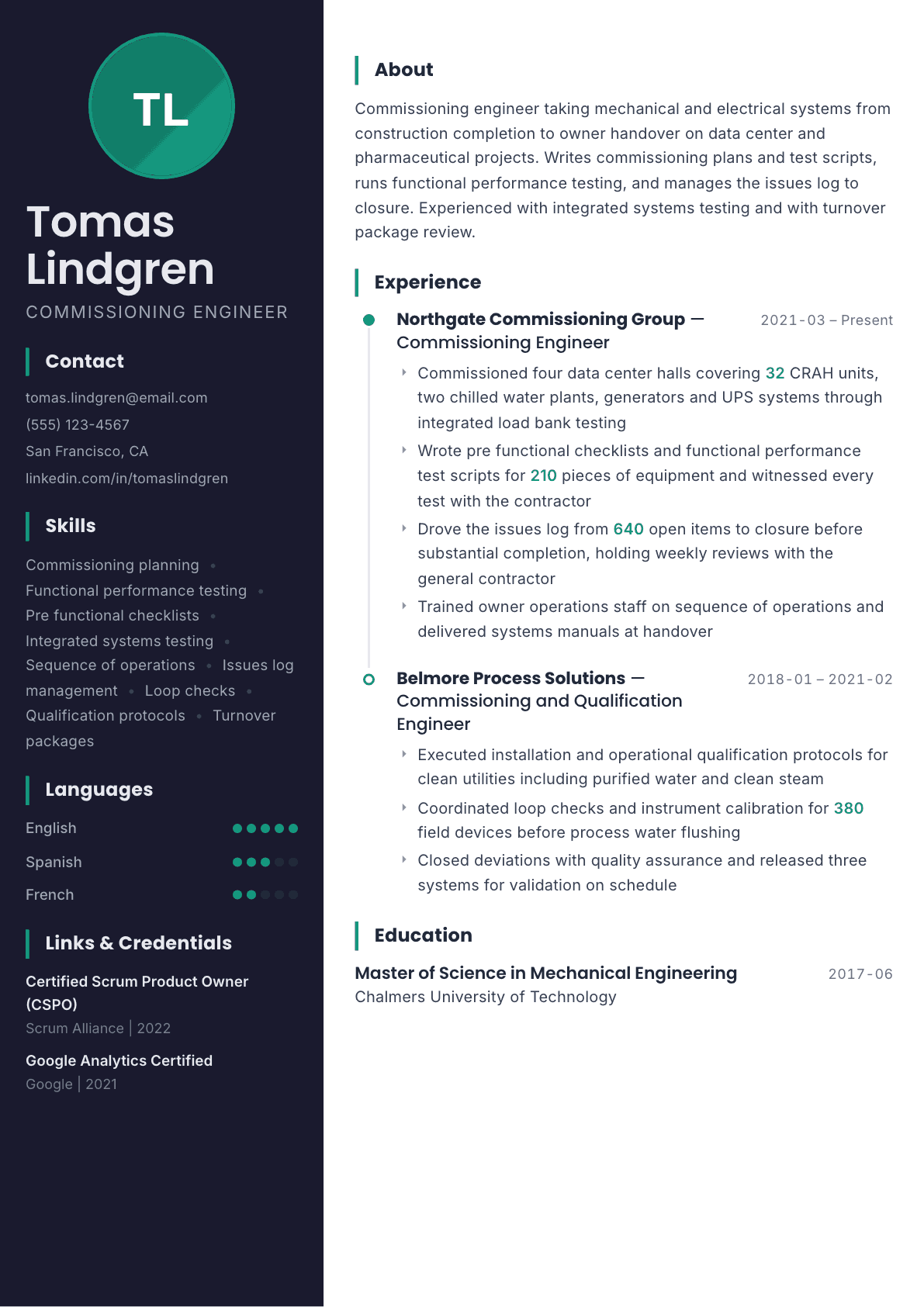
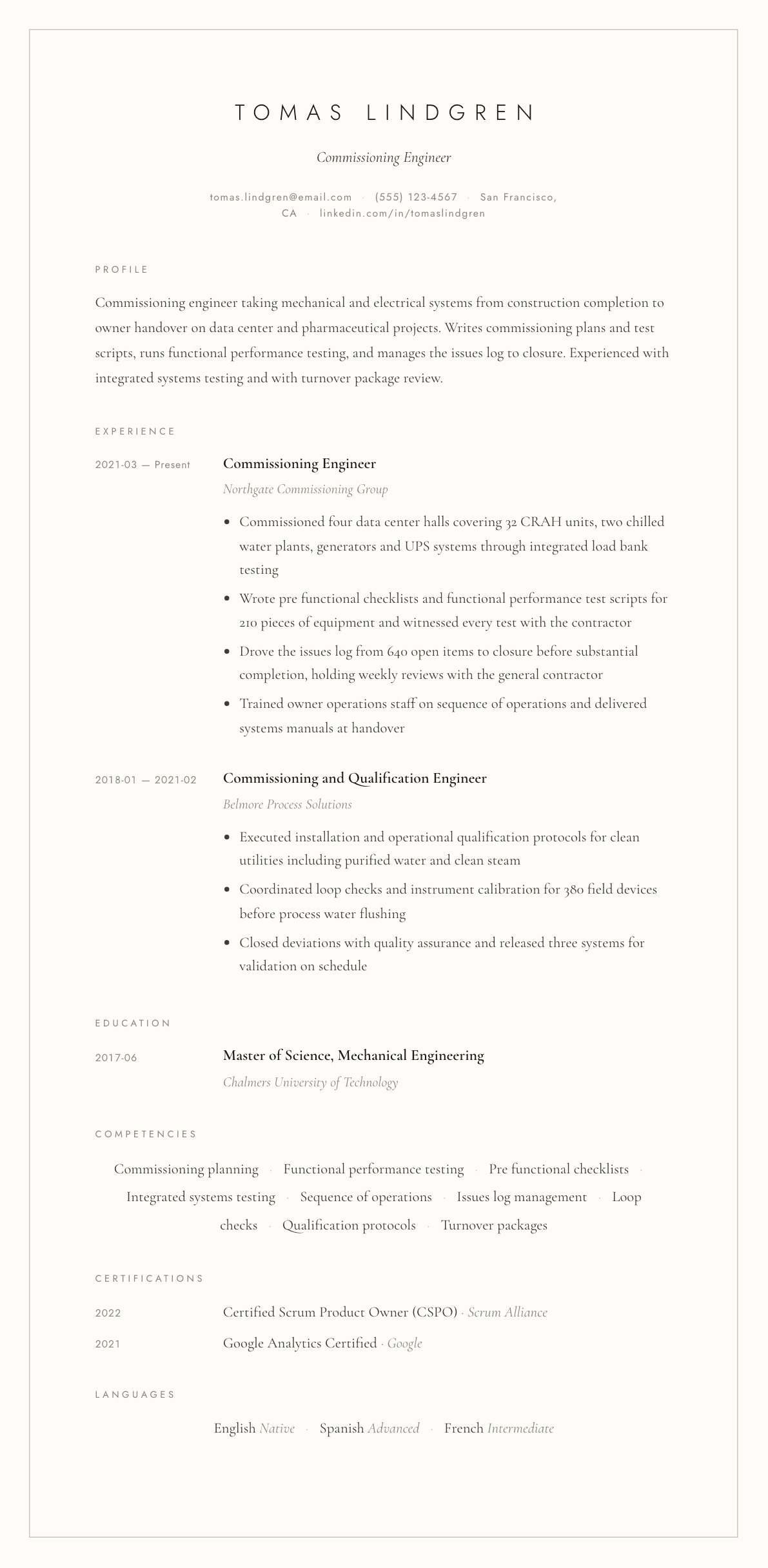
Example Commissioning Engineer summary
Commissioning engineer with seven years taking mechanical and electrical systems from construction completion through owner handover on data center and pharmaceutical projects. Writes commissioning plans and functional test scripts, runs integrated systems and load bank testing, and drives the issues log to closure. Closed 640 open items before substantial completion on a four hall data center. Seeking a lead commissioning role.
Skills to list on a Commissioning Engineer resume
- Commissioning plans
- Pre functional checklists
- Functional performance testing
- Integrated systems testing
- Load bank testing
- Sequence of operations review
- Building automation verification
- Issues log management
- Turnover package review
- Installation qualification
- Operational qualification
- Instrument loop checks
- Owner training
- Punch list closure
- Startup support
What actually gets this resume read
- State the project type and size for every assignment, because a data center handover differs from a process plant.
- List the systems you commissioned by name: chilled water, generators, UPS, air handlers, clean utilities.
- Show the issues log by open count and closure, since owners judge a commissioning engineer on closure discipline.
- Say whether you wrote the scripts or executed someone else scripts, as the two are hired at different levels.
- Include integrated systems testing and load bank work explicitly, because those are the hardest tests to staff.
- Mention qualification protocols and deviation handling if you have worked under regulated pharmaceutical rules.
How to write a commissioning engineer resume
Commissioning is the last mile of a construction project and the one everybody underestimates. The equipment is installed, the schedule is late, and someone has to prove that every system actually performs the way the design said it would before an owner takes the keys. A commissioning engineer is hired for the discipline to test properly under that pressure and the diplomacy to make a contractor fix what fails.
Because of that, the resume is read for three signals. Systems: which ones you have actually tested, at what scale, in which sector. Process: whether you wrote the plans and scripts or executed someone else, and how you managed the issues log. Closure: whether the projects you touched reached substantial completion and handover with the log clean.
This guide covers the format commissioning firms and owner teams expect, what belongs in each section, three summaries from a first role through a lead, before and after bullets from testing and handover work, and the questions engineers ask when moving between data centers, pharmaceutical facilities and commercial buildings.
Format: project driven, with a systems list a reader can scan
Use reverse chronological experience with a project list underneath, or lead with projects if you have moved between firms as a contractor. Commissioning work is remembered by project, so a reader looking for data center experience wants to find it without reading three job descriptions.
Give each project the sector, the size, the systems commissioned and your role. Whether you were the engineer executing tests, the agent authoring the plan or the lead coordinating a team changes how the same project reads.
- Header: name, city, phone, email, travel availability and any commissioning credential.
- Order: summary, certifications, experience, project list, technical systems, education.
- Regulated work adds a line stating the qualification framework you executed under.
Summary: sector, systems, and where you sit in the process
Name the sectors you have worked: data centers, pharmaceutical and biotech, healthcare, laboratories, higher education, commercial office or industrial. Then the systems: chilled water plants, air handling and terminal units, generators and uninterruptible power, electrical distribution, controls, clean utilities.
Then say what you produce. Writing commissioning plans and functional test scripts is a different market rate from executing scripts another engineer wrote. Be explicit, because the interview will establish it in the first five minutes anyway.
Experience: the test sequence, not the job description
Walk the reader through the sequence you own. Design review comments raised during documentation. Submittal and installation verification. Pre functional checklists against equipment. Point to point verification of controls. Functional performance testing against the sequence of operations. Integrated systems testing with load banks and failure scenarios. Then training, systems manuals and turnover packages.
Attach numbers to each stage. Equipment counts on checklists, tested points, test scripts written, issues raised and closed, and the date the log reached zero relative to substantial completion. Owners and firms both track issue closure, so it is the measure everyone in this field understands.
Failure scenarios are the part that distinguishes a strong commissioning engineer. Utility loss with generator start and transfer, chiller failure and lead lag rotation, uninterruptible power on battery, smoke control activation. Say which ones you have witnessed and what did not work the first time.
On regulated projects, describe the qualification path in its own bullets: installation and operational qualification protocols executed, deviations raised and closed with quality assurance, and the systems released for validation.
Systems, controls and documentation tools
Split the technical block into mechanical systems, electrical systems, controls and documentation. Controls deserve detail, because most functional testing is really an argument with a sequence of operations. Name the building automation platform, whether you trend and interpret data, and whether you can read the point list and the sequence narrative side by side.
Documentation tools matter more than people expect. Commissioning management platforms, issue tracking systems and the format of the turnover package all vary by firm, and naming what you have used shortens your ramp up in the reader mind.
Certifications, travel and posting keywords
Commissioning credentials are worth listing with the issuing body because owners sometimes require them contractually. Add any electrical safety training relevant to switching and load bank work, since site access can depend on it.
State your travel tolerance plainly. Much of this work is project based and away from home, and a firm will not guess. Posting terms to mirror include pre functional checklists, functional performance testing, integrated systems testing, sequence of operations, issues log, punch list, turnover packages, owner training and startup support.
Commissioning Engineer resume summary examples
First commissioning role
Mechanical engineering graduate with a year executing pre functional checklists and witnessing air balance on two commercial office fit outs. Reads sequences of operations, trends data on a building automation front end, and is looking for a commissioning engineer role with a specialist firm.
Six years in
Commissioning engineer with six years across data center and laboratory projects. Writes functional test scripts, runs integrated systems testing with load banks and utility failure scenarios, and manages the issues log to closure with general contractors. Comfortable leading a hall handover with owner operations staff present.
Commissioning lead
Commissioning lead with twelve years on data center and pharmaceutical projects. Authors commissioning plans and test programs, directs teams of four to six engineers, and has closed logs of several hundred items before substantial completion. Experienced with qualification protocols and deviation management under quality oversight.
Work experience bullets: before and after
Before: Commissioned mechanical and electrical systems on construction projects.
After: Commissioned four data center halls covering 32 CRAH units, two chilled water plants, generators and uninterruptible power through integrated load bank testing at full design load.
Naming the systems, the counts and the integrated test proves the work went past equipment startup into whole system performance.
Before: Wrote and executed test procedures for building systems.
After: Wrote pre functional checklists and functional performance test scripts for 210 pieces of equipment and witnessed every test alongside the installing contractor.
Authorship plus equipment count plus witnessing shows the full scope of the role rather than a paperwork task.
Before: Tracked and resolved commissioning issues.
After: Drove the issues log from 640 open items to zero before substantial completion, running weekly closure reviews with the general contractor and trade foremen.
The starting count, the endpoint and the meeting rhythm show how closure was actually achieved rather than claimed.
Before: Supported the qualification of clean utilities.
After: Executed installation and operational qualification protocols for purified water and clean steam, closing eleven deviations with quality assurance and releasing three systems for validation on plan.
Protocol type, deviation handling and the release outcome are the specifics a regulated project team needs to see.
Before: Provided training to the client at handover.
After: Trained owner operations staff on the sequence of operations for chilled water and generator systems, then delivered indexed systems manuals and as built control drawings at handover.
It names what was taught and what was handed over, which is how an owner judges whether a handover was real.
Hard skills
- Commissioning plan authoring
- Pre functional checklists
- Functional performance testing
- Integrated systems testing
- Load bank and failure scenario testing
- Sequence of operations review
- Building automation trending
- Point to point controls verification
- Issues log and punch list management
- Turnover package review
- Installation and operational qualification
- Instrument loop checks and calibration review
- Air and water balancing review
- Owner training delivery
Soft skills
- Holding contractors to a standard
- Meeting facilitation
- Written test documentation
- Calm under schedule pressure
- Client reporting
- Coordinating trades on site
Certifications worth listing
- Certified Commissioning Professional (CCP) (Building Commissioning Certification Board)
- Building Commissioning Professional (BCxP) (US Green Building Council)
- Certified Building Commissioning Professional (CBCP) (Association of Energy Engineers)
- Professional Engineer (PE) (State licensing board via NCEES examination)
- NFPA 70E Electrical Safety Training (Approved electrical safety training providers)
Mistakes that cost commissioning engineer candidates the interview
- Saying you commissioned a building without naming a single system, which hides whether you tested air or power.
- Blurring the line between writing scripts and executing them, when the two are hired at different levels and rates.
- Reporting issues raised without issues closed, which tells an owner nothing about whether the project finished.
- Leaving integrated systems testing off when it is the hardest and scarcest capability in this market.
- Omitting travel availability on a resume for work that is almost always somewhere other than home.
- Describing regulated qualification work in commercial commissioning language, which confuses a quality reviewer.
Commissioning Engineer resume questions
What is the difference between commissioning and startup?
Startup is the contractor bringing equipment to life. Commissioning is independent verification that the installed systems meet the owner requirements, including integrated behavior under failure. Make clear on your resume which side of that line you worked.
Do I need a commissioning certification to get hired?
Not usually for a first role, but owners sometimes require a certified professional on a contract, so holding one makes you easier to staff. List the credential and the issuing body, and add the level or specialty when the certification defines one.
How do I move from design or field engineering into commissioning?
Lead with anything test related: startup witnessing, balancing review, controls checkout, punch list closure. Then show you can read a sequence of operations and turn it into a test script, because that translation is the core skill of the job.
How much detail should I give about the issues log?
Enough to show closure discipline. State the open count at peak, when the log reached zero relative to substantial completion, and how often you held review meetings. Avoid naming contractors who performed badly, since the industry is small.
Is data center commissioning experience transferable to pharmaceutical work?
The mechanical and electrical testing transfers well. The documentation culture does not, because regulated projects run on qualification protocols and formal deviation handling. Name the systems you can carry across and be honest about the paperwork you would need to learn.
Related resume examples
- Mechanical Engineer Resume example
- Electrical Engineer Resume example
- Field Engineer Resume example
- Validation Engineer Resume example
- Systems Engineer Resume example
- Instrumentation Engineer Resume example