Fire Protection Engineer Resume Examples: free ATS score
Write a Fire Protection Engineer Resume That Clears Plan Review
By Mustafa Tarabya, founder of CVBooster · Published · Updated
Fire protection engineer resume example with sprinkler and alarm design bullets, NFPA keywords and a practical writing guide.
Sample resumes for a fire protection engineer
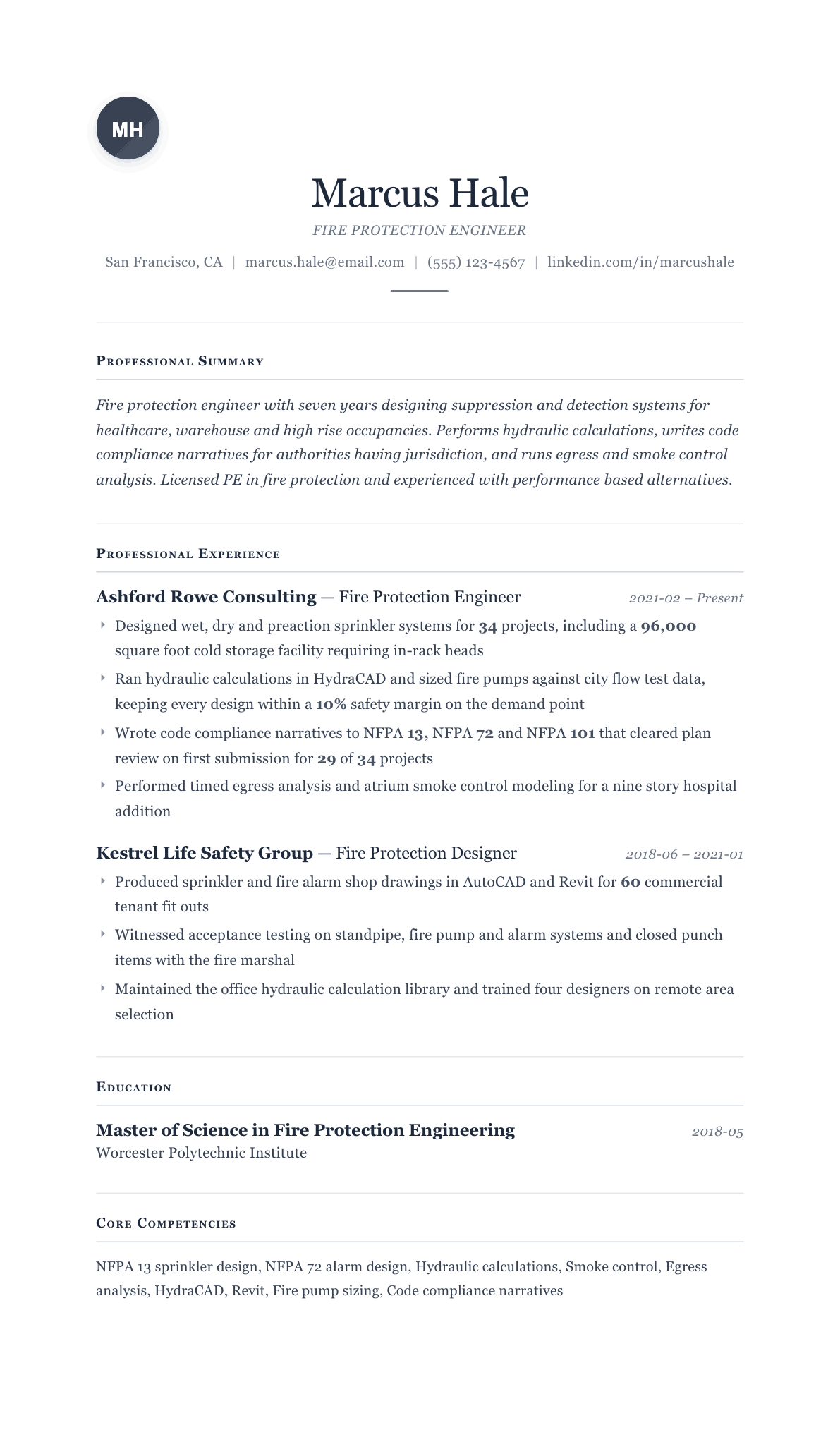
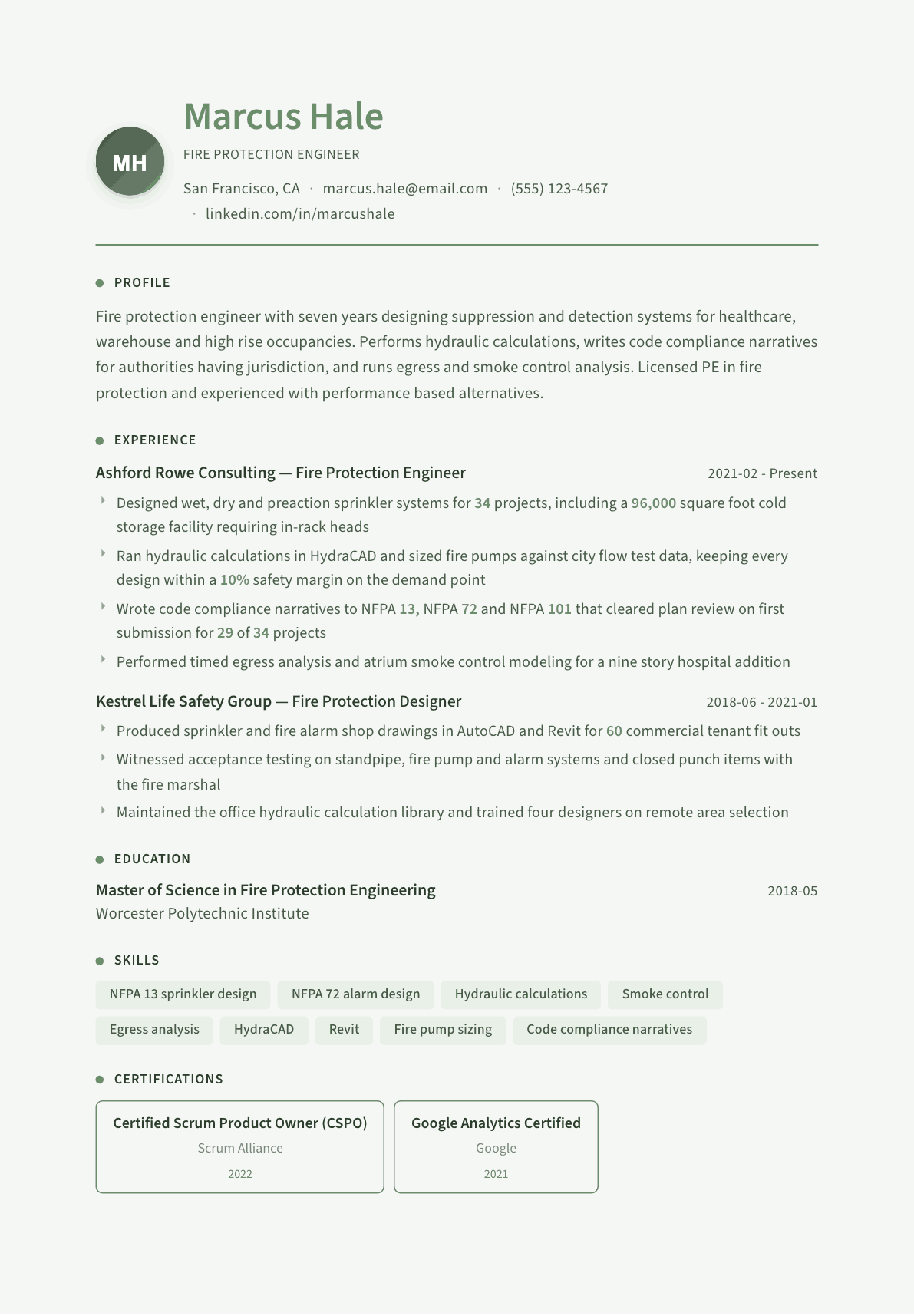
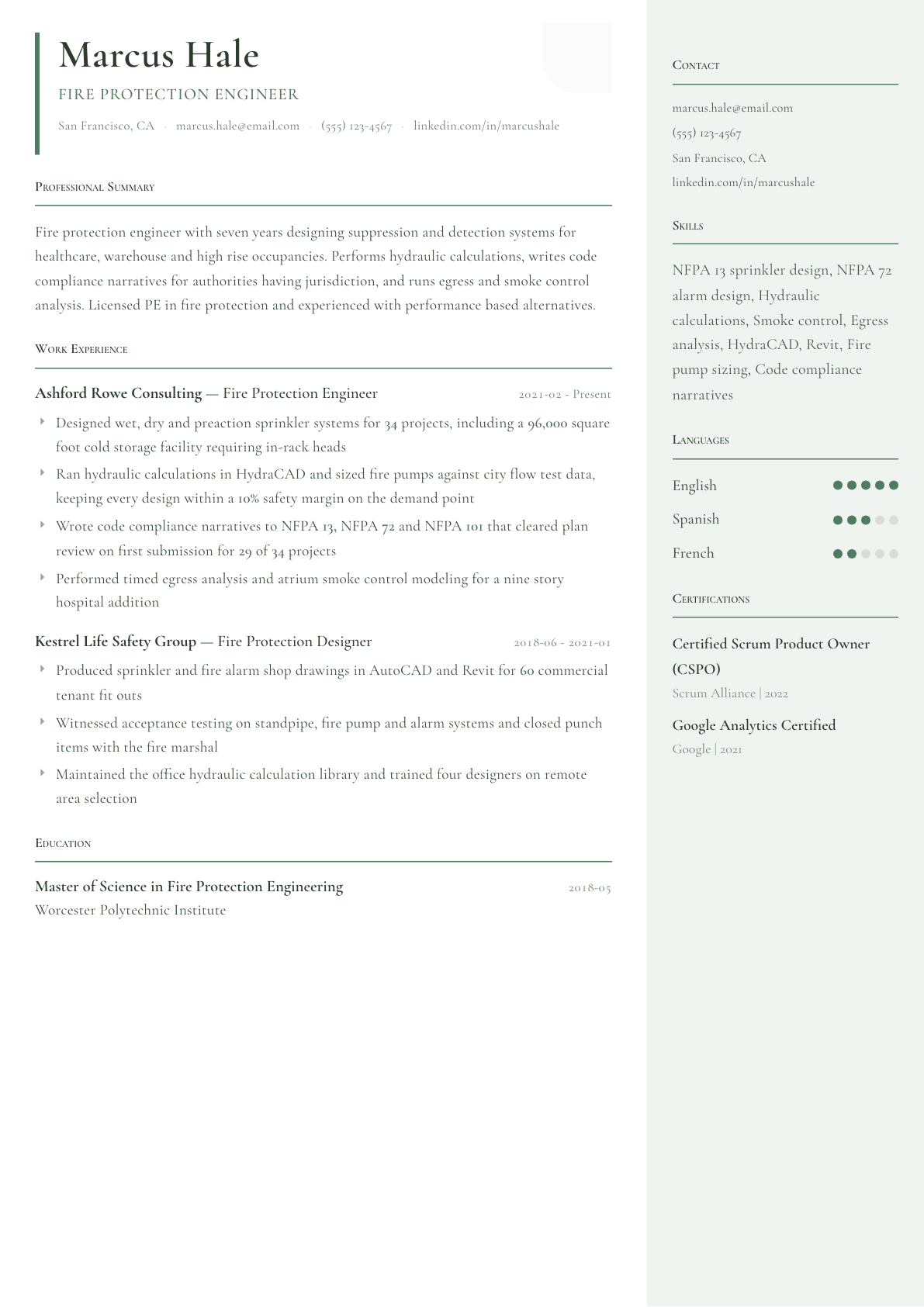
The same fire protection engineer content laid out in three CVBooster templates, so you can see what the finished document looks like before you write a word.
Example Fire Protection Engineer summary
Fire protection engineer with seven years designing suppression and detection systems for healthcare, cold storage and high rise projects. Performs hydraulic calculations, sizes fire pumps against city flow tests, and writes code compliance narratives to NFPA 13, NFPA 72 and NFPA 101. Cleared plan review on first submission for 29 of 34 recent projects and modeled atrium smoke control for a nine story hospital addition.
Skills to list on a Fire Protection Engineer resume
- NFPA 13
- NFPA 72
- NFPA 101
- Sprinkler system design
- Fire alarm design
- Hydraulic calculations
- Fire pump sizing
- Standpipe systems
- Smoke control analysis
- Egress modeling
- Special hazard suppression
- Code compliance narratives
- HydraCAD
- Revit
- Acceptance testing
- Plan review coordination
What actually gets this resume read
- Name the occupancies you have designed for, since a warehouse rack project reads nothing like a hospital.
- Cite the standards you applied by number, such as NFPA 13, NFPA 72, NFPA 101 and the adopted building code.
- Show plan review outcomes, because approval on first submission is the metric consulting managers value most.
- Put the PE license and its fire protection discipline in the header along with every state of registration.
- Separate suppression, detection and life safety analysis work so a reader can find the depth they need.
- Mention performance based design or modeling tools only if you can discuss the input assumptions in an interview.
How to write a fire protection engineer resume
A fire protection engineer resume is judged on whether the reader believes you can get a design through an authority having jurisdiction. That is the commercial reality of the discipline. Consulting principals are hiring billable capacity that clears plan review, insurers are hiring judgment about risk, and owners are hiring someone who can argue for a design in front of a fire marshal without losing the room.
The screener therefore looks for three things. Occupancies, because a rack storage warehouse, an operating theater suite and a high rise residential tower each demand a different design mind. Standards fluency, cited by number, attached to calculations you actually ran. And evidence of the approval process: submissions, comment responses, acceptance testing and final sign off.
This guide covers the format and section order the discipline expects, three summaries from a first job through a senior engineer, before and after bullets from suppression, detection and life safety work, and the questions engineers ask when moving between consulting, insurance and code enforcement.
Format: put the license and standards where they are found first
Single column, reverse chronological, no icons in the experience block. Consulting firms circulate resumes as attachments in proposal packages, so the file also has to look right when a client reads it next to three competitors.
The header carries your name, the PE license with the fire protection discipline, and every state of registration. Firms win work by geography, so a list of states is a direct statement of where you can be billed. Add the FE if you are still working toward licensure.
- Header: name, PE with discipline and states, city, phone, email.
- Order: summary, licenses and certifications, technical skills, experience, projects, education.
- Consultants add a project list with occupancy, size, systems designed and approval outcome.
Summary: occupancies, systems, and the approval record
Three lines that name the occupancies you have designed for, the systems you own, and the level of analysis you can perform. Healthcare, cold storage, high rise, data center, industrial and educational buildings all read as distinct experience to a principal choosing who to put on a pursuit.
Then say something about approvals. Designs cleared on first submission, or a difficult negotiation with a fire marshal that ended in an accepted alternative, tells a reader more than any adjective. If you do performance based design, say so here and be ready to discuss your design fire assumptions.
Experience: systems designed, calculations run, review cleared
Every job opens with the practice: consulting, owner side, insurance, contractor engineering or enforcement. Then the building types and sizes. Then bullets that name systems and calculations. Wet, dry, preaction and deluge sprinkler design. Standpipes. Fire pumps sized against city flow test data. Clean agent and water mist for special hazards. Detection and notification layouts. Smoke control. Timed egress analysis.
Attach the standard to the calculation. Sprinkler design to NFPA 13 with the density and area of operation you selected. Alarm and detection layout to NFPA 72. Means of egress and occupancy classification against NFPA 101 and the adopted building code. That combination of a calculation plus its governing standard is the single strongest signal on this resume.
Close each job with the delivery side: submissions made, comments resolved, acceptance testing witnessed, punch items closed with the fire marshal. Design that never got approved is not a project a firm can bill.
Technical skills: standards, calculation tools, modeling
Separate three lines. Standards and codes by number, so a parser can match them. Design and calculation software such as HydraCAD, AutoSPRINK, Revit and AutoCAD. Analysis and modeling tools for smoke movement and egress if you use them, with the honest note that a modeling line invites deep interview questions.
Add hazard specific competence where you have it: hazardous materials classification, combustible dust, flammable liquid storage arrangements, battery energy storage rooms, and industrial special hazard suppression. Those specialties are chronically short staffed and worth naming explicitly.
Projects and the keywords in postings
A project list is more persuasive than another paragraph of duties for anyone in consulting. Give each entry the occupancy, the size, the systems you designed and one outcome line covering approval or commissioning.
Recurring posting language worth mirroring includes life safety analysis, means of egress, hydraulic calculations, fire pump sizing, water supply analysis, sprinkler design, fire alarm design, smoke control, code consulting, plan review, acceptance testing and existing building surveys.
Fire Protection Engineer resume summary examples
First engineering role
Fire protection engineering graduate with an internship producing sprinkler layouts and hydraulic calculations for commercial tenant fit outs. Trained in NFPA 13 and NFPA 72, comfortable in AutoCAD and Revit, FE passed, and seeking a design engineer position with a life safety consultancy.
Six years in
Fire protection engineer with six years designing suppression and detection systems for healthcare, warehouse and educational buildings. Runs hydraulic calculations, sizes fire pumps against city flow tests, and writes code compliance narratives that have cleared plan review on first submission for most recent projects.
Senior engineer and PE
Senior fire protection engineer licensed in four states with eleven years across high rise, cold storage and hospital work. Seals suppression and life safety packages, performs timed egress and atrium smoke control analysis, negotiates alternatives with authorities having jurisdiction, and supervises a team of five designers.
Work experience bullets: before and after
Before: Designed sprinkler systems for commercial buildings.
After: Designed wet, dry and preaction sprinkler systems for 34 projects including a cold storage warehouse of roughly ninety six thousand square feet that needed in-rack heads and a dry pipe trip time check.
Project count plus a hard occupancy shows the range and the difficulty rather than a generic system type.
Before: Performed hydraulic calculations for fire protection systems.
After: Ran hydraulic calculations in HydraCAD against city flow test data and sized a fire pump so the demand point held a 10% margin below available supply at the remote area.
It names the tool, the water supply data source and the design margin, which is how a reviewer checks the work.
Before: Prepared code compliance documentation for projects.
After: Wrote code compliance narratives addressing NFPA 13, NFPA 72 and NFPA 101 that carried 29 of 34 projects through plan review with no resubmission required.
Citing the standards and the first pass approval rate turns documentation into a measurable commercial result.
Before: Analyzed building egress and smoke control.
After: Performed timed egress analysis and atrium smoke control modeling for a nine story hospital addition, and defended the design fire assumptions in a meeting with the fire marshal.
The building, the analysis type and the defense in front of the authority prove judgment rather than software operation.
Before: Witnessed testing of installed systems.
After: Witnessed acceptance testing on fire pumps, standpipes and alarm systems across 60 tenant fit outs and closed every punch item with the jurisdiction before occupancy.
It shows the project actually reached occupancy, which is the outcome an owner and a firm both care about.
Hard skills
- NFPA 13 sprinkler system design
- NFPA 72 fire alarm and detection design
- NFPA 101 life safety analysis
- Hydraulic calculations
- Water supply and flow test analysis
- Fire pump sizing and standpipe design
- Special hazard and clean agent suppression
- Smoke control analysis
- Timed egress analysis
- Code compliance narratives
- HydraCAD and AutoSPRINK
- Revit and AutoCAD
- Acceptance testing and commissioning
- Existing building surveys
Soft skills
- Negotiating with authorities
- Client presentation
- Technical writing
- Design review and mentoring
- Coordination with architects
- Managing review comments
Certifications worth listing
- Professional Engineer (PE), Fire Protection (State licensing board via NCEES examination)
- Fundamentals of Engineering (FE) (NCEES)
- Certified Fire Protection Specialist (CFPS) (National Fire Protection Association)
- NICET Certification in Water Based Systems Layout (National Institute for Certification in Engineering Technologies)
- NICET Certification in Fire Alarm Systems (NICET)
Mistakes that cost fire protection engineer candidates the interview
- Writing about fire protection generally without naming a single occupancy you have designed for.
- Citing standards as a list at the bottom instead of attaching each one to the calculation it governed.
- Leaving the states of PE registration off, which hides the geography a consulting firm can bill you in.
- Claiming performance based design experience you cannot defend when an interviewer asks about design fires.
- Skipping the approval and acceptance testing side, so the resume shows drawings but never a finished building.
- Mixing NICET designer work and stamped engineering work together, which makes the level of the role unclear.
Fire Protection Engineer resume questions
Is a PE license required to work as a fire protection engineer?
Sealing drawings requires one, so consulting careers stall without it. Insurance, owner side and enforcement roles routinely hire unlicensed engineers. If you are on the path, state the FE result and when you intend to sit for the PE.
Do I need a fire protection engineering degree for this field?
No. Mechanical, civil and chemical graduates enter the discipline regularly. What matters is documented design work under the fire codes, so lead with the systems designed and the standards applied rather than the degree title.
How do I show experience with authorities having jurisdiction?
Give plan review outcomes and negotiated alternatives. First submission approvals, comment responses that avoided redesign, and any accepted equivalency argument are the clearest evidence that you can move a project through review.
Should I list NICET certifications alongside a PE?
Yes, and keep them in the same block with their levels. NICET credentials prove layout capability that many engineering graduates lack, and contractors and design build teams filter for them specifically when staffing a project.
How long should a fire protection engineer resume be?
One page for the first few years, two once you have a project list worth reading. Add a separate project sheet when you apply to consultancies, since they often attach it directly to a proposal for a client.
Related resume examples
- Safety Engineer Resume example
- Mechanical Engineer Resume example
- HVAC Engineer Resume example
- Building Engineer Resume example
- Transportation Engineer Resume example
- Battery Engineer Resume example