Aerospace Engineer Resume Examples: the lines they read
Launch Your Aerospace Engineer Resume to New Heights
By Mustafa Tarabya, founder of CVBooster · Published · Updated
Create an aerospace engineer resume featuring propulsion, avionics, or structures expertise with industry-specific keywords and metrics that recruiters seek.
Sample resumes for a aerospace engineer
The same aerospace engineer content laid out in three CVBooster templates, so you can see what the finished document looks like before you write a word.
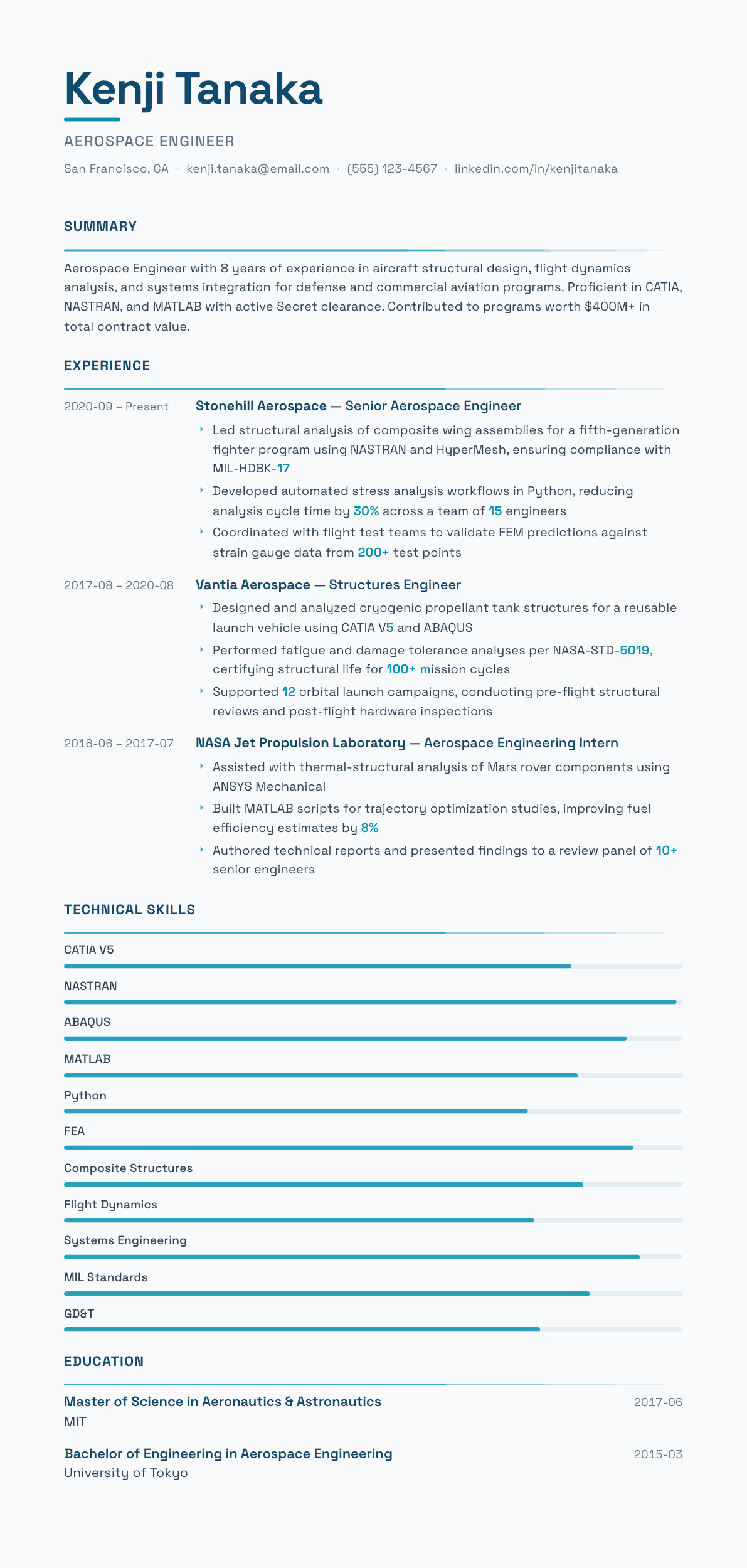
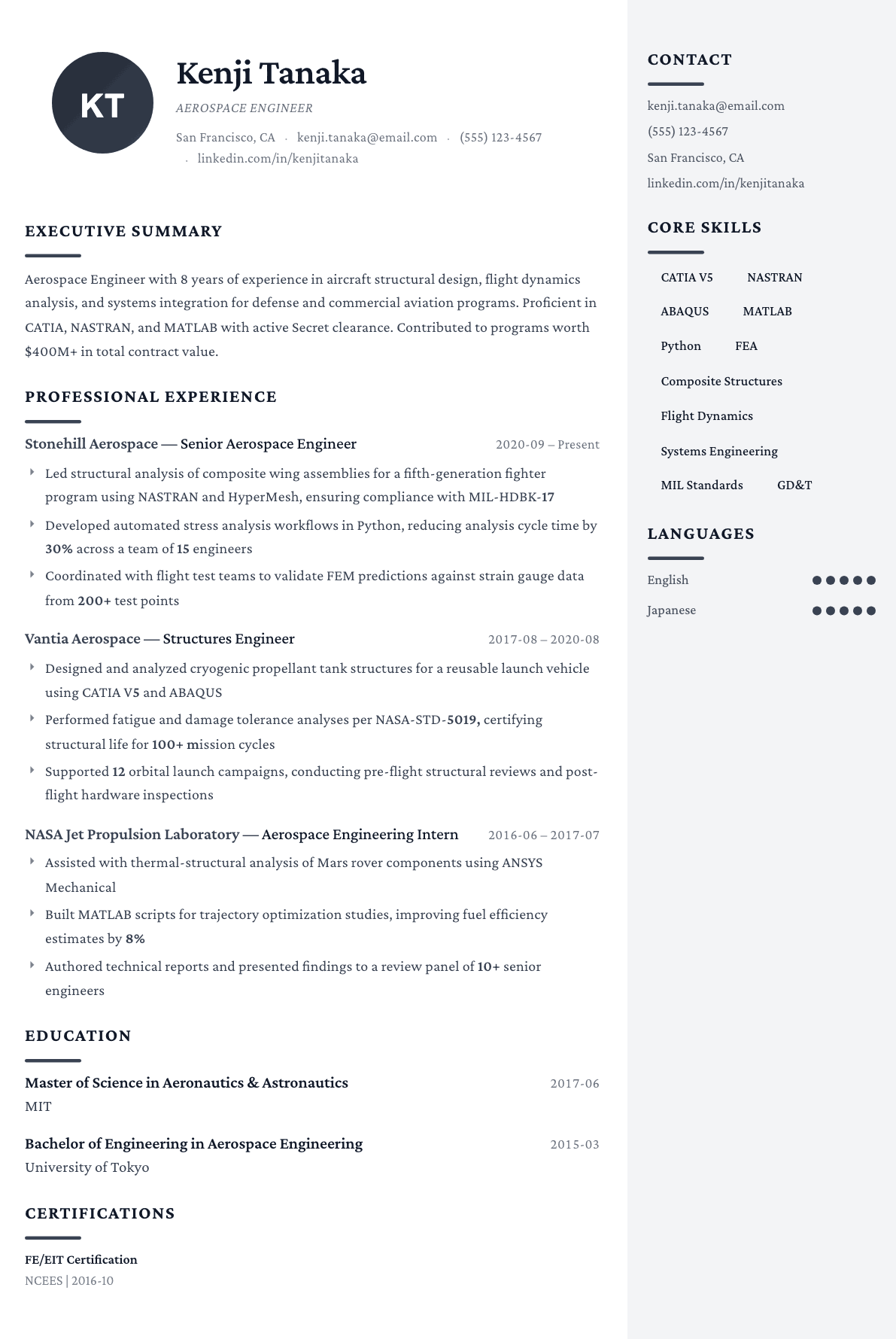
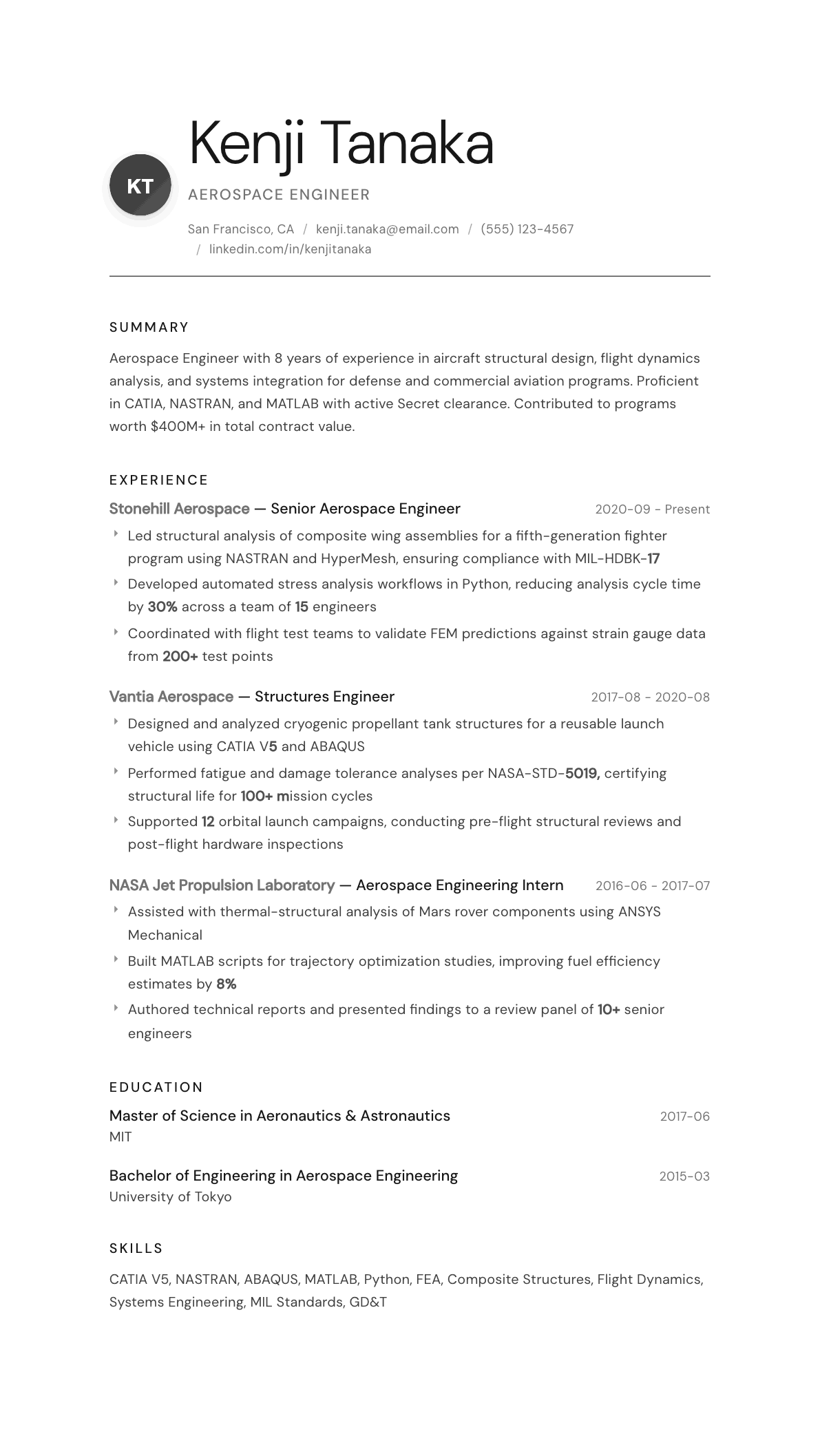
Example Aerospace Engineer summary
Aerospace Engineer with 8 years of experience in structural analysis, flight dynamics, and systems integration for defense and space programs. Expert in CATIA, NASTRAN, and MATLAB with active Secret clearance. Contributed to $400M+ in program value across commercial aviation and launch vehicle structures.
Skills to list on a Aerospace Engineer resume
- CATIA V5
- NASTRAN
- ABAQUS
- ANSYS
- MATLAB
- Python
- FEA / FEM
- CFD
- Composite Structures
- Flight Dynamics
- Orbital Mechanics
- Systems Engineering
- GD&T
- Fatigue & Damage Tolerance
- MIL-HDBK Standards
What actually gets this resume read
- Highlight aerospace-specific software: CATIA, NASTRAN, ABAQUS, ANSYS, MATLAB, Simulink, STK.
- Reference applicable standards: MIL-HDBK, NASA-STD, DO-178C, AS9100, FAR Part 25.
- Mention your security clearance level if applicable (Secret, Top Secret).
- Quantify contributions: program value, weight savings, test points validated, mission cycles.
- Specify your discipline: structures, propulsion, avionics, guidance & control, or systems.
- Include programming languages used for analysis automation: Python, MATLAB, Fortran.
How to write a aerospace engineer resume
Aerospace hiring has a gate before the technical review. Most defense and many commercial programs are export controlled, so a recruiter checks two things before reading a single bullet: whether you are eligible to work on controlled technical data, and whether you hold or have held a clearance. A resume that leaves both unstated gets set aside, not because the candidate is unqualified but because the recruiter cannot tell.
Past that gate, the hiring engineer wants to know your discipline. Aerospace engineer is an umbrella over structures, propulsion, aerodynamics, thermal, guidance navigation and control, avionics, systems and test, and those groups hire separately. A resume that reads as generically aerospace lands in nobody's pile, because the structures lead is looking for margin of safety work and the guidance lead is looking for Simulink models.
This guide covers how to present clearance and eligibility, how to write discipline-specific analysis work, which programs and standards to name, and how to describe classified or proprietary work without saying anything you should not. It includes summaries for a new graduate, a mid-level analyst and a lead.
Format: clearance, eligibility and discipline in the top third
One page under about eight years, two after that. Reverse chronological, plain text, no graphics. Large primes run keyword-driven applicant tracking, so the tools and standards need to appear as words rather than inside a skills chart.
Directly under your name, put your work authorization status in the terms the industry uses, your clearance level and whether it is active, current or expired with the date band, and your discipline. Something like structures and stress analysis, active Secret clearance is enough. Do not name the granting agency or investigation details.
- Header: name, city and state, phone, email, clearance status, work authorization for export-controlled work.
- Sections in order: summary, technical skills, professional experience, education, publications and patents, certifications.
- New graduates add a projects section for capstone, rocketry club, design build fly and internship work.
Summary: discipline, vehicle class, phase of the lifecycle
Three lines that answer three questions. Which discipline do you practice, which vehicle class have you worked on, and where in the lifecycle do you sit. A stress engineer on commercial transport structures in detail design is a different hire from a launch vehicle test engineer supporting campaigns on a pad, and the words fixed wing, rotorcraft, launch vehicle, satellite bus, hypersonics, unmanned aircraft and propulsion all carry that meaning quickly.
Name the lifecycle phase explicitly: conceptual trade studies, preliminary design, detail design and analysis, qualification and test, certification, or sustaining engineering. Hiring managers staff by phase because the skills genuinely differ, and candidates almost never say which one they have lived in.
Experience: the analysis, the loads, and what your work released
An aerospace bullet is only convincing when it names the physical problem and the method. Say what you analyzed, under what loading or environment, in which solver, against which criteria, and what the analysis allowed the program to do. Sizing a composite wing rib for ultimate load in a finite element model and releasing the stress report that cleared the part for build is a complete story. Performed structural analysis is not.
Include the reviews you supported. Preliminary design review, critical design review, test readiness review and qualification test campaigns are the milestones a program runs on, and saying you owned a data package through one of them tells a lead you can work inside a real schedule and defend your numbers to a review board.
Test and flight correlation is worth its own bullets when you have it. Comparing model predictions to strain gauge, accelerometer or wind tunnel data and then updating the model is the work that separates engineers who run software from engineers who understand what the software is doing.
Tools and standards, named exactly as the posting does
List the analysis codes with the version family where it matters: NASTRAN, ABAQUS, ANSYS Mechanical and Fluent, LS-DYNA, STAR-CCM+, Femap and HyperMesh for preprocessing, and CATIA, NX or Creo for the model you analyzed. For guidance and controls, MATLAB and Simulink with the specific toolboxes, plus the code generation path if you have used it. For mission analysis, tools such as STK and orbital propagators.
Standards signal experience more than tools do, because you only cite them when you have worked to them. Depending on your corner of the industry that might be the airworthiness regulations for transport aircraft, environmental qualification testing, software and hardware assurance levels for airborne systems, quality management for aviation and space, or the handbooks used for metallic and composite material allowables. Name the ones you have actually applied.
- Finite element and computational fluid dynamics solvers you have run and post-processed.
- CAD systems and configuration management or product lifecycle tools.
- Scripting used for automation, typically Python or MATLAB, with what it replaced.
- Regulatory and qualification standards you have written or reviewed against.
Classified and proprietary work: how to say enough
Describe the engineering, not the program. You can almost always state the discipline, the structure or subsystem type, the analysis method, the tool and the scale of the effort without touching anything controlled. Replace a program name with a vehicle class and a customer type, and replace specific performance numbers with the fact that requirements were met and verified.
When a whole role cannot be described, write a short unclassified position summary and note that details are available in an appropriate setting. Recruiters in this industry see that constantly and it costs you nothing. What does cost you is putting controlled data on a resume that lives in a third-party system.
Aerospace Engineer resume summary examples
New graduate
Aerospace engineering graduate with a structures focus, 2 internships in stress analysis and a capstone leading the airframe team on a 20-pound unmanned aircraft flown 12 times. Proficient in NASTRAN, Femap and Python automation, and eligible for work on export-controlled programs.
Five years in
Stress engineer with 5 years on commercial transport composite structures, sizing wing and empennage components to ultimate load and releasing stress reports through detail design. Active Secret clearance, fluent in NASTRAN, HyperMesh and CATIA V5, and correlated 3 component tests against model predictions.
Lead engineer
Lead structures engineer with 12 years across launch vehicle and satellite programs, responsible for the primary structure analysis package through 2 critical design reviews and a full qualification campaign. Directs a team of 6 analysts and owns the loads and dynamics interface with the vehicle contractor.
Work experience bullets: before and after
Before: Performed structural analysis on aircraft components.
After: Sized composite wing ribs and spar splices to ultimate load in NASTRAN with HyperMesh models, releasing 14 stress reports that cleared the assembly for first article build.
The component, the load case, the solver and the released deliverable turn a category into an engineering record.
Before: Used Python to automate analysis tasks.
After: Built a Python toolchain that generated load cases, ran the solver and assembled margin of safety tables, cutting a full airframe analysis cycle from 3 weeks to 4 days for a team of 15.
Naming what the script produced and the cycle time it replaced makes the automation an engineering result, not a hobby.
Before: Supported design reviews.
After: Owned the structures data package through preliminary and critical design review, defending 40 margin summaries and closing 22 review board action items before release.
Review ownership and action item closure prove you can carry work through a program gate.
Before: Worked on testing.
After: Correlated finite element predictions against 200 strain gauge channels from a static test article, updating joint stiffness in the model to bring predictions within 8% of measured strain.
Channel counts and a correlation result show test experience rather than attendance at a test.
Before: Did fatigue analysis for the program.
After: Performed damage tolerance and fatigue analysis on a cryogenic tank weld region, certifying structural life for 100 mission cycles and defining the inspection interval used in the maintenance plan.
The specific region, the certified life and the downstream maintenance decision show the analysis mattered.
Hard skills
- Finite element analysis
- NASTRAN and ABAQUS
- Computational fluid dynamics
- CATIA and NX modeling
- MATLAB and Simulink
- Python automation
- Loads and dynamics analysis
- Fatigue and damage tolerance
- Composite structures
- Geometric dimensioning and tolerancing
- Systems engineering and requirements management
- Test planning and data correlation
- Qualification and environmental testing
Soft skills
- Defending analysis to a review board
- Cross-discipline coordination
- Technical writing for release
- Working under configuration control
- Supplier technical oversight
- Mentoring junior analysts
Certifications worth listing
- Fundamentals of Engineering (FE) and Engineer in Training (National Council of Examiners for Engineering and Surveying)
- Professional Engineer (PE) License (State Board of Professional Engineers)
- Certified Systems Engineering Professional (CSEP) (International Council on Systems Engineering)
- Airframe and Powerplant Mechanic Certificate (Federal Aviation Administration)
- Project Management Professional (PMP) (Project Management Institute)
Mistakes that cost aerospace engineer candidates the interview
- Omitting clearance status and eligibility for export-controlled work, which is the first filter a defense recruiter applies.
- Writing as a generic aerospace engineer instead of naming structures, propulsion, controls, thermal or test.
- Listing solvers as a tool inventory without ever saying what was analyzed or what the analysis released.
- Putting controlled or proprietary performance data on a resume that will sit in a third-party recruiting system.
- Skipping design reviews and qualification milestones, which are how program experience is measured in this industry.
- Describing internships and student competition work in the same voice as professional analysis, with no distinction in scope.
Aerospace Engineer resume questions
Should I put my security clearance on an aerospace resume?
Yes, state the level and whether it is active, current or expired with the year band. Do not include your investigation date, granting agency, polygraph details or program access names. Recruiters filter on the level and the status alone.
How do I describe classified work I cannot name?
Describe the engineering in unclassified terms: the discipline, the structure or subsystem type, the analysis method, the tools and the team size. Substitute a vehicle class for the program name and state that further detail is available in an appropriate setting.
Do I need a professional engineer license in aerospace?
Rarely, because most aerospace work falls under the industrial exemption and is governed by company and regulatory processes instead. It helps in consulting, forensic work and some government roles, and the fundamentals exam is still a reasonable early credential.
How do I move from a student rocketry team into industry?
Treat the project like a job entry with a scope line: vehicle size, team you led, the subsystem you owned, the analysis you ran and what flew. Test and flight history is the strongest thing a graduate can put on the page.
What do hiring managers look for in an aerospace resume first?
Eligibility and clearance, then discipline, then evidence you have released work under configuration control. Analysis anyone can rerun is common; engineers who have signed a report, defended it at a review and correlated it against test data are not.
Related resume examples
- Mechanical Engineer Resume example
- Electrical Engineer Resume example
- Robotics Engineer Resume example
- Simulation Engineer Resume example
- Design Engineer Resume example
- Automotive Engineer Resume example