Tool and Die Maker Resume Examples: the lines they read
A Tool and Die Maker Resume That Shows Die Ownership
By Mustafa Tarabya, founder of CVBooster · Published · Updated
Tool and die maker resume example with progressive die, mold and fixture keywords, plus a guide to tryout, repair and tolerance evidence.
Sample resumes for a tool and die maker
The same tool and die maker content laid out in three CVBooster templates, so you can see what the finished document looks like before you write a word.
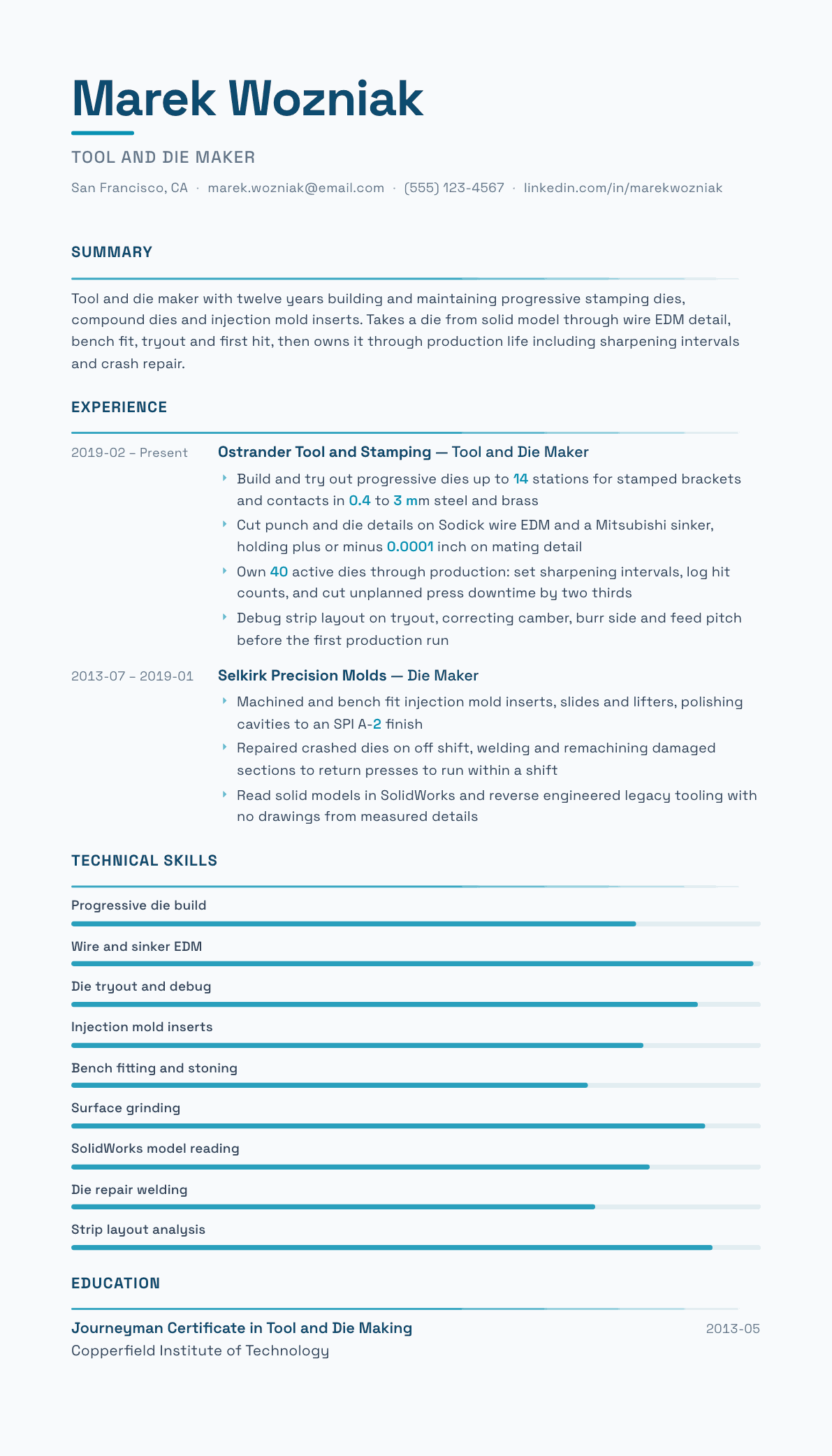
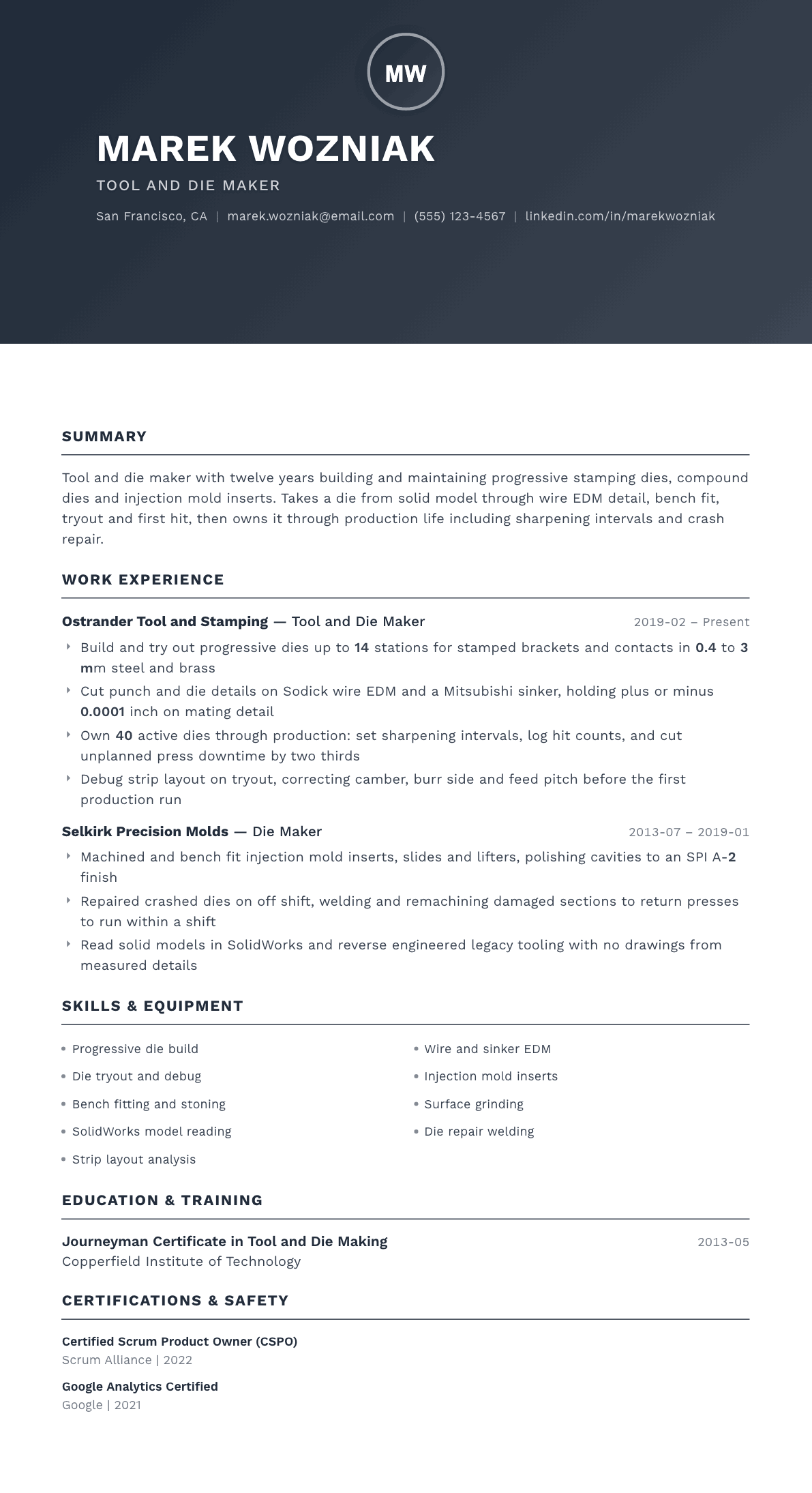
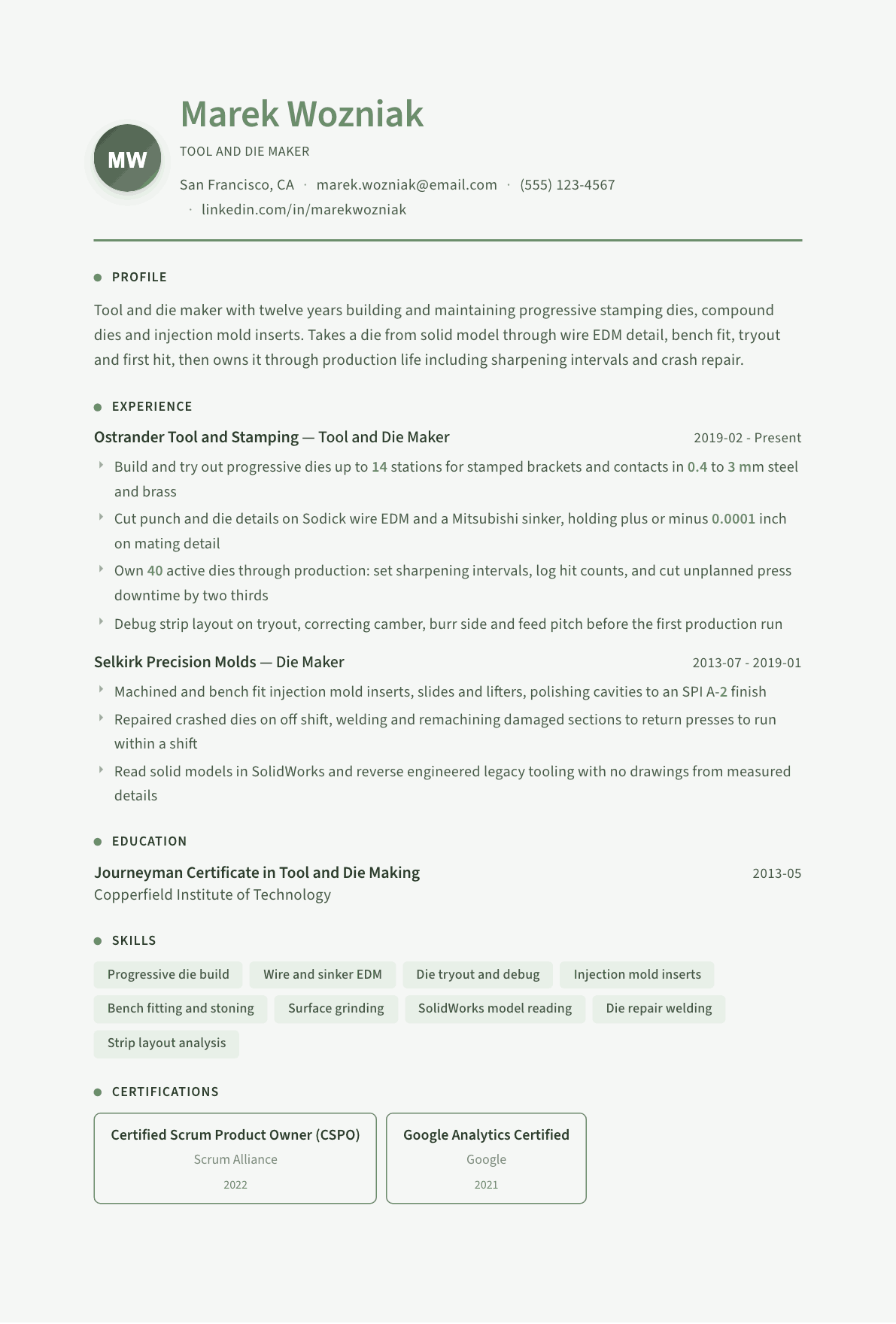
Example Tool and Die Maker summary
Tool and die maker with twelve years building progressive stamping dies up to fourteen stations and maintaining injection mold inserts. Cuts detail on wire and sinker EDM to plus or minus 0.0001 inch on mating features, benches and stones the fit, then runs tryout and corrects strip layout before first production. Owns forty active dies through their production life, tracking hit counts and sharpening intervals to keep presses running.
Skills to list on a Tool and Die Maker resume
- Progressive die construction
- Compound and blanking dies
- Injection mold insert work
- Wire EDM
- Sinker EDM
- Jig grinding
- Surface grinding
- Bench fitting and stoning
- Die tryout and first hit
- Strip layout and feed pitch
- Die repair and weld buildup
- Cavity polishing to SPI finish
- SolidWorks and print reading
- Hit count and maintenance logs
- Reverse engineering legacy tooling
What actually gets this resume read
- Say how many stations your progressive dies ran and what material and thickness they stamped.
- Separate die building from die repair, because shops hire for one or the other and pay them differently.
- Name your EDM machines and the tolerance you hold on mating detail, since that is the trade test.
- Give the number of active dies you own and what you track on them, such as hit counts and sharpening intervals.
- Show a tryout story: what you found in the strip and what you changed to fix burr side or camber.
- List the CAD you read, and say whether you take a solid model straight to the machine or work from prints.
How to write a tool and die maker resume
Tool and die work is one of the few trades where the hiring manager can tell from half a page whether you are the real thing. He runs presses that stop when a die stops, and he is deciding whether you can build tooling, fix tooling, or only run the surface grinder while someone else does the thinking. What separates the three is visible in how you describe a die.
A page that says "built and repaired dies and fixtures using various machine tools" tells him nothing. A tool and die maker page names the die type and the station count, the material and thickness it stamped, the tolerance held on mating detail, and what happened at tryout. Tryout is the moment the trade is tested: the strip comes out, the burr is on the wrong side, the part is out of flat, and someone has to know whether to change the die clearance, the pad pressure or the feed pitch.
This guide covers how to lay the page out, how to write die building separately from die repair, how to prove tolerance and finish work, and how to describe owning tooling through its production life rather than just handing it off after first hit.
Format: a tooling inventory instead of a duties list
One to two pages, reverse chronological. What makes a tool and die resume different from a general machining one is that the strongest section is not the job history at all, it is a short inventory of the tooling you have built and owned. Put it high on the page and keep it factual.
List die types with the numbers that describe them: progressive dies by station count, compound and blanking dies, draw dies with the draw depth, form and trim tooling, injection mold inserts and the cavity count they served, check fixtures and welding fixtures. A tool room manager reading that block already knows whether you fit his press line before he reaches your first employer.
- Contact line: name, phone, email, city, plus the shift and whether you cover off shift die crashes.
- Tooling inventory block: die and mold types with stations, material, thickness and press tonnage.
- Machine block: EDM, grinders, mills and the CAD you read, each with the make.
- Experience: employer, whether it was a captive tool room or a job shop, then bullets on build, tryout and repair.
- Apprenticeship and journeyman detail near the end with the hours completed.
Build work: from model to first hit
Describe the sequence you own. Taking a solid model or a print, laying out the die, machining or ordering details, cutting punches and buttons on wire EDM, sinking form detail, surface grinding to size, bench fitting and stoning, assembling and shimming, then the tryout. If you only own part of that chain, say which part. A shop that needs a bench hand and a shop that needs a builder are hiring different people.
Give the tolerance you hold on mating detail, because that number is the trade test. Cutting punch and die clearance correctly for the material thickness and hardness is what makes the difference between a die that runs a shift and one that galls in an hour. Say what clearance rule you work to and how you adjust it for stainless, brass or high strength steel.
Tryout deserves its own bullet. Describe a real correction: burr side wrong, so you flipped the cut direction; part out of flat, so you added a pressure pad; feed pitch drifting, so you reset the pilot and adjusted the lifter height. That kind of sentence proves you have stood at the press with a part in your hand.
Die repair and ownership: the part that keeps presses running
Most tool and die makers spend more hours maintaining tooling than building it, and hiring managers know it. Say how many active dies you own, what you track on them, and what your intervention looks like. Hit counts logged, sharpening at set intervals, spring replacement schedules, punch and button inventories kept stocked so a crash does not become a two day outage.
Crash repair is worth a bullet of its own. Welding a damaged section, remachining it, refitting the detail and getting the press back into production inside a shift is a concrete, measurable contribution. Give the downtime figure if you have it, because a tool room manager translates that straight into press hours saved.
If you have reduced press downtime or scrap through a tooling change, put the before and after on the page. A die whose sharpening interval more than doubled in hits after a clearance and coating change is the kind of story that gets you interviewed.
- Number of active dies you maintain and how you decide when one comes out of the press.
- Sharpening intervals, hit count tracking and where the log lives.
- Crash repair method: weld buildup, remachining, refit, and how long a return to production takes.
- Spare detail management, so a broken punch does not idle a press line.
- Any tooling change that lengthened die life or cut scrap, with the numbers on both sides.
EDM, grinding and finish work
Name your EDM machines and what you cut on them. Wire work for punches, buttons and inserts, sinker work for form detail and ribs, and any small hole drilling. Give the tolerance and the surface finish you produce, and say whether you write the programs or run someone else's. Jig grinding, if you have it, belongs in the summary because it is a scarce skill and shops search for it.
For mold work, cavity finishing is the visible half of the job. Give the SPI finish grades you polish to and the media you use, since an A-2 finish and a B-3 finish are different amounts of bench time. If you have textured or EDM finished cavities, say so with the plastic and the part it served.
Keywords and how tool rooms search
Stamping and molding employers search on concrete tooling language: progressive die, transfer die, blank, pierce, form, coin, draw, cam, lifter, pilot, stripper, nitrogen spring, strip layout, feed pitch, die clearance, tryout, first hit, hit count. Use them where the work actually happened, not as a keyword pile at the bottom.
Say what press tonnage range and what feed equipment you have worked with, because a die maker who has only worked small presses will feel every difference on a 600 ton line. Mention your CAD literacy plainly: reading a solid model, taking dimensions from it, or actually modeling die details yourself are three separate claims.
Tool and Die Maker resume summary examples
Apprentice die maker
Fourth year tool and die apprentice with 7000 hours in a captive stamping tool room. Grinds die sections to size, cuts punches on wire EDM under supervision, and benches and stones details for the journeymen. Completed the classroom portion in machine tool theory, print reading and die design fundamentals.
Journeyman builder
Tool and die maker with ten years building progressive dies up to twelve stations for stamped brackets and contacts in 0.4 to 3 mm steel and brass. Cuts detail on wire and sinker EDM to plus or minus 0.0001 inch, benches the fit, and runs tryout including strip correction before first production.
Tool room lead
Tool room lead with eighteen years across stamping dies and injection mold inserts, responsible for 60 active dies, the spare detail crib and the build schedule. Quotes new tooling, assigns work to four journeymen, and cut unplanned press downtime by two thirds through interval based sharpening.
Work experience bullets: before and after
Before: Built and repaired stamping dies.
After: Built and tried out progressive dies up to 14 stations for stamped contacts in 0.4 to 3 mm brass and steel, running on presses from 60 to 400 tons with coil feed.
Station count, material range and press tonnage let a tool room manager match the tooling to his own press line.
Before: Used EDM machines to make die components.
After: Cut punches, buttons and form inserts on a Sodick wire machine and a Mitsubishi sinker, holding plus or minus 0.0001 inch on mating detail and setting die clearance to material thickness and hardness.
Machines, tolerance and the clearance reasoning show trade judgment rather than machine operation.
Before: Fixed dies when they had problems.
After: Repaired crashed dies on off shift by welding and remachining damaged sections, refitting the detail at the bench and returning the press to production inside a single shift.
The method and the return to production time turn a vague fix into a measurable contribution.
Before: Maintained dies in production.
After: Owned 40 active dies through production life, setting sharpening intervals from hit counts and keeping punch and button spares stocked, which cut unplanned press downtime by two thirds.
Ownership scope, the tracking method and the downtime result together describe a system, not a task.
Before: Helped with die tryout.
After: Debugged strip layout on tryout by correcting burr side, adding a pressure pad to hold flatness and resetting pilot height to hold feed pitch across the full coil.
Naming three specific corrections proves hands on tryout experience that cannot be faked in an interview.
Hard skills
- Progressive die construction
- Compound, blank and pierce tooling
- Draw and form die work
- Injection mold insert building
- Wire EDM programming and operation
- Sinker EDM and small hole drilling
- Surface and jig grinding
- Bench fitting, stoning and shimming
- Die tryout and strip debugging
- Die clearance and cutting geometry
- Weld buildup and die repair
- Cavity polishing to SPI finish grades
- Solid model and print interpretation
- Hit count and maintenance record keeping
Soft skills
- Diagnosing a stamped part by looking at the burr
- Working alone on off shift when a press is down
- Explaining a tooling decision to a production supervisor under pressure
- Patience at the bench when the fit is close but not right
- Teaching an apprentice without taking the file out of his hand
Certifications worth listing
- NIMS Machining Level II Credential (National Institute for Metalworking Skills)
- NIMS Machining Level III Credential (National Institute for Metalworking Skills)
- Journeyworker Certificate of Completion of Apprenticeship (U.S. Department of Labor Office of Apprenticeship)
- OSHA 10-Hour General Industry (OSHA Training Institute)
Mistakes that cost tool and die maker candidates the interview
- Describing dies as dies without the type, the station count, the material thickness or the press tonnage they ran on.
- Mixing die building and die maintenance into one blur, when shops advertise and pay for them separately.
- Leaving tryout off the page, which is the exact skill a tool room manager cannot verify any other way.
- Listing EDM machines without the tolerance held or whether you write the programs yourself.
- Claiming CAD skills that amount to opening a model and rotating it, instead of saying you read models and take dimensions from them.
- Never mentioning off shift availability, when most crash repair happens when production is running and the tool room is empty.
Tool and Die Maker resume questions
How do I show die tryout experience on paper?
Write one bullet describing a real correction you made: what the strip or the part showed, what you changed in the die, and what the result was. A specific fix like adjusting pad pressure to hold flatness proves more than any list of tryout as a duty.
Should mold work and stamping die work go on the same resume?
Keep both if you have both, but separate them into distinct blocks so a reader can find the one he needs. A stamping tool room manager will skim past mold polishing, while a molder wants cavity finish grades and slide work spelled out in detail.
What if my shop calls me a die repair technician rather than a tool and die maker?
Use your official title, then describe the build work you actually do underneath it. Titles vary by plant, and a tool room manager judges from the tasks. Inflating the title creates a problem the moment someone calls your old employer to check.
How much does apprenticeship documentation matter?
It matters a lot in unionized and captive tool rooms, where the journeyman card sets the pay scale. Give the hours completed, the sponsoring employer or program, and the classroom subjects. If you learned on the job without formal papers, say that plainly and lead with tooling you have built.
Can I include photographs of tooling I built?
Only with your employer's permission, since die designs are usually customer property. A safer approach is a short list of tooling with the type, stations, material and tolerance, which gives an interviewer everything to ask about without exposing anyone's intellectual property.
Related resume examples
- Machinist Resume example
- CNC Machinist Resume example
- Tooling Engineer Resume example
- Metal Fabricator Resume example
- Press Operator Resume example
- Machine Operator Resume example