Machine Operator Resume Examples: the lines they read
Write a Machine Operator Resume That Names Your Machines
By Mustafa Tarabya, founder of CVBooster · Published · Updated
Machine operator resume example with setup, gauging and downtime keywords, plus a guide to writing run rates, scrap and machine list.
Sample resumes for a machine operator
The same machine operator content laid out in three CVBooster templates, so you can see what the finished document looks like before you write a word.
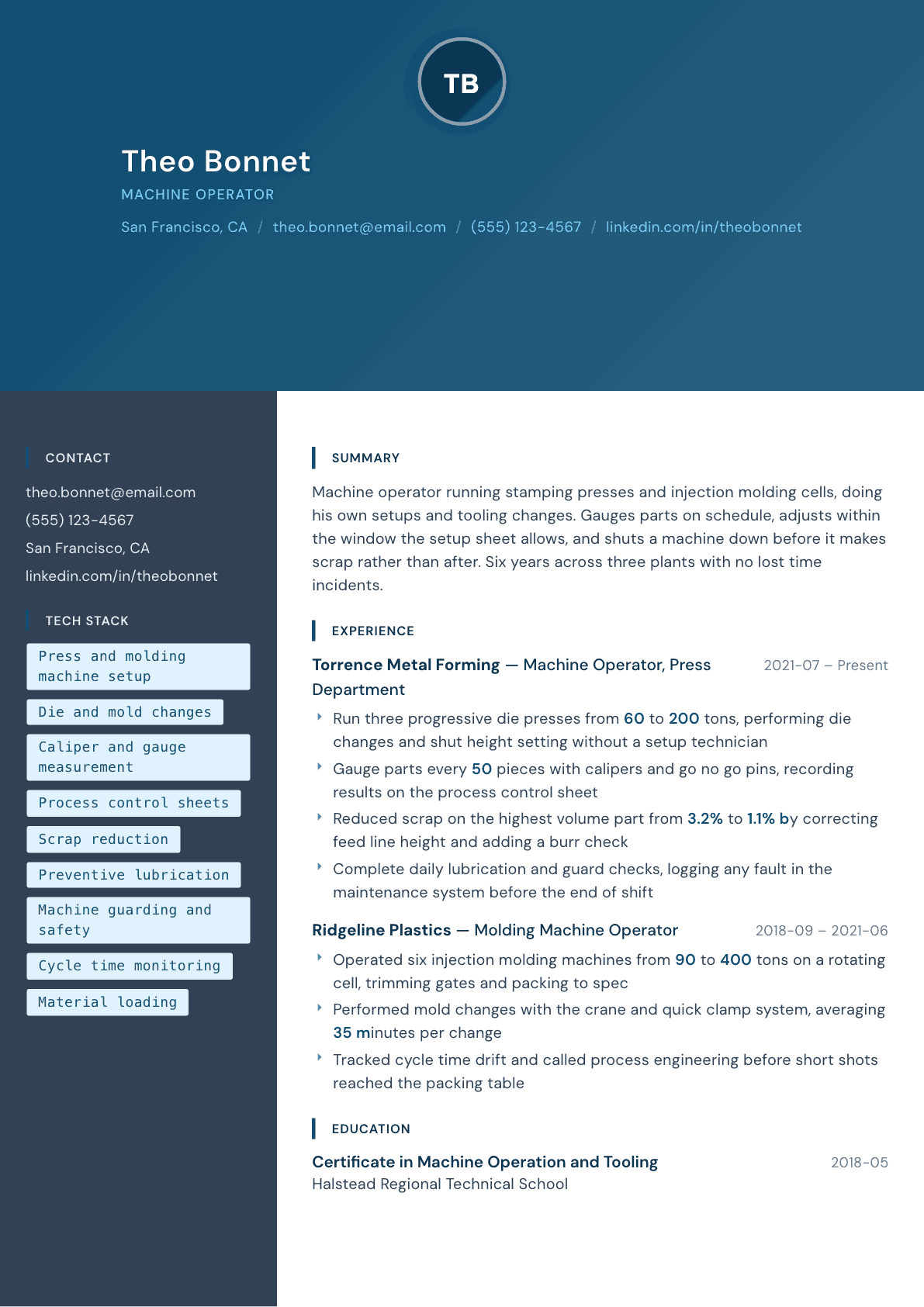
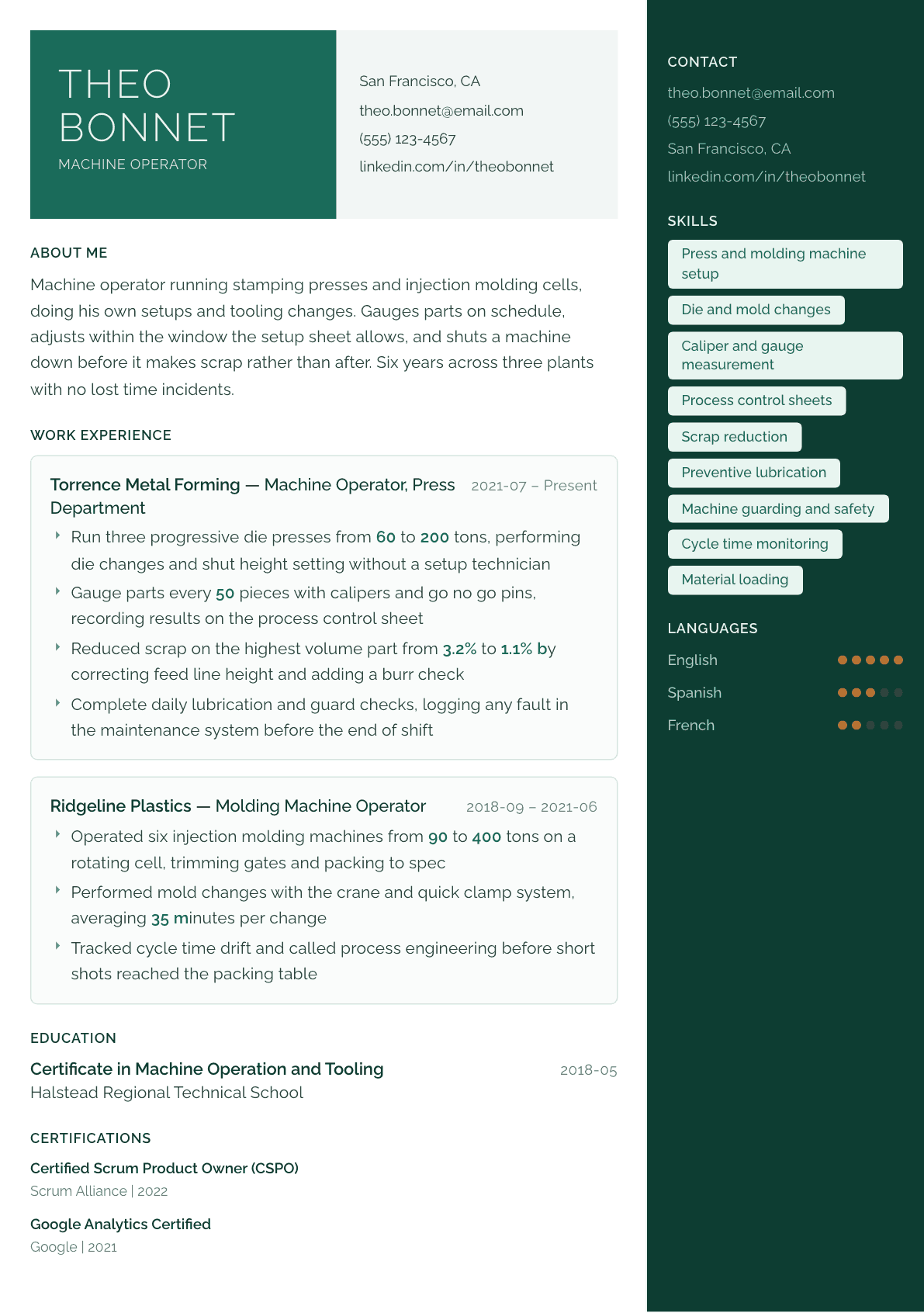
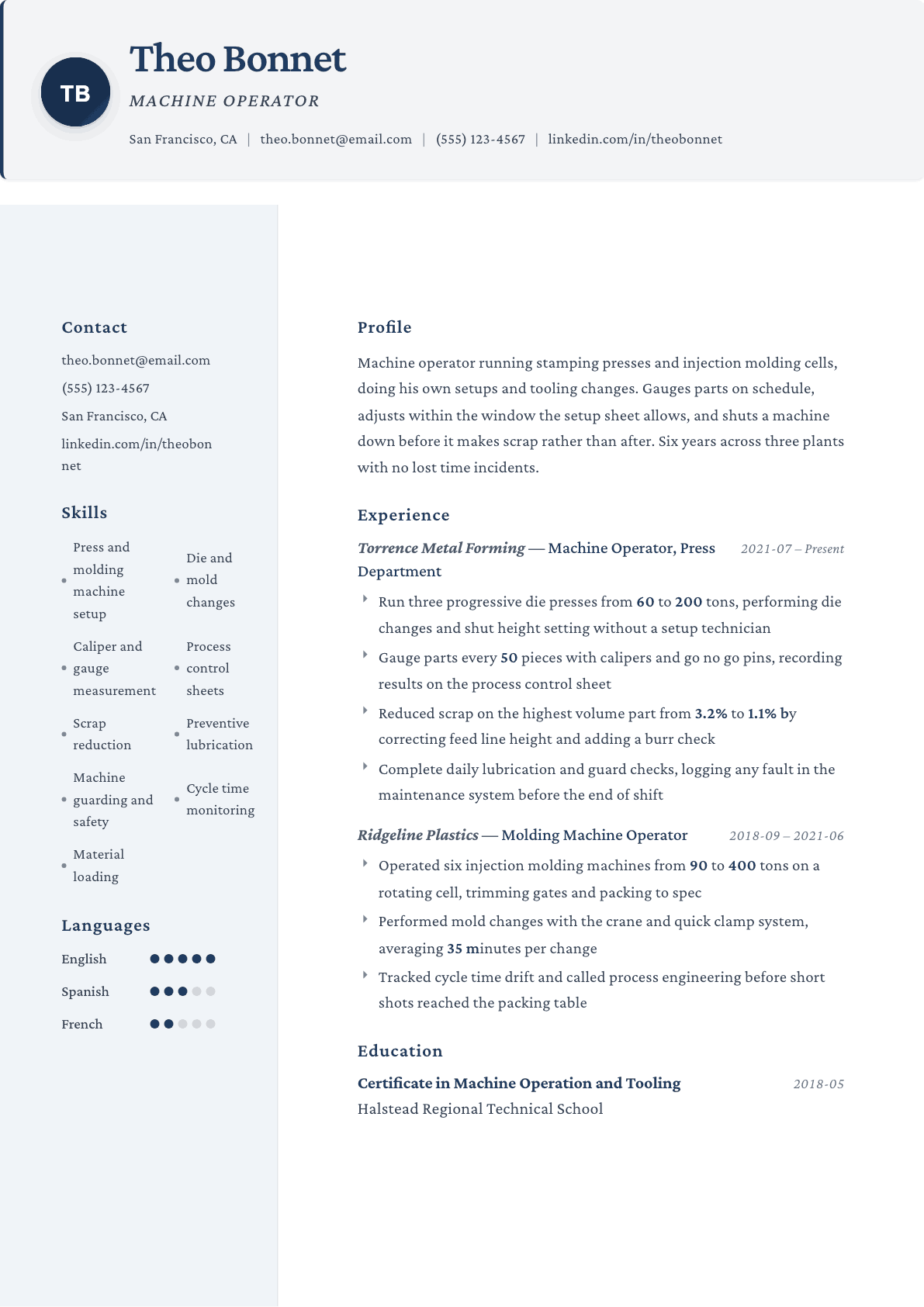
Example Machine Operator summary
Machine operator running progressive die presses and injection molding cells, performing his own die and mold changes without a setup technician. Gauges parts on a fixed interval with calipers and go no go pins, records results on the process control sheet, and stops a machine at the first sign of drift. Cut scrap on the highest volume part by more than half through a feed line correction.
Skills to list on a Machine Operator resume
- Machine setup and teardown
- Die and mold changeover
- Stamping press operation
- Injection molding operation
- Calipers, micrometers and gauges
- Go no go inspection
- Process control documentation
- Scrap and downtime tracking
- Preventive lubrication
- Lockout tagout
- Machine guarding
- Material loading and coil handling
- Cycle time monitoring
- Basic troubleshooting
What actually gets this resume read
- List your machines by type and tonnage or size, because a plant hires for the equipment it already owns.
- Say whether you set up your own machines, since setup capable operators are paid and screened differently.
- Give the gauging routine: what you measure, with what tool, and how often the setup sheet requires it.
- Put scrap and downtime numbers on the page, because those are the two figures a plant manager tracks daily.
- Name the material you run, whether steel coil, resin, aluminum or paperboard, since handling differs by material.
- Include machine guarding, lockout tagout and any powered industrial truck clearance you hold.
How to write a machine operator resume
Machine operator resumes are sorted by equipment before they are read for anything else. A stamping plant is looking for press experience, a molder is looking for tonnage and mold change time, a converting plant is looking for web handling. A resume that says operated various machinery answers none of those searches and gets filed under general labor.
The second sort is setup capability. An operator who loads material and presses cycle start is paid differently from an operator who changes the die, sets shut height, dials in the process and proves out the first part. That distinction is worth real money and it is invisible unless you write it explicitly.
This guide covers listing equipment so a plant recognizes its own, writing the setup and gauging work that raises your grade, using scrap and downtime as evidence, and the questions operators ask when they want to move from one machine family to another.
Format: one page, with an equipment block that reads like an inventory
One page, reverse chronological, plain formatting. The one structural difference from other production resumes is the equipment block, which should sit directly under the summary and read like a short inventory: machine type, size or tonnage, control type and material. Plants search on those words and supervisors read them first.
Do not scatter machine names through your bullets and hope the reader assembles the list. Give the list, then let the bullets show what you did with the equipment. Both halves are needed, and separating them makes the page far quicker to scan.
- Equipment block: press tonnage range, molding machine tonnage, machine count, and control or gauge types.
- Sections: summary, equipment, operating experience, safety and certifications, education.
- Name the material you run, since coil steel, resin, board and film handle nothing alike.
Summary: machines, setup ownership, and how you protect the part
Lead with the machine family and tonnage range, then state whether you do your own setups. An operator running progressive die presses from sixty to two hundred tons who performs die changes and sets shut height without a setup technician has established his grade in one sentence.
Close with quality behavior. Gauging on a fixed interval, adjusting inside the window the setup sheet allows, and stopping the machine at the first sign of drift rather than after a bin of scrap tells a plant manager how you will behave on his floor at three in the morning.
Experience: setup, gauging, scrap and downtime
Anchor each job with the department, the machines and the shift. Then build bullets around the four things a plant tracks. Setup: what you change, how long it takes, and whether you need help. Gauging: what you measure, with what tool, at what interval, and where it gets recorded.
Scrap: the rate and the fix. A bullet that says scrap on the highest volume part fell from a rate above three to just over one by correcting feed line height and adding a burr check is worth more than a paragraph of duties, because it shows the operator diagnosed rather than reported.
Downtime: what you clear yourself and what you escalate. Clearing a jam, replacing a worn insert, correcting a feed misalignment and calling maintenance for anything electrical is a reasonable boundary, and stating it clearly reads as maturity rather than as limitation.
Add the daily upkeep that keeps machines alive: lubrication routes, guard and interlock checks, filter and screen changes, coolant checks. Plants running lean maintenance teams weight this heavily.
- Give changeover time by name of change: die change, mold change, roll change, size change.
- State the gauging interval and the instruments, plus where results are recorded.
- Attach a scrap or reject figure to a specific cause you found and corrected.
- Draw the line between what you fix and what maintenance fixes.
Safety, guarding and clearances
Machine work carries the highest energy hazards on a plant floor, so the safety block is not a formality. Name lockout tagout, machine guarding and interlock verification, pinch point awareness, crane or hoist clearance if you change tooling, and any powered industrial truck certification you hold.
If you have gone years without a recordable injury on equipment this size, say it plainly with the period attached. Insurance cost and recordable rates are a live concern for every plant manager reading your resume, and a clean record on presses or molding machines is genuinely valuable.
Moving between machine families
Operators regularly move from molding to stamping, or from converting to packaging, and the move is easier to sell than most candidates think. The transferable core is setup logic, gauging discipline, process drift awareness and tooling care, and naming that core explicitly gives the reader permission to hire across the gap.
Support it with the closest technical overlap you have. Crane assisted tooling changes, quick clamp systems, hydraulic and pneumatic basics, and reading a setup sheet all appear in more than one machine family. Then say what you would need to learn, because an honest gap reads better than an overclaim.
Machine Operator resume summary examples
Entry level operator
Production worker moving into machine operation after two years loading, unloading and gauging parts on a press cell. Reads setup sheets, measures with calipers and go no go pins, and completed lockout tagout and machine guarding training. Seeking an operator seat with setup training available.
Three years on molding
Machine operator running six injection molding machines from ninety to four hundred tons on a rotating cell. Performs mold changes with the crane and quick clamp system, trims and packs to spec, and tracks cycle time drift so short shots are caught before they reach the packing table.
Setup capable press operator
Machine operator with six years on progressive die presses from sixty to two hundred tons, performing die changes and shut height setting without a setup technician. Gauges every fiftieth piece against the process control sheet and cut scrap on the highest volume part from 3.2% to 1.1% by correcting feed line height.
Work experience bullets: before and after
Before: Operated machines in a manufacturing facility.
After: Ran three progressive die presses from sixty to two hundred tons, performing die changes and shut height setting without a setup technician.
Machine family, tonnage range and setup ownership together define the pay grade the bullet is arguing for.
Before: Checked parts to make sure they were good.
After: Gauged parts every fifty pieces with calipers and go no go pins, recording each result on the process control sheet at the machine.
An interval, a tool and a record turn an inspection claim into a verifiable routine.
Before: Reduced scrap on my machine.
After: Cut scrap on the highest volume part from 3.2% to 1.1% by correcting feed line height and adding a burr check to the gauging routine.
The cause and the countermeasure show diagnosis, which is what separates an operator from a machine minder.
Before: Did changeovers between jobs.
After: Performed mold changes with the overhead crane and quick clamp system, averaging 35 minutes from last part to first good part.
Measuring from last part to first good part is the honest definition, and it shows you know how changeover is scored.
Before: Did basic maintenance on the equipment.
After: Completed daily lubrication routes and guard and interlock checks, logging any fault in the maintenance system before the end of shift.
Naming the routine and the handoff proves the upkeep actually happened rather than being intended.
Hard skills
- Machine setup and teardown
- Die and mold changeover
- Shut height and process parameter setting
- Stamping press operation
- Injection molding operation
- Calipers, micrometers and go no go gauges
- Process control sheet recording
- Scrap and downtime tracking
- Coil, resin and material handling
- Daily lubrication and guard checks
- Lockout tagout
- Overhead crane and hoist use
Soft skills
- Alertness to process drift
- Steadiness on repetitive checks
- Willingness to stop the machine
- Clear fault reporting
- Care with tooling
Certifications worth listing
- OSHA 10-Hour General Industry (OSHA Outreach Training Program)
- Certified Production Technician 4.0 (CPT 4.0) (Manufacturing Skill Standards Council)
- Machining Level I (National Institute for Metalworking Skills)
Mistakes that cost machine operator candidates the interview
- Writing operated various machinery, which matches no plant search and reads as no experience at all.
- Failing to say whether you set up your own equipment, which is the single biggest pay grade signal in the role.
- Leaving tonnage, size or machine count off, so a plant cannot tell whether your equipment resembles its own.
- Giving no gauging detail, which makes every quality claim on the page unverifiable.
- Omitting the material you run, when coil steel and resin demand completely different handling skills.
- Listing safety training as a single generic line rather than naming lockout tagout and guarding explicitly.
Machine Operator resume questions
How do I list machines when I have run a dozen different types?
Group them by family with a size range rather than listing every serial variant. Presses by tonnage, molding machines by clamp force, and converting equipment by web width give a reader the shape of your experience without a page of model numbers.
I do setups but I am titled operator. How do I show that?
Put it in the summary and in the first bullet of the job. Setup capable is a pay grade, not a title, so write what you change and whether a setup technician is involved. Interviewers verify it quickly and the claim is easy to defend.
How do I move from molding to stamping or the other way?
Lead with the shared core: setup logic, gauging discipline, tooling care and process drift awareness. Then name the overlapping mechanics such as crane assisted tooling changes and quick clamp systems, and be honest about what you would need to learn.
Should I put cycle time on a machine operator resume?
Yes when you influenced it. Monitoring cycle time drift and calling process engineering before defects reach packing is a genuine skill. Avoid quoting a standard cycle time that the tooling determines and you had no hand in setting.
Does a forklift certification help a machine operator application?
It helps, especially in smaller plants where operators move their own material and tooling. List the truck class you are cleared on, since a stand up reach truck and a sit down counterbalance are treated as separate clearances.
Related resume examples
- Press Operator Resume example
- Injection Molding Operator Resume example
- CNC Operator Resume example
- Production Operator Resume example
- Printing Press Operator Resume example
- Tool and Die Maker Resume example