Press Operator Resume Examples: the lines they read
Write a Press Operator Resume That Names Your Tonnage
By Mustafa Tarabya, founder of CVBooster · Published · Updated
Press operator resume example, keyword list and writing guide covering tonnage, progressive dies, coil feed setup, die changes and first article checks.
Sample resumes for a press operator
The same press operator content laid out in three CVBooster templates, so you can see what the finished document looks like before you write a word.
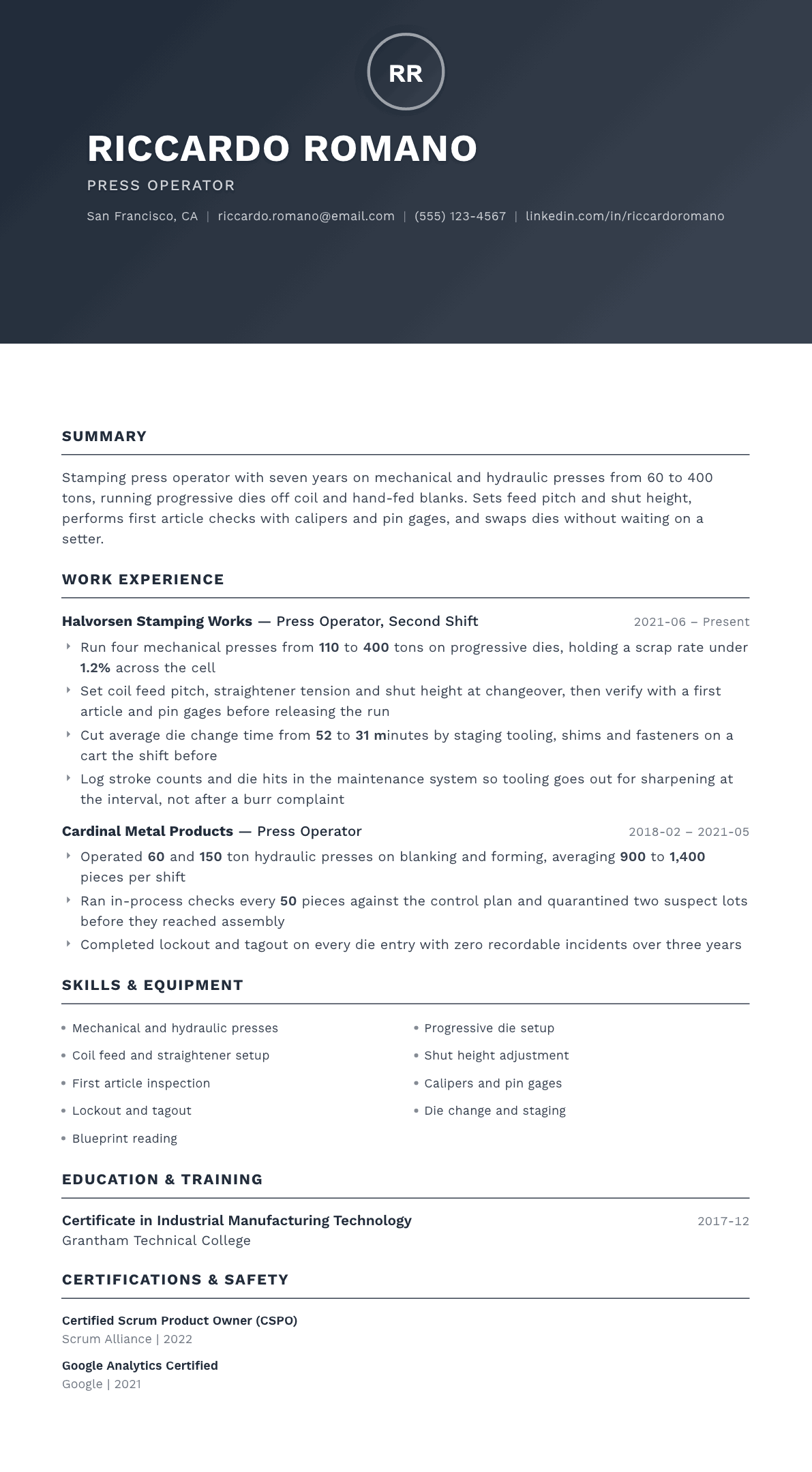
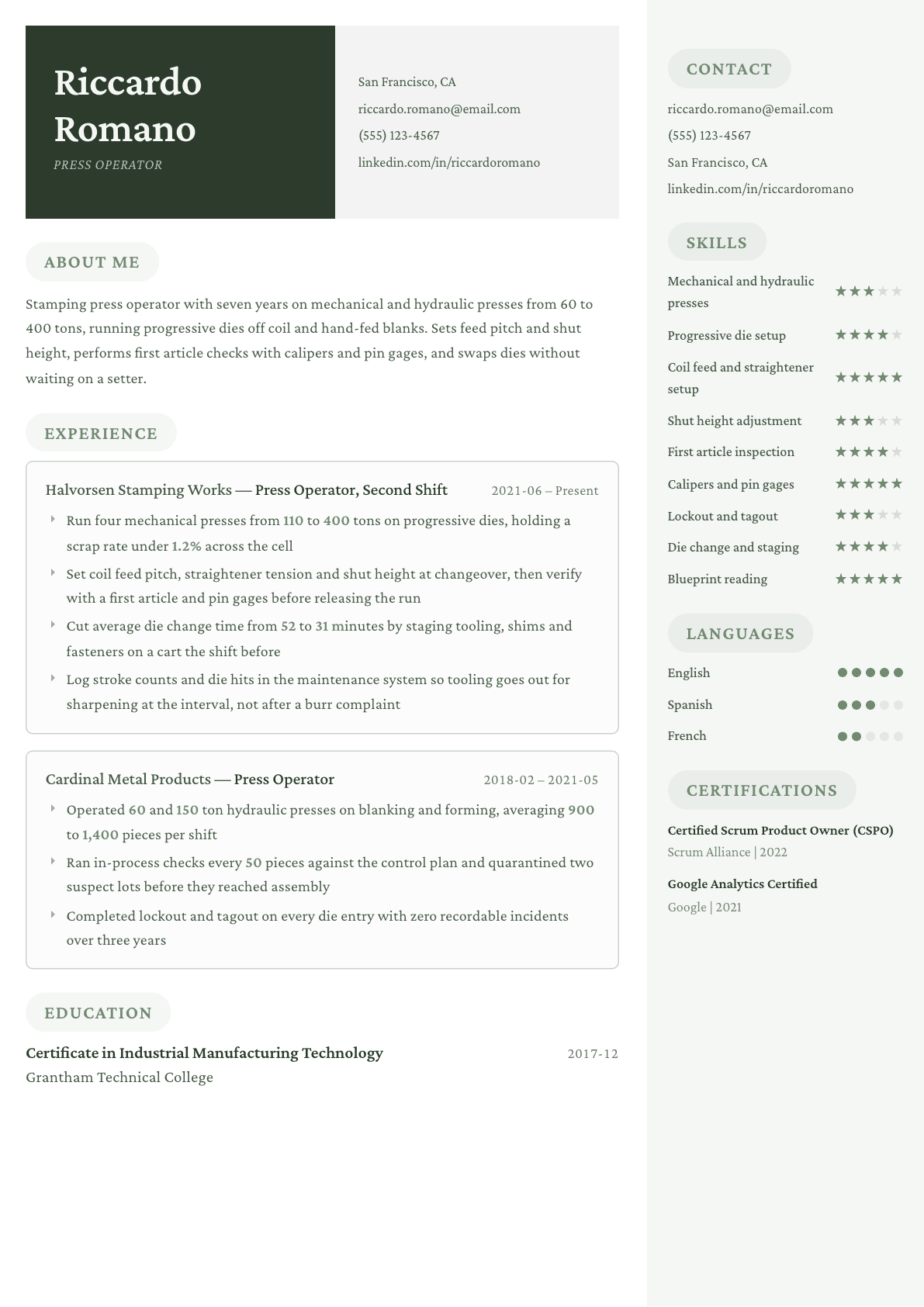
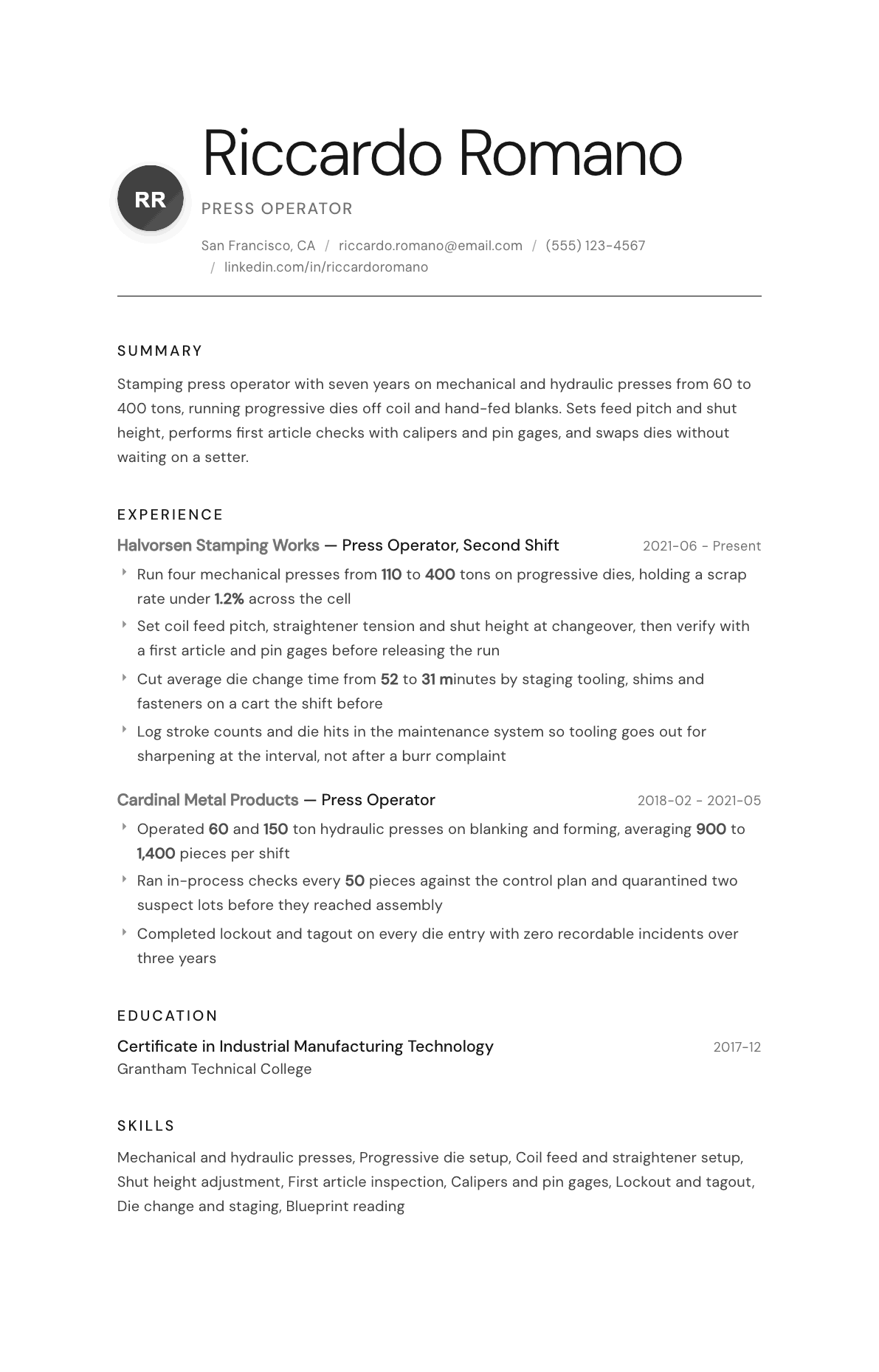
Example Press Operator summary
Press operator with seven years on mechanical and hydraulic stamping presses from 60 to 400 tons, running progressive dies off coil and hand-fed blanks. Sets feed pitch, straightener tension and shut height at changeover, runs a first article before releasing the job, and holds scrap under the cell target. Changes dies without waiting on a setter and logs stroke counts so tooling leaves at the sharpening interval rather than after a burr complaint.
Skills to list on a Press Operator resume
- Mechanical press operation
- Hydraulic press operation
- Progressive die running
- Blanking and forming
- Coil feed threading
- Straightener and uncoiler setup
- Shut height and counterbalance
- Die changeover
- First article inspection
- In-process gaging
- Calipers, micrometers and pin gages
- Blueprint and tolerance reading
- Lockout and tagout
- Scrap and downtime logging
- Preventive tooling checks
What actually gets this resume read
- Give the tonnage range you have run, because a shop buying a 600 ton line will not guess at it.
- Say whether you set your own dies or wait for a setter, since that single fact changes the pay grade.
- Name your feed type: coil with a straightener, hand-fed blanks, or a robot cell with a transfer bar.
- Put your die change time on the page with what you did to shorten it, staging carts included.
- Show the gages you actually pick up, from calipers and pin gages to a height gage or optical comparator.
- State your scrap rate against the target you were held to, so a supervisor can read it in context.
How to write a press operator resume
The person reading a press operator resume is usually a stamping supervisor with an open second shift and a die she cannot afford to have run badly. She wants three facts fast: the tonnage you have stood in front of, whether you set your own tooling, and what your parts measure when somebody checks them. Everything else on the page is context.
Most press operator resumes fail on vagueness. They say operated presses in a manufacturing environment and leave the supervisor to guess whether that means a 60 ton hand-fed OBI or a 600 ton line running progressive dies off a coil at high strokes per minute. Those are not the same skill and they do not pay the same.
This guide covers the layout a stamping shop expects, what to put in the summary, how to write experience bullets that carry tonnage and gaging, before and after examples, the credentials worth listing, and the questions operators ask when they move from a job shop to a tier supplier.
Format: one page, equipment block above the job history
Reverse chronological, one page. A stamping supervisor reads the top third and decides whether to keep going, so put an equipment block directly under your contact line. That block is the press list: type, tonnage range, feed method and the dies you have run. It is the fastest way to answer the question the whole resume exists to answer.
Below that, the jobs. Each one names the shop type first, because a job shop with short runs and constant die changes is a different working life from a high volume automotive supplier where one die sits in the press for a week. Give the shift you worked and whether you ran one press or tended a cell of several.
- Contact line, then an equipment block: press types, tonnage range, feed method, die families you have run.
- Skills grouped as setup, gaging and safety rather than dumped into one alphabetized list.
- Each job labeled with shop type, press count, shift and whether you set your own dies.
- Certificates and safety training in a short block near the bottom where a supervisor can verify them.
Summary: tonnage, feed, setup authority, scrap
Three or four lines, no adjectives. Give the years you have stood at a press, the tonnage range, the feed method, whether you set dies yourself, and the scrap number you held. A supervisor can price that summary against her open requisition in about ten seconds, which is exactly the point.
Setup authority is the line most operators leave out and the one that moves you up a grade. There is a real difference between an operator who runs what a setter hands over and one who threads the coil, sets the pitch, dials the shut height and releases the job. If you can do the second thing, say it in the first two lines.
Experience: what you set, what you measured, what you scrapped
Open each job with the environment: press types and tonnages, part families, run lengths and whether the shop is a job shop, a captive plant or a tier supplier. Then three to five bullets on the work. Setup bullets carry the specifics a stamping supervisor recognizes, feed pitch, straightener tension, shut height, counterbalance pressure, lubrication settings and the shim stack you use to bring a die back in.
The inspection half matters as much. Say what you check at first article, what you check in process, how often, and with what. Calipers, pin gages, a height gage, a thread gage, a fixture or an optical comparator each say something different about the tolerance world you have lived in.
Close with the numbers a plant tracks: scrap rate against target, strokes or pieces per shift, downtime, and die change time. If you shortened a die change, describe the change you made, staging tooling on a cart, pre-setting fasteners, or building a shim kit, because the method is the part a supervisor can copy.
Safety and tooling care, written like an operator not a poster
Every operator claims to be safety conscious and it reads as filler. Replace the claim with practice: lockout and tagout on every die entry, two hand control and light curtain checks at startup, guarding verification after a die change, and how you handle a stuck slug or a misfeed without reaching into the die area.
Tooling care is the other half. Stroke counts logged so dies leave at the sharpening interval, punches replaced before burrs show up in a customer complaint, and die protection sensors respected rather than bypassed to keep a run alive. A supervisor who has paid for a crashed die reads those lines carefully.
Keywords a stamping job posting will use
Stamping postings recycle a tight vocabulary: progressive die, transfer die, blanking, piercing, forming, draw, coil feed, straightener, uncoiler, shut height, strokes per minute, first article, lockout and tagout. Use the exact words from the posting where the work is real, once in your equipment block and once inside a bullet that shows it.
Add the systems you touch. A supervisor scanning for a plant that runs a maintenance system or an enterprise resource planning terminal wants an operator who already logs stroke counts, downtime reasons and production counts without being chased for them every shift.
Press Operator resume summary examples
First press job
Manufacturing certificate graduate with 6 months on 60 to 110 ton hydraulic presses running hand-fed blanking and forming. Trained in lockout and tagout, caliper and pin gage checks, and first article verification. Looking for a full time press operator seat on second shift.
Five years in
Press operator with 5 years on mechanical presses from 110 to 400 tons running progressive dies off coil. Sets feed pitch, straightener tension and shut height without a setter, holds scrap under 1.5%, and changes dies in about 30 minutes with staged tooling.
Lead operator and setter
Lead press operator with 12 years across job shop and tier supplier stamping, running presses to 600 tons and setting transfer and progressive tooling. Owns first article release for the cell, trains new operators on die protection, and holds die change time under 25 minutes.
Work experience bullets: before and after
Before: Operated presses in a manufacturing environment.
After: Ran four mechanical presses from 110 to 400 tons on progressive dies off coil, averaging 40 strokes per minute across two part families.
Tonnage, feed and stroke rate tell a supervisor what you can walk into without retraining.
Before: Responsible for die changes.
After: Set progressive dies without a setter, dialing shut height, feed pitch and straightener tension, then released the job on a first article checked with pin gages and a height gage.
Setup authority plus the release check is the difference between an operator grade and a setter grade.
Before: Reduced downtime during changeovers.
After: Cut average die change from 52 to 31 minutes by staging tooling, shims and fasteners on a cart during the previous shift and pre-setting the feed for the next job.
The method is repeatable, so a supervisor can see the saving surviving your first week.
Before: Checked parts for quality.
After: Ran in-process checks every 50 pieces against the control plan and quarantined two suspect lots before they reached assembly, holding scrap at 1.2% against a 2% target.
A check interval, a catch and a scrap figure against target beat any general claim about quality.
Before: Followed all safety procedures.
After: Completed lockout and tagout on every die entry, verified light curtains and two hand controls at startup, and cleared misfeeds with the ram blocked, with no recordable incidents in three years.
Naming the specific controls proves the habit, where following procedures proves nothing.
Hard skills
- Mechanical press operation
- Hydraulic press operation
- Progressive and transfer die running
- Blanking, piercing and forming
- Coil threading and uncoiler setup
- Feed pitch and straightener adjustment
- Shut height and counterbalance setting
- Die change and tooling staging
- First article and in-process inspection
- Calipers, micrometers, pin and thread gages
- Blueprint and tolerance reading
- Lockout and tagout
- Die protection sensor use
- Scrap, stroke and downtime logging
Soft skills
- Standing a full shift at pace without losing check discipline
- Calling a problem early instead of running to the end of the order
- Handing over a press cleanly between shifts
- Coaching a new operator without slowing the line
- Staying steady when a die crashes mid run
Certifications worth listing
- Certified Production Technician (CPT) (Manufacturing Skill Standards Council)
- OSHA 10-Hour General Industry (OSHA Outreach Training Program, U.S. Department of Labor)
Mistakes that cost press operator candidates the interview
- Writing operated presses without ever naming a tonnage, which forces the supervisor to assume the smallest one.
- Leaving out whether you set your own dies, the single fact that decides which pay grade the resume lands in.
- Listing quality checks without the gage, so nobody can tell whether you work to thousandths or to eyeball.
- Claiming safety awareness in place of the actual controls: lockout, light curtains, blocked ram, guarded access.
- Skipping die change time and scrap rate, the two numbers a stamping plant argues about every single week.
- Using one resume for a job shop and a tier supplier when the first wants changeover speed and the second wants run stability.
Press Operator resume questions
How do I show press experience if I only ran one machine?
Go deep instead of wide. Give the press make, tonnage, feed type, the part families and the run lengths, then show the setup and inspection work you did on it. A supervisor will take one press understood thoroughly over four presses described in a sentence.
Should a press operator resume list strokes per minute?
Yes, when you know it, because stroke rate tells a reader how much of your shift is monitoring and how much is handling. Pair it with pieces per shift so the number is anchored to output rather than sitting alone as a machine specification.
Do I need a forklift or overhead crane endorsement on the page?
List them if you hold them, since dies move by crane or truck in most shops and an operator who can rig a die saves waiting time. Name the employer evaluation or training that authorized you rather than implying a license you do not carry.
How do I move from operator to setter or tool setter?
Rewrite the experience section around setup work you already do: shut height, feed pitch, shimming, die protection and first article release. Then name the tooling you have set unsupervised. Setters are hired on evidence of independent releases, not on years standing at a press.
What belongs on a press operator resume with no factory background?
Put your training certificate, the machines you touched in class and any measurement work above unrelated jobs. Then add physical shift facts a supervisor cares about: steel toe experience, standing shifts, rotating schedules and comfort working with hearing protection all day.
Related resume examples
- Machine Operator Resume example
- CNC Operator Resume example
- Welder Resume example
- Production Supervisor Resume example
- Printing Press Operator Resume example
- Tool and Die Maker Resume example