Machinist Resume Examples: free ATS score and gap list
Build a Machinist Resume That Names Your Tolerances
By Mustafa Tarabya, founder of CVBooster · Published · Updated
Machinist resume example, keyword list and writing guide covering manual and CNC work, tolerances, tooling, inspection and setup reduction.
Sample resumes for a machinist
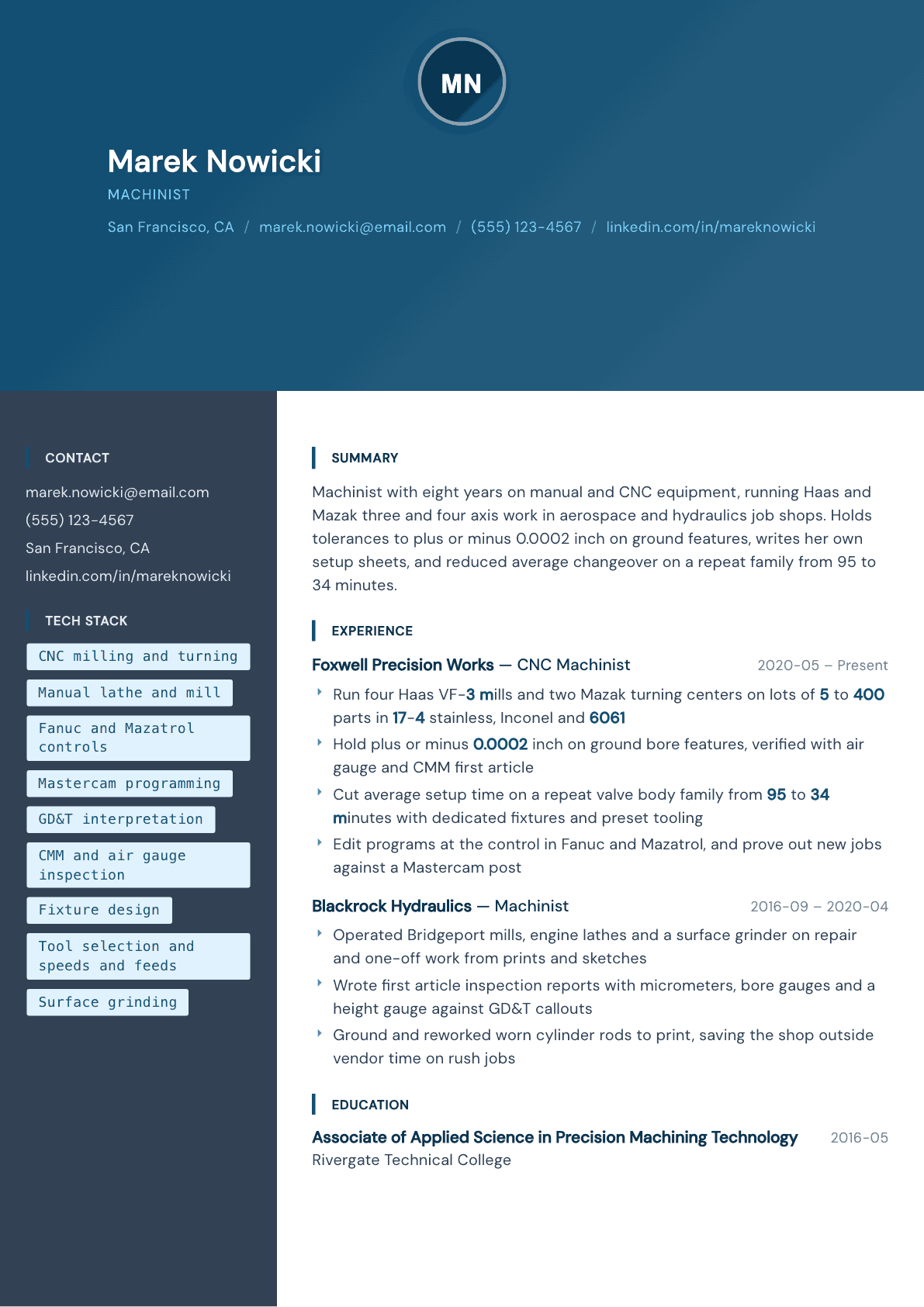
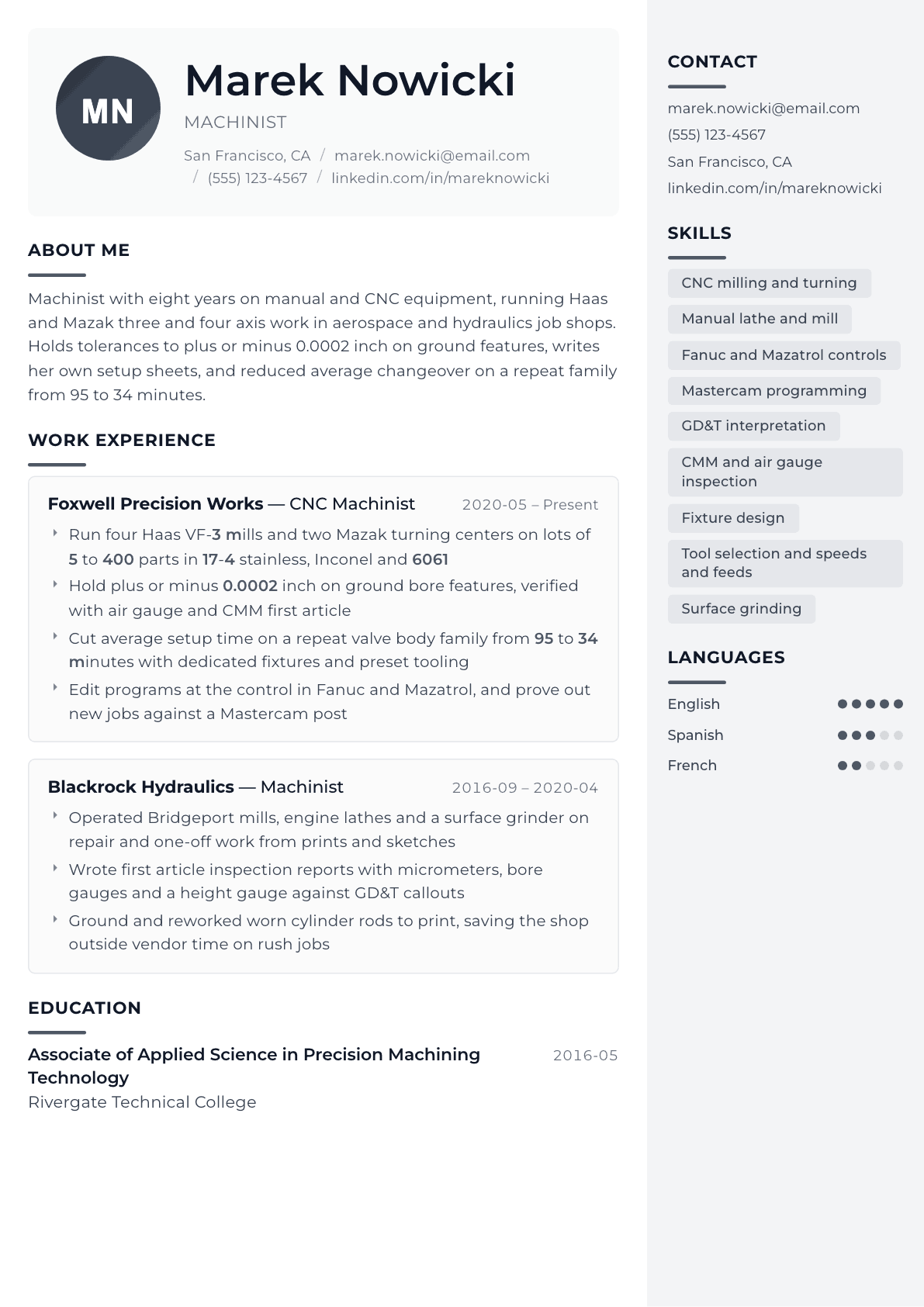
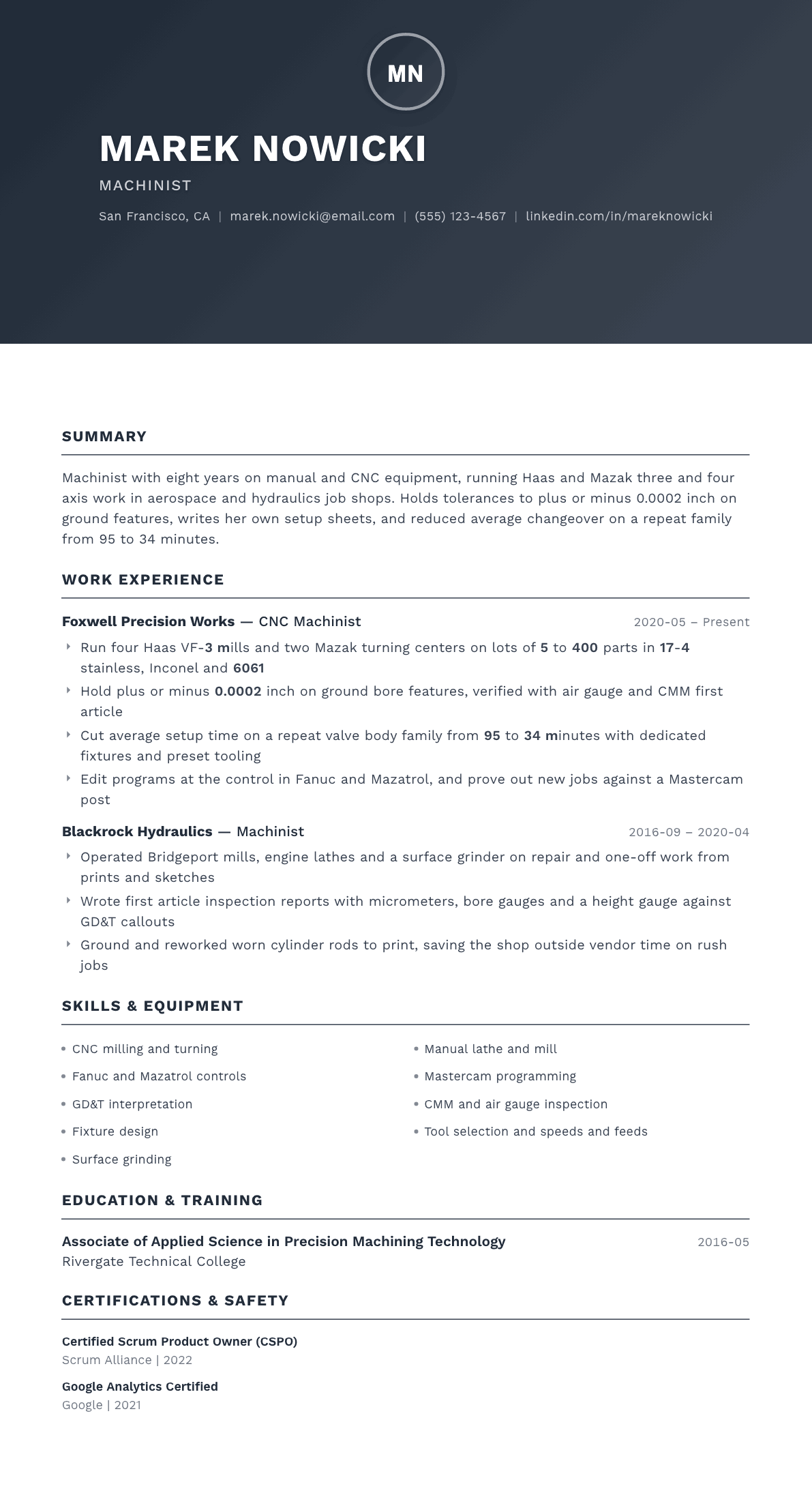
The same machinist content laid out in three CVBooster templates, so you can see what the finished document looks like before you write a word.
Example Machinist summary
Machinist with eight years across manual and CNC work in aerospace and hydraulics job shops, running Haas mills and Mazak turning centers on lots from five parts to four hundred. Holds ground features to plus or minus 0.0002 inch verified by air gauge and CMM, edits at Fanuc and Mazatrol controls, and proves out new jobs from a Mastercam post. Cut changeover on a repeat family by more than half with dedicated fixtures.
Skills to list on a Machinist resume
- CNC milling
- CNC turning
- Manual lathe operation
- Bridgeport mill work
- Surface and cylindrical grinding
- Fanuc control editing
- Mazatrol conversational programming
- Mastercam toolpaths
- GD&T and print reading
- CMM first article inspection
- Micrometers and bore gauges
- Workholding and fixture build
- Speeds and feeds optimization
- Tool crib and preset management
- Setup reduction
- Deburring and finishing
What actually gets this resume read
- State the tightest tolerance you hold in production, not in theory, and name the gauge that proves it.
- List controls and machine models by name, because a shop buys a machinist who can walk to a specific control.
- Show your materials, since cutting Inconel and titanium is a different trade from cutting aluminum brackets.
- Give a setup time you reduced with the before and after figures, which is the number a shop owner cares about.
- Separate programming from operating, and say whether you write at the control, in CAM, or both.
- Put your inspection work on the page: first article reports, CMM programs, and how you read GD&T callouts.
How to write a machinist resume
The person reading a machinist resume is usually the shop foreman, and he is standing next to the machine he needs covered. He has a print with a tolerance block on it, a spindle that is idle, and a suspicion that the last three applicants called themselves machinists because they pressed cycle start. Your page has one job: convince him that you can take a print and a chunk of material and produce a good part without a babysitter.
That means specifics, and the specifics are always the same four: the tolerance you actually hold, the machines and controls you run, the materials you cut, and how you prove the part is right. Every strong machinist resume answers those four in the first third of the page. Every weak one says "operated CNC machines to produce quality parts" and leaves the foreman guessing.
This guide walks through the sections a job shop reads, how to write about setup as distinct from operation, how to present programming honestly, and what to put down when your experience is manual, when it is CNC, or when it is the mix most shops actually want.
Format: one page, machines and tolerance visible before the fold
One page is right for most machinists. A foreman scans, and everything that matters fits: a summary that names the tolerance and the platforms, a machine list, then two or three jobs with real bullets. Go to two pages only if you have run a long list of distinct machine families and hold formal credentials worth spelling out.
Give the machine list its own short block rather than burying models in job bullets. Write the make, the model family and the control together, because those three as a set are what a shop matches against its floor. A shop with Haas mills and a Fanuc lathe reads "Haas VF-3, Fanuc 0i-TF, Mazak Quick Turn with Mazatrol" and knows you can start Monday.
- Contact line: name, phone, email, city, and the shift you are available for, since machining runs around the clock.
- Summary: tolerance held, machine families, materials, and whether you set up as well as run.
- Equipment block: mills, lathes, grinders and inspection gear, each with make and control.
- Experience: shop type first, then lot sizes, then what you set up and what you held.
- Training and credentials last, with any NIMS or apprenticeship detail spelled out.
Setup versus operation: state which one you do
The single biggest divide in machinist hiring is between a setup machinist and a machine operator. A setup hand indicates the fixture, dials in the vise, touches off tools, sets work offsets, proves the first part and adjusts offsets through the run. An operator loads, unloads and gauges. Both are real jobs and both are paid, but a shop advertising for a machinist almost always means the first one, and a page that blurs the line gets a phone screen that ends quickly.
So say it directly. Name the workholding you set: vises, chucks, collet systems, soft jaws you cut yourself, tombstones, magnetic chucks on the grinder. Say how you touch off, whether you use a tool presetter, and how long a typical setup takes you on a job you have run before.
Tolerance, materials and inspection: the proof of the trade
Give the tightest tolerance you hold in production, on what feature, in what material, and how you verify it. Plus or minus 0.0002 inch on a ground bore checked with an air gauge is a claim with evidence attached. "Tight tolerances" is not a claim at all. If your work is mostly plus or minus 0.005 inch on weldments, say that, because a shop that does structural work would rather hire an honest hand than a stretched one.
Materials matter as much as numbers. Cutting 6061 all day is not the same trade as roughing Inconel 718 or interrupted cuts in hardened tool steel. List the materials by name and grade where you know it, and mention anything that changed your approach: chip control in stainless, thermal growth on long aluminum parts, tool life management in titanium.
Then inspection. Say what you use and what you produce: micrometers, bore gauges, height gauge and surface plate, thread and pin gauges, CMM programs you write or run, first article reports against a ballooned print. GD&T literacy belongs here too. A machinist who can read a true position callout and set the datum scheme correctly is worth more than one who checks every dimension as if it were plus or minus.
- Name the tolerance with the feature, material and gauge, not as a bare number.
- List materials by alloy family, and flag any exotic or hardened work you have done.
- Say whether you write first article reports and against what document.
- Mention CMM work honestly: running programs, editing them, or writing them from scratch are three different skills.
- Include surface finish requirements if you grind or if your prints call out Ra values.
Programming: what you write and where you write it
Shops care about the difference between editing at the control, conversational programming, and building toolpaths in CAM. Say which you do. Writing a hole pattern in Mazatrol at the machine is a genuine skill. So is posting from Mastercam or Fusion and proving out the program safely with single block and a rapid override. Claiming both when you only do one is the fastest way to lose a job in week one.
If you have improved a program, that is a bullet worth having. Cycle time reduced by changing to a high feed mill and a trochoidal path, tool life doubled by fixing speeds and feeds, a second operation removed by reworking the fixture. Those are the machinist contributions a shop owner can convert into money, and they lift you above a page of duties.
Keywords job shops and manufacturers filter on
Postings recycle a tight vocabulary: setup, first article, GD&T, tolerance, offsets, workholding, deburring, prototype, production run, ISO and AS9100 environments, tool crib. Aerospace shops add traceability, material certs and lot control. Medical shops add cleanliness and documentation. Read the posting and use its own words once in your equipment block and once inside a bullet where you show the work.
Name the quality system you have worked under if you know it, because a shop with an aerospace approval needs machinists who already understand why the paperwork exists. That single line often decides which of two similar machinists gets called.
Machinist resume summary examples
Recently out of school
Machining graduate with 900 lab hours on manual lathes, Bridgeport mills and a Haas VF-2, plus a six month internship running production lots in aluminum and mild steel. Reads GD&T, inspects with micrometers and bore gauges, and has cut soft jaws and set work offsets under supervision.
Five to eight years
Machinist with eight years across manual and CNC work in aerospace and hydraulics job shops, running Haas mills and Mazak turning centers on lots from five to four hundred parts. Holds ground bore features to plus or minus 0.0002 inch verified by air gauge, and cut setup on a repeat family by more than half.
Lead machinist
Lead machinist with fifteen years, responsible for a nine machine cell, the tool crib and first article approval. Programs in Mastercam, designs fixtures for repeat families, and mentors three apprentices. Reduced scrap on a titanium bracket program by rebuilding the workholding and rewriting the roughing strategy.
Work experience bullets: before and after
Before: Operated CNC machines to make parts.
After: Ran four Haas VF-3 mills and two Mazak turning centers on lots of 5 to 400 parts in 17-4 stainless, Inconel 718 and 6061, setting up every job from print without a lead hand.
Machine models, lot range, alloys and setup ownership turn a duty statement into a picture of the actual work.
Before: Worked to tight tolerances.
After: Held plus or minus 0.0002 inch on ground bore features and 16 Ra surface finish, verified with an air gauge on every part and a CMM first article at the start of each lot.
A number tied to a feature, a finish and a gauge is verifiable, while tight tolerances is only an adjective.
Before: Reduced setup times.
After: Cut average changeover on a repeat valve body family from 95 to 34 minutes by building a dedicated fixture plate and presetting tooling offline while the previous job finished.
The before and after with the method behind it lets a shop owner see the capacity he would gain by hiring you.
Before: Used inspection equipment to check parts.
After: Wrote first article inspection reports against ballooned prints using micrometers, bore gauges, thread gauges and a height gauge on a granite plate, and interpreted true position callouts to set the datum scheme.
It shows the documentation and the GD&T reasoning behind inspection instead of naming a drawer of tools.
Before: Helped improve machining programs.
After: Rewrote the roughing pass on a housing from conventional pocketing to a trochoidal toolpath, dropping cycle time from 21 to 13 minutes and tripling insert life on the same cutter.
A named strategy change with cycle time and tool life attached is a contribution a shop can put a value on.
Hard skills
- CNC milling setup and operation
- CNC turning and live tooling
- Manual lathe and knee mill work
- Surface and cylindrical grinding
- Fanuc control programming and editing
- Mazatrol conversational programming
- Mastercam toolpath creation
- GD&T interpretation and datum schemes
- Workholding, soft jaws and fixture build
- Tool selection, speeds and feeds
- CMM first article inspection
- Micrometers, bore and thread gauges
- Surface finish measurement
- Deburring and finishing operations
Soft skills
- Judging when a part is worth saving and when to scrap it
- Working from a print without needing every dimension explained
- Handing over a job mid run with clean notes
- Keeping a steady pace on a long production lot
- Asking the programmer the right question before proving out
Certifications worth listing
- NIMS Machining Level I Credential (National Institute for Metalworking Skills)
- NIMS Machining Level II Credential (National Institute for Metalworking Skills)
- Certified Production Technician (Manufacturing Skill Standards Council)
- OSHA 10-Hour General Industry (OSHA Training Institute)
Mistakes that cost machinist candidates the interview
- Calling yourself a machinist when the job was loading and unloading, which unravels in the first technical question about touching off tools.
- Writing tight tolerances instead of the actual number, the feature it applied to and the gauge that proved it.
- Leaving the controls off the machine list, so a shop cannot tell whether you have ever stood in front of the one it owns.
- Claiming CAM programming when your real skill is editing at the control, a gap that shows within days of starting.
- Skipping materials entirely, which hides the difference between years of aluminum and years of hardened tool steel.
- Filling the page with duties and no cycle time, scrap or setup improvement a shop owner can convert into capacity.
Machinist resume questions
Should a manual machinist bother applying to CNC shops?
Yes, and lead with the reasoning skills manual work builds: work offsets, tool geometry, feel for chip load and the ability to salvage a part. Say plainly which CNC exposure you have and that you are ready to be trained on the control, since many shops prefer that over a button pusher.
How much detail should I give about machines I only ran occasionally?
Put them in a separate line labeled as familiar rather than mixing them with your daily platforms. A foreman will forgive limited hours on a swiss lathe, but he will not forgive discovering on day one that your listed experience was two weeks of covering for someone.
Is a NIMS credential worth listing if I already have years of experience?
Yes, because it gives a hiring manager a fixed reference point for skills you would otherwise have to demonstrate on a test part. It matters most when you are changing industries or moving from a small shop into a company that documents everything.
How do I show quality work when my shop does not track scrap by machinist?
Describe the controls you personally run: first article approval, in process checks at set intervals, offset adjustments recorded, and any part you caught before it left the cell. Naming the discipline is credible even without a shop wide number behind it.
Do I need a portfolio as a machinist?
A short list of representative parts helps more than photographs: the feature, the material, the tolerance and the machine. If you have permission to show images of non proprietary work, one page of parts with those details attached gives an interview something concrete to talk about.
Related resume examples
- CNC Machinist Resume example
- CNC Programmer Resume example
- Tool and Die Maker Resume example
- Manufacturing Technician Resume example
- CNC Operator Resume example
- Woodworker Resume example