UX Researcher Resume Examples: free ATS score and gap list
User Experience Researcher Resume, Built Around Your Studies
By Mustafa Tarabya, founder of CVBooster · Published · Updated
User experience researcher resume guide: build it around studies, with method, sample and decision in every bullet, plus summaries by level.
Sample resumes for a ux researcher
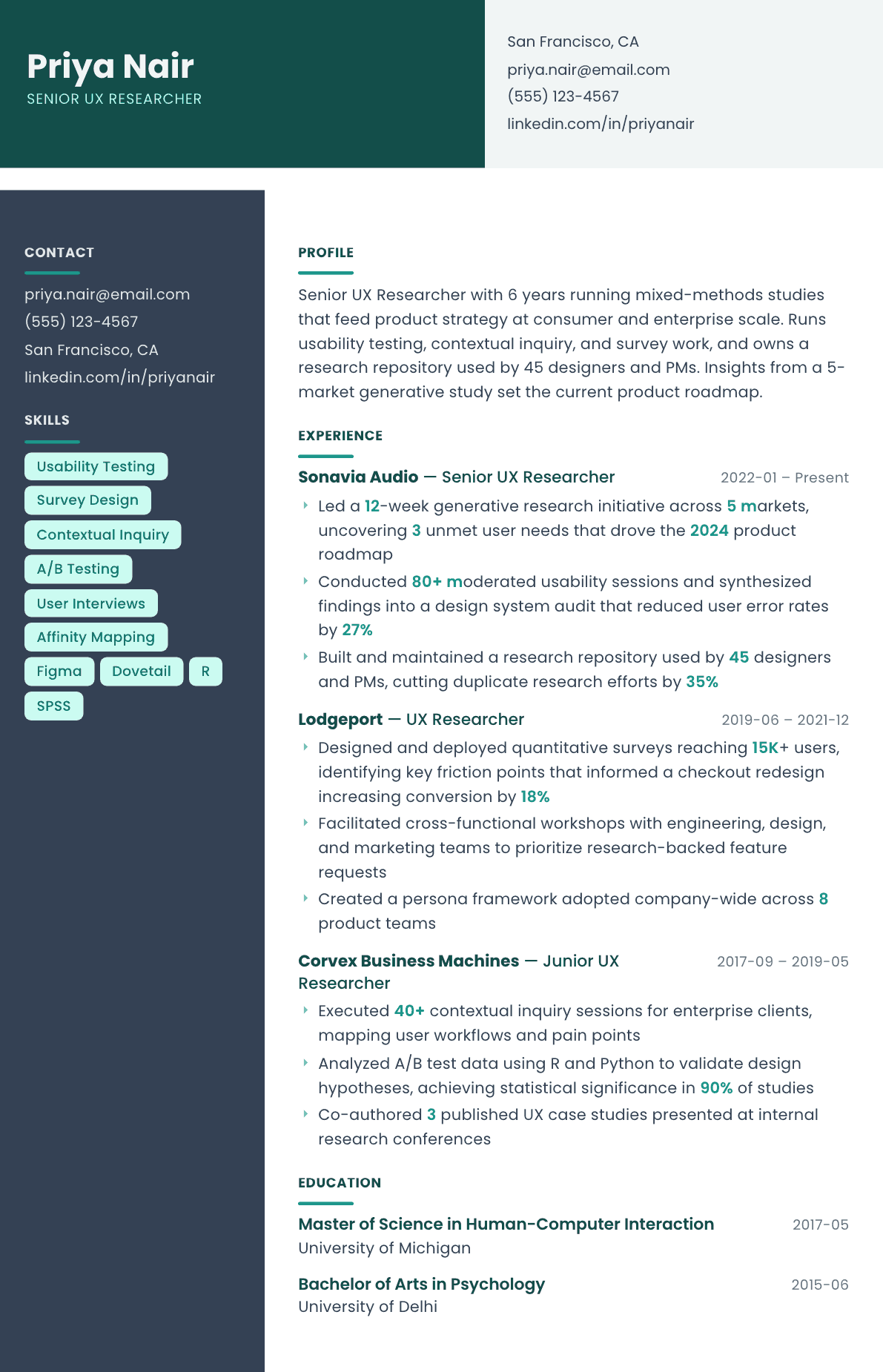
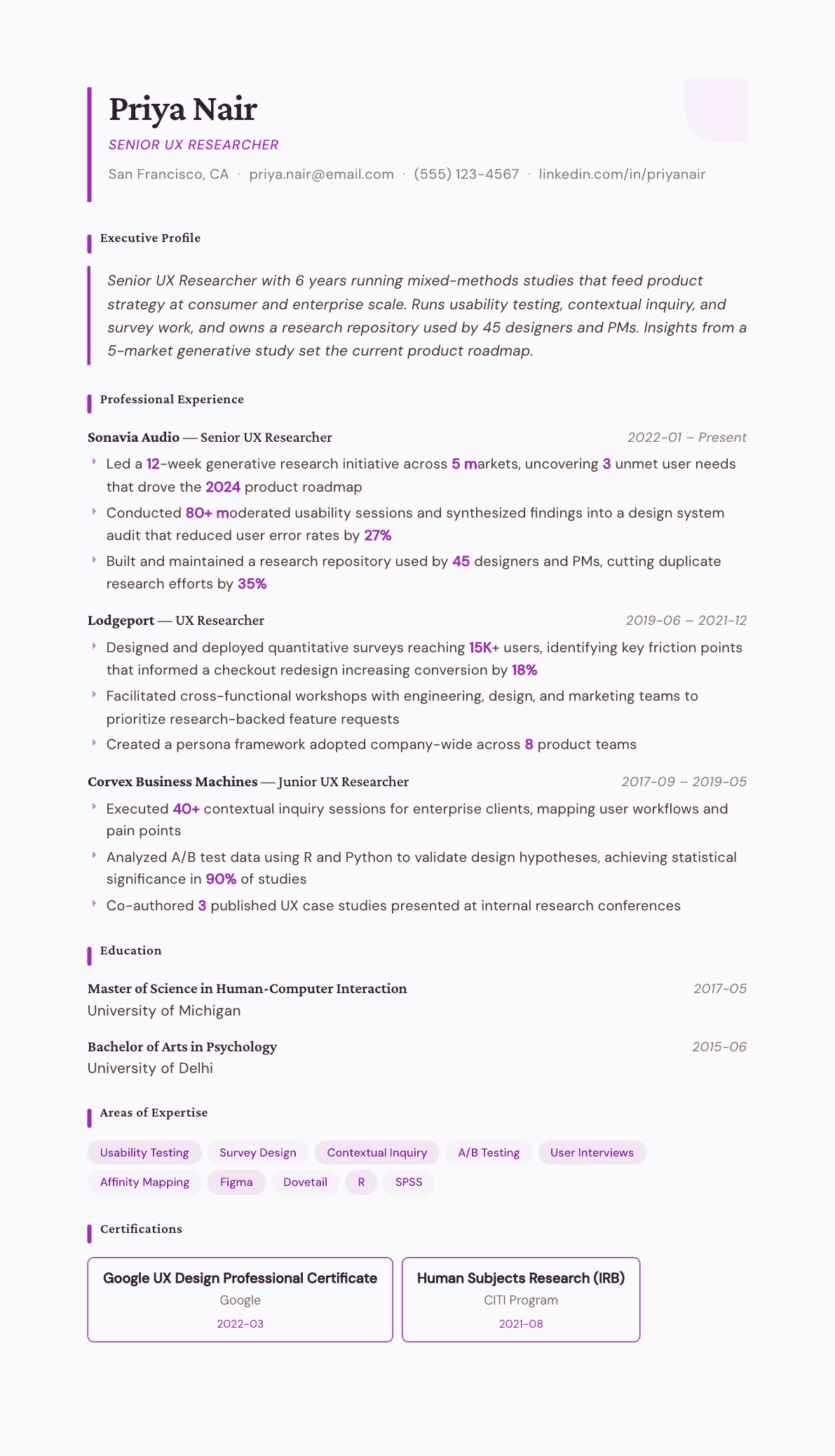
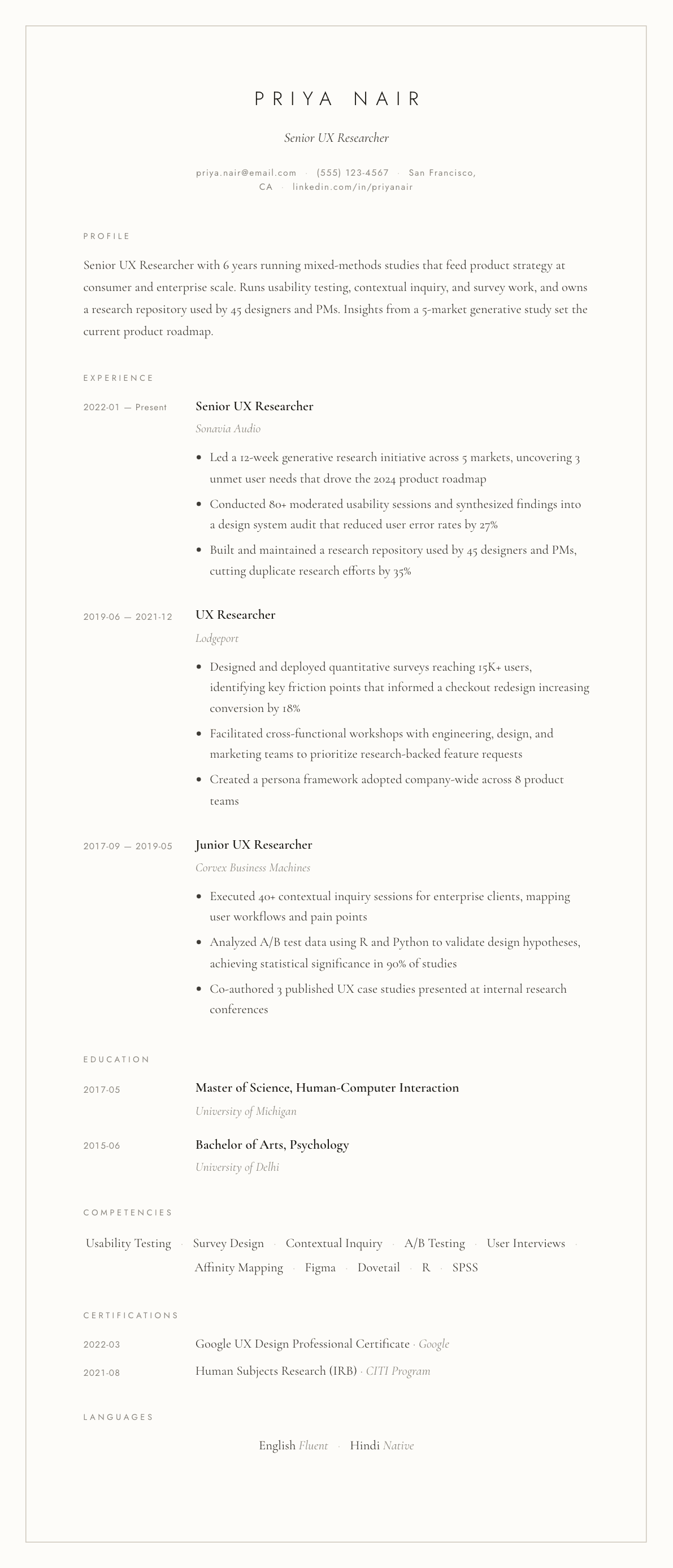
The same ux researcher content laid out in three CVBooster templates, so you can see what the finished document looks like before you write a word.
Example UX Researcher summary
Empathetic UX Researcher with 6 years of experience delivering mixed-methods insights that shape product strategy. Skilled in usability testing, survey design, and data analysis with a track record of improving user satisfaction scores by 30%. Seeking a senior role to lead research operations and mentor growing research teams.
Skills to list on a UX Researcher resume
- Usability Testing
- User Interviews
- Survey Design
- A/B Testing
- Contextual Inquiry
- Card Sorting
- Diary Studies
- Affinity Mapping
- Persona Development
- Journey Mapping
- Dovetail
- Optimal Workshop
- Figma
- R / SPSS
- Qualitative Analysis
What actually gets this resume read
- Quantify the impact of your research: cite how insights influenced product metrics like conversion, retention, or NPS.
- Specify your methods (usability testing, diary studies, card sorting, surveys) to show breadth and depth.
- Include tools you use for analysis and synthesis: Dovetail, Optimal Workshop, Maze, Miro, R, or SPSS.
- Highlight cross-functional collaboration and how you presented findings to stakeholders.
- Mention participant recruitment strategies and sample sizes to demonstrate research rigor.
- Link to a portfolio or case study site where hiring managers can see your research process.
How to write a ux researcher resume
A research manager reading your resume is testing for rigor and for influence, in that order. Rigor means you chose a method that could actually answer the question, recruited a sample that matched the population, and did not overstate what a small qualitative study can support. Influence means somebody changed something because of what you found. A researcher who is rigorous and ignored gets hired occasionally. A researcher who is persuasive and sloppy gets found out.
The field splits along a line that hiring managers care about deeply. Generative or foundational research explores a problem space before anything is designed. Evaluative research tests something that exists or is about to. Mixed methods researchers move between qualitative depth and quantitative scale, running surveys, log analysis and experiments alongside interviews. Say where you sit, because a team that needs survey design and statistics will not hire on a page of usability sessions.
A user experience researcher resume, usually shortened to UX researcher resume, works when every entry reads like a study with a consequence. This guide covers how to structure a research resume around studies rather than duties, three summaries by level, before and after bullets that show method and consequence, and the questions researchers ask when they try to describe confidential findings on a public document.
Format: one page, studies as the unit, methods visible early
One page, or two if you have an academic publication record worth listing. The header carries name, city, email and a link to a portfolio or a small set of research case studies. Research portfolios are usually gated, so put the password on the resume rather than making a manager ask for it.
Section order: summary, experience, methods, tools and analysis, publications and talks, education. Education sits higher for researchers than for most design roles, because a graduate degree in a research discipline is a common and legitimate signal, though it is not a requirement at most companies.
- Treat each study as the unit of work: the question, the method, the sample, the finding, the decision it drove.
- Name the domain and the population you have studied: consumers, clinicians, developers, administrators, drivers.
- Say whether you worked embedded in one product team or as a central function serving many.
- Note whether you recruited participants yourself, since recruitment is often the hardest part of the job.
Summary: methods, population, and how findings landed
Say whether you are qualitative, quantitative or mixed methods, then the domain and the population you have access to. Then the influence line: a roadmap that changed, a feature that was cut, a strategy that was set, an assumption that was killed before it cost a year of engineering.
Killing a bad idea is one of the most valuable things a researcher does and almost nobody writes it down. If your study stopped a build that was going to fail, that belongs in the summary, because every research manager has fought for exactly that kind of outcome.
Experience: study design, sampling, analysis, decision
Every strong research bullet contains a method, a sample, a finding and a consequence. The method has to be the right one for the question: interviews and contextual inquiry for understanding behavior in context, diary studies for behavior over time, usability testing for evaluating an interface, surveys for measuring prevalence, log analysis for what people actually do, experiments for causal claims. Naming the method alongside the question shows judgment rather than habit.
Sampling is where credibility is won or lost. State the sample size, how participants were recruited and screened, and why that population was the right one. A researcher who writes about eight participants without pretending it is representative is more trustworthy than one who reports a percentage from twelve people.
Analysis deserves description. For qualitative work that means transcription, coding, thematic analysis and how you handled disagreement between analysts. For quantitative work it means the statistics you actually ran, how you handled missing data, and what you did about significance and effect size. Vague analysis language is the fastest way for an experienced research manager to lose confidence.
End with the decision. Name what changed: a roadmap priority, a rejected concept, a redesigned flow, a revised positioning, a new segment definition. Research with no stated consequence reads as a report that was filed and never opened.
- Give sample size and recruitment source for every study you cite.
- Say who the audience for the findings was: a product team, a leadership review, or a company wide readout.
- Include research operations work: participant panels, incentives, consent, scheduling and tooling.
- Mention the research repository and whether findings were reused by others after you published them.
Mixed methods, statistics and knowing the limits
If you do quantitative work, be precise about it. Survey design including question wording, scale choice, sampling frame and pilot testing. Analysis including significance testing, regression, segmentation and how you decided a difference was real. Tools such as R, Python, SQL or a statistics package, plus enough SQL to pull your own behavioral data instead of waiting for an analyst.
Equally important is stating limits. Writing that a finding was directional rather than conclusive, or that a small qualitative sample suggested a hypothesis that a later survey measured, shows exactly the discipline a research manager is hiring for. Overclaiming from small samples is the most common reason a research resume loses credibility with the person best qualified to judge it.
Research operations, democratization and stakeholder work
Much of a modern research job is infrastructure. Building and maintaining a participant panel, handling consent and data retention properly, running incentives and scheduling, and choosing the tooling that lets studies run without a month of setup. These are unglamorous and they are why some teams ship four studies a quarter and others ship one.
The other half is making findings stick. Readouts that people attend, short written summaries that get read, a searchable repository that stops the same question being asked every year, and training product managers and designers to run simple evaluative studies themselves while you handle the hard ones. Describing that work shows you understand that a finding nobody acts on has no value.
UX Researcher resume summary examples
Junior researcher
UX researcher with two years running evaluative studies for a product team, mostly moderated usability sessions in rounds of 6 to 8 and unmoderated tests. Handles recruitment and screening, codes transcripts for thematic analysis, and publishes short readouts to a shared repository.
Mixed methods researcher
Mixed methods UX researcher with five years across consumer and enterprise products. Runs generative interview studies and diary studies, designs surveys reaching thousands of respondents, and pulls behavioral data in SQL to check whether reported behavior matches logged behavior before writing conclusions.
Staff researcher
Staff UX researcher with nine years, leading foundational research programs that set product strategy for two business lines. Built the participant panel and repository, mentors four researchers, and has stopped two planned builds by testing the underlying assumption before engineering committed.
Work experience bullets: before and after
Before: Conducted user interviews and usability testing for the product team.
After: Ran a 14 participant contextual inquiry study with warehouse supervisors on site, finding that the scanning step failed most often when gloves were worn, which changed the target size requirement for the redesign.
Method, sample, setting, finding and the decision it drove are all present, so a research manager can judge the work.
Before: Ran a survey to understand user needs.
After: Designed and fielded a survey to a screened sample of 1,200 active users, pilot tested the wording with 10 participants first, and segmented responses to show that two groups wanted opposite defaults.
Pilot testing and segmentation show survey craft, which separates a real quantitative researcher from someone sending a form.
Before: Presented research findings to stakeholders.
After: Delivered a readout to product, design and engineering leads, followed by a one page summary in the repository, after which the team cut a planned feature and moved the quarter to the problem the study surfaced.
It names the audience, the artifact and the decision, which is the only proof that research had influence.
Before: Built a research repository for the team.
After: Built a tagged research repository covering three years of studies, with a standard summary format and searchable findings, which let designers answer recurring questions without commissioning a new study.
Reuse is the actual value of a repository, and stating it shows why the infrastructure work mattered.
Before: Analyzed data to validate design hypotheses.
After: Combined 20 moderated sessions with a log analysis of the same flow, showing that the step people described as confusing was not the step where they dropped, and redirected the redesign accordingly.
Triangulating self report against behavior is exactly the rigor a research manager is testing for.
Hard skills
- Generative and foundational research
- Moderated usability testing
- Unmoderated remote testing
- Contextual inquiry and field studies
- Diary and longitudinal studies
- Survey design and fielding
- Thematic analysis and coding
- Statistical analysis
- SQL and behavioral log analysis
- Experiment and A/B test interpretation
- Participant recruitment and screening
- Research repository management
- Concept and prototype evaluation
- Accessibility research with assistive technology users
Soft skills
- Asking non-leading questions
- Listening without steering
- Presenting uncomfortable findings
- Stating uncertainty plainly
- Building trust with participants
- Influencing without authority
Certifications worth listing
- Nielsen Norman Group UX Certification (Nielsen Norman Group)
- Certified Professional in Accessibility Core Competencies (CPACC) (International Association of Accessibility Professionals)
- Google UX Design Certificate (Google)
Mistakes that cost ux researcher candidates the interview
- Reporting a percentage from a handful of participants, which tells a research manager you do not understand your own sample.
- Listing methods with no sample sizes, recruitment source or findings attached, which reads as a course syllabus.
- Describing studies that were run without ever naming a decision that followed from them.
- Presenting only evaluative usability work when the posting is for foundational or mixed methods research.
- Omitting research operations, which is where most of the practical difficulty of the job actually lives.
- Claiming causal effects from correlational data, the fastest way to lose credibility with the person reviewing the page.
UX Researcher resume questions
How do I show research impact when the findings are confidential?
Describe the method, the sample and the type of decision without naming the product or the number. Saying a study of a stated size led a team to cut a planned feature communicates influence while keeping the specifics inside the company where they belong.
Do I need a graduate degree to be a UX researcher?
It is common and it helps, especially for quantitative and foundational roles, but it is not required at most companies. What replaces it is demonstrated method judgment: choosing the right study for the question, sampling properly, and analyzing without overclaiming.
What should a UX research portfolio contain?
Two or three studies presented end to end: the question, why that method, how participants were recruited, what you found, what changed, and what you would do differently. Depth on a few studies beats a gallery of session clips or affinity boards.
How do I move from academic research into UX research?
Translate the vocabulary and shorten the timelines. Frame studies around product decisions rather than contributions to a literature, show that you can deliver a usable answer in weeks rather than years, and demonstrate at least one applied study with a real product team.
Should my resume say user experience researcher or UX researcher?
Use the exact title from the posting in your headline, and write the other form once in your summary, for example "User experience (UX) researcher with five years in mixed methods." Applicant tracking systems and recruiters search for both forms, and that one line lets your resume match either search without stuffing keywords.