Veterans Service Officer Resume Examples: free ATS score
Write a Veterans Service Officer Resume That Shows Real Claims Work
By Mustafa Tarabya, founder of CVBooster · Published · Updated
Veterans service officer resume example with claims, accreditation and appeals keywords, plus a guide to writing caseload and outcome evidence.
Sample resumes for a veterans service officer
The same veterans service officer content laid out in three CVBooster templates, so you can see what the finished document looks like before you write a word.
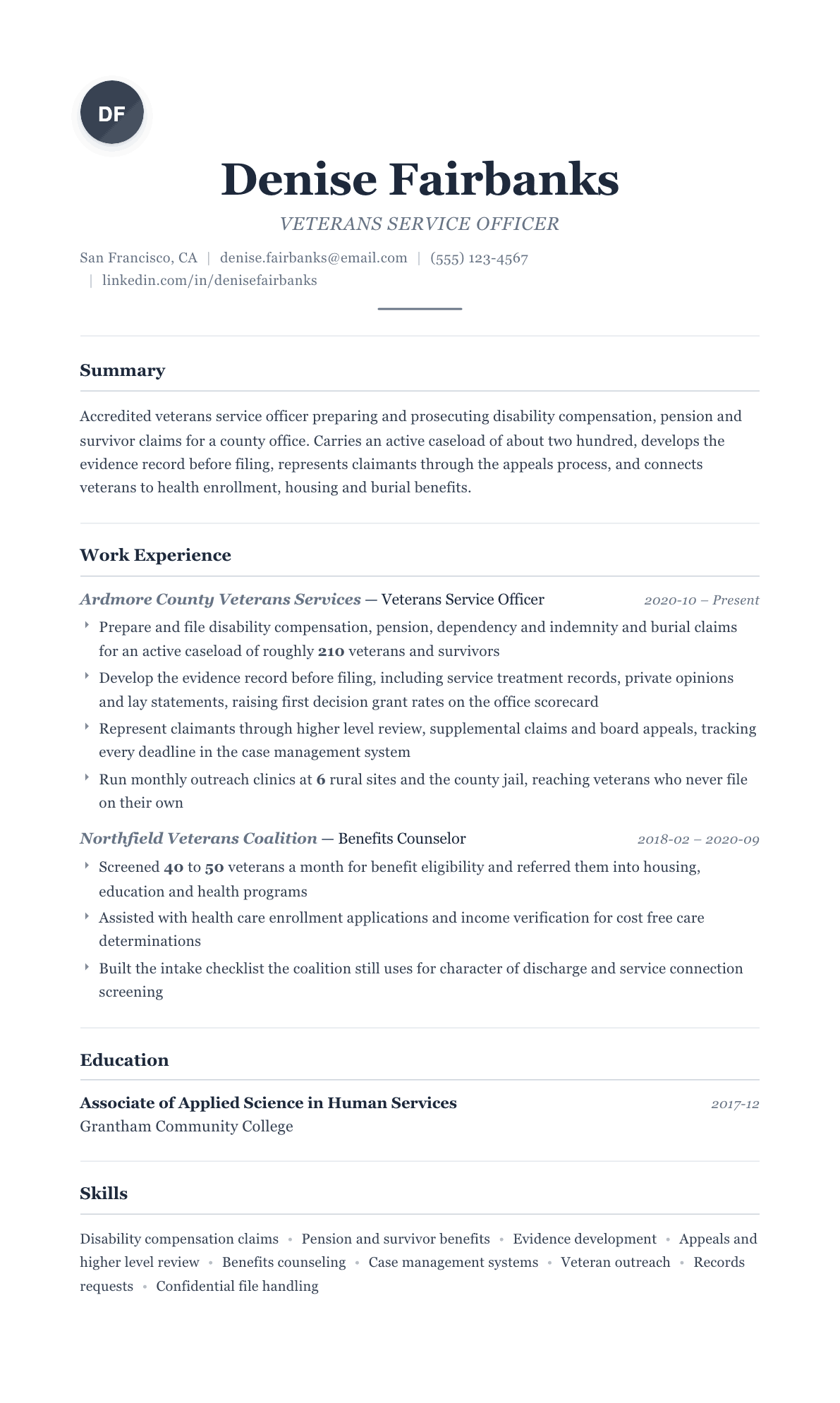
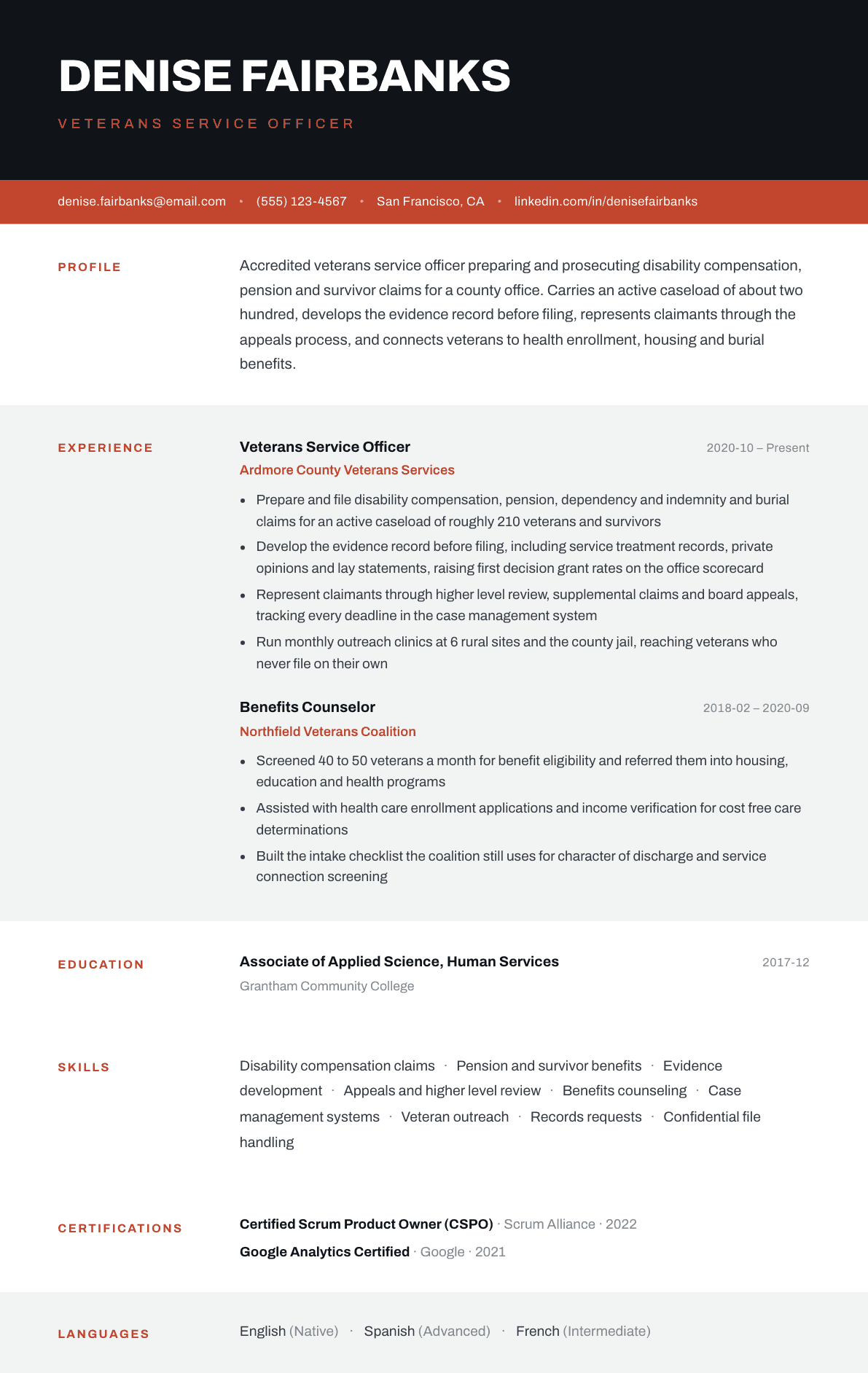
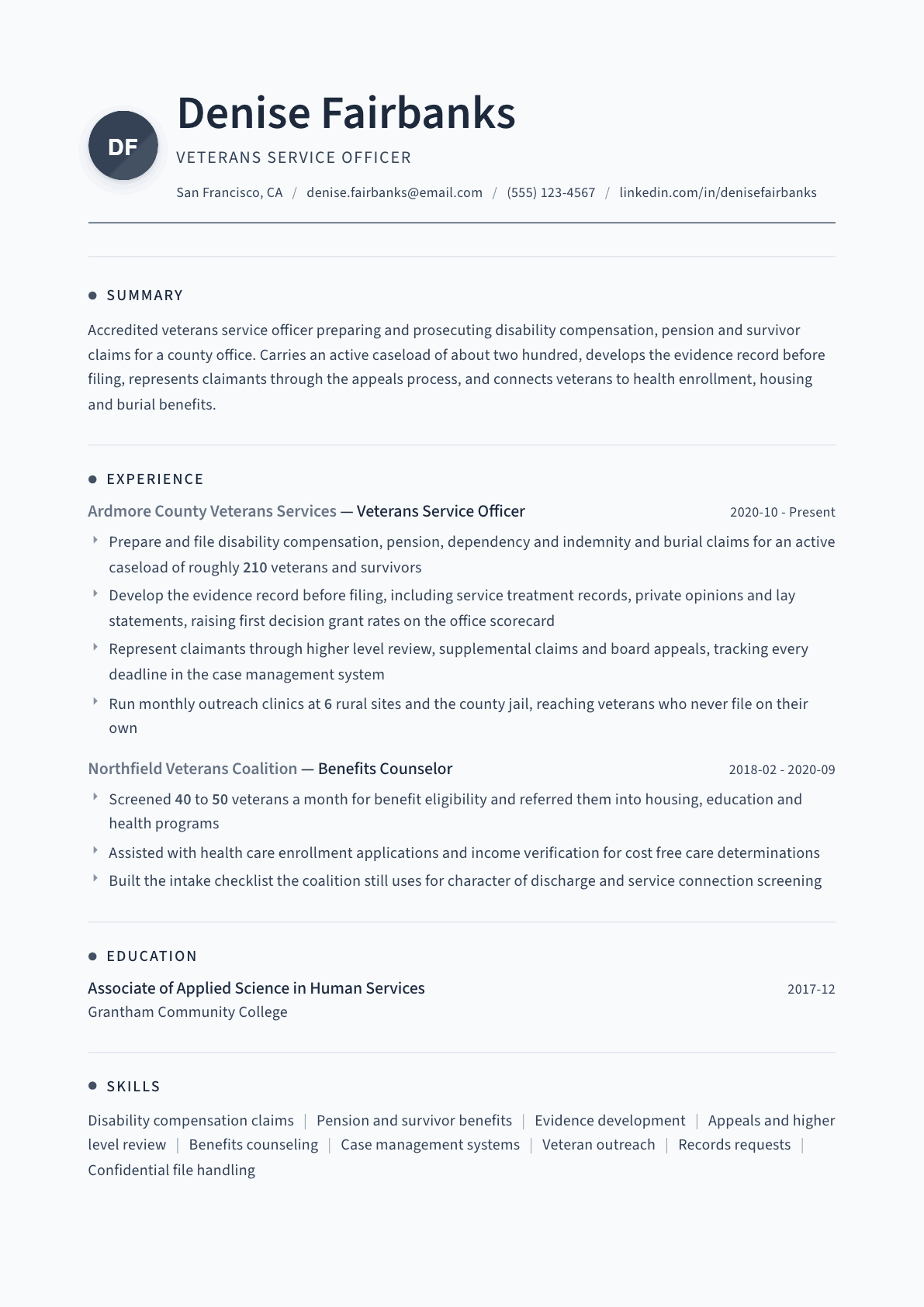
Example Veterans Service Officer summary
Accredited veterans service officer with six years preparing disability compensation, pension, survivor and burial claims for a county office, carrying an active caseload above two hundred. Develops the evidence record before filing, represents claimants through higher level review and board appeals, and runs rural outreach clinics that reach veterans who would otherwise never file. Background in benefits counseling and human services.
Skills to list on a Veterans Service Officer resume
- Disability compensation claim preparation
- Pension and aid and attendance claims
- Dependency and indemnity compensation
- Evidence development and record requests
- Service connection analysis
- Higher level review and supplemental claims
- Board of appeals representation
- Character of discharge screening
- Health care enrollment support
- Burial and memorial benefits
- Case management system documentation
- Benefits counseling and interviewing
- Community outreach clinics
- Referral to housing and employment programs
- Confidential records handling
What actually gets this resume read
- State your accreditation, who granted it, and the year, because an office cannot let you file without it.
- Give your active caseload size and the claim types you carry, since that is how directors compare candidates.
- Show evidence development work, not just filing, because the record you build decides the rating outcome.
- Name the appeal lanes you have handled and how you track statutory deadlines for each claimant.
- Include outreach numbers and locations, since counties fund these positions on veterans reached.
- Mention your own service history if you have one, with branch, years and character of discharge.
How to write a veterans service officer resume
A county or state veterans services director hires for one thing above all: whether you can turn a veteran's messy stack of records into a claim that gets granted the first time. Everything else on the page supports that. Accreditation, caseload, appeal experience and outreach numbers are all evidence about the same question.
The resumes that stall describe the job as customer service. They say the applicant "assisted veterans with benefits questions and provided referrals," which describes a front counter rather than a representative. The actual work is evidence development: pulling service treatment records, identifying the gap between a diagnosis and a service connection, obtaining a supporting opinion, and filing a claim that anticipates the rater's objection before it is raised.
This guide walks through what a veterans service officer resume needs, how to present accreditation and caseload, summaries for three career stages, before and after bullets drawn from real claims work, and the questions people ask when they come into this field from military service or social services.
Format: one page, accreditation and caseload above everything
One page for almost everyone, reverse chronological. County and state offices hire through a public human resources process that checks a posted qualification list, so mirror the posting language exactly and make each requirement findable. A clever layout does not help here; a missing keyword can end the application before a director sees it.
Put accreditation in a line of its own near the top, with the accrediting authority and the year it was granted. An office cannot let an unaccredited person prepare or present claims, so this line is a gate rather than a credit. If you are not yet accredited, say what training you have completed and where you stand in the process, because directors do hire candidates who are partway through it.
- Header block: name, city and state, phone, email, then accreditation with the granting authority.
- Second line: active caseload size and the claim types you carry, since directors compare candidates on this first.
- Veterans put branch, years served and character of discharge in a short service line rather than a full military job history.
- Each position names the office type, the population served, and whether you filed claims or only screened for eligibility.
Summary: accreditation, caseload, claim types, outcomes
Three or four lines. Accreditation and who granted it, active caseload, the claim types you handle, and one outcome that shows quality rather than volume. Grant rate on first decisions, average development time before filing, or the share of your appeals that succeed at higher level review are all things directors track.
If you are moving in from a related field, name the transferable half. A social services caseworker brings interviewing, documentation discipline and referral networks. A former service member brings the vocabulary of service records and the credibility that comes from having lived the system. Say which one you are bringing instead of leaving the director to guess.
Experience: the claim work, in the order it actually happens
Open each job with the office and the population, then walk the claim lifecycle in your bullets. Intake and eligibility screening, including character of discharge questions that decide whether anything else is possible. Evidence development: service treatment records, personnel records, private medical opinions, buddy statements and the veteran's own lay evidence. Filing, with the claim types you prepare. Then appeals.
Evidence development is where you prove you are a representative rather than a form filler. Say what you gather, from whom, and how long the development takes before you file. A director reading that you build the record first and file second knows you understand why premature claims come back denied.
Appeals need their own bullet. Name the lanes you have worked, how you decide between them, and how you track statutory deadlines for every claimant. Missing a deadline is the failure this profession fears most, so the tracking system you use is a legitimate thing to put on a resume.
Caseload, outreach and the numbers a county funds
Give your active caseload as a number and say what a caseload means in your office, since some count open claims and others count enrolled veterans. Add the volume you file in a year and the claim mix. A director building a staffing case to a county board needs someone who can produce those numbers, and a candidate who already thinks in them is easier to hire.
Outreach is often what funds the position. Rural clinics, jail and treatment court visits, stand down events, nursing home visits and partnerships with veteran service organizations all reach people who never walk into an office. Give the locations, the cadence and the claims that came out of them, because a county board approves budgets on veterans reached rather than on good intentions.
Skills, systems and the keywords a veterans office screens on
The vocabulary is stable: service connection, disability compensation, pension, aid and attendance, dependency and indemnity compensation, burial benefits, character of discharge, evidence development, lay statement, higher level review, supplemental claim, board appeal, health care enrollment and income verification. Use the posting's exact terms once each in the place where the work appears.
Name the systems you work in: the case management platform your office uses, the electronic claims filing environment you are accredited to access, and the records request channels you use for service and medical documents. Add a line on confidentiality, because these files hold medical, financial and service information and a director needs to see that you treat them accordingly.
Veterans Service Officer resume summary examples
Newly accredited
Newly accredited veterans service officer with a human services background and two years of benefits counseling, screening 40 to 50 veterans a month for eligibility and referring into housing, education and health programs. Completed accreditation training, assisted on 60 compensation filings under supervision, and seeking a full claims caseload.
County service officer
Accredited veterans service officer carrying an active caseload of roughly 210 veterans and survivors across compensation, pension, dependency and indemnity and burial claims. Develops the full evidence record before filing, represents claimants through higher level review and supplemental claims, and runs monthly outreach clinics at six rural sites.
Supervising officer
Supervising veterans service officer leading a county office of five accredited representatives, owning quality review on every filing and representing claimants at board hearings. Rebuilt the intake and development checklist that raised first decision grant rates, and manages the county reporting that supports the office budget request.
Work experience bullets: before and after
Before: Assisted veterans with filing benefits claims.
After: Prepared and filed disability compensation, pension, dependency and indemnity and burial claims for an active caseload of roughly 210 veterans and survivors across a rural county.
Claim types and caseload size are the two numbers a director uses to compare one candidate against another.
Before: Gathered documents to support claims.
After: Developed the evidence record before filing, obtaining service treatment records, private medical opinions and lay statements, which raised first decision grant rates on the office scorecard.
Naming the evidence types and the effect shows a representative who builds a record rather than submits a form.
Before: Helped veterans appeal denied claims.
After: Represented claimants through higher level review, supplemental claims and board appeals, selecting the lane based on the defect in the decision and tracking every deadline in the case management system.
Lane selection and deadline tracking are the professional judgments that separate real appeal work from resubmission.
Before: Participated in community outreach events.
After: Ran monthly outreach clinics at six rural sites and the county jail, reaching veterans who had never filed and converting those contacts into new compensation and pension claims.
Locations, cadence and the claims generated are what a county board looks at when it funds the position.
Before: Screened veterans for eligibility.
After: Screened 40 to 50 veterans a month for benefit eligibility, including character of discharge review, and referred them into housing, education and health care enrollment programs.
Volume plus the discharge review shows you handle the threshold question that decides whether a claim is possible.
Hard skills
- Disability compensation claim preparation
- Pension and aid and attendance claims
- Dependency and indemnity compensation
- Burial and memorial benefits
- Service connection analysis
- Evidence development and records requests
- Character of discharge screening
- Higher level review and supplemental claims
- Board of appeals representation
- Health care enrollment and income verification
- Case management system documentation
- Benefits counseling and structured interviewing
- Community outreach clinic delivery
Soft skills
- Interviewing about trauma without pushing
- Managing expectations on a claim that will take months
- Persistence with records custodians who do not answer
- Discretion with medical and service files
- Steadiness with a claimant who arrives angry
Certifications worth listing
- Accreditation as a Representative of a Recognized Veterans Service Organization (U.S. Department of Veterans Affairs)
- National Veterans Service Officer Certification (National Association of County Veterans Service Officers)
Mistakes that cost veterans service officer candidates the interview
- Describing the role as customer service and referrals, which hides the claims preparation work directors are actually hiring for.
- Leaving accreditation off the page or stating it without the granting authority, when it is the gate that allows you to file at all.
- Giving no caseload number, so the reader cannot tell whether you carried thirty claimants or three hundred.
- Writing filing volume without any quality measure, when grant rates and appeal outcomes are what a scorecard tracks.
- Ignoring appeals entirely, which suggests you hand a denial back to the veteran instead of working the next lane.
- Skipping outreach numbers in a field where counties justify the position on veterans reached and claims generated.
Veterans Service Officer resume questions
Do I have to be a veteran to work as a veterans service officer?
No. Many offices prefer it and some give hiring preference, but accreditation and claims competence are the requirements. If you have served, add a short service line with branch, years and character of discharge rather than a full military job history.
How do I show accreditation if I am still in training?
State the training you have completed, the organization sponsoring your accreditation and your expected completion. Directors regularly hire candidates partway through, because they would rather start someone in the pipeline than wait for a fully accredited applicant who may not appear.
What does an active caseload number actually mean?
Define it on your resume, since offices count differently. Say whether the number is open claims, enrolled veterans or annual filings. A defined number invites a real conversation, while an undefined one makes a director suspect the figure was chosen to sound large.
How much detail can I give about individual claimants?
None that identifies anyone. Describe claim types, evidence categories and outcomes in aggregate. A director will read any identifying detail as a confidentiality failure, which is a serious problem in a role that handles medical and service records daily.
How do I move from social services into this role?
Lead with the transferable core: structured interviewing, documentation discipline, deadline management and referral networks. Then close the gap by naming the accreditation training you have completed and any exposure you have to service records and the claims process.
Related resume examples
- Eligibility Worker Resume example
- Case Manager Resume example
- Social Worker Resume example
- Child Support Officer Resume example
- State Government Employee Resume example
- Emergency Management Coordinator Resume example