Sterile Processing Technician Resume Examples: free score
Build a Sterile Processing Technician Resume Operating Rooms Trust
By Mustafa Tarabya, founder of CVBooster · Published · Updated
A sterile processing technician resume example with instrument tray volumes, sterilizer types, CBSPD and HSPA credentials, keywords and a full guide.
Sample resumes for a sterile processing technician
The same sterile processing technician content laid out in three CVBooster templates, so you can see what the finished document looks like before you write a word.
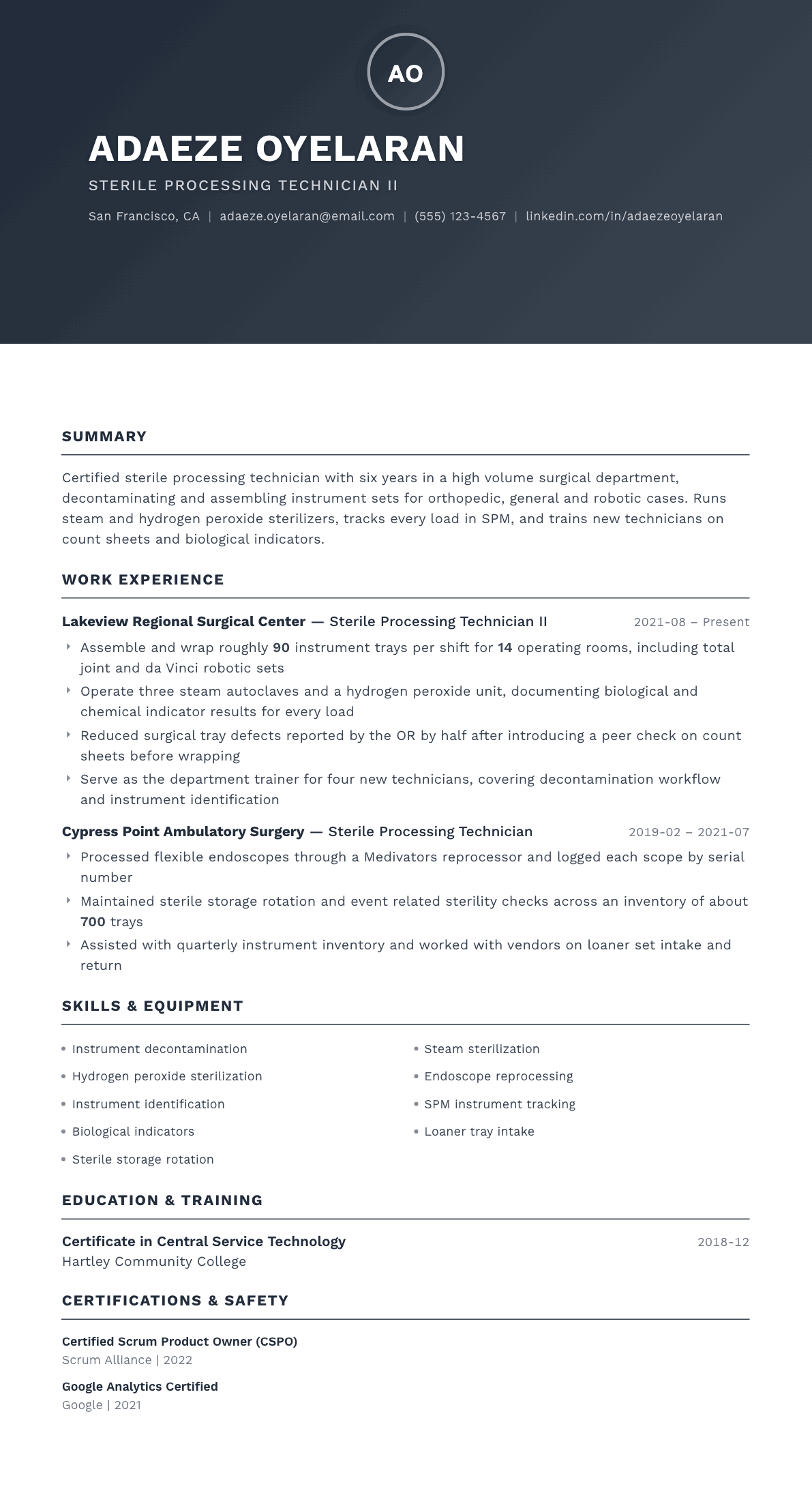
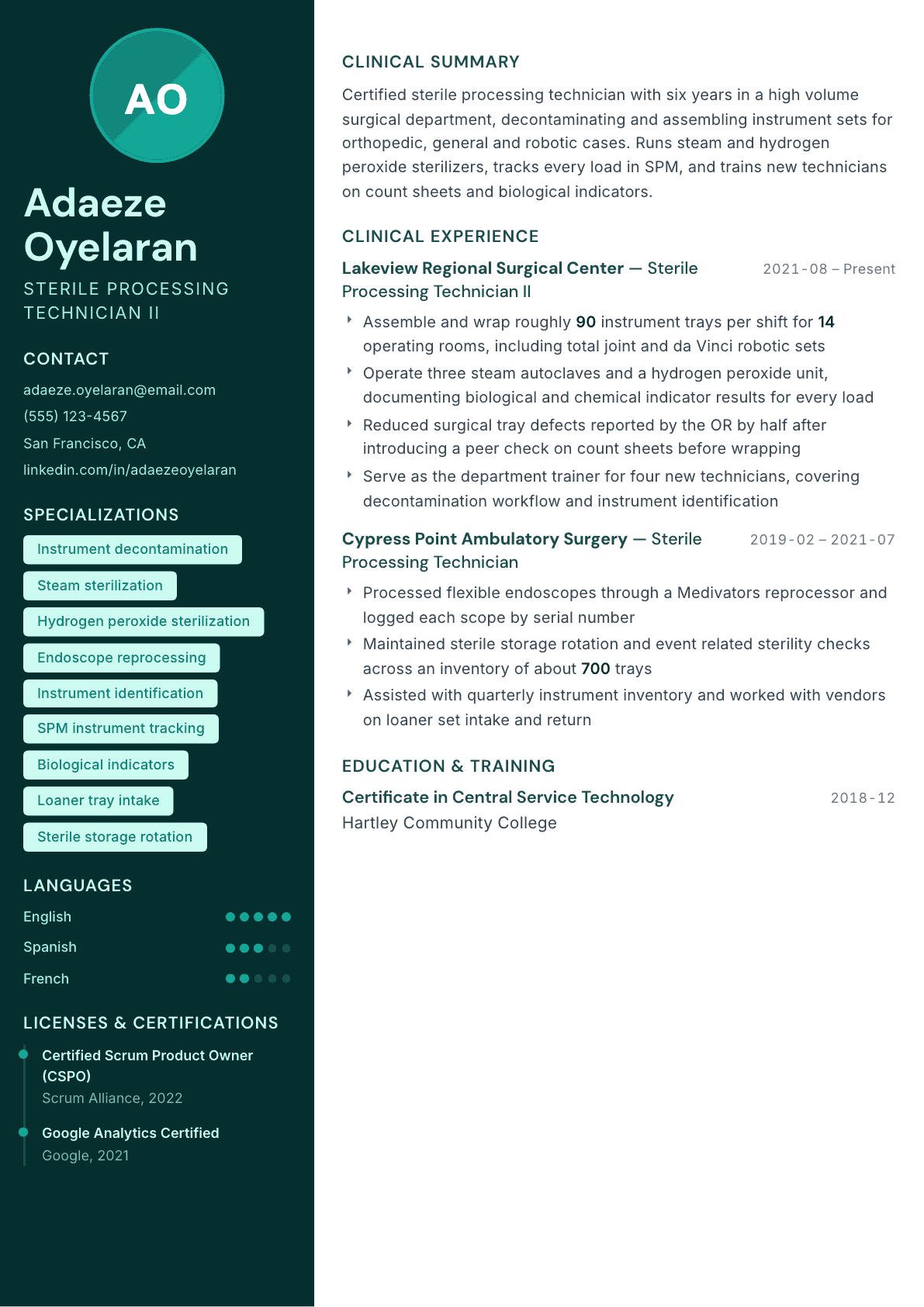
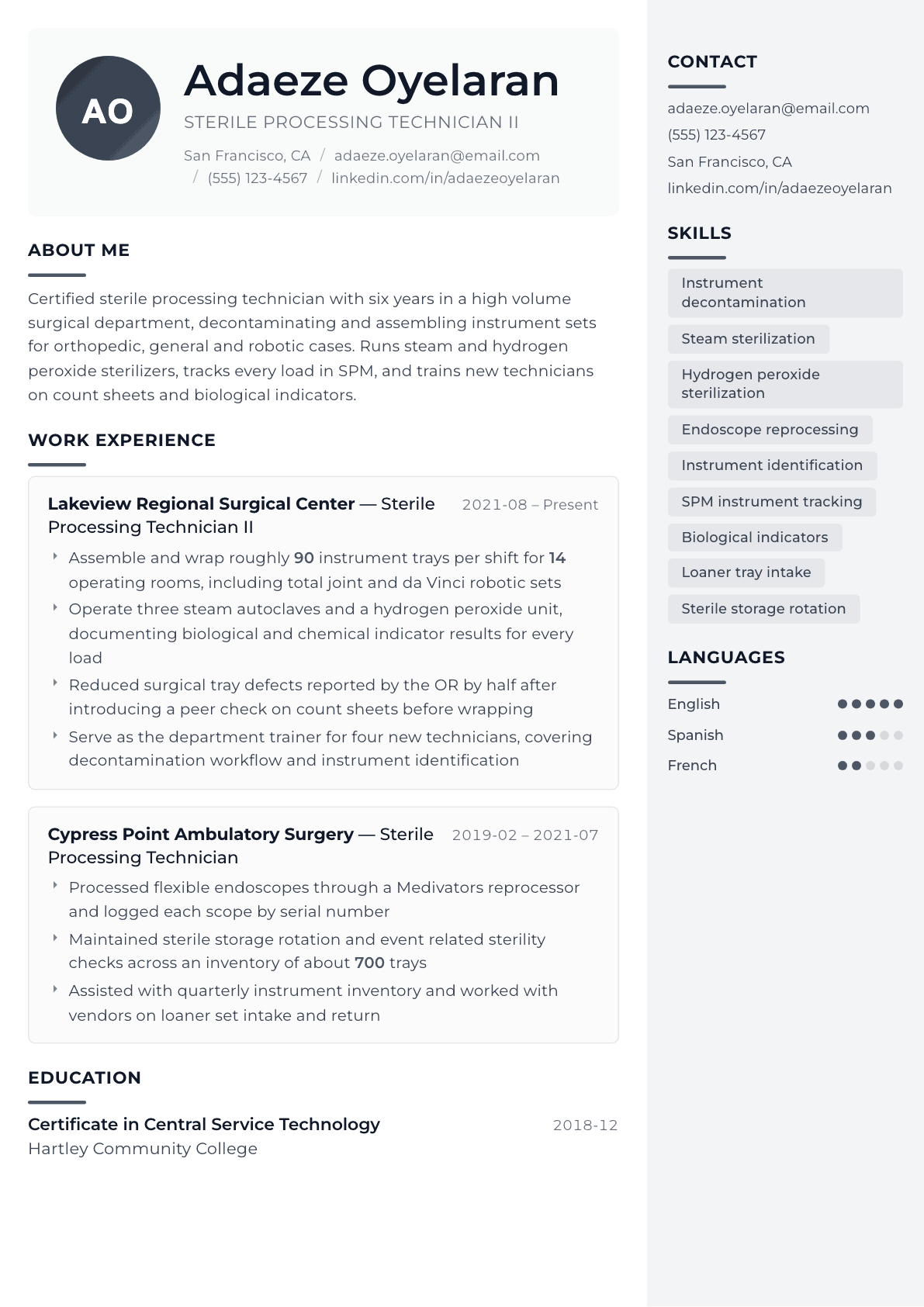
Example Sterile Processing Technician summary
Certified sterile processing technician with six years supporting fourteen operating rooms in a busy surgical center. Assembles about 90 trays per shift across orthopedic, general and robotic services, runs steam and hydrogen peroxide sterilizers, and documents every load. Cut OR reported tray defects by half through a peer check on count sheets, and now trains new technicians on decontamination workflow.
Skills to list on a Sterile Processing Technician resume
- Decontamination
- Instrument assembly
- Steam autoclave operation
- Low temperature sterilization
- Endoscope reprocessing
- Instrument tracking software
- Count sheet accuracy
- Biological and chemical indicators
- Loaner instrumentation
- Sterile storage
- Case cart preparation
- Infection prevention
- Equipment quality checks
- Inventory control
What actually gets this resume read
- Put your certification and the issuing board in the header, because most surgical departments filter on the credential before reading anything else.
- Give tray volume per shift and the number of operating rooms you supply, since that is how a manager measures throughput experience.
- Name every sterilizer and washer you have run, including the manufacturer, because departments hire for the equipment they already own.
- List the surgical specialties whose sets you assemble, since orthopedic and robotic instrumentation carry very different learning curves.
- Mention the tracking software by name, whether SPM, Censitrac or Sterile Processing Microsystems, so the ATS matches the posting.
- Show quality work such as biological indicator logging, recall handling and count sheet accuracy rather than describing routine cleaning.
How to write a sterile processing technician resume
Sterile processing hiring runs on two questions: is the certification current, and can this person assemble a complicated tray correctly at speed. The surgical services manager reading your resume has an operating room schedule that stalls when a set comes up short, so every line you write is being judged against the risk of a missing instrument at the field.
That is why volume and specialty matter more here than adjectives. A technician who has wrapped total joint sets and reprocessed robotic instrumentation is a different hire from one who has only handled minor procedure trays, even if both have the same number of years. Say which one you are in the first job heading.
This guide covers the section order surgical departments expect, the equipment and tracking software names that carry you through keyword screens, example summaries for a new certificate holder through a lead technician, and rewritten bullets that turn routine cleaning into evidence of quality work.
Format: one page, credentials at the very top
One page is standard for this role unless you have held lead or educator positions across several facilities. Use a single column with no graphics. Hospital systems run large applicant tracking platforms and a plain layout parses cleanly.
Put the certification abbreviation directly after your name and repeat it in full, with the issuing board, in a credentials block above experience. Departments that require certification within a set window will not read past a resume that hides it.
- Header: name with certification abbreviation, city and state, phone, email.
- Credentials block: certification name, issuing board, current status.
- Sections: summary, credentials, experience, equipment and systems, education.
Summary: setting, volume, specialties, sterilization methods
Three lines. Name the facility type, whether hospital central service, an ambulatory surgery center or an offsite reprocessing plant. Give the number of operating rooms you supply, the trays per shift you assemble, and the sterilization methods you run. That is the entire hiring question compressed into one paragraph.
If you are new, say what your training program included: hours of clinical externship, the sets you assembled, and the equipment you were checked off on. A manager will take an eager new technician with clear exposure over a vague one with a year of unspecified work.
Experience: workflow area, throughput, specialty sets
Break each job into the three workflow areas so the reader knows where you spent time: decontamination, assembly and packaging, and sterilization and sterile storage. Many technicians are strong in one and thin in another, and a department short in decontamination will hire for it directly.
Then quantify. Trays per shift, operating rooms supported, case carts built per day, endoscopes reprocessed per week and the size of the tray inventory all tell a manager what you can carry. Add the specialties: orthopedic and spine, robotic, cardiovascular, ophthalmology, labor and delivery, endoscopy.
Finish each job with a quality bullet. Tray defect rate reported by the operating room, biological indicator documentation, loaner set intake accuracy and recall handling are the parts of the job that get audited, so they are the parts worth writing down.
Equipment and systems: name the manufacturers
This is the keyword section. List the washer disinfectors, ultrasonic units, steam autoclaves, low temperature units and endoscope reprocessors you have run, by manufacturer where you know it. Steris, Getinge, Medivators and Olympus appear in postings because a department is hiring to run the equipment it already bought.
Add the instrument tracking software: SPM, Censitrac, Instrument Tracking or the module inside the hospital system. Note whether you built or edited count sheets, since that is a step above scanning trays through.
- Washer disinfectors, ultrasonic cleaners, cart washers.
- Steam autoclaves, hydrogen peroxide and other low temperature units.
- Endoscope reprocessors, drying cabinets, borescope inspection.
- Tracking software, count sheet building, loaner management systems.
Standards and quality language screeners look for
Postings borrow language from the recognized practice standards: instructions for use, event related sterility, biological and chemical indicators, Bowie-Dick testing, load documentation, immediate use steam sterilization and point of use treatment. Use the terms accurately and only where you have done the work, because an interviewer will ask you to explain any one of them.
Sterile Processing Technician resume summary examples
New certificate holder
Certified sterile processing technician fresh from a 400-hour clinical externship in a six-room ambulatory surgery center. Checked off on decontamination workflow, ultrasonic cleaning, steam autoclave operation and general surgery tray assembly. Comfortable reading count sheets and instructions for use, and seeking a hospital central service department with structured orientation.
Five years in
Sterile processing technician supplying fourteen operating rooms, assembling about 90 trays per shift across orthopedic, general and robotic services. Runs steam and hydrogen peroxide sterilizers with full indicator documentation, reprocesses flexible endoscopes, and handles loaner set intake against vendor count sheets under tight turnover windows.
Lead technician
Lead sterile processing technician for a level II trauma center, coordinating three shifts and an inventory of roughly 2,000 trays. Built count sheets in the tracking system, cut operating room reported defects through a peer verification step, and trains every new technician through a documented competency checklist before independent assembly.
Work experience bullets: before and after
Before: Cleaned and sterilized surgical instruments.
After: Decontaminated and assembled roughly 90 instrument trays per shift for 14 operating rooms, including total joint, spine and robotic sets.
Tray volume, room count and named specialties tell a manager exactly what throughput you have carried.
Before: Operated sterilizers according to policy.
After: Ran three steam autoclaves and a hydrogen peroxide unit, documenting Bowie-Dick tests, chemical indicators and biological indicator results for every load.
Naming the units and the specific quality checks proves you understand load documentation rather than button pressing.
Before: Helped reduce errors in the department.
After: Cut operating room reported tray defects by half by introducing a peer verification of count sheets before wrapping and a photo reference sheet for the six most complex sets.
An outcome plus two named process changes turns a vague improvement claim into something repeatable.
Before: Worked with vendors on loaner instruments.
After: Received and processed loaner sets from six orthopedic vendors, verifying every tray against the vendor count sheet and holding delivery cutoffs so sets could complete a full cycle before case time.
The vendor count and the delivery cutoff detail show you protect the schedule, which is what loaner management is really about.
Before: Trained new employees.
After: Trained four new technicians through a documented competency checklist covering decontamination flow, instrument identification and packaging, signing each off before independent tray assembly.
A checklist and a sign-off make training auditable, which is how a department has to run it anyway.
Hard skills
- Instrument decontamination
- Ultrasonic cleaning
- Instrument identification and assembly
- Steam sterilization
- Low temperature sterilization
- Flexible endoscope reprocessing
- Biological and chemical indicator documentation
- Instrument tracking software
- Count sheet building
- Loaner tray intake and return
- Sterile storage and stock rotation
- Case cart preparation
Soft skills
- Attention to detail
- Working under turnover pressure
- Communication with operating room staff
- Following instructions for use
- Teamwork across shifts
- Training newer technicians
Certifications worth listing
- Certified Registered Central Service Technician (CRCST) (Healthcare Sterile Processing Association)
- Certified Instrument Specialist (CIS) (Healthcare Sterile Processing Association)
- Certified Endoscope Reprocessor (CER) (Healthcare Sterile Processing Association)
- Certified Sterile Processing and Distribution Technician (CSPDT) (Certification Board for Sterile Processing and Distribution)
- Certified Flexible Endoscope Reprocessor (CFER) (Certification Board for Sterile Processing and Distribution)
Mistakes that cost sterile processing technician candidates the interview
- Hiding the certification in an education block at the bottom when it is the first thing the department verifies.
- Writing generic cleaning duties with no tray volume, room count or specialty, which reads the same as every other file in the stack.
- Skipping the equipment names, so the resume never matches a posting written around the units the facility owns.
- Claiming endoscope experience without saying which reprocessor and whether you handled drying, storage and borescope inspection.
- Leaving out quality documentation, which is the part of the role that survives an accreditation survey.
- Listing operating room experience as if it were the same job, when assembly accuracy and decontamination flow are what this department buys.
Sterile Processing Technician resume questions
Do I need certification to get hired in sterile processing?
Many hospitals require it at hire and most of the rest require it within a set window after starting. If you are studying, list the credential with the awarding board and your scheduled exam date, because departments will interview a candidate who has a concrete plan.
How do I show tray assembly skill on paper?
Give the number of trays per shift, name the specialty sets you build, and mention count sheet use and peer verification. A manager reading total joint, spine and robotic sets alongside a defect rate knows more in one line than a paragraph of adjectives could tell them.
Should I include a surgical technologist or operating room role?
Yes, because instrument familiarity transfers directly and helps you communicate with the field. Frame it around instrument identification, set composition and case turnover rather than patient positioning, so the reader sees the part that matters for this department.
What if my experience is only in an ambulatory surgery center?
Say so plainly and give the room count and case types. Surgery center technicians often run every workflow area alone, which is a real strength. Name the sterilizers and the tracking method you used, and mention any hospital caliber sets you handled such as orthopedic implants.
How long should a sterile processing resume be?
One page for most technicians. Move to two only when you have lead, educator or manager experience across more than one facility, or when you carry several specialty certifications that need their own block with issuing bodies and current status.