Social Work Interview Questions: 7 UK Model Answers
By Mustafa Tarabya, founder of CVBooster · Published · Updated
11 min read
Social work interview questions in the UK test one thing above all: whether you can explain a decision you made about a real family, why you made it, and what you would do differently. Every panel asks about safeguarding, values, managing risk and using supervision, and most add a written exercise or a case scenario on the day. The capabilities a panel listens for come from the BASW Professional Capabilities Framework, and the duties come from the National Careers Service social worker profile. Below are the questions in the order a panel usually asks them, with seven full model answers tagged by level. Written by Mustafa Tarabya, who hired for his own company, read every application himself and now writes CVBooster's guides.
You have done three placements, written forty pages of reflective logs and passed a degree that asks you to explain your own feelings in a footnoted essay. Then a panel of three asks why you want to be a social worker and your mind goes completely blank. That is normal. The answer is already in your placement notes.
Social work questions for interviews: what the panel is scoring
Most local authority panels score each answer against the person specification and add one or two follow up questions per answer. The panel is normally a team manager, a senior practitioner and sometimes someone from HR or a person with lived experience of services.
The framework they score against is the same one your degree used. BASW describes it as follows: "The PCF is the profession-owned, overarching framework of social work education and professional development in England". When a question feels vague, ask yourself which of its nine domains it belongs to, and answer with a case that shows that domain.
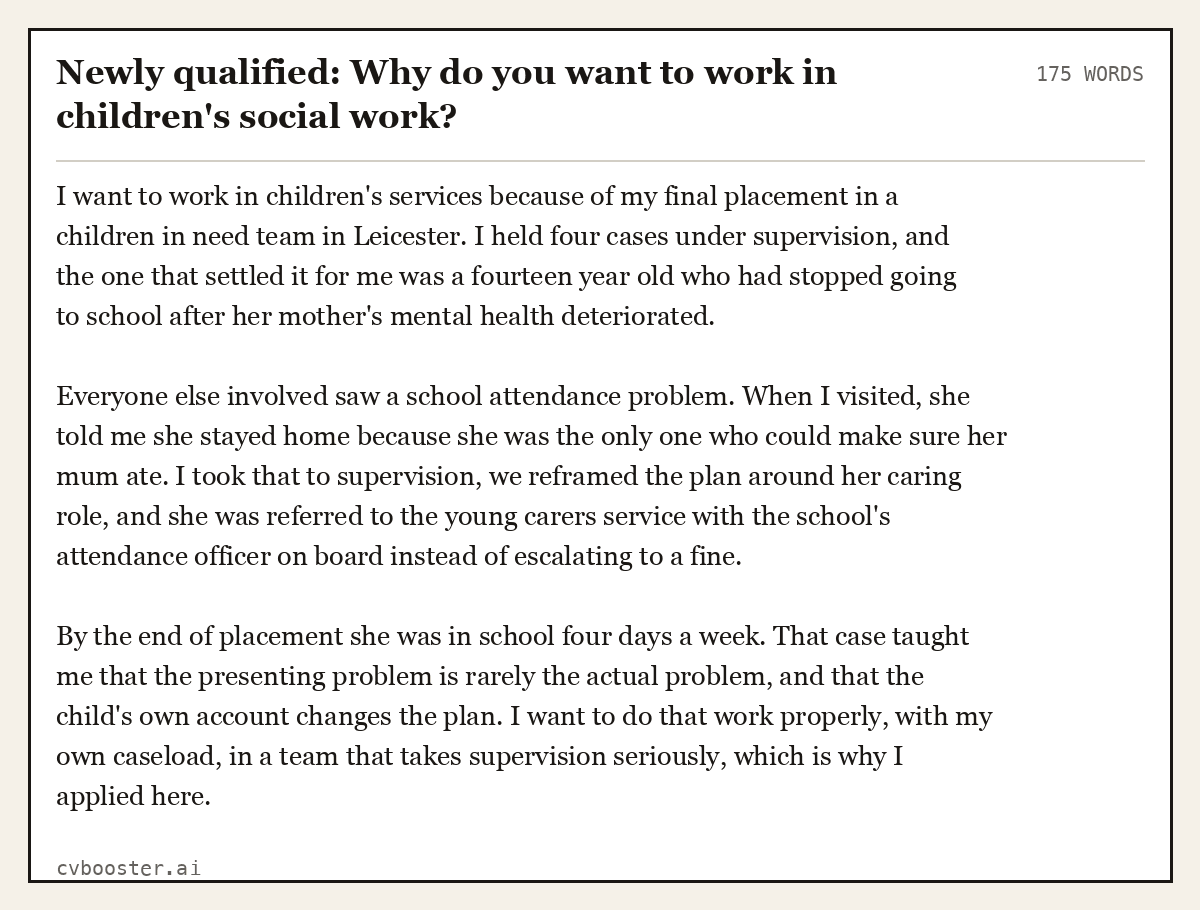
Newly qualified: Why do you want to work in children's social work? (175 words)
I want to work in children's services because of my final placement in a children in need team in Leicester. I held four cases under supervision, and the one that settled it for me was a fourteen year old who had stopped going to school after her mother's mental health deteriorated.
Everyone else involved saw a school attendance problem. When I visited, she told me she stayed home because she was the only one who could make sure her mum ate. I took that to supervision, we reframed the plan around her caring role, and she was referred to the young carers service with the school's attendance officer on board instead of escalating to a fine.
By the end of placement she was in school four days a week. That case taught me that the presenting problem is rarely the actual problem, and that the child's own account changes the plan. I want to do that work properly, with my own caseload, in a team that takes supervision seriously, which is why I applied here.
Values and motivation questions
Values questions sound soft and are scored hard. The panel wants to hear the value named, then a moment where it cost you something to act on it.
- Why social work, and why this team?
- What does anti-oppressive practice look like in your day to day work?
- Tell us about a time your values conflicted with a decision you had to carry out.
- How do you build a relationship with a parent who does not want you in the house?
The second question maps to a PCF domain that asks you to "Recognise diversity and apply anti-discriminatory, anti-racist and anti-oppressive principles in practice." Use a case where you changed something concrete, such as booking an interpreter instead of using a child to translate, or moving a meeting so a working father could attend.
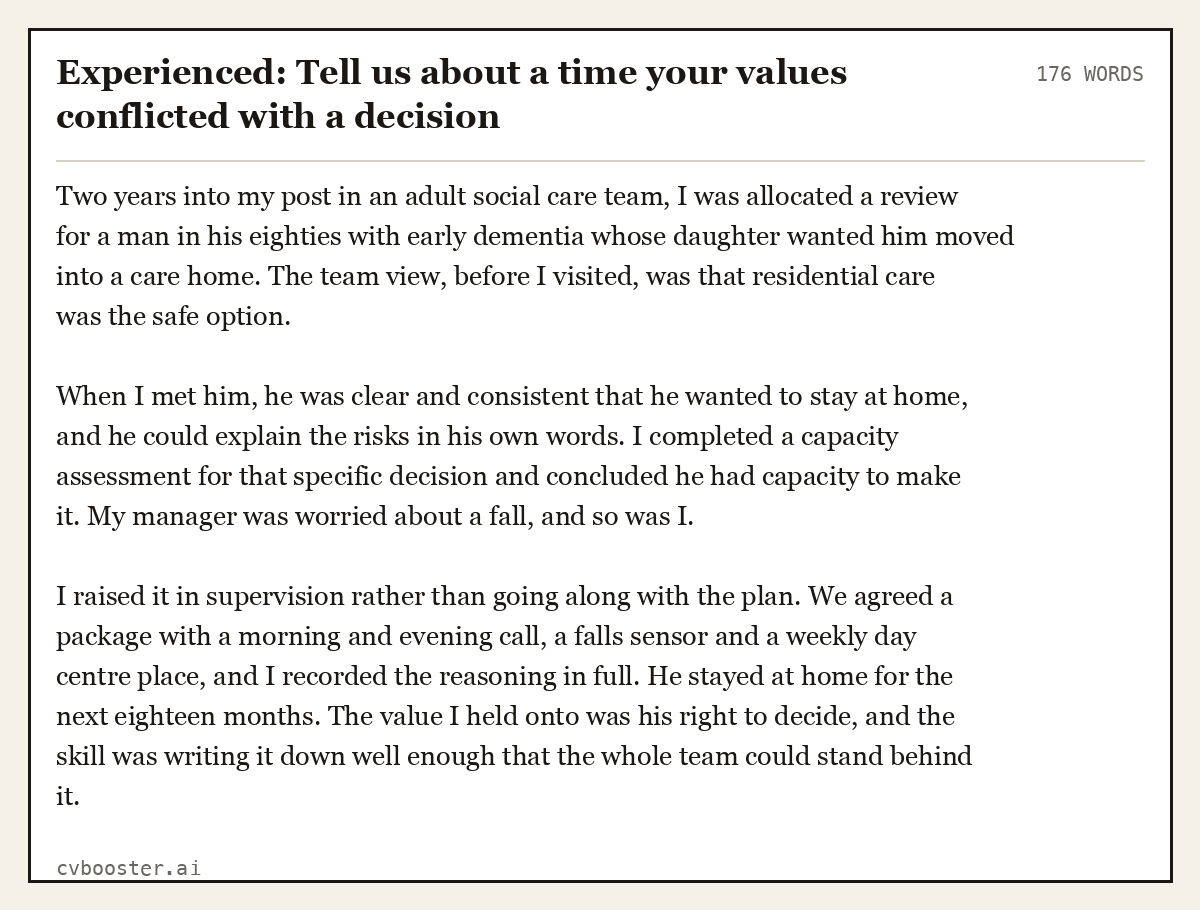
Experienced: Tell us about a time your values conflicted with a decision (176 words)
Two years into my post in an adult social care team, I was allocated a review for a man in his eighties with early dementia whose daughter wanted him moved into a care home. The team view, before I visited, was that residential care was the safe option.
When I met him, he was clear and consistent that he wanted to stay at home, and he could explain the risks in his own words. I completed a capacity assessment for that specific decision and concluded he had capacity to make it. My manager was worried about a fall, and so was I.
I raised it in supervision rather than going along with the plan. We agreed a package with a morning and evening call, a falls sensor and a weekly day centre place, and I recorded the reasoning in full. He stayed at home for the next eighteen months. The value I held onto was his right to decide, and the skill was writing it down well enough that the whole team could stand behind it.
Safeguarding and risk questions
Every social work interview has at least one safeguarding question, and most have two. The panel is checking that you know your threshold, your procedures and your own limits.
- Talk us through what you would do if a child disclosed abuse on a home visit.
- How do you assess risk when the information you have conflicts?
- Tell us about a time you escalated a concern and the outcome.
- What would you do if you disagreed with a strategy meeting decision?
The Community Care advice on difficult interview questions gives the plain reason these questions exist: "Employers prefer candidates who show a high level of problem-solving skills." In a safeguarding answer, problem solving means sequence: immediate safety, who you told and when, what you recorded, and what happened next.
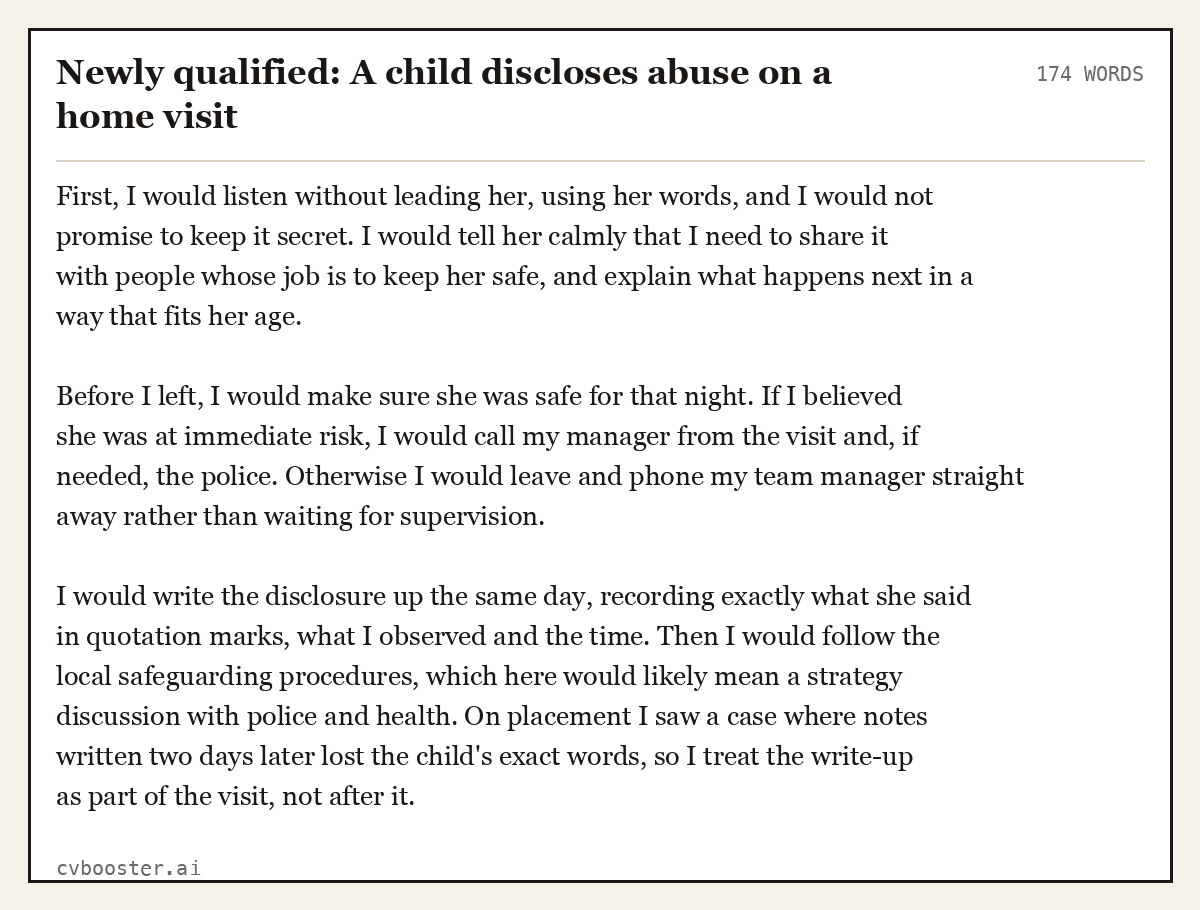
Newly qualified: A child discloses abuse on a home visit (174 words)
First, I would listen without leading her, using her words, and I would not promise to keep it secret. I would tell her calmly that I need to share it with people whose job is to keep her safe, and explain what happens next in a way that fits her age.
Before I left, I would make sure she was safe for that night. If I believed she was at immediate risk, I would call my manager from the visit and, if needed, the police. Otherwise I would leave and phone my team manager straight away rather than waiting for supervision.
I would write the disclosure up the same day, recording exactly what she said in quotation marks, what I observed and the time. Then I would follow the local safeguarding procedures, which here would likely mean a strategy discussion with police and health. On placement I saw a case where notes written two days later lost the child's exact words, so I treat the write-up as part of the visit, not after it.
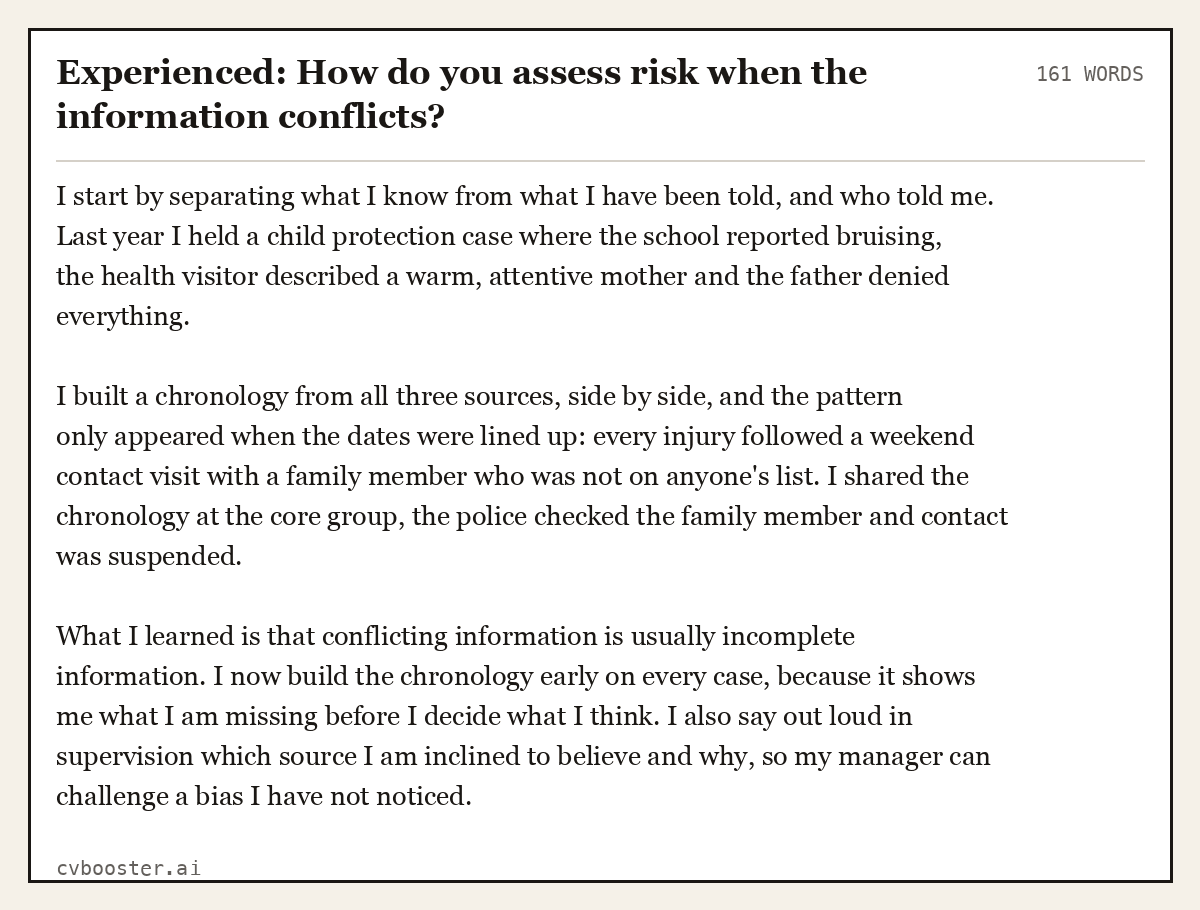
Experienced: How do you assess risk when the information conflicts? (161 words)
I start by separating what I know from what I have been told, and who told me. Last year I held a child protection case where the school reported bruising, the health visitor described a warm, attentive mother and the father denied everything.
I built a chronology from all three sources, side by side, and the pattern only appeared when the dates were lined up: every injury followed a weekend contact visit with a family member who was not on anyone's list. I shared the chronology at the core group, the police checked the family member and contact was suspended.
What I learned is that conflicting information is usually incomplete information. I now build the chronology early on every case, because it shows me what I am missing before I decide what I think. I also say out loud in supervision which source I am inclined to believe and why, so my manager can challenge a bias I have not noticed.
Reflection, supervision and resilience questions
Panels ask about supervision because the job depends on it. The National Careers Service lists one of the day to day duties as to "keep accurate records, write reports and review cases with your supervisors". A good answer shows you bring cases to supervision with a question, not just an update.
- How do you use supervision?
- Tell us about a mistake you made and what you learned.
- How do you manage a heavy caseload without letting recording slip?
- How do you look after yourself after a difficult visit?
The reflection domain of the PCF asks you to "Apply critical reflection and analysis to inform and provide a rationale for professional decision-making." The word rationale is the point. Say what you decided, and why.
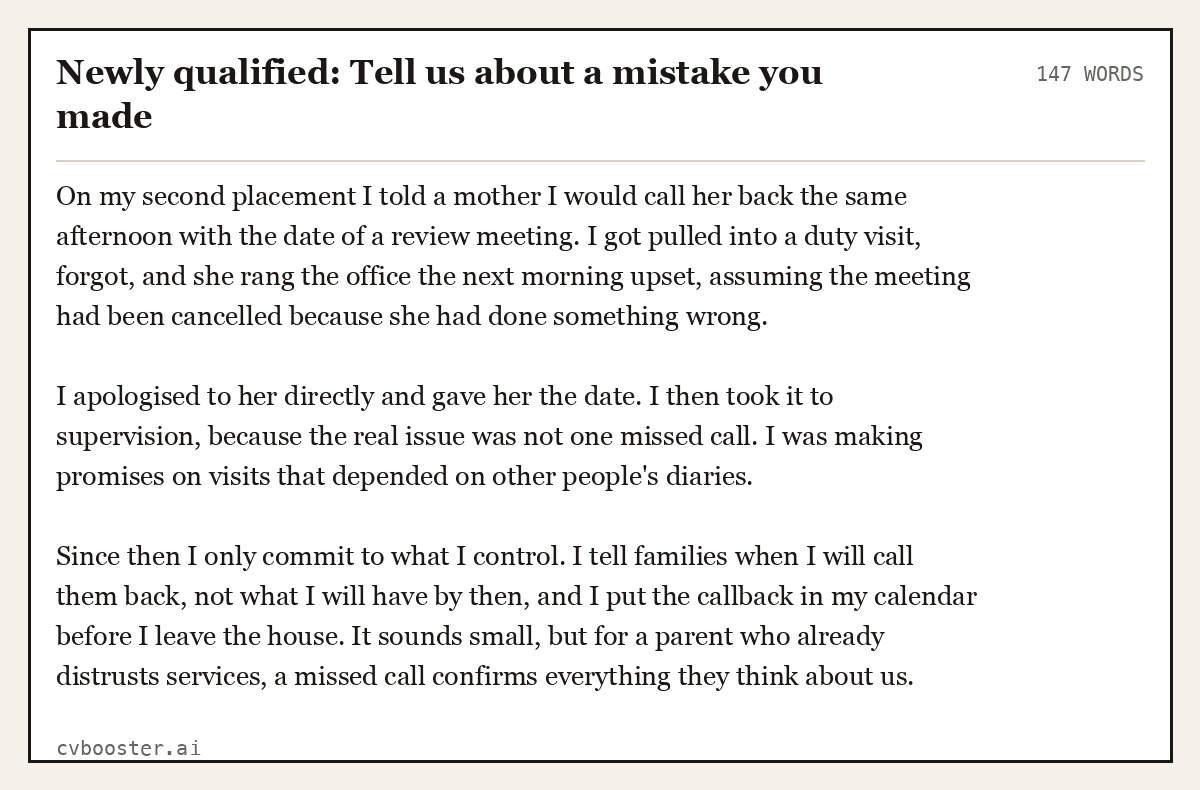
Newly qualified: Tell us about a mistake you made (147 words)
On my second placement I told a mother I would call her back the same afternoon with the date of a review meeting. I got pulled into a duty visit, forgot, and she rang the office the next morning upset, assuming the meeting had been cancelled because she had done something wrong.
I apologised to her directly and gave her the date. I then took it to supervision, because the real issue was not one missed call. I was making promises on visits that depended on other people's diaries.
Since then I only commit to what I control. I tell families when I will call them back, not what I will have by then, and I put the callback in my calendar before I leave the house. It sounds small, but for a parent who already distrusts services, a missed call confirms everything they think about us.
Scenario and written exercise questions
Many authorities give you a case summary on the day and a fixed time to write an analysis, or ask a scenario question in the room. They want structure under time pressure.
Use the same order every time: immediate safety, the information you have, the information you are missing, the people you would speak to, your initial view of risk and the next step. Keep it in plain English, because the written exercise is also a test of whether a parent could read your report.
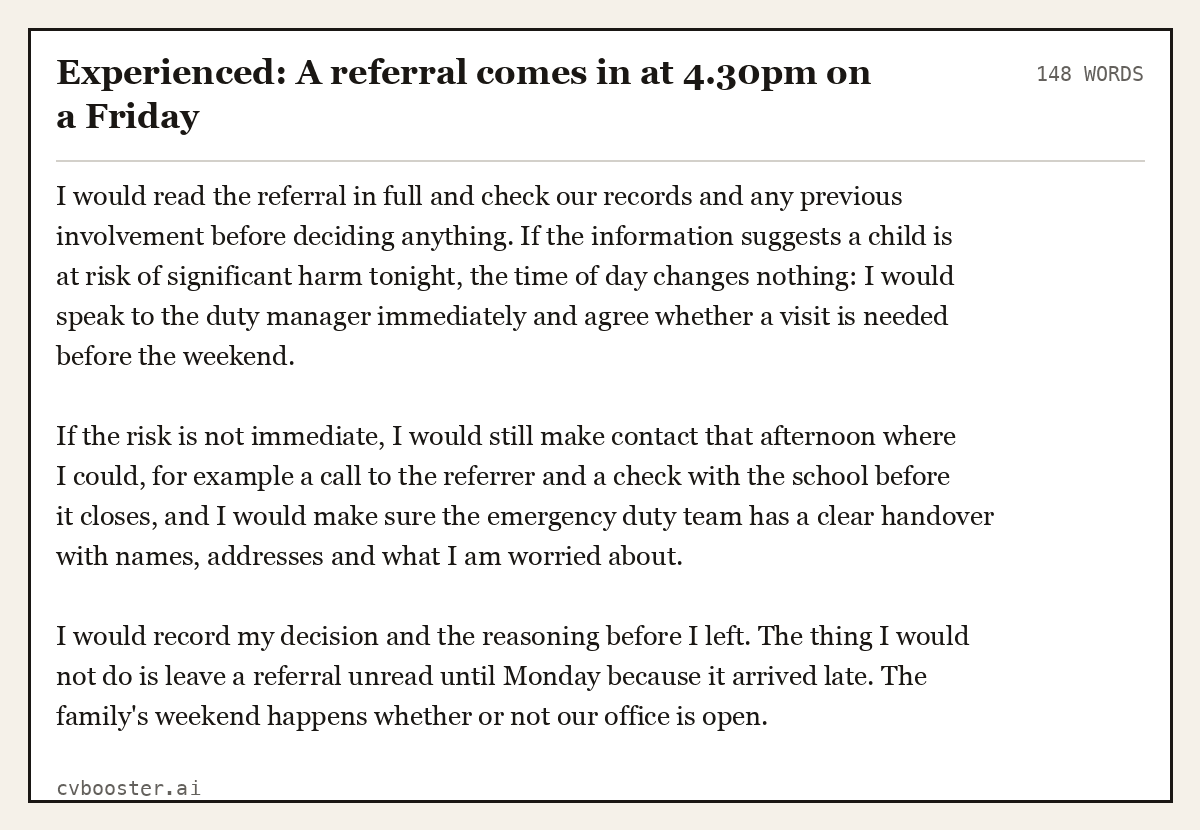
Experienced: A referral comes in at 4.30pm on a Friday (148 words)
I would read the referral in full and check our records and any previous involvement before deciding anything. If the information suggests a child is at risk of significant harm tonight, the time of day changes nothing: I would speak to the duty manager immediately and agree whether a visit is needed before the weekend.
If the risk is not immediate, I would still make contact that afternoon where I could, for example a call to the referrer and a check with the school before it closes, and I would make sure the emergency duty team has a clear handover with names, addresses and what I am worried about.
I would record my decision and the reasoning before I left. The thing I would not do is leave a referral unread until Monday because it arrived late. The family's weekend happens whether or not our office is open.
Questions for senior and experienced social workers
Senior practitioner and team manager panels move from your own practice to how you develop other people's. The PCF leadership domain asks you to "Take responsibility for the professional learning and development of others."
- How do you support a newly qualified worker through the Assessed and Supported Year in Employment (ASYE)?
- Tell us about a time you challenged practice in your team.
- How do you balance caseload pressure with quality?
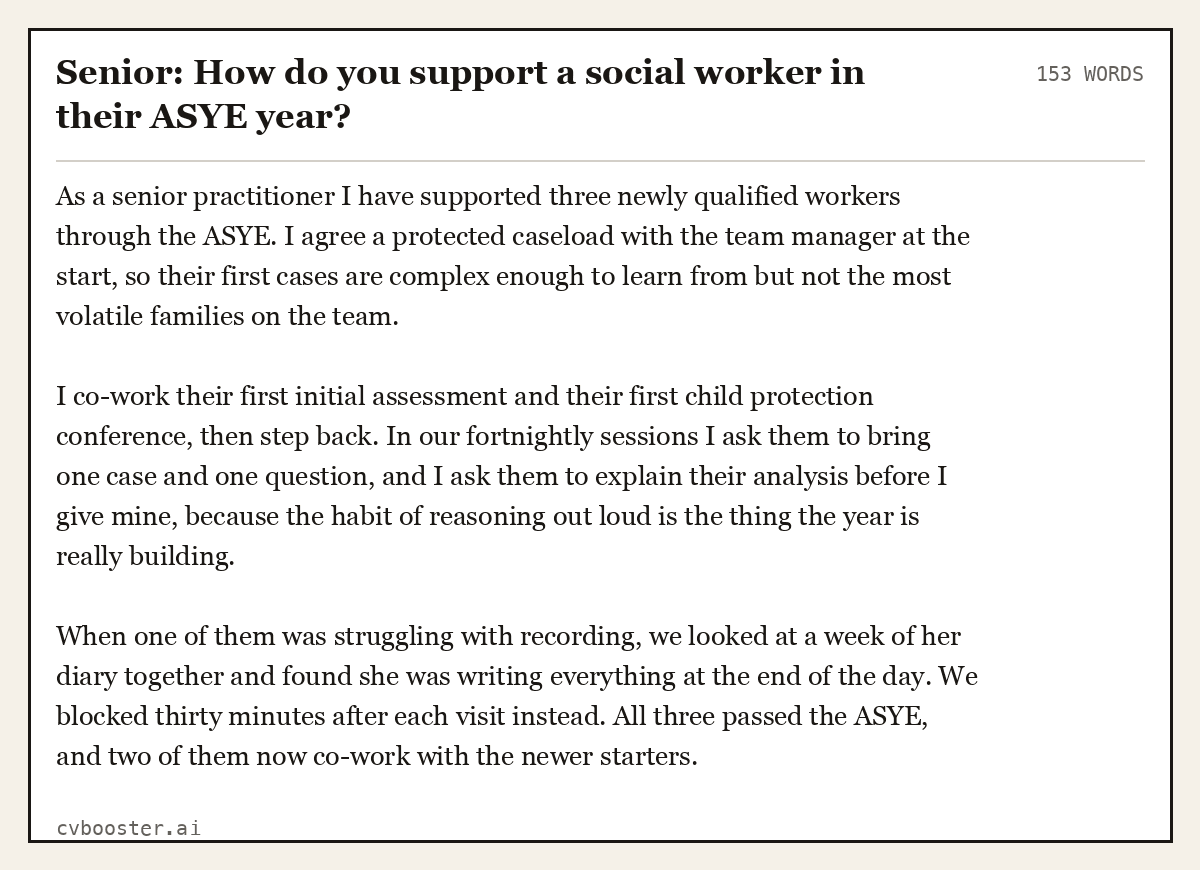
Senior: How do you support a social worker in their ASYE year? (153 words)
As a senior practitioner I have supported three newly qualified workers through the ASYE. I agree a protected caseload with the team manager at the start, so their first cases are complex enough to learn from but not the most volatile families on the team.
I co-work their first initial assessment and their first child protection conference, then step back. In our fortnightly sessions I ask them to bring one case and one question, and I ask them to explain their analysis before I give mine, because the habit of reasoning out loud is the thing the year is really building.
When one of them was struggling with recording, we looked at a week of her diary together and found she was writing everything at the end of the day. We blocked thirty minutes after each visit instead. All three passed the ASYE, and two of them now co-work with the newer starters.
Questions to ask the panel at the end
Ask about the job you will actually do. Three questions that tell you more than any advert:
- What is the average caseload for a social worker in this team, and how is it decided?
- How often is supervision, and who provides it?
- What has changed in the team in the last year?
The answers tell you whether the team is stable, and the panel learns you are thinking about how you will practise, not just whether you get the job. Before the interview, read your application against the person specification again, because panels ask follow ups from your supporting statement. If you are still writing it, our social worker resume guide and the social worker cover letter examples show how to put your placements first.
For the answer structure, the STAR interview questions guide breaks down situation, task, action and result, and the competency based interview questions and answers cover the scoring panels use. If you are applying for a support role first, the support worker interview questions and care assistant interview questions cover the frontline versions.
Frequently asked questions
What questions are asked in a social work interview?
Expect questions on why you chose social work, values and anti-oppressive practice, safeguarding and escalation, risk assessment, using supervision, managing a caseload and working with other agencies. Many UK authorities add a written exercise or case scenario. Senior posts add questions about supervising and developing other social workers.
How do I prepare for a social worker interview?
Pick four or five cases from your placements or practice that show safeguarding, values, reflection and multi-agency work, and practise telling each in under two minutes. Reread the person specification and your own application. Practise a timed written analysis of a short case summary using a fixed structure.
What is the written exercise in a social work interview?
It is usually a short case summary you analyse against the clock, covering risk, missing information, who you would contact and your next step. Panels mark structure, analysis and plain English. Write as if the family will read it, because in practice they often will.
How do I answer safeguarding questions in a social work interview?
Give the sequence: immediate safety, who you told and when, what you recorded and in whose words, the procedure you followed and the outcome. Use a real case if you have one. Name your limits, such as calling your manager, rather than suggesting you would handle it alone.
What questions do newly qualified social workers get asked?
The same core questions, scored against your placements instead of employment. Expect questions about your final placement cases, how you used supervision, what you learned from a mistake and what support you want in your ASYE year. Panels expect less experience and more honest reflection.
Related articles
- Creative Interview Questions With 6 Sample Answers
- ED Nurse Interview Questions With 9 Full Sample Answers
- Female Job Interview Attire: Six UK Outfits by Job Type
- Interview Questions for an LPN: 9 Full Sample Answers
More articles
- Soft Skills for a Resume: Communication Examples and More
- Special Education Teacher Interview Questions: 12 Answers
- Resume for Sports: 6 Athletic and Sports Job Resumes
Looking for a worked example for your job title? Browse the resume examples by job title.