Volunteer Coordinator Resume Examples: read this first
Rally Support with a Volunteer Coordinator Resume
By Mustafa Tarabya, founder of CVBooster · Published · Updated
Build a volunteer coordinator resume showcasing your recruitment, training, and engagement strategies for volunteer programs.
Sample resumes for a volunteer coordinator
The same volunteer coordinator content laid out in three CVBooster templates, so you can see what the finished document looks like before you write a word.
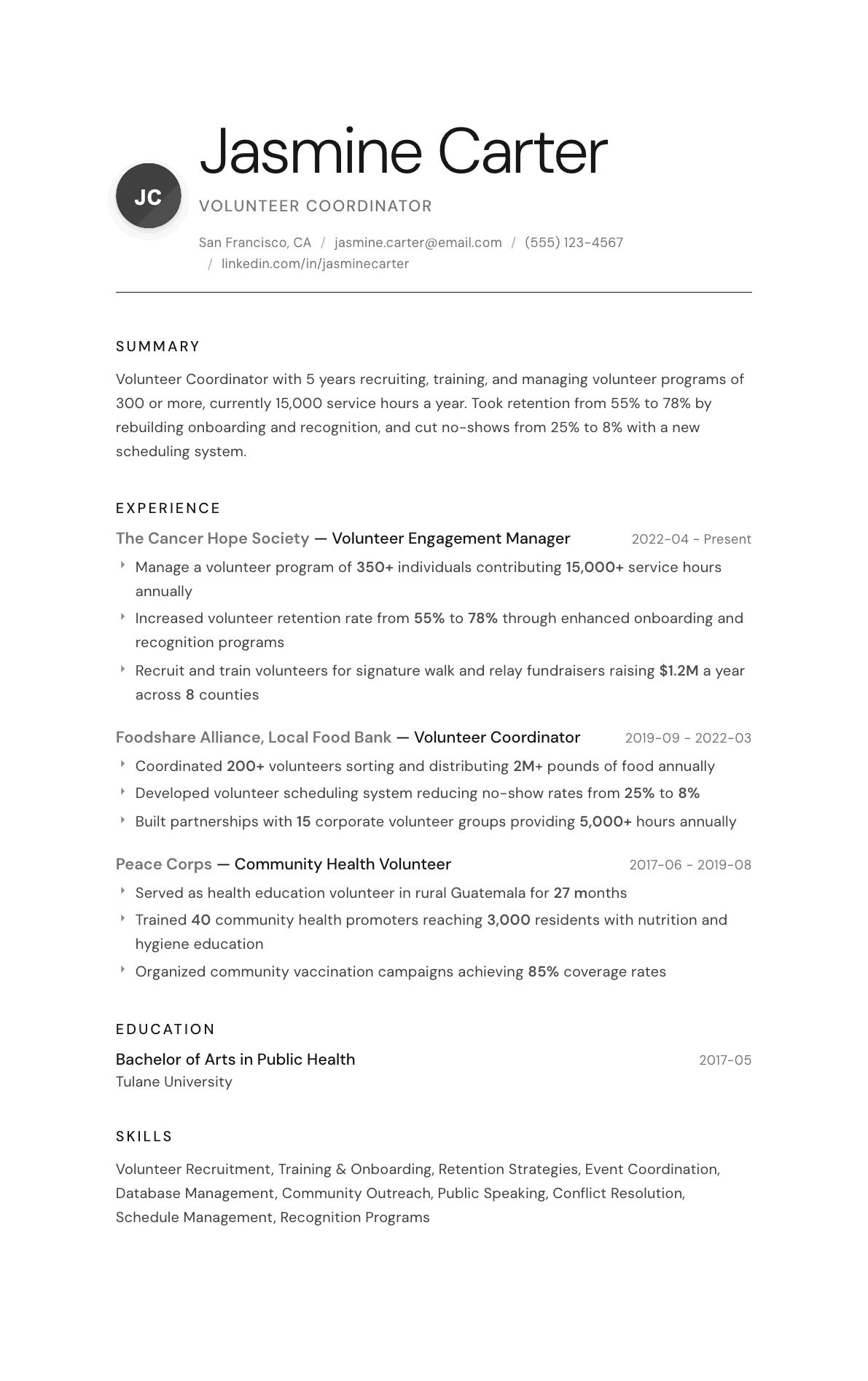
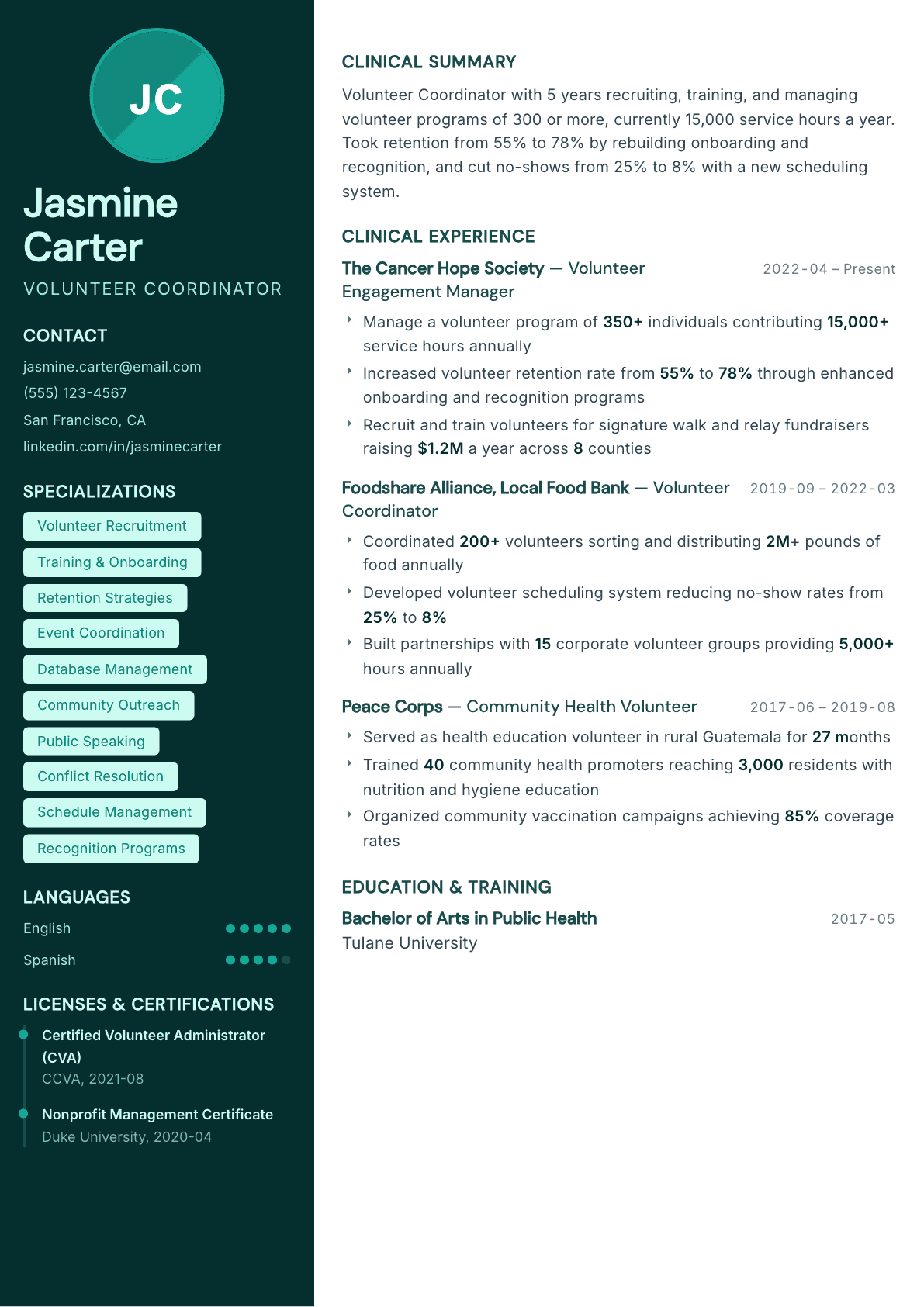
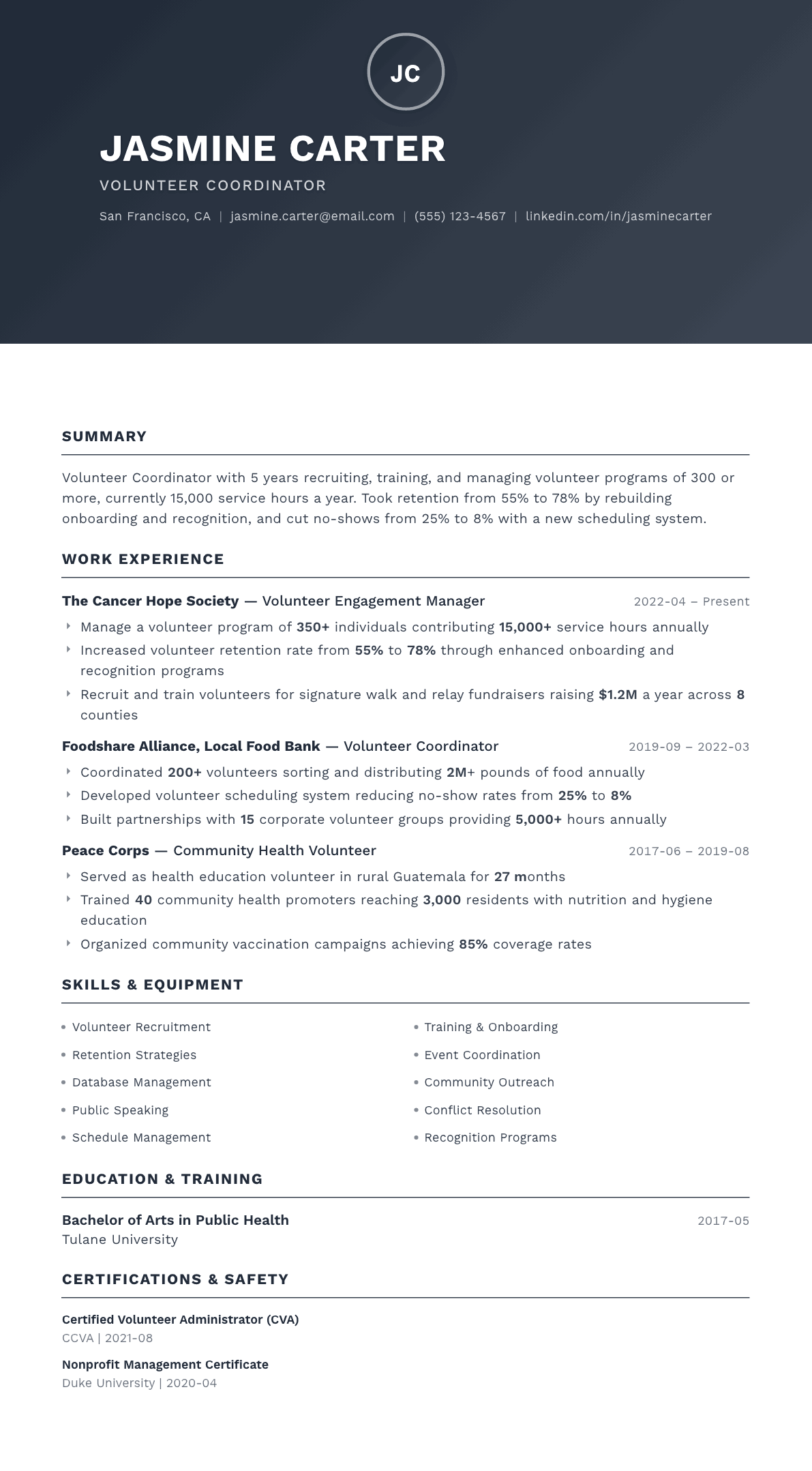
Example Volunteer Coordinator summary
Volunteer Coordinator, 5 years, currently 350 volunteers and 15,000 service hours a year. Took retention from 55% to 78% and built 15 corporate volunteer partnerships worth 5,000 hours. CVA certified, looking for a volunteer program director role.
Skills to list on a Volunteer Coordinator resume
- Volunteer Recruitment
- Training & Development
- Retention & Recognition
- Event Coordination
- Database Management
- Community Partnerships
- Public Speaking
- Conflict Resolution
- Schedule Management
- Social Media Outreach
- Program Evaluation
- Cultural Competency
- Grant Compliance
- Risk Management
What actually gets this resume read
- Quantify your volunteer program: number of volunteers managed, service hours contributed, retention rates.
- Highlight recruitment strategies: corporate partnerships, university programs, online platforms.
- Include CVA certification as it is the recognized credential for volunteer management professionals.
- Show your ability to train, motivate, and retain volunteers through recognition and engagement programs.
- Mention volunteer management software: Better Impact, VolunteerHub, SignUpGenius, Galaxy Digital.
How to write a volunteer coordinator resume
A volunteer coordinator is running a workforce that can quit at any moment with no consequence, and the resume has to prove you can hold that workforce together. The manager hiring you is thinking about the shifts that go uncovered on a Saturday, the volunteers who complete orientation and never return, and the background check that did not get run before someone worked with children.
So the numbers that matter are not how many volunteers you recruited. They are how many were active, how many hours they gave, what share came back after their first shift, and how many shifts went unfilled. Recruitment is the easy half of this job and every experienced manager knows it.
This guide covers the section order, how to write about screening and risk management without sounding bureaucratic, summaries from a first coordinator role through a manager of a large volunteer program, and rewrites that turn a warm description of volunteers into evidence of a program you ran.
Format: one page, program size in every job line
One page for nearly everyone in this role. Open each job with the size of the volunteer program you managed: active volunteers, annual service hours, the number of roles or placements, the number of sites, and whether the volunteers worked with vulnerable populations. Those five facts set the difficulty level of everything that follows.
If you have managed episodic corporate groups as well as ongoing individual volunteers, separate them. Running a two hundred person corporate build day is project work; sustaining forty weekly tutors is program work, and different employers need different halves.
- Job line: active volunteers, annual hours, roles, sites, population served.
- Order: summary, volunteer program experience, systems, education, training and credentials.
- Note any experience with volunteers under eighteen or with court-ordered service, since both add rules.
Summary: scale, retention, and the risk you managed
Say the scale of the program, the setting, and the retention figure you are proudest of. Then say what kind of screening environment you worked in, because a hospital volunteer program with health clearances and a food pantry program with a sign-in sheet are separated by an enormous amount of administrative work.
Avoid describing yourself as passionate about volunteers. The claim is universal in this field and it displaces the specifics that would actually differentiate you.
Recruitment, screening and onboarding: the pipeline with a gate
Recruitment bullets should name the sources: corporate partnerships, universities and service learning offices, faith communities, retiree groups, volunteer matching sites and referrals from current volunteers. Then say what converted, since inquiry counts are not placements.
Screening is where liability lives. Describe the process you ran: applications, interviews, reference checks, criminal background checks and the vendor used, motor vehicle records for drivers, health clearances for clinical settings, and mandated reporter training. Say how long the process took, because slow onboarding is the single largest source of volunteer loss.
Onboarding is where retention starts. General orientation, role-specific training, a first shift with a buddy, and a check-in call after the first month are the elements that make people come back, and each one is worth a line if you built it.
- Recruitment sources and the conversion from inquiry to first shift.
- Screening steps and the days from application to first assignment.
- Orientation and role-specific training you designed or delivered.
- First-shift support and the follow-up rhythm afterward.
Retention, recognition and scheduling
Report retention as a rate over a defined period, since that is what a manager compares. Then describe the mechanisms behind it: consistent scheduling, shift reminders, a clear escalation path when a volunteer has a problem, meaningful assignments rather than filler tasks, and recognition that goes beyond an annual lunch.
Scheduling deserves attention because it is the daily grind of the job. Coverage rate, how you handled no-shows, standby lists, and whether you moved the program from email and spreadsheets to a scheduling platform are all concrete improvements worth stating.
Systems, records and reporting
Name the volunteer management systems you have administered: VolunteerHub, Better Impact, Galaxy Digital, Volgistics, POINT, Salesforce with a volunteer module, or SignUpGenius for lighter programs. Say what you configured rather than what you clicked, such as building role profiles, hour tracking, or automated reminders.
Then report upward. Volunteer hours often support grant match requirements and board reporting, so a coordinator who produced clean hour totals and a value estimate for the annual report is doing work the finance and development teams depend on.
Volunteer Coordinator resume summary examples
First coordinator role
Volunteer coordinator with 2 years managing 85 active volunteers across 2 food distribution sites, covering 30 weekly shifts and 9,000 annual service hours. Cut the time from application to first shift from 3 weeks to 6 days by restructuring orientation.
Five years in
Volunteer coordinator with 5 years running a hospital auxiliary program of 300 active volunteers, including health clearances, background checks and role-specific training for 18 placements. Lifted 6-month retention from 44% to 62% with a buddy shift and a first-month check-in.
Volunteer program manager
Volunteer program manager with 9 years leading multi-site programs, currently 600 active volunteers across 5 locations and 2 supervisors. Migrated the program to Better Impact, built role profiles and hour tracking, and held shift coverage above 95% through a staffing shortage.
Work experience bullets: before and after
Before: Recruited and managed volunteers for the organization.
After: Managed 300 active volunteers across 18 placements in a hospital setting, covering 250 weekly shift hours and coordinating with 12 department supervisors on assignments and evaluations.
Active count, placements, weekly hours and department contacts describe a program rather than a duty.
Before: Improved volunteer retention.
After: Lifted 6-month volunteer retention from 44% to 62% by pairing every new volunteer with an experienced buddy for a first shift and calling each one after their first month.
A retention rate over a defined window plus the two mechanisms behind it makes the result reproducible.
Before: Handled volunteer applications and background checks.
After: Ran the full screening pipeline of application, interview, 2 references and a criminal background check, and cut time from application to first assignment from 3 weeks to 6 days.
The steps and the cycle time show that you controlled the process that most often loses new volunteers.
Before: Organized volunteer appreciation events.
After: Built a recognition program with milestone hour awards, handwritten notes at 6 months, and a supervisor nomination each quarter, replacing a single annual lunch that under a third of volunteers attended.
Naming what it replaced and the specific touchpoints turns an event into a designed retention practice.
Before: Used software to track volunteer hours.
After: Migrated 600 volunteer records to Better Impact, configured role profiles, hour tracking and automated shift reminders, and produced quarterly hour totals used for grant match reporting.
Configuration work and a downstream use for the data prove system ownership rather than data entry.
Hard skills
- Volunteer recruitment and placement
- Screening, references and background checks
- Orientation and role-specific training design
- Shift scheduling and coverage management
- Retention and recognition programs
- Service hour tracking and reporting
- Risk management and volunteer policy
- Corporate and group volunteer projects
- VolunteerHub and Better Impact
- Volgistics and Galaxy Digital
- Mandated reporter and safety training delivery
- Grant match reporting from volunteer hours
Soft skills
- Warmth with firm boundaries
- Redirecting a poor fit kindly
- Reliability volunteers can count on
- Conflict handling with staff supervisors
- Recognition that feels personal
- Composure when a shift falls apart
Certifications worth listing
- Certified in Volunteer Administration (CVA) (Council for Certification in Volunteer Administration)
- Certified Nonprofit Professional (CNP) (Nonprofit Leadership Alliance)
- Mental Health First Aid (National Council for Mental Wellbeing)
Mistakes that cost volunteer coordinator candidates the interview
- Reporting total volunteers recruited rather than active volunteers, hours and retention, which is what a manager budgets around.
- Leaving out screening and background checks, when risk management is the part of the job that protects the organization.
- Describing appreciation events as the retention strategy while the real causes of attrition go unmentioned.
- Failing to state shift coverage, since uncovered shifts are the problem a hiring manager is trying to solve.
- Treating a corporate group day and a weekly tutoring corps as the same accomplishment.
- Listing a volunteer platform without saying what you configured inside it.
- Writing warmly about volunteers without a single number attached to the program you ran.
Volunteer Coordinator resume questions
Which volunteer numbers belong on a resume?
Active volunteers rather than cumulative sign-ups, annual service hours, retention over a stated period, shift coverage rate, and the number of distinct roles or sites. Those five let a manager compare your program to theirs without asking.
How do I show risk management without sounding bureaucratic?
Attach it to an outcome. Say that you ran background checks and reference calls and reduced time to first assignment, or that you built a mandated reporter training and closed a gap found in an audit. The process only reads as dull when nothing follows from it.
Is the Certified in Volunteer Administration credential worth it?
It is the recognized professional credential in this field and it distinguishes candidates for larger programs, particularly in health care and higher education. It requires documented experience and an exam, so it is usually pursued after a few years in the role.
How do I move from volunteer coordinator to a broader nonprofit role?
Highlight the transferable systems: recruiting and onboarding a workforce, training design, scheduling under constraints, database administration and reporting to funders. Those map directly onto human resources, program management and operations roles.
Should I include my own volunteer service on the resume?
A short line is fine and often relevant, because coordinators who have been volunteers understand the experience from the other side. Keep it brief so it does not compete with the paid program management record above it.
Related resume examples
- Program Coordinator Resume example
- Outreach Coordinator Resume example
- Community Organizer Resume example
- Volunteer Manager Resume example
- Social Services Manager Resume example
- Social Worker Resume example