Podiatrist Resume Examples: free ATS score and gap list
Write a Podiatrist Resume That Shows Clinical Volume and Surgical Scope
By Mustafa Tarabya, founder of CVBooster · Published · Updated
A podiatrist resume example with clinic volume, surgical case mix and board certification detail, plus keywords and a full resume writing guide.
Sample resumes for a podiatrist
The same podiatrist content laid out in three CVBooster templates, so you can see what the finished document looks like before you write a word.
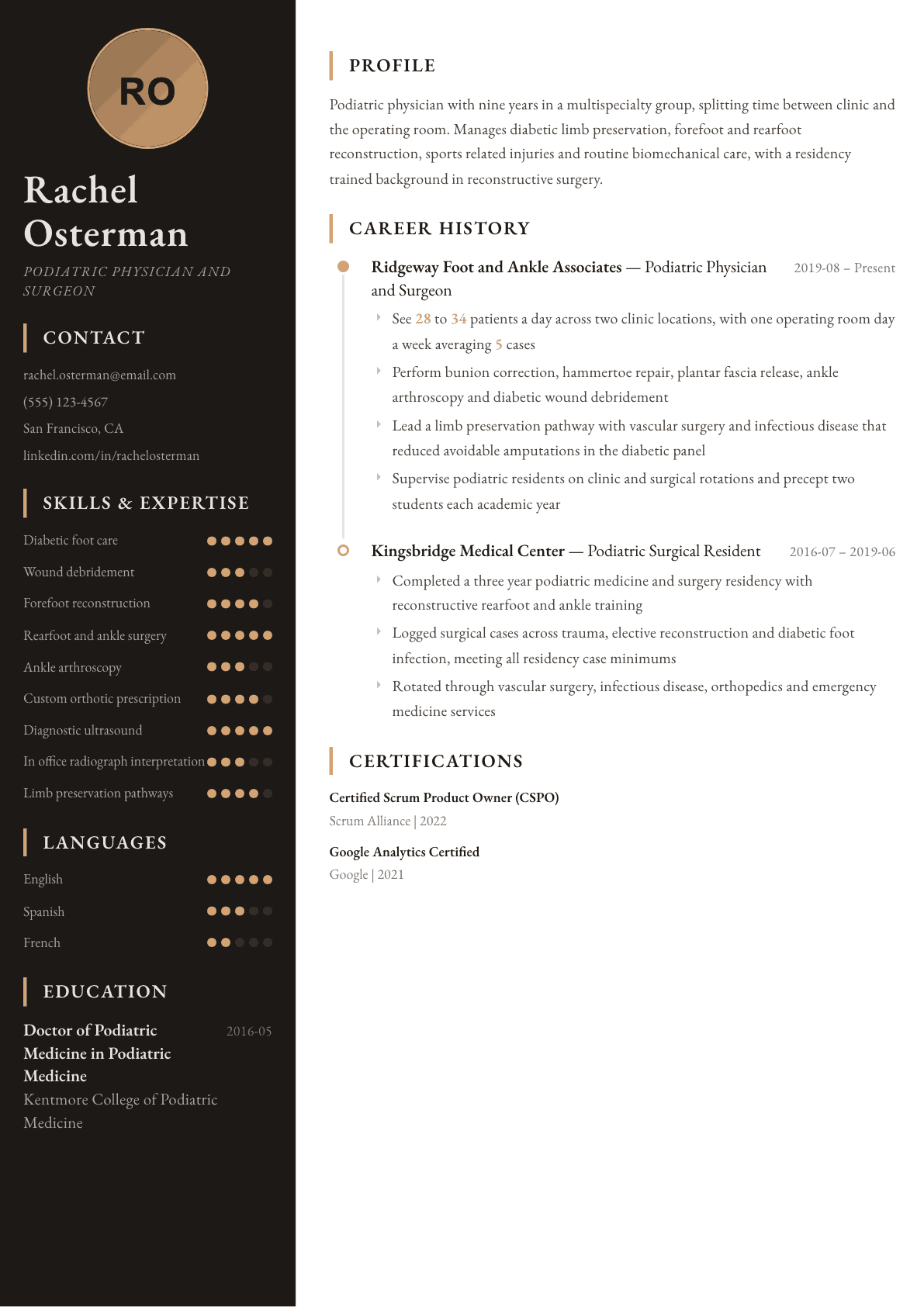
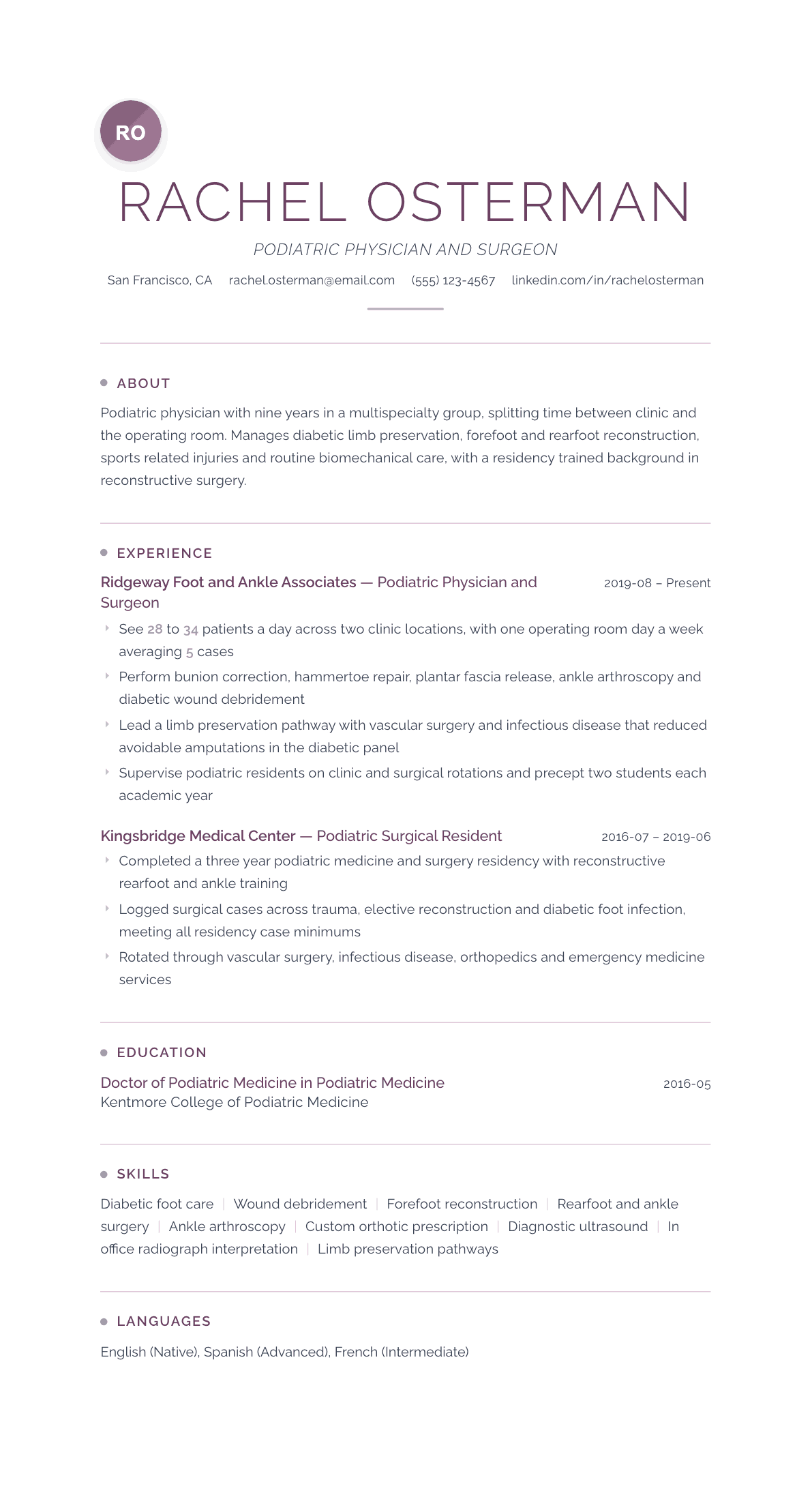
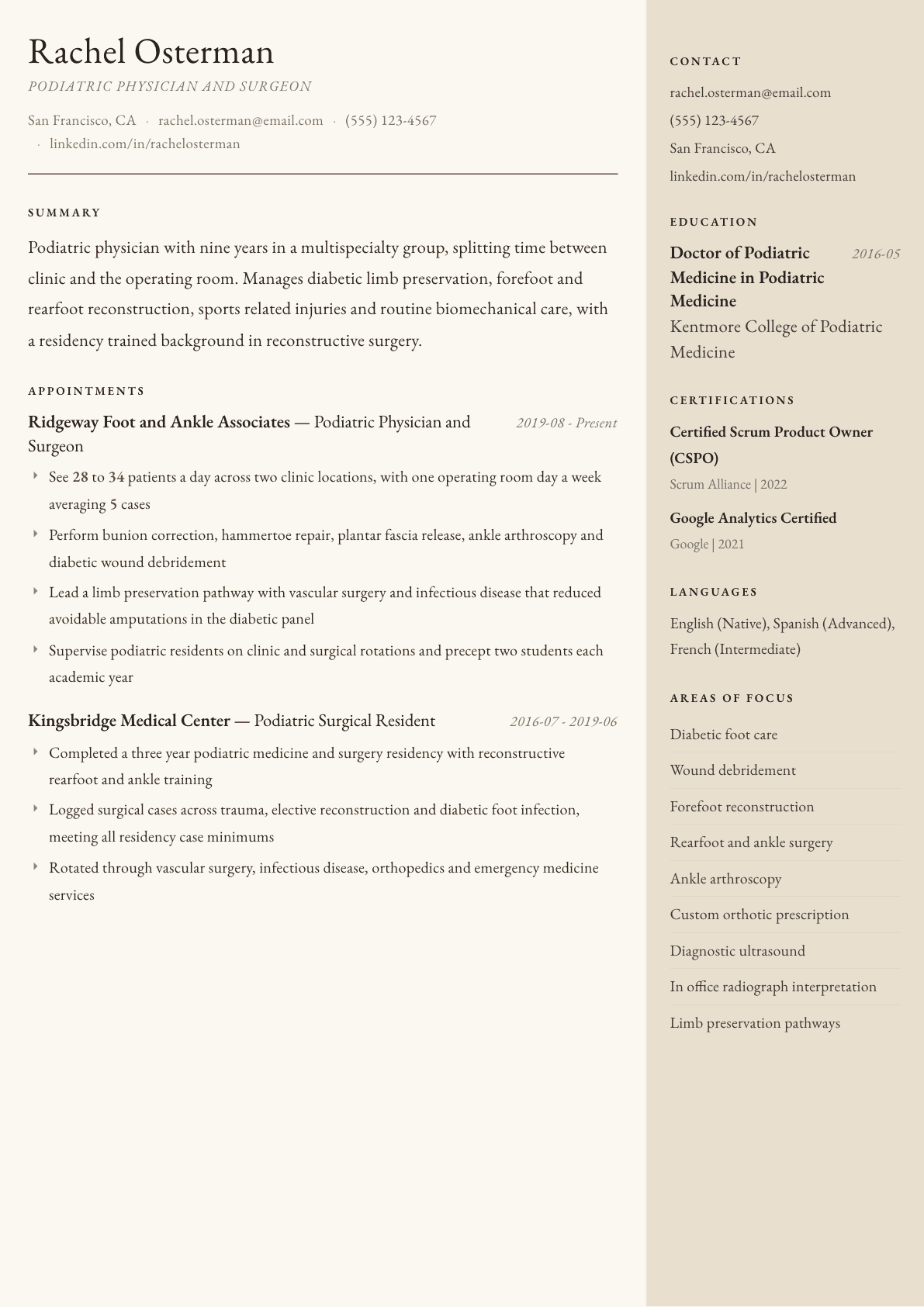
Example Podiatrist summary
Board certified podiatric physician and surgeon with nine years in a multispecialty group. Sees a high volume clinic across two locations with a weekly operating room day covering bunion and hammertoe correction, plantar fascia release, ankle arthroscopy and diabetic wound procedures. Leads a limb preservation pathway with vascular surgery and infectious disease, and supervises podiatric residents and students.
Skills to list on a Podiatrist resume
- Diabetic foot and wound care
- Sharp debridement
- Forefoot reconstruction
- Rearfoot and ankle reconstruction
- Ankle arthroscopy
- Trauma fixation
- Nail and skin procedures
- Custom orthotic prescription
- Biomechanical examination
- Diagnostic musculoskeletal ultrasound
- Radiograph interpretation
- Total contact casting
- Limb preservation coordination
- Residency and student supervision
What actually gets this resume read
- State residency type and length clearly, since reconstructive rearfoot and ankle training changes what a group can hire you for.
- List board certification or board qualified status with the certifying body, because credentialing staff look for it first.
- Break out clinic volume and operating room days, so a practice can model your schedule from the resume alone.
- Name your surgical case mix, from bunion and hammertoe correction to trauma fixation and ankle arthroscopy.
- Describe diabetic limb preservation work by the team you worked with, such as vascular surgery and infectious disease.
- Include state licenses, DEA registration status and hospital privileges, since credentialing timelines drive start dates.
How to write a podiatrist resume
A podiatrist resume is read by two audiences with different checklists. The practice or hospital recruiter is looking at residency type and length, board status, state licensure, DEA registration and how quickly you can be credentialed. The senior podiatrist or department chief is looking at case mix: how much surgery, what kind, how much diabetic limb work, and whether your clinic pace matches theirs.
That means the page has to carry both credentialing facts and clinical volume. A curriculum vitae style document is normal in this field and expected for hospital and academic positions, but the first page still needs to answer the practical questions rather than opening with a list of society memberships.
This guide sets out the order those readers expect, three summaries from a graduating resident through an established surgeon, before and after bullets built from clinic and operating room work, and the questions podiatrists ask when they join a group, buy into a practice or move into a hospital employed role.
Format: credentialing facts on page one
Use a curriculum vitae structure, but front load the practical block. Under your name and doctorate, list residency type and length, board certification or board qualified status with the certifying body, active state licenses, DEA registration status and current hospital privileges. Credentialing timelines drive start dates, and a recruiter who can see all of that at once moves your file faster.
Then a practice profile block: clinic days and volume, operating room days per week or month, and the surgical case categories you perform. Two or three lines here save a hiring partner an entire phone call.
- Header: name with doctorate, city and state, phone, email, and the states you are licensed in.
- Order: summary, credentials and licensure, practice profile, professional experience, residency, education, surgical case categories, presentations and publications.
- Graduating residents put residency first with the case log summary by category.
Summary: setting, split, and surgical scope
Three sentences that state the practice setting, the clinic and surgical split, and the scope of your surgical training. A podiatric physician in a multispecialty group seeing a high volume clinic with one operating room day a week covering forefoot and rearfoot reconstruction has said the essential things immediately.
Name your subspecialty pull if you have one: diabetic limb preservation, sports medicine and biomechanics, pediatric deformity, wound care, or reconstructive rearfoot and ankle surgery. Groups hire to fill a gap, so being explicit about your strongest area helps rather than narrows you.
Experience: clinic volume, case mix, and the pathways you run
Open with patients per day and locations covered, then the operating room schedule and average cases per list. Those three numbers let a practice model your production without a discovery call. Add call coverage, since emergency department call for foot infections and trauma is a real part of the workload and worth stating.
Break out the surgical case categories. Bunion correction, hammertoe repair, plantar fascia release, tendon transfer, flatfoot reconstruction, ankle arthroscopy, ankle fracture fixation, Charcot reconstruction, amputation and diabetic wound debridement are separate competencies. A practice hiring for rearfoot capacity will search for exactly those words.
Then describe the pathways rather than the procedures alone. A limb preservation pathway built with vascular surgery and infectious disease, a wound clinic protocol with total contact casting, or a shared post operative pathway with physical therapy all show you can build systems, which is what distinguishes a partner from an employee.
Clinic capability, imaging and the office based work
A great deal of podiatric value is generated in the office. Say what you do there: in office radiographs and their interpretation, diagnostic musculoskeletal ultrasound, injections including ultrasound guided, nail and skin procedures, sharp debridement, biomechanical examination and gait analysis, casting for custom orthotics, total contact casting and durable medical equipment dispensing.
If you have run ancillary services, say so. Orthotic laboratories, dispensing programs and wound care product management all carry operational responsibility, and a practice buying into growth wants a partner who has managed one.
- Imaging: radiographs, diagnostic ultrasound, and whether you interpret independently.
- Office procedures by category, with any guided injection technique named.
- Teaching: residents supervised, students precepted, and any lecture or journal club responsibility.
Residency, teaching and the record
Give the residency program type and length and summarize the case log by category rather than reproducing it. A three year podiatric medicine and surgery residency with reconstructive rearfoot and ankle training, with case volume grouped into forefoot, rearfoot, trauma and soft tissue, is the format a chief reads fastest.
Add teaching and academic work in a short section: residents supervised, students precepted, lectures delivered, research or case reports published, and any committee service. Hospital employed and academic positions weight this heavily, and private groups read it as evidence you will help train the next hire.
Podiatrist resume summary examples
Graduating resident
Graduating podiatric medicine and surgery resident completing three years with reconstructive rearfoot and ankle training. Logged cases across forefoot correction, trauma fixation, soft tissue procedures and diabetic foot infection, with rotations through vascular surgery, infectious disease, orthopedics and emergency medicine.
Six years in group practice
Podiatric physician and surgeon seeing 28 to 34 patients a day across two clinic locations with one weekly operating room day averaging 5 cases. Performs bunion and hammertoe correction, plantar fascia release, ankle arthroscopy and diabetic wound procedures, and shares emergency department call for foot infections.
Established surgeon and teacher
Board certified foot and ankle surgeon with fourteen years in a multispecialty group. Leads a limb preservation pathway with vascular surgery and infectious disease, performs Charcot and flatfoot reconstruction, supervises residents on clinic and surgical rotations, and chairs the wound care committee for a three hospital system.
Work experience bullets: before and after
Before: Saw patients in the clinic and performed surgery.
After: Saw 28 to 34 patients a day across two clinic locations with one operating room day a week averaging 5 cases, plus shared emergency department call for foot infections and trauma.
Clinic volume, locations, surgical days and call coverage let a practice model your production and your schedule directly.
Before: Performed a variety of foot and ankle surgeries.
After: Performed bunion correction, hammertoe repair, plantar fascia release, tendon transfer, ankle arthroscopy and diabetic wound debridement, with rearfoot reconstruction cases scheduled monthly.
Named procedures are what a group searches for when filling a specific surgical gap in the practice.
Before: Treated a lot of diabetic foot patients.
After: Led a limb preservation pathway with vascular surgery and infectious disease covering urgent referral criteria, offloading with total contact casting and staged debridement before any amputation decision.
Describing the pathway and the specialties involved shows you can build a system rather than treat one wound at a time.
Before: Used ultrasound and x-rays in the office.
After: Interpreted in office weight bearing radiographs and performed diagnostic musculoskeletal ultrasound, including ultrasound guided injections for plantar fascia and tendon pathology.
Naming weight bearing views and guided injection technique demonstrates real imaging capability rather than equipment access.
Before: Helped teach residents and students.
After: Supervised podiatric residents on clinic and surgical rotations, precepted two students each academic year, and led a monthly case conference on complex reconstruction planning.
Teaching responsibilities described by frequency and format read as an academic role rather than occasional supervision.
Hard skills
- Diabetic foot and wound care
- Sharp debridement
- Forefoot reconstruction
- Rearfoot and ankle reconstruction
- Ankle arthroscopy
- Trauma fixation
- Charcot reconstruction
- Nail and skin procedures
- Custom orthotic prescription and casting
- Biomechanical examination and gait analysis
- Diagnostic musculoskeletal ultrasound
- Weight bearing radiograph interpretation
- Total contact casting and offloading
- Ultrasound guided injection
Soft skills
- Setting realistic surgical expectations
- Working across vascular and infectious disease teams
- Resident teaching and feedback
- Decision making under limb threat
- Clinic pace management
- Patient adherence counseling for offloading
Certifications worth listing
- Board Certified in Foot Surgery (American Board of Foot and Ankle Surgery)
- Board Certified in Reconstructive Rearfoot and Ankle Surgery (American Board of Foot and Ankle Surgery)
- Board Certified in Podiatric Medicine (American Board of Podiatric Medicine)
- Certified Wound Specialist Physician (CWSP) (American Board of Wound Management)
- Advanced Cardiovascular Life Support (ACLS) (American Heart Association)
Mistakes that cost podiatrist candidates the interview
- Burying residency type and length, when it is the first thing a group checks to know what you can be hired to do.
- Leaving board status ambiguous instead of stating board certified or board qualified with the certifying body.
- Giving no clinic volume or operating room schedule, so a practice cannot model production from the resume.
- Listing surgery generically rather than by procedure category, which makes keyword matching impossible.
- Omitting state licenses and DEA status, which are the details that set the achievable start date.
- Filling page one with society memberships and continuing education while credentialing facts sit on page three.
Podiatrist resume questions
Should a podiatrist use a resume or a curriculum vitae?
Use a curriculum vitae for hospital, academic and most group practice applications, since credentialing and academic detail matter. Keep the first page practical: credentials, licensure, practice profile and case mix, then let the record follow behind it.
How do I present my residency case log?
Summarize by category rather than listing every case. Group the numbers into forefoot, rearfoot and ankle, trauma, soft tissue and diabetic foot procedures, and note that the full log is available. A chief wants the shape of your training, not the spreadsheet.
What should a podiatrist include about board certification?
State the certifying body and whether you are certified or board qualified, and name the specific certification since foot surgery and reconstructive rearfoot and ankle surgery are separate. If you are in the qualification window, give your examination timing.
How much detail should I give about clinic volume?
Give patients per day, the number of locations you cover and your operating room schedule. Practices build compensation models on production, so these figures often decide whether you get a first conversation about a partnership track.
Do hospital privileges belong on the resume?
Yes. List current and past hospital and surgery center privileges with the facility type, because credentialing staff use them to estimate how long onboarding will take and which cases you can begin scheduling immediately.