References on Resume: 7 Examples and What to Send Instead
By Mustafa Tarabya, founder of CVBooster · Published · Updated
9 min read
References do not belong on a resume. Send a separate one-page reference sheet when the employer asks for it, with three to four names, and keep the resume space for evidence. The rules on what an employer may then check come from the EEOC and FTC joint guidance, quoted below and fetched in September 2026. The complete reference sheet comes first, then seven worked entries, the email that asks someone to be a reference, and the lines never to print. Written by Mustafa Tarabya, who hired for his own company, read every application himself and now writes CVBooster's guides.
The reference sheet, complete
One page, your name at the top in the same font as your resume, three to four entries, nothing else.
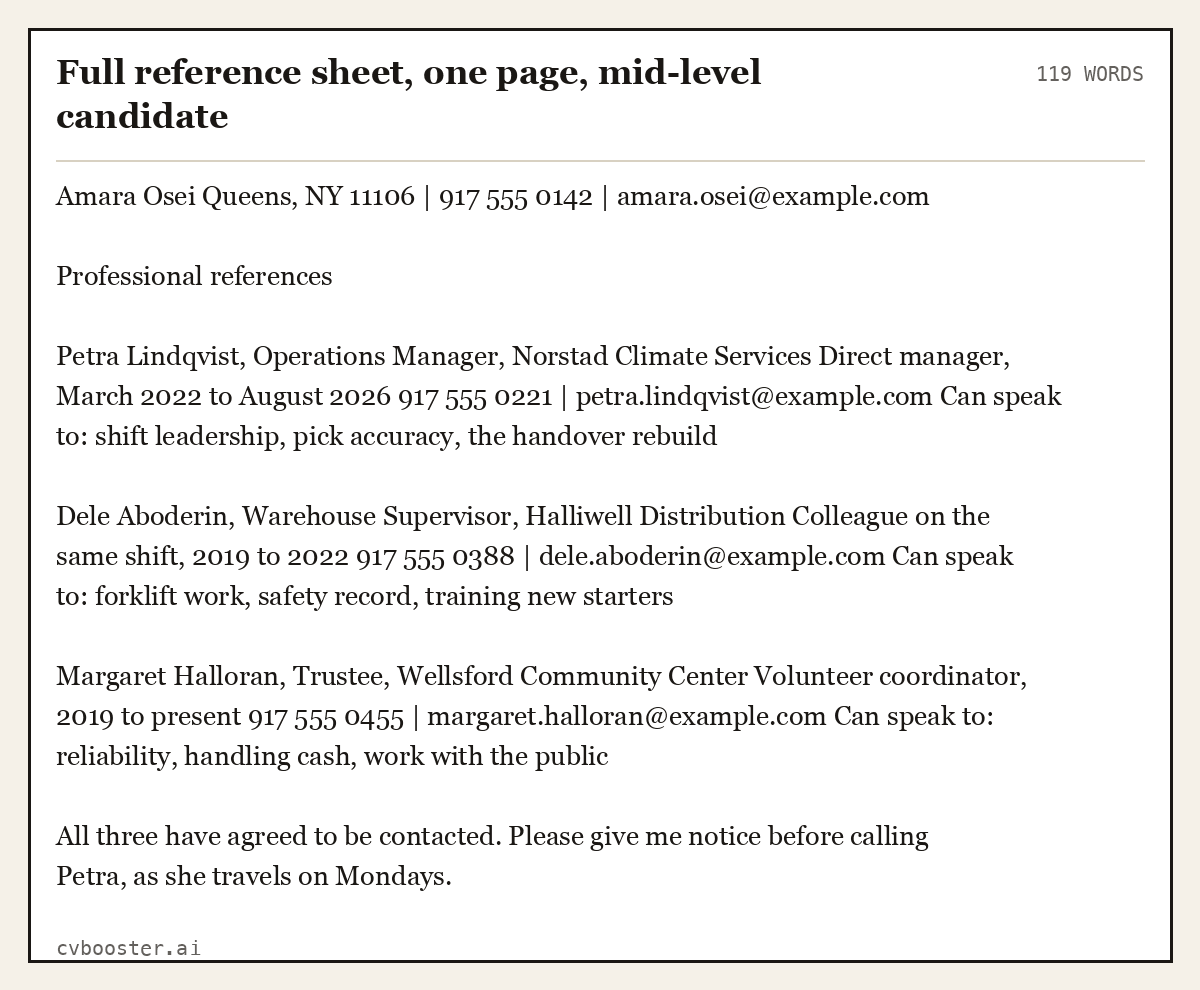
Full reference sheet, one page, mid-level candidate (119 words)
Amara Osei Queens, NY 11106 | 917 555 0142 | amara.osei@example.com
Professional references
Petra Lindqvist, Operations Manager, Norstad Climate Services Direct manager, March 2022 to August 2026 917 555 0221 | petra.lindqvist@example.com Can speak to: shift leadership, pick accuracy, the handover rebuild
Dele Aboderin, Warehouse Supervisor, Halliwell Distribution Colleague on the same shift, 2019 to 2022 917 555 0388 | dele.aboderin@example.com Can speak to: forklift work, safety record, training new starters
Margaret Halloran, Trustee, Wellsford Community Center Volunteer coordinator, 2019 to present 917 555 0455 | margaret.halloran@example.com Can speak to: reliability, handling cash, work with the public
All three have agreed to be contacted. Please give me notice before calling Petra, as she travels on Mondays.
Seven worked entries, one per situation
Each entry is three lines: who they are, what the relationship was with dates, and the one thing they can speak to. The third line is the part everybody leaves out and the part that gets used.
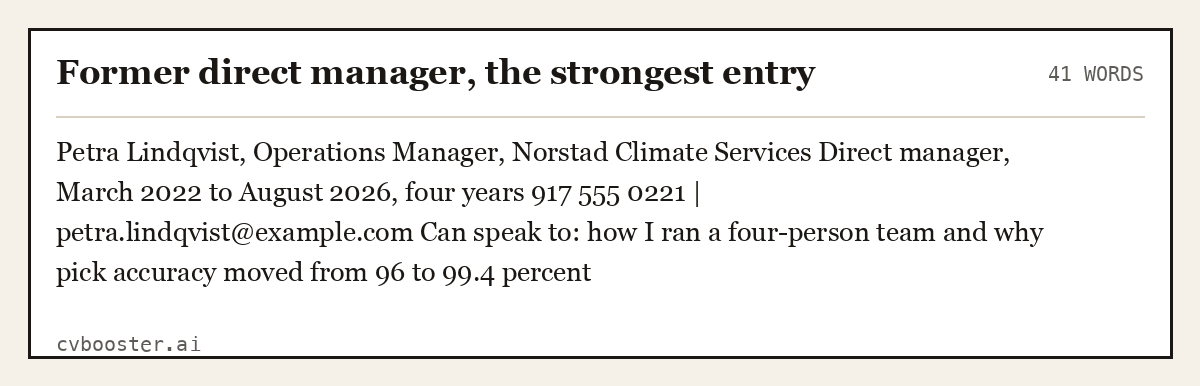
Former direct manager, the strongest entry (41 words)
Petra Lindqvist, Operations Manager, Norstad Climate Services Direct manager, March 2022 to August 2026, four years 917 555 0221 | petra.lindqvist@example.com Can speak to: how I ran a four-person team and why pick accuracy moved from 96 to 99.4 percent
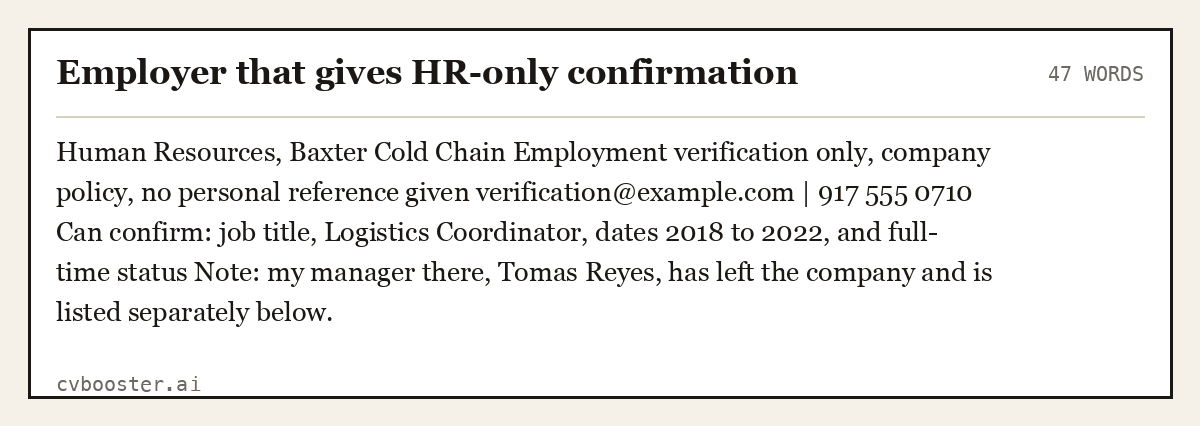
Employer that gives HR-only confirmation (47 words)
Human Resources, Baxter Cold Chain Employment verification only, company policy, no personal reference given verification@example.com | 917 555 0710 Can confirm: job title, Logistics Coordinator, dates 2018 to 2022, and full-time status Note: my manager there, Tomas Reyes, has left the company and is listed separately below.
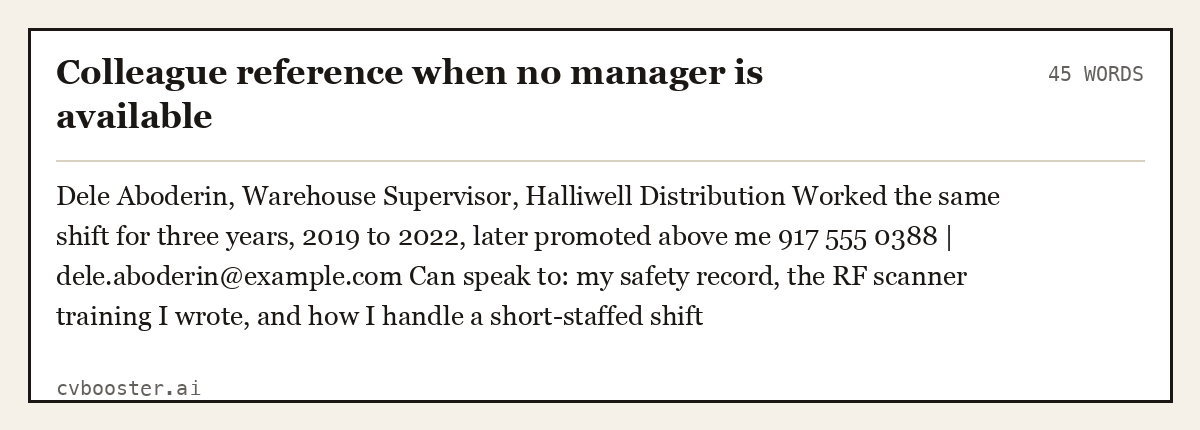
Colleague reference when no manager is available (45 words)
Dele Aboderin, Warehouse Supervisor, Halliwell Distribution Worked the same shift for three years, 2019 to 2022, later promoted above me 917 555 0388 | dele.aboderin@example.com Can speak to: my safety record, the RF scanner training I wrote, and how I handle a short-staffed shift
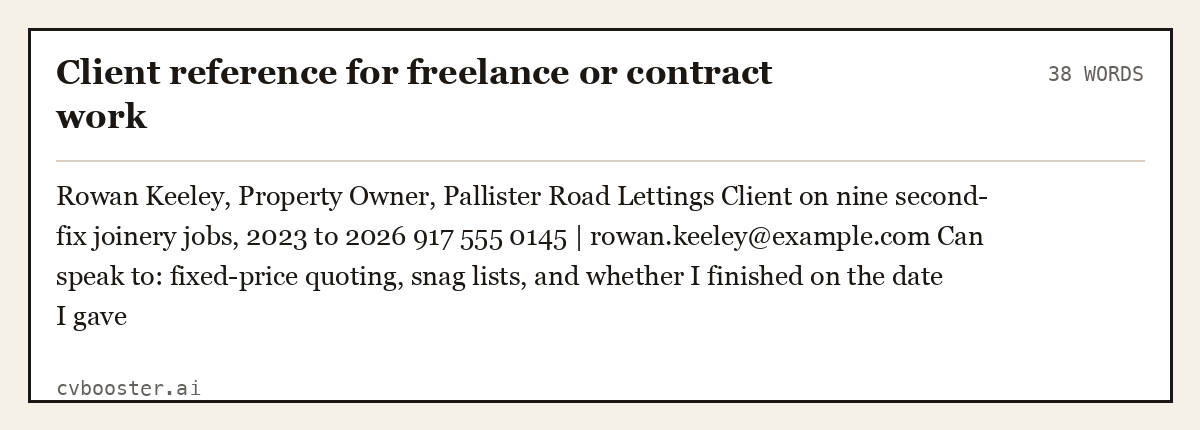
Client reference for freelance or contract work (38 words)
Rowan Keeley, Property Owner, Pallister Road Lettings Client on nine second-fix joinery jobs, 2023 to 2026 917 555 0145 | rowan.keeley@example.com Can speak to: fixed-price quoting, snag lists, and whether I finished on the date I gave
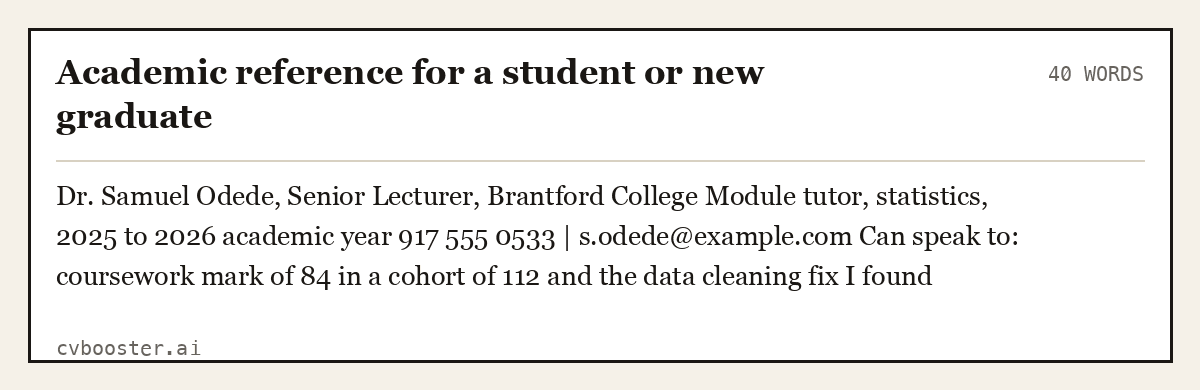
Academic reference for a student or new graduate (40 words)
Dr. Samuel Odede, Senior Lecturer, Brantford College Module tutor, statistics, 2025 to 2026 academic year 917 555 0533 | s.odede@example.com Can speak to: coursework mark of 84 in a cohort of 112 and the data cleaning fix I found
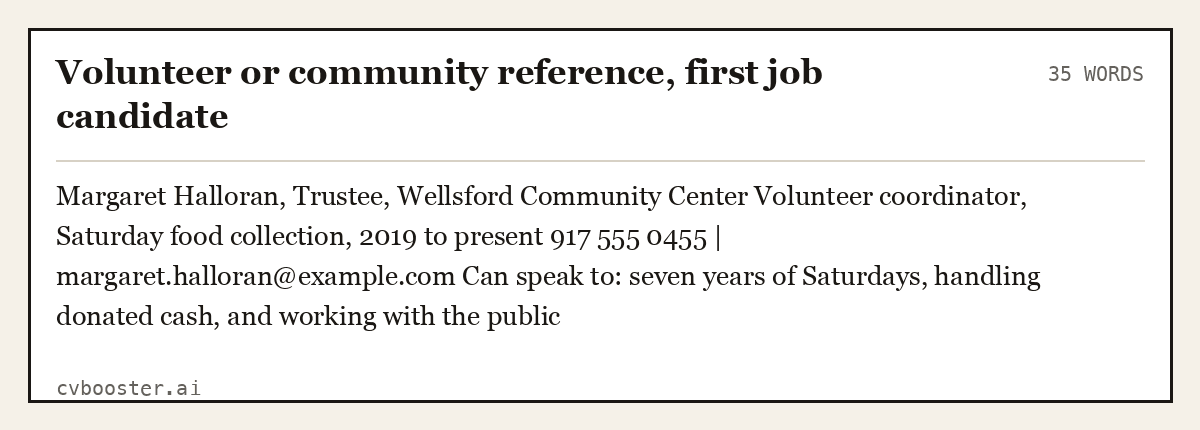
Volunteer or community reference, first job candidate (35 words)
Margaret Halloran, Trustee, Wellsford Community Center Volunteer coordinator, Saturday food collection, 2019 to present 917 555 0455 | margaret.halloran@example.com Can speak to: seven years of Saturdays, handling donated cash, and working with the public
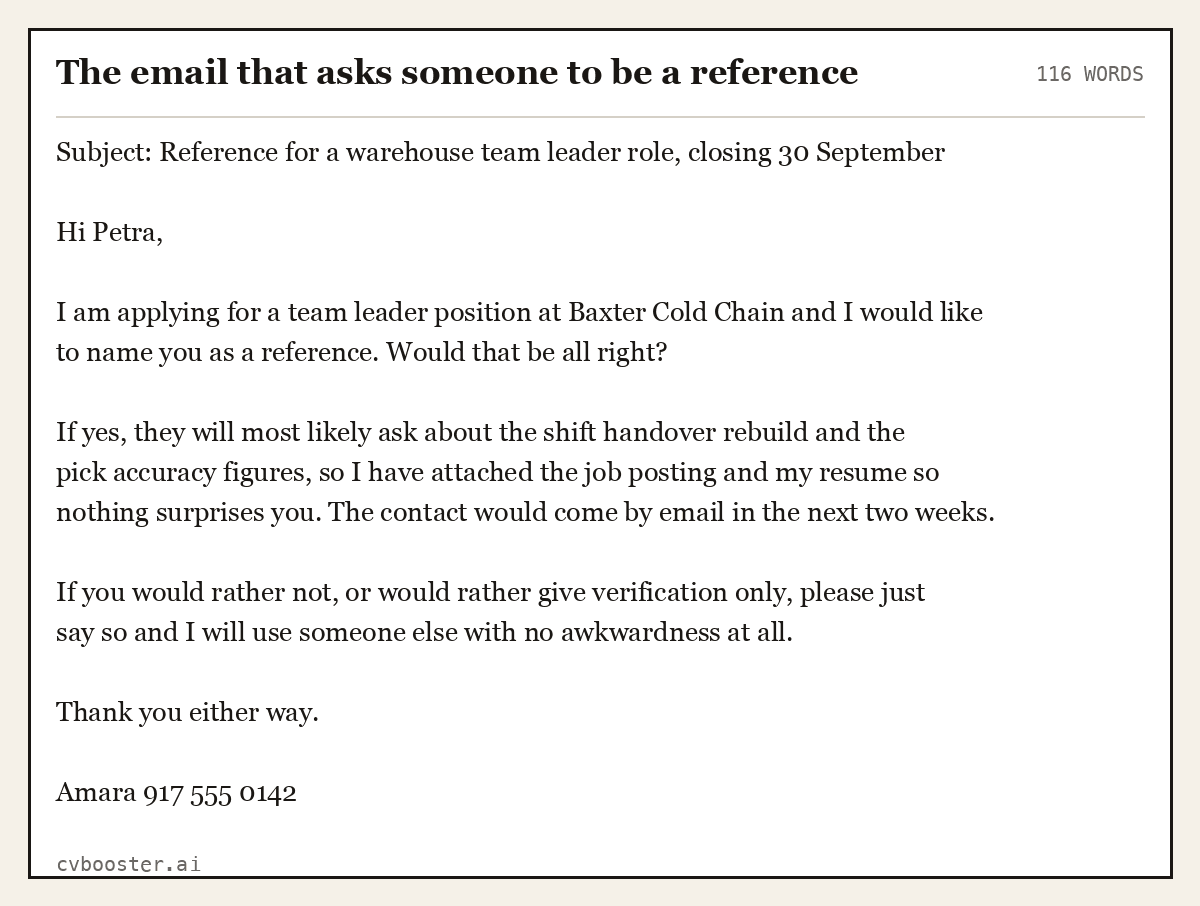
The email that asks someone to be a reference (116 words)
Subject: Reference for a warehouse team leader role, closing 30 September
Hi Petra,
I am applying for a team leader position at Baxter Cold Chain and I would like to name you as a reference. Would that be all right?
If yes, they will most likely ask about the shift handover rebuild and the pick accuracy figures, so I have attached the job posting and my resume so nothing surprises you. The contact would come by email in the next two weeks.
If you would rather not, or would rather give verification only, please just say so and I will use someone else with no awkwardness at all.
Thank you either way.
Amara 917 555 0142
Who counts, and how many
- Three is the standard, four is the maximum. More names reads as padding and nobody calls the fourth.
- At least two must have managed you. A reference list of peers only raises a question you do not want asked.
- One recent. A reference older than five years is a character reference, not a work reference.
- Never a relative, and never a friend with no working relationship to describe.
- Ask first, every time. A surprised reference is worse than no reference.
What an employer may check, in the official wording
Knowing the limits tells you what a reference call can and cannot cover, and where a background check takes over.
The EEOC states plainly: "Any background information you receive from any source must not be used to discriminate in violation of federal law", in its joint guidance with the FTC on background checks. The same publication, hosted by the FTC, sets the other half of the rule: "when you run background checks through a company in the business of compiling background information, you must comply with the Fair Credit Reporting Act (FCRA)", on the FTC business guidance page.
A phone call to your old manager is not a consumer report and sits outside the FCRA. A paid screening company's report does not, and you must be told about it.
When the employer sets the format
Some employers state the document rules in the posting, and the reference sheet is a document. The USAJOBS Help Center says your resume "meets all requirements listed in the job announcement", on its resume help page. If a federal announcement asks for names inside the resume, follow the announcement rather than this page.
For the layout of the covering note that goes with a sheet, the Purdue OWL is the plainest guide, including the rule that when the reader is unknown you should "use a nonsexist salutation, such as their job title followed by the receiver's name", on its basic business letters page.
A reference on a resume or CV in Australia
Australian job ads and applicants say referees rather than references, and the convention on a CV is looser than the American rule above. Many Australian applicants end the CV with a short Referees section of two names, and some ads ask for two referees in the application itself. Both are fine, as long as every person listed has agreed and knows the role you applied for.
If you list referees on an Australian CV, give each one the same four lines as the sheet: name, job title and employer, relationship with dates, and a phone number and email. Two referees is the usual number, and at least one should be a recent supervisor. If the ad does not ask for them and space is tight, keep them on a separate page and send it when the employer asks after the interview.
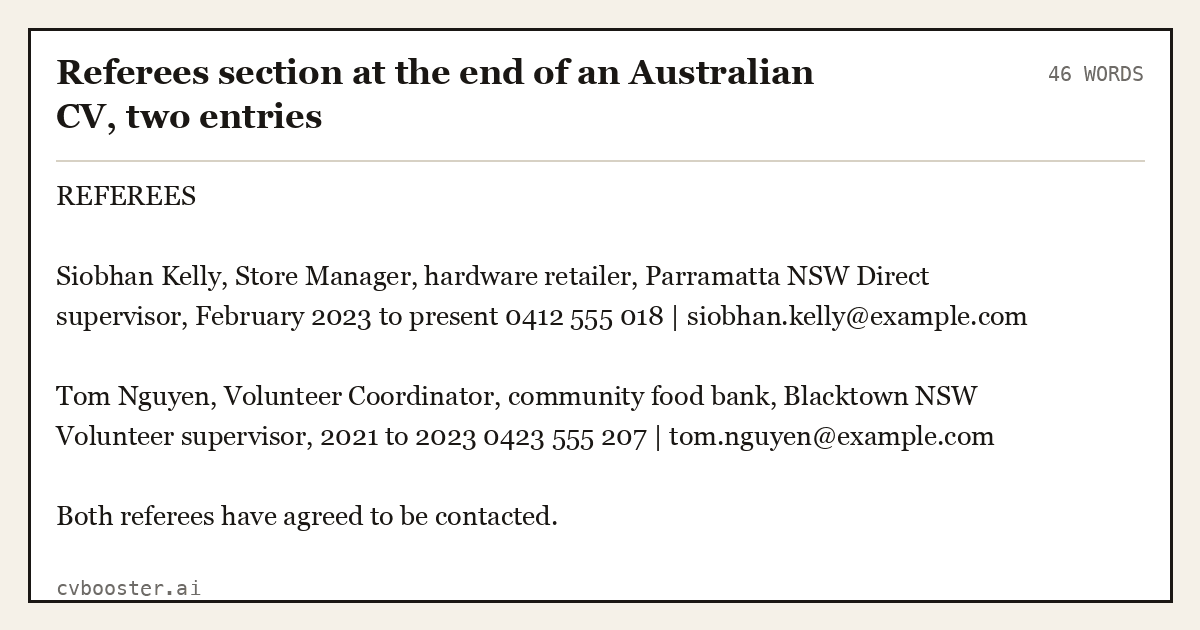
Referees section at the end of an Australian CV, two entries (46 words)
REFEREES
Siobhan Kelly, Store Manager, hardware retailer, Parramatta NSW Direct supervisor, February 2023 to present 0412 555 018 | siobhan.kelly@example.com
Tom Nguyen, Volunteer Coordinator, community food bank, Blacktown NSW Volunteer supervisor, 2021 to 2023 0423 555 207 | tom.nguyen@example.com
Both referees have agreed to be contacted.
How to put references in a CV in the UK
In the UK the same document is a CV, and the advice is short. The National Careers Service says: "You might want to include a section about references if there is someone who has agreed to give you one." It then adds that "you should not put someone else's contact details on your CV. Instead, you can say that 'references are available on request'."
So there are two correct ways to write references in a CV for a UK employer. The first is one closing line, which keeps your referees' details private until the employer is ready to check them. The second, when the advert asks for referees in the application, is a short section with two names, each with job title, organisation, how they know you and contact details, given with their permission. If the advert asks for your most recent employer, make that person the first entry.
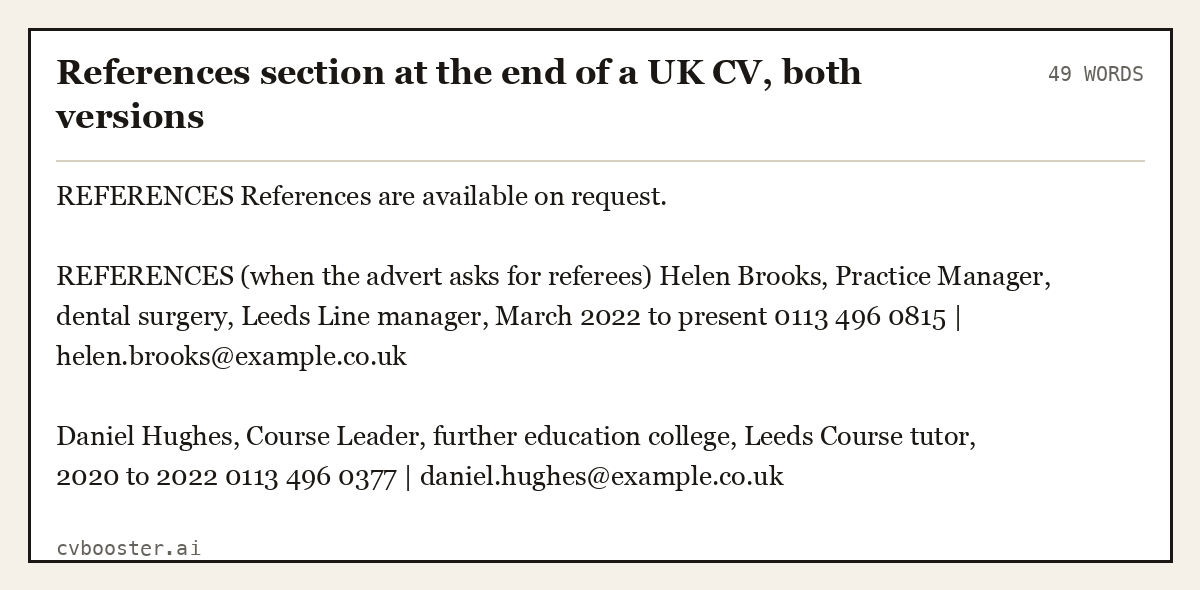
References section at the end of a UK CV, both versions (49 words)
REFERENCES References are available on request.
REFERENCES (when the advert asks for referees) Helen Brooks, Practice Manager, dental surgery, Leeds Line manager, March 2022 to present 0113 496 0815 | helen.brooks@example.co.uk
Daniel Hughes, Course Leader, further education college, Leeds Course tutor, 2020 to 2022 0113 496 0377 | daniel.hughes@example.co.uk
What to do when your old manager has left
Name the company's HR line for verification and add the manager separately with a personal email, marked as "former manager, now at another employer". That combination gives the employer something checkable and something human, and it explains the gap before anyone asks.
If the company has closed, say so in the entry and offer a colleague from the same team plus any documentary proof you hold, such as a payslip or a contract.
Never print these on a resume
- A block of names and phone numbers. It burns space and hands out other people's contact details.
- "References available upon request." Everybody knows, and it wastes a line.
- "Excellent references available." A claim about other people's opinions is not evidence.
- A reference's home address or job title with no relationship line.
- Anyone you have not asked in the last three months.
Tip: Write the reference sheet before you need it. Chasing three permissions in the 24 hours after an interview is how good candidates lose the offer.
See references on a resume for the short version of this rule, reference letter for the written letter, character reference letter for a non-work referee, and resume header for matching the sheet to your resume. Families hiring childcare ask for something more specific, covered in the nanny reference letter samples. If your last job ended in a dismissal, our guide on how to explain getting fired in an interview shows what to say before the reference call.
Frequently asked questions
How to write job references?
Write three lines per reference: name, job title and employer, then the relationship with dates, then the one topic they can speak to. Put them on a separate one-page sheet that matches your resume header, and send it only when the employer asks.
How do I put a reference in a CV?
Add a short References or Referees section at the end with two names, each with job title, employer, how they know you and a phone number or email, after asking their permission. On a UK CV, add it only when the advert asks for referees; on a US resume, put the same lines on a separate sheet.
How to write personal references?
A personal reference should still carry a role and a timeframe: a volunteer coordinator, a coach, a landlord, with dates. Say what they have seen you do rather than what they think of you, and never use a relative, which most employers discount automatically.
How to include references in cover letter?
Do not list them there either. One line at the end is enough: "Two contactable references, including my most recent manager, are available on request." Save the names and numbers for the reference sheet, and only send it when it is asked for.
Do you need references on your resume or CV?
On a US resume, no. No employer expects them on the page, and they cost you a quarter of your most valuable space. On an Australian CV, a short Referees section with two names at the end is common and accepted. On a UK CV, end with "references are available on request" unless the advert asks for referees, then add two with their permission. Either way, keep a separate sheet ready and only list people who have agreed.
How many references should you have?
Three, with a fourth in reserve. At least two should have managed you, and at least one should be from your most recent role. Beyond four, nobody calls, and a long list starts to look like an attempt to dilute a weak one.
Related articles
- Irish CV Conventions: Referees, Garda Vetting and Permits
- Referees on an Australian Resume: How Many and Who
- Accountancy CV Example: 6 UK Accounts CVs by Career Level
- Accounting Interview Questions and Answers: 7 Full Examples
More articles
- Referral Letter: Six Complete Examples and the Rules
- Relocation Cover Letter: 6 Samples for Moving to a New City
- Residency Recommendation Letter: 6 Samples That Get Read
Looking for a worked example for your job title? Browse the resume examples by job title.