Pharmacist Interview Questions and Answers: UK Guide
By Mustafa Tarabya, founder of CVBooster · Published · Updated
8 min read
Pharmacist interview questions in the UK test three things: clinical judgement under pressure, how you protect patients when something goes wrong, and how you work with prescribers and the pharmacy team. The constraint is that every good answer is a real case told in order, situation, what you did and what changed, and that the panel is listening for the General Pharmaceutical Council's standards behind it. The GPhC says on its standards page that there are "nine standards that you're responsible for meeting, and they apply whatever setting you work in." Seven full answers follow, tagged by level, for community, hospital and GP practice roles. Written by Mustafa Tarabya, who hired for his own company, read every application himself and now writes CVBooster's guides.
"Tell us about a time you spotted a prescribing error"
This is the most common clinical question, and the one most often answered too vaguely. Name the drug, the risk and the call you made.
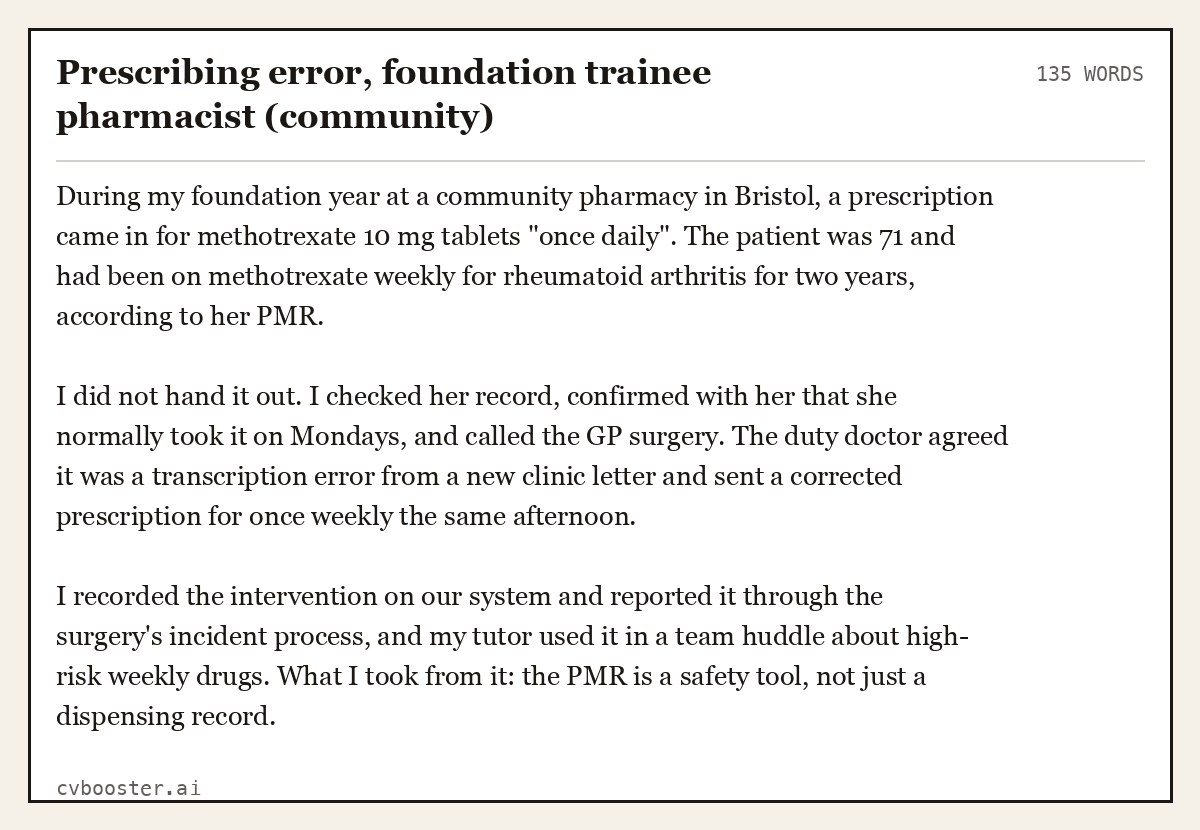
Prescribing error, foundation trainee pharmacist (community) (135 words)
During my foundation year at a community pharmacy in Bristol, a prescription came in for methotrexate 10 mg tablets "once daily". The patient was 71 and had been on methotrexate weekly for rheumatoid arthritis for two years, according to her PMR.
I did not hand it out. I checked her record, confirmed with her that she normally took it on Mondays, and called the GP surgery. The duty doctor agreed it was a transcription error from a new clinic letter and sent a corrected prescription for once weekly the same afternoon.
I recorded the intervention on our system and reported it through the surgery's incident process, and my tutor used it in a team huddle about high-risk weekly drugs. What I took from it: the PMR is a safety tool, not just a dispensing record.
The nine standards the panel is listening for
The GPhC's Standards for pharmacy professionals are the frame for most questions. Each one begins "Pharmacy professionals must". Map one real story to each, and you will rarely be caught without an answer.
| Standard | Question it usually becomes |
|---|---|
| "provide person-centred care" | A patient who refused advice or had a difficult need |
| "work in partnership with others" | Disagreeing with a prescriber |
| "communicate effectively" | Explaining a complex regimen |
| "maintain, develop and use their professional knowledge and skills" | Your recent CPD |
| "use their professional judgement" | A request you refused |
| "behave in a professional manner" | Pressure from a manager or targets |
| "respect and maintain a person's confidentiality and privacy" | A relative asking about a patient |
| "speak up when they have concerns or when things go wrong" | An error you made or saw |
| "demonstrate leadership" | Leading a change or a team |
If the job is in the NHS, add the values from the NHS Constitution, which lists "Working together for patients", "Respect and dignity", "Commitment to quality of care", "Compassion", "Improving lives" and "Everyone counts". The NHS interview questions guide has answers built on those values.
"Tell us about a time you disagreed with a prescriber"
The panel wants to hear partnership, not a fight. Show you had the evidence ready and kept the patient at the centre.
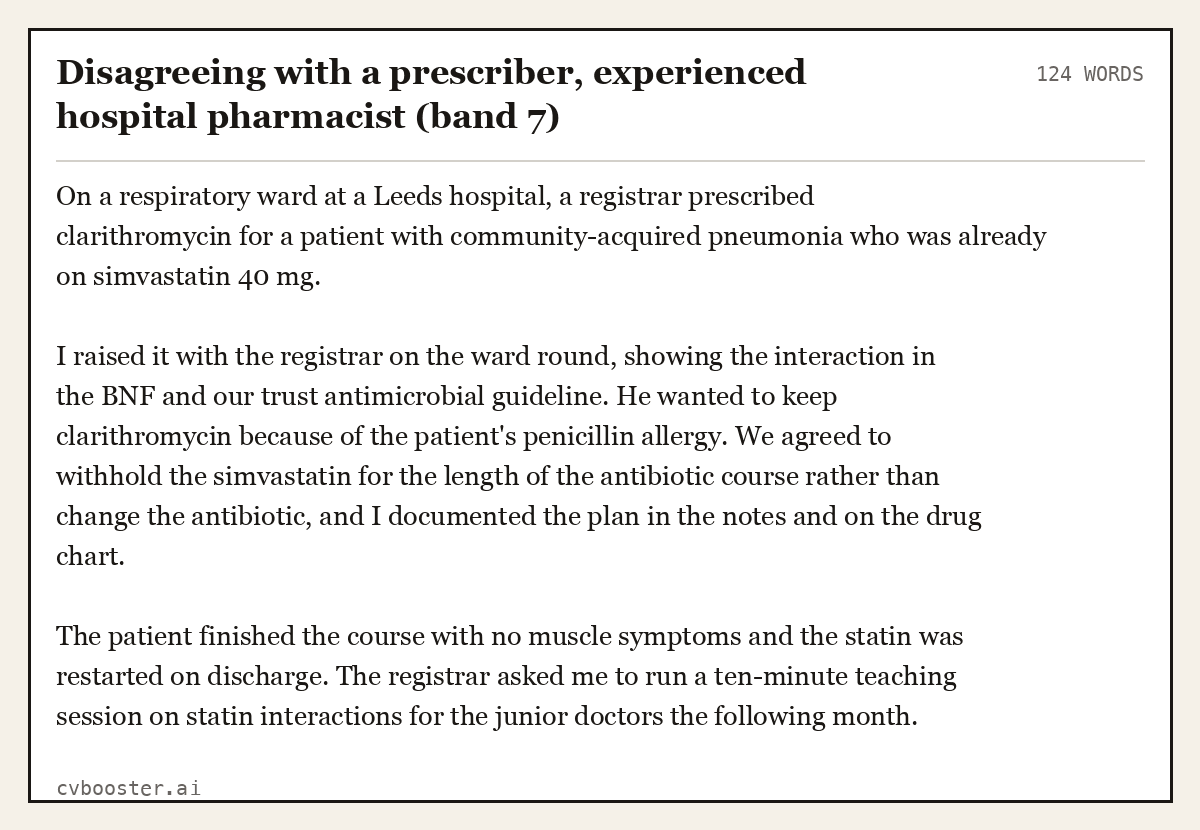
Disagreeing with a prescriber, experienced hospital pharmacist (band 7) (124 words)
On a respiratory ward at a Leeds hospital, a registrar prescribed clarithromycin for a patient with community-acquired pneumonia who was already on simvastatin 40 mg.
I raised it with the registrar on the ward round, showing the interaction in the BNF and our trust antimicrobial guideline. He wanted to keep clarithromycin because of the patient's penicillin allergy. We agreed to withhold the simvastatin for the length of the antibiotic course rather than change the antibiotic, and I documented the plan in the notes and on the drug chart.
The patient finished the course with no muscle symptoms and the statin was restarted on discharge. The registrar asked me to run a ten-minute teaching session on statin interactions for the junior doctors the following month.
"Describe a dispensing error you made"
Everyone has made one. The question tests whether you speak up, so answer with a real one and say what changed.
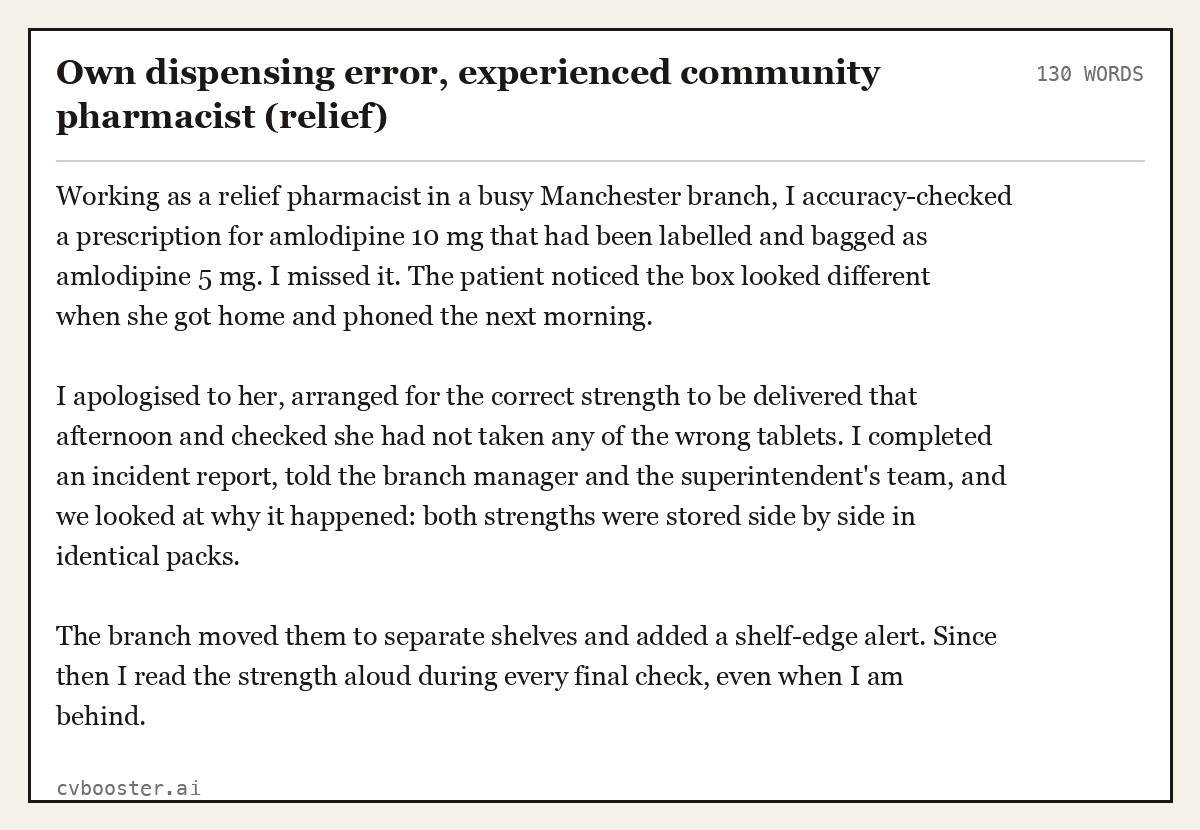
Own dispensing error, experienced community pharmacist (relief) (130 words)
Working as a relief pharmacist in a busy Manchester branch, I accuracy-checked a prescription for amlodipine 10 mg that had been labelled and bagged as amlodipine 5 mg. I missed it. The patient noticed the box looked different when she got home and phoned the next morning.
I apologised to her, arranged for the correct strength to be delivered that afternoon and checked she had not taken any of the wrong tablets. I completed an incident report, told the branch manager and the superintendent's team, and we looked at why it happened: both strengths were stored side by side in identical packs.
The branch moved them to separate shelves and added a shelf-edge alert. Since then I read the strength aloud during every final check, even when I am behind.
"A patient's daughter phones asking about her mother's medicines"
A confidentiality question. The answer is neither "never" nor "yes", it is checking consent.
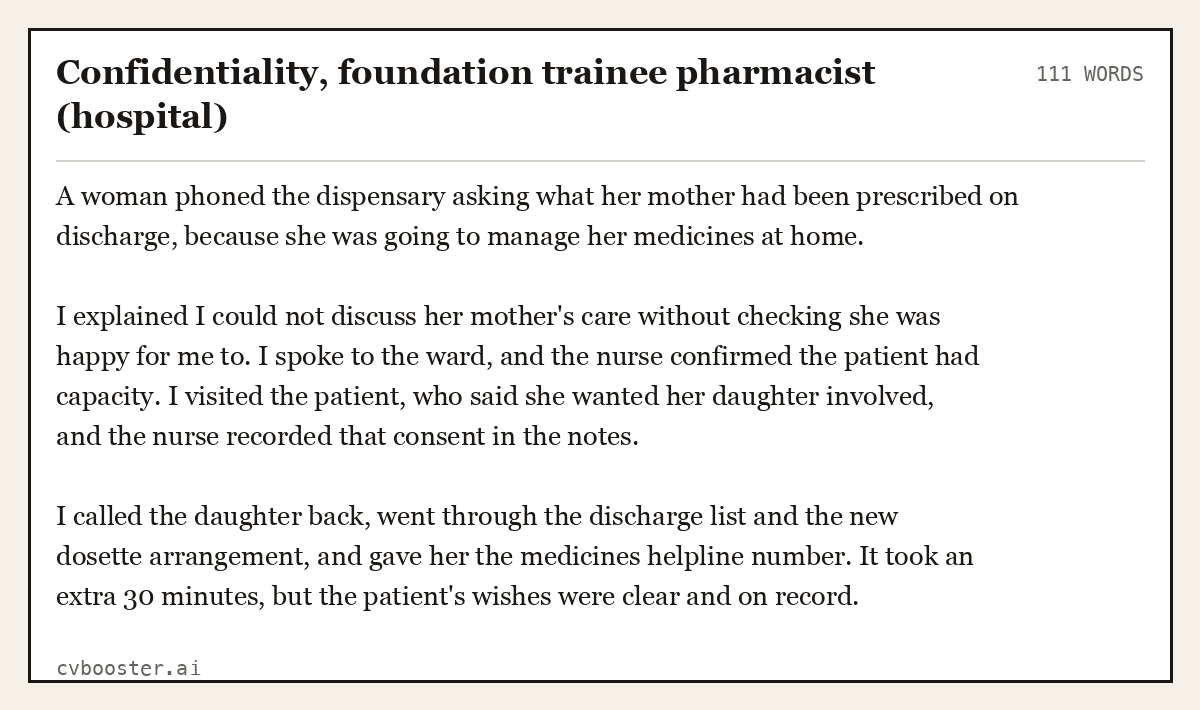
Confidentiality, foundation trainee pharmacist (hospital) (111 words)
A woman phoned the dispensary asking what her mother had been prescribed on discharge, because she was going to manage her medicines at home.
I explained I could not discuss her mother's care without checking she was happy for me to. I spoke to the ward, and the nurse confirmed the patient had capacity. I visited the patient, who said she wanted her daughter involved, and the nurse recorded that consent in the notes.
I called the daughter back, went through the discharge list and the new dosette arrangement, and gave her the medicines helpline number. It took an extra 30 minutes, but the patient's wishes were clear and on record.
"Why GP practice pharmacy?" (or why community, or why hospital)
A motivation question. Lead with what you have already done in that setting, not with what you hope to learn.
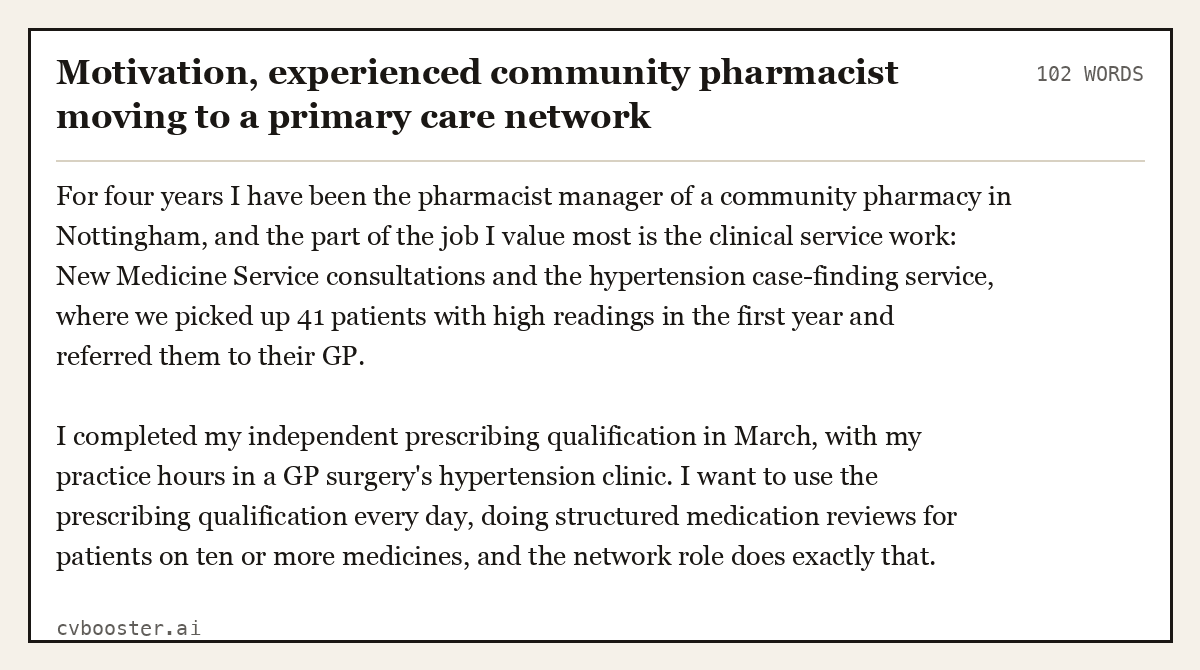
Motivation, experienced community pharmacist moving to a primary care network (102 words)
For four years I have been the pharmacist manager of a community pharmacy in Nottingham, and the part of the job I value most is the clinical service work: New Medicine Service consultations and the hypertension case-finding service, where we picked up 41 patients with high readings in the first year and referred them to their GP.
I completed my independent prescribing qualification in March, with my practice hours in a GP surgery's hypertension clinic. I want to use the prescribing qualification every day, doing structured medication reviews for patients on ten or more medicines, and the network role does exactly that.
"How do you keep up to date?"
The CPD question. Name a specific thing you learned and where you used it.
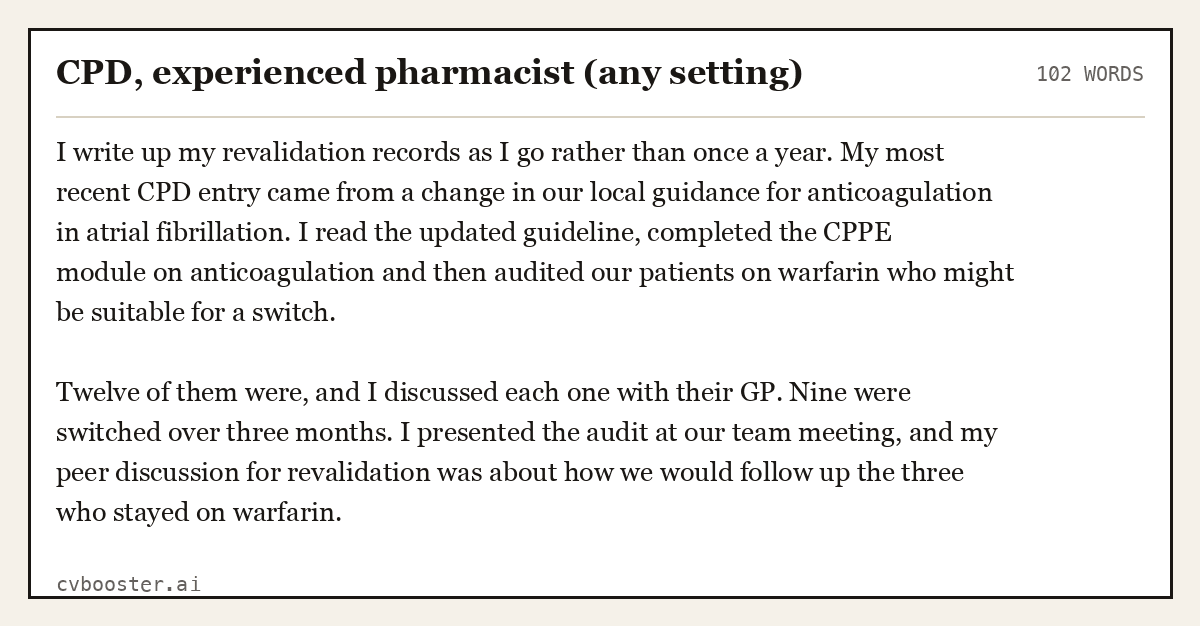
CPD, experienced pharmacist (any setting) (102 words)
I write up my revalidation records as I go rather than once a year. My most recent CPD entry came from a change in our local guidance for anticoagulation in atrial fibrillation. I read the updated guideline, completed the CPPE module on anticoagulation and then audited our patients on warfarin who might be suitable for a switch.
Twelve of them were, and I discussed each one with their GP. Nine were switched over three months. I presented the audit at our team meeting, and my peer discussion for revalidation was about how we would follow up the three who stayed on warfarin.
Other questions to prepare
- Talk us through how you would handle a request for emergency supply without a prescription.
- What would you do if you found a colleague had been taking stock?
- How would you manage a queue of 15 patients with one dispenser off sick?
- Tell us about a time you improved a process in the pharmacy.
- What is the biggest safety risk in our setting, and how would you reduce it?
- Hospital roles: how would you prioritise discharge prescriptions on a busy afternoon?
- Foundation roles: what do you expect from your designated supervisor?
Answer each with a real case using the STAR method. For general questions such as strengths and weaknesses, use common interview questions and answers.
Before the interview
Read the job description and person specification line by line, and match one story to each essential criterion. Bring your GPhC registration number and your revalidation records. If the role includes a clinical test or OSCE-style station, practise calculations under time pressure and counselling a patient on a new medicine in under five minutes. Then make sure your CV says the same as your answers: NMC PIN and HCPC registration on a CV shows how to list a professional registration so screeners see it.
Frequently asked questions
What questions are asked in a pharmacist interview?
Expect a clinical question about a prescribing or dispensing error, a question about disagreeing with a prescriber, a confidentiality scenario, a motivation question, and one about CPD. Hospital and NHS interviews add values-based questions. Most panels also include one or two scenario questions about workload or an ethical dilemma.
How do I answer pharmacist interview questions?
Use one real case per answer, told in order: the situation, what you did, and what changed. Name the drug and the risk in clinical answers. Panels listen for the GPhC standards, such as speaking up when things go wrong and working in partnership with others.
What should a foundation trainee pharmacist prepare for an interview?
Prepare cases from placements and summer work: a prescription you queried, a patient conversation, a mistake and what you learned. Expect a calculation test in many hospital and multiple pharmacy interviews, and know why you chose that sector for your foundation year.
What questions should I ask at the end of a pharmacist interview?
Ask about the team structure and skill mix, the clinical services you would deliver, the support for prescribing or further training, and how performance is reviewed in the first six months. Avoid asking about pay before an offer unless the panel raises it.
Are hospital pharmacist interviews different from community ones?
Hospital interviews usually involve a panel, a clinical scenario or ward case, and NHS values questions. Community interviews put more weight on services, workload management, team leadership and patient-facing scenarios. Both test the same GPhC standards.
Related articles
- How to Cancel an Interview: 7 Emails That Keep Doors Open
- Java Interview Questions and Answers: 8 Worked Examples
- Special Education Teacher Interview Questions: 12 Answers
- Adjectives to Describe Yourself and the Sentence for Each
More articles
- Professional Cover Letter Examples for Any Industry
- What a Professional CV Writer Costs in the UK, and When to Pay
- Professional Resume Writing Services: Worth Paying?
Looking for a worked example for your job title? Browse the resume examples by job title.