Resume Screening: The 6 Stages and 8 Lines That Pass Them

Resume screening is the first filter in hiring: the employer checks your application against the job's minimum requirements, sorts the people who meet them, and sends the strongest few to the hiring manager. The constraint is that every stage looks for evidence on the page, not potential, so a requirement you meet but did not write down counts as missing. The US Environmental Protection Agency's after-you-apply guide shows the same sequence in federal hiring. Below: the six stages, how AI screening fits in, the rules that limit it, and eight lines that pass or fail.
Your application status has said "Received" for three weeks. It is not ignoring you. It is a status field, and status fields have no feelings and very few updates.
A line that fails screening, and the fix
Start with the most common failure, because it costs nothing to fix. The job ad asks for a specific thing. The resume says something close to it. Close does not match.
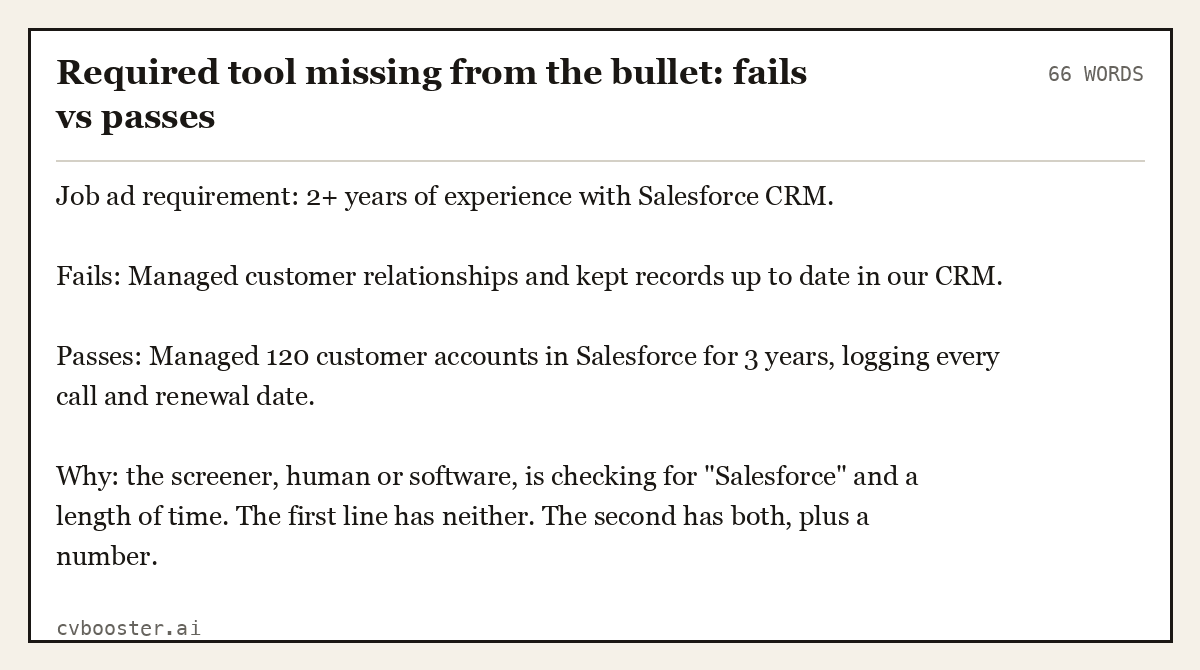
Required tool missing from the bullet: fails vs passes
66 wordsJob ad requirement: 2+ years of experience with Salesforce CRM.
Fails: Managed customer relationships and kept records up to date in our CRM.
Passes: Managed 120 customer accounts in Salesforce for 3 years, logging every call and renewal date.
Why: the screener, human or software, is checking for "Salesforce" and a length of time. The first line has neither. The second has both, plus a number.
Create my CVOr start from one of our free resume templates
The 6 stages of the resume screening process
Not every employer uses every stage, and small companies may skip straight to a person reading. Larger employers usually run some version of all six.
| Stage | Who or what does it | What it checks |
|---|---|---|
| 1. Application questions | The application form | Yes or no requirements: work authorization, license, location, shift |
| 2. Parsing | The applicant tracking system (ATS) | Turns your file into fields: name, titles, dates, skills |
| 3. Minimum qualifications | A recruiter, rules or both | Degree, years, license, required skills |
| 4. Ranking or matching | Recruiter search, filters or AI scoring | How closely you match the ad |
| 5. Human review | Recruiter, then hiring manager | Evidence, results, fit for the team |
| 6. Phone screen | Recruiter | Salary range, availability, the basics in your own words |
Stage 1: application questions
Many online applications start with questions such as "Are you authorized to work in the US?" or "Do you hold a current CDL Class A?". These are often called knockout questions, because a wrong answer can end the application before anyone reads the resume. Answer them truthfully and exactly; a "no" where you mean "yes, starting in January" is a no.
Stage 2: parsing
The ATS reads your file and splits it into fields. Simple layouts parse cleanly; text boxes, tables used for layout, headers with your contact details and icons in place of words can come out in the wrong order or not at all. Our guide to what ATS software actually does explains what is real here and what is myth.
Stage 3: minimum qualifications
Someone checks the hard requirements: degree, years, license, a named skill. In federal hiring this is explicit. The EPA says a human resources specialist first reviews your application to determine if you meet "the eligibility, qualifications, and educational requirements of the position", and then decides whether you are among the qualified or best qualified candidates.
Stage 4: ranking or matching
This is where the ATS and AI come in. A recruiter may search the applicant pool for a skill, filter by location, or see a match score the software calculated. How much weight the score gets depends on the employer. The words that move you up are the ones in the job ad, which is why our analysis of ATS keywords in real job ads is worth ten minutes.
Stage 5: human review
A recruiter, then the hiring manager, reads the shortlist. In federal hiring the EPA describes the HR officer sending a list of best qualified candidates, a Certificate of Eligibility, to the hiring manager, who decides who to interview. Here the question changes from "does this person qualify" to "is this person better than the other five".
Stage 6: the phone screen
A short call with a recruiter to confirm the basics: salary expectations, notice period, location, and whether you can explain your resume in your own words. Being shortlisted is not a promise of an interview; NIST's federal applicant guide says hiring officials may choose to interview all, some, or none of the referred applicants.
AI resume screening: what it does and the rules around it
AI resume screening means software scores or ranks applications against the job, sometimes summarizes them for the recruiter, and sometimes suggests who to contact. It does not change what wins: the requirement, written clearly, with evidence. Our page on AI recruitment tools covers the main kinds.
There are legal limits. New York City's Local Law 144, explained by the city's Department of Consumer and Worker Protection, prohibits employers and employment agencies from using an automated employment decision tool unless it has had a bias audit within one year of use, information about the audit is public, and certain notices have been given to candidates. At the federal level, the EEOC's guidance on employment tests and selection procedures explains that Title VII, the ADA and the ADEA prohibit discriminatory employment tests and selection procedures.
What this means for you: if you need an accommodation for an online assessment or an application step, ask for it. The employer's careers page or the recruiter is the place to start.
Seven more lines that pass or fail screening
Each example below shows the requirement, a line that fails, a line that passes, and why. Copy the pattern, not the job.
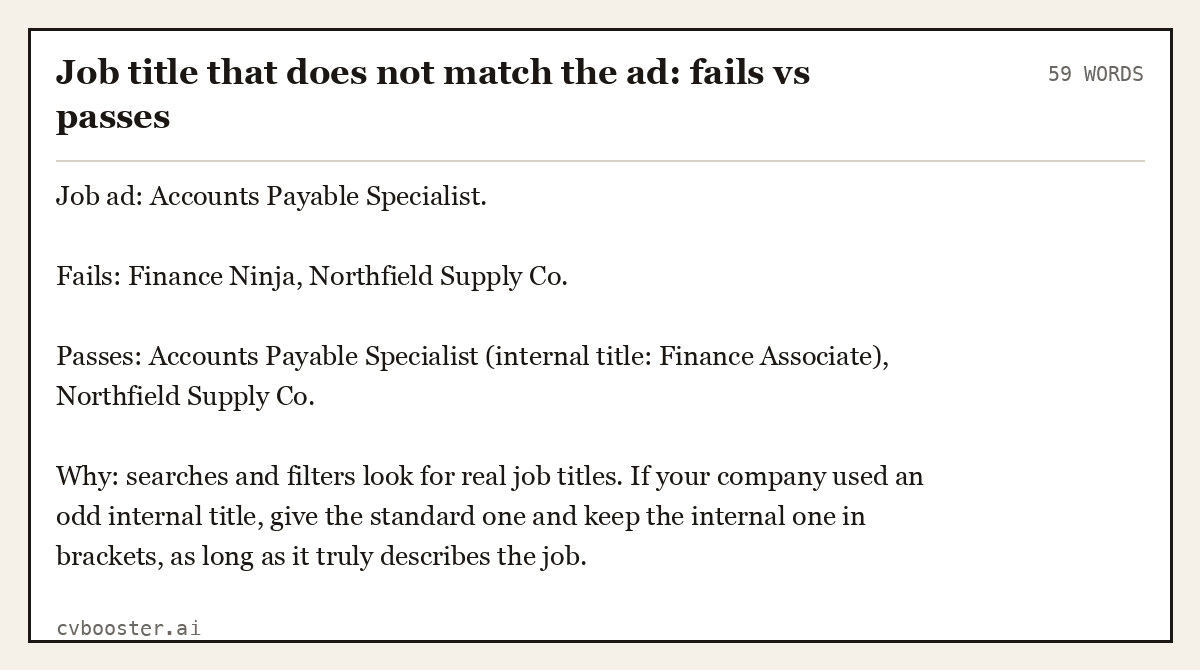
Job title that does not match the ad: fails vs passes
59 wordsJob ad: Accounts Payable Specialist.
Fails: Finance Ninja, Northfield Supply Co.
Passes: Accounts Payable Specialist (internal title: Finance Associate), Northfield Supply Co.
Why: searches and filters look for real job titles. If your company used an odd internal title, give the standard one and keep the internal one in brackets, as long as it truly describes the job.
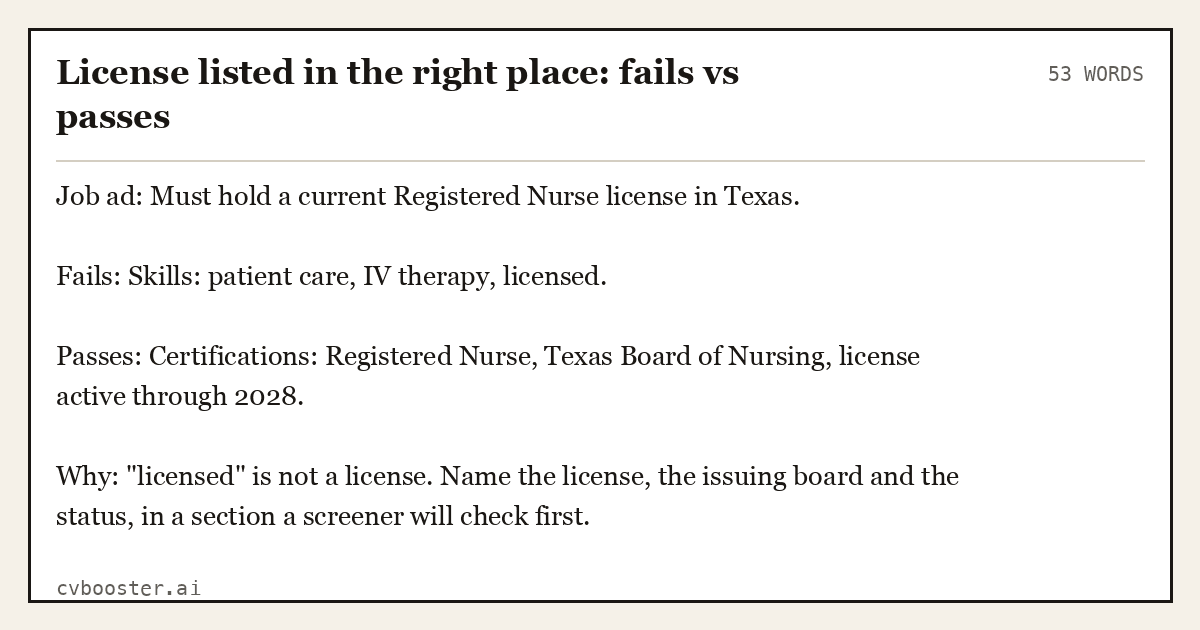
License listed in the right place: fails vs passes
53 wordsJob ad: Must hold a current Registered Nurse license in Texas.
Fails: Skills: patient care, IV therapy, licensed.
Passes: Certifications: Registered Nurse, Texas Board of Nursing, license active through 2028.
Why: "licensed" is not a license. Name the license, the issuing board and the status, in a section a screener will check first.
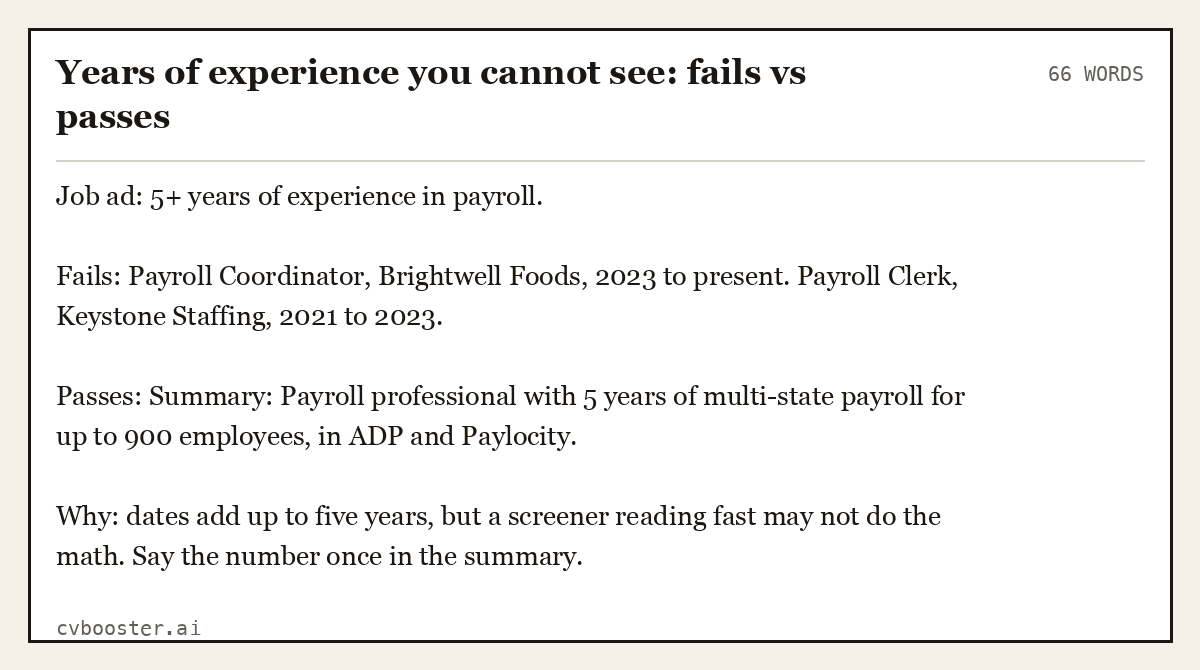
Years of experience you cannot see: fails vs passes
66 wordsJob ad: 5+ years of experience in payroll.
Fails: Payroll Coordinator, Brightwell Foods, 2023 to present. Payroll Clerk, Keystone Staffing, 2021 to 2023.
Passes: Summary: Payroll professional with 5 years of multi-state payroll for up to 900 employees, in ADP and Paylocity.
Why: dates add up to five years, but a screener reading fast may not do the math. Say the number once in the summary.
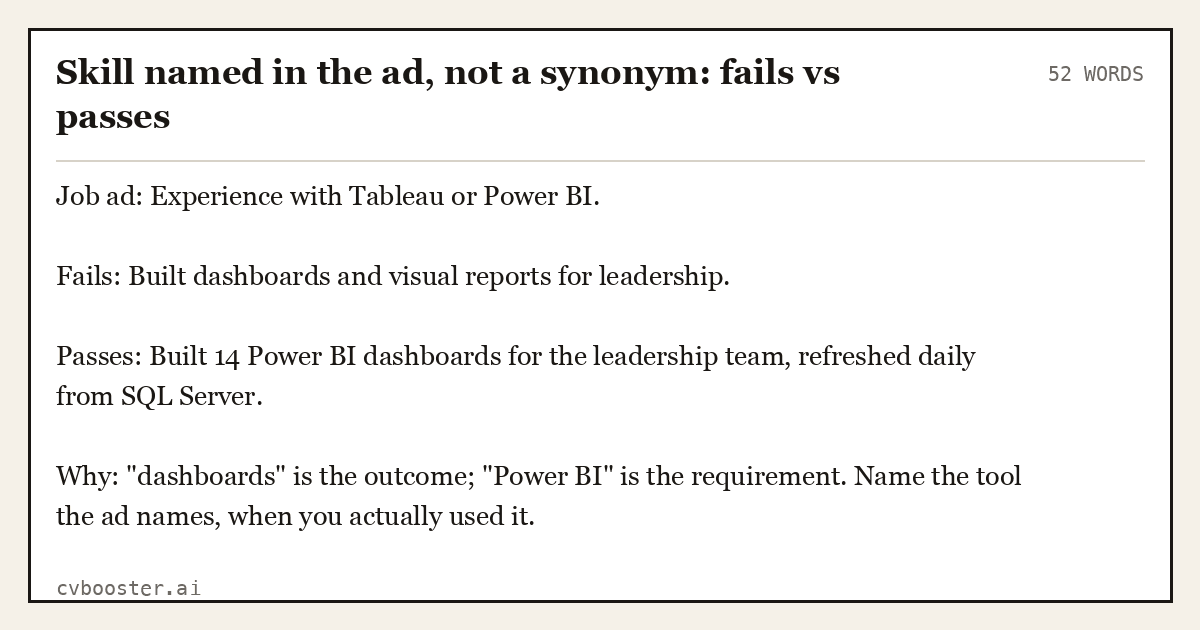
Skill named in the ad, not a synonym: fails vs passes
52 wordsJob ad: Experience with Tableau or Power BI.
Fails: Built dashboards and visual reports for leadership.
Passes: Built 14 Power BI dashboards for the leadership team, refreshed daily from SQL Server.
Why: "dashboards" is the outcome; "Power BI" is the requirement. Name the tool the ad names, when you actually used it.
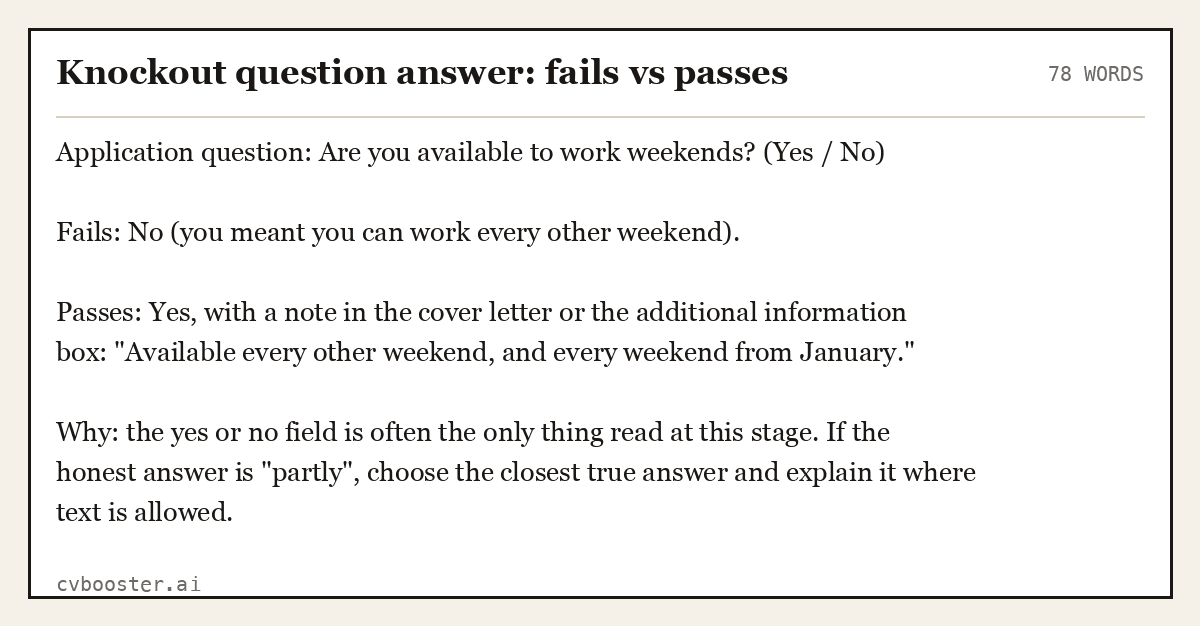
Knockout question answer: fails vs passes
78 wordsApplication question: Are you available to work weekends? (Yes / No)
Fails: No (you meant you can work every other weekend).
Passes: Yes, with a note in the cover letter or the additional information box: "Available every other weekend, and every weekend from January."
Why: the yes or no field is often the only thing read at this stage. If the honest answer is "partly", choose the closest true answer and explain it where text is allowed.
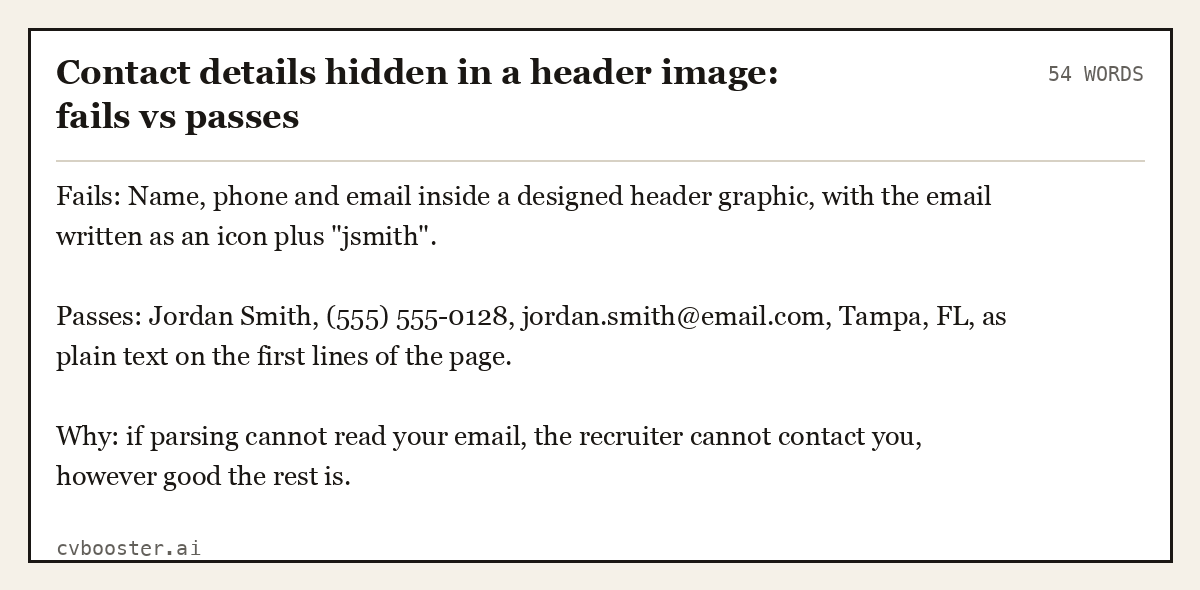
Contact details hidden in a header image: fails vs passes
54 wordsFails: Name, phone and email inside a designed header graphic, with the email written as an icon plus "jsmith".
Passes: Jordan Smith, (555) 555-0128, jordan.smith@email.com, Tampa, FL, as plain text on the first lines of the page.
Why: if parsing cannot read your email, the recruiter cannot contact you, however good the rest is.
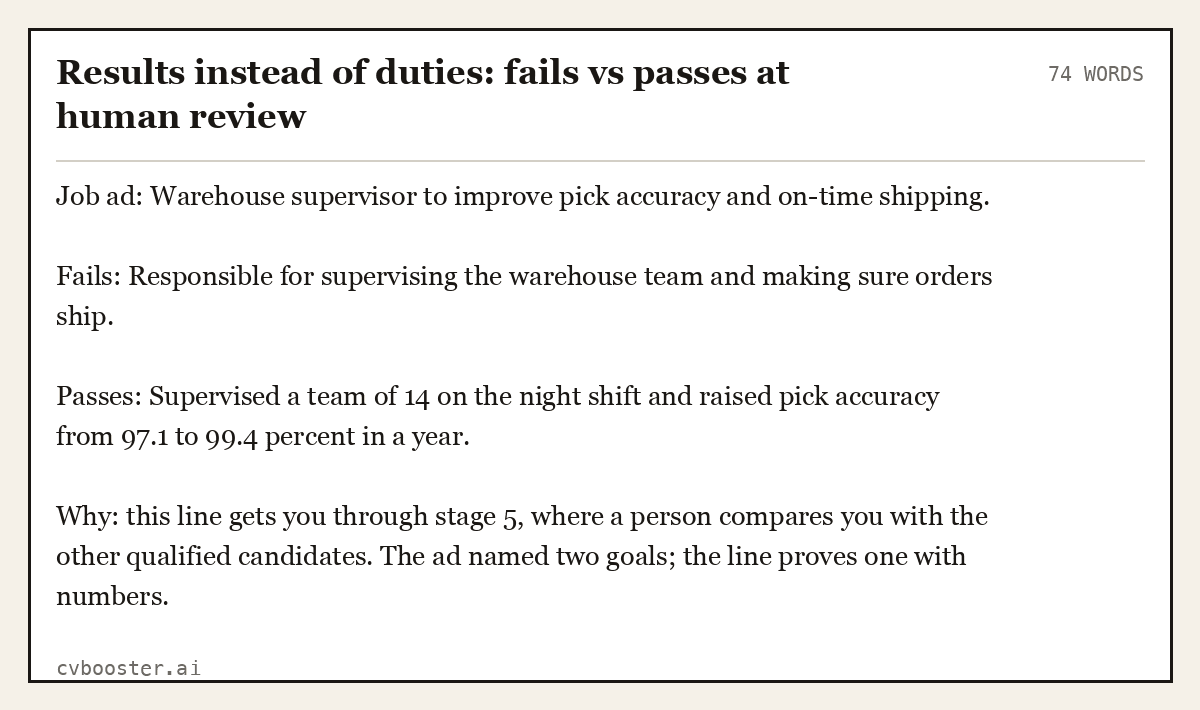
Results instead of duties: fails vs passes at human review
74 wordsJob ad: Warehouse supervisor to improve pick accuracy and on-time shipping.
Fails: Responsible for supervising the warehouse team and making sure orders ship.
Passes: Supervised a team of 14 on the night shift and raised pick accuracy from 97.1 to 99.4 percent in a year.
Why: this line gets you through stage 5, where a person compares you with the other qualified candidates. The ad named two goals; the line proves one with numbers.
How to get your resume through screening
- Copy the requirements list from the ad into a note. Mark each one you meet.
- Write each met requirement into the resume in the ad's own words, in a bullet with evidence.
- Put the hard requirements where screeners look first: licenses and certifications in their own section, years in the summary.
- Use a simple layout: one column, standard headings, contact details as plain text.
- Answer application questions exactly, and explain partial answers where text is allowed.
- Check the file with the ATS checker before you send it.
For the layout side, our ATS-friendly resume guide shows clean examples.
Frequently asked questions
What is resume screening?
Resume screening is the first step of hiring, where an employer checks applications against the job's requirements and decides who moves forward. It can be done by a recruiter, by software rules, by AI scoring or by a mix. Screeners look for evidence on the page: titles, years, skills, licenses and results that match the ad.
How do employers screen resumes?
Most employers start with application questions, then an applicant tracking system parses the resume into fields. A recruiter checks minimum qualifications, searches or ranks the pool, and sends a shortlist to the hiring manager. A short phone screen often follows. Federal agencies describe the same order on their careers pages, ending with interviews.
Do AI tools reject resumes automatically?
It depends on how the employer sets them up. Some tools only rank or summarize applications for a recruiter; others are configured to filter on knockout answers. Where AI tools are used to make hiring decisions, laws such as New York City's Local Law 144 require bias audits and notices to candidates.
How long does resume screening take?
There is no standard timeline. The EPA says reviewing who is qualified or best qualified can take a few days or a few weeks, depending on the number of applications. Private employers vary just as much. If a posting names a closing date, screening often starts after it.
How can I pass resume screening?
Write every requirement you meet into the resume in the ad's own words, with evidence: the tool, the number of years, the license and a result. Keep the layout simple so it parses cleanly, answer application questions exactly, and put licenses and years where screeners look first. Then check the file before applying.
What is the difference between resume screening and an ATS?
An ATS, or applicant tracking system, is software that stores and organizes applications. Resume screening is the process of deciding who moves forward. The ATS is one tool used in screening, alongside application questions, recruiter review and sometimes AI scoring. A person usually makes the final shortlist decision.
More in this series: related guides
- AI Letter Writer: 7 Prompts and the Fixed Letters They Need
- Amazon Resume Example: 6 Resumes Using Leadership Principles
- Best Resume Builder: 9 Tools Compared on the Free Download
- Business Analyst Cover Letter: 8 Examples by Level
- Career Change Cover Letter: 8 Examples by Career Switch
- Chef Cover Letter: 8 Examples From Line Cook to Exec Chef
- Cover Letter Heading: Format and 10 Complete Examples
- Creative Resume Template: 6 Designs with Complete Examples
- Data Scientist Cover Letter: 8 Examples From Entry Level
- Digital Marketing Cover Letter: 8 Examples by Specialty
- EAP Program: What It Covers, Is It Confidential, 7 Scripts
- Full Stack Development: Layers, Skills, Pay and Examples
- Help With Resume Wording: 60 Before and After Lines
- How to Make Your Resume Stand Out: 15 Moves That Work
- How to Quit a Job: 7 Steps and 8 Scripts You Can Use
- How to Start a Cover Letter: 30 Openings and 3 Letters
- Resume Fixer: 15 Fixes With Before and After Examples
- Resume PDF Download: 6 Ready Formats and How to Save a PDF
- Simple CV Format: Section Order and 6 Examples for Any Job
- Truck Driver Cover Letter: 8 Examples for CDL Drivers
- US Resume Format: Rules and 6 Examples for American Jobs
- Walmart Resume Example: 6 Resumes for Real Store Roles
- Warehouse Worker Cover Letter: 8 Examples by Job Type
- What Is Practical Nursing: LPN Role, Training, Pay, Exam
Looking for a worked example for your job title? Browse the resume examples by job title.