Female Job Interview Attire: Six UK Outfits by Job Type
By Mustafa Tarabya, founder of CVBooster · Published · Updated
9 min read
The right female job interview attire is one step smarter than what the people in that job wear on a normal day: tailored trousers or a knee length skirt, a plain top or blouse, a jacket or neat knit, and shoes you can walk in without thinking about them. The one constraint is the workplace, not your gender, so a nursery interview and a law firm interview need different clothes. GOV.UK guidance on dress codes says "Dress policies for men and women do not have to be identical, but standards imposed should be equivalent." Below: how to read the dress code, six complete outfits by job type and video interviews, checked in October 2026. Written by Mustafa Tarabya, who hired for his own company, read every application himself and now writes CVBooster's guides.
The one rule: dress one step above the job
You will try on four outfits the night before, decide the first one was right, and still wonder on the bus whether the blazer is too much. It is not too much. A blazer can come off in the waiting room. A missing one cannot be added.
I ran the interviews at my own company. Clothes never answered a question for anyone, but a candidate tugging at a skirt spends the first minute on the skirt instead of on the question.
Find out what people in the role wear on an ordinary Tuesday, then go one step smarter:
- Uniform or workwear (retail, care, hospitality): smart casual.
- Smart casual (most offices, schools, charities, tech): business casual, with a structured jacket.
- Business casual (finance, consultancy, senior public sector): a trouser suit, skirt suit or dress with a jacket.
- Suits every day (law, banking, board level): your best suit, with nothing you need to adjust.
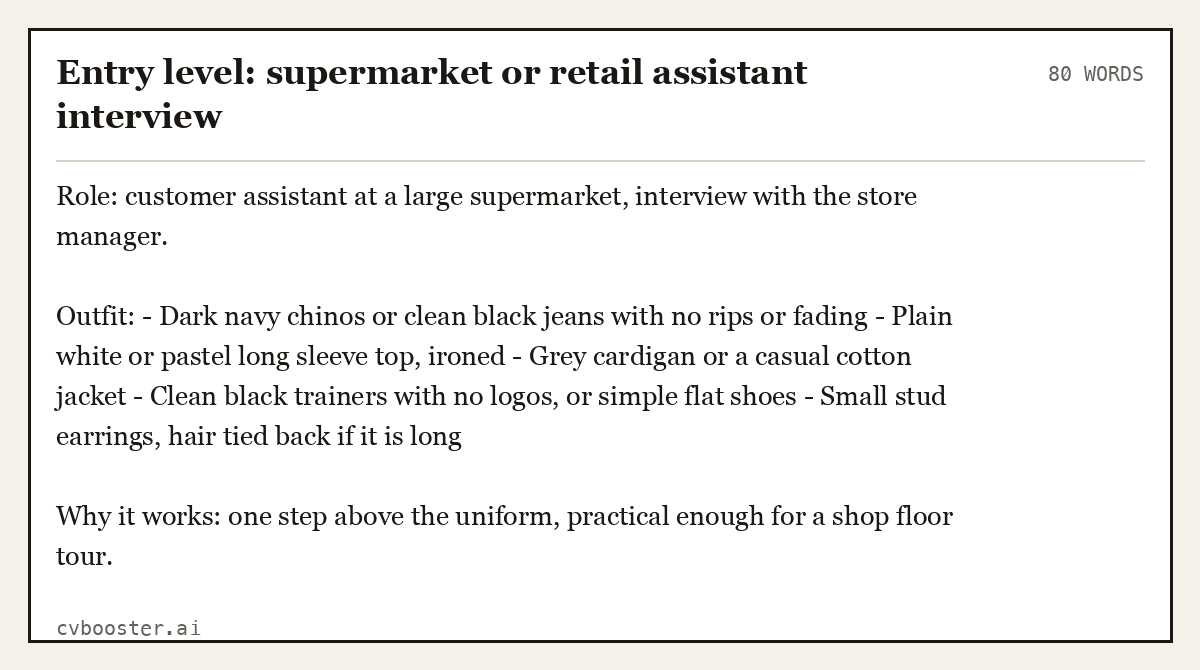
Entry level: supermarket or retail assistant interview (80 words)
Role: customer assistant at a large supermarket, interview with the store manager.
Outfit: - Dark navy chinos or clean black jeans with no rips or fading - Plain white or pastel long sleeve top, ironed - Grey cardigan or a casual cotton jacket - Clean black trainers with no logos, or simple flat shoes - Small stud earrings, hair tied back if it is long
Why it works: one step above the uniform, practical enough for a shop floor tour.
How to find out the dress code before the day
You do not have to guess. There are four quick ways to check what the employer expects, and one of them usually answers the question.
- Read the invitation. Some employers say "smart casual" or mention a practical task. If you will be doing a trial shift, a lesson or a ward tour, the clothes need to work for that.
- Look at the company's own photos. The careers page, the team page and recent posts show what staff actually wear, which is more honest than any dress code.
- Walk past or look at the entrance. For local jobs, the staff going in at nine o'clock tell you more than a website.
- Ask. A short line to the person who invited you is normal: "Could you tell me the dress code for the interview?" Nobody marks you down for asking.
The National Careers Service, the government's careers service for England, lists practical steps for the day itself, including "give yourself plenty of time to arrive". Plan the outfit with that in mind: shoes you can walk ten minutes in, and a coat that covers you if it rains.
Office and graduate interview outfits
Office interviews are where most people overthink it. The safe answer is a business casual outfit in two or three colours, with one item that is clearly smart, usually the jacket.
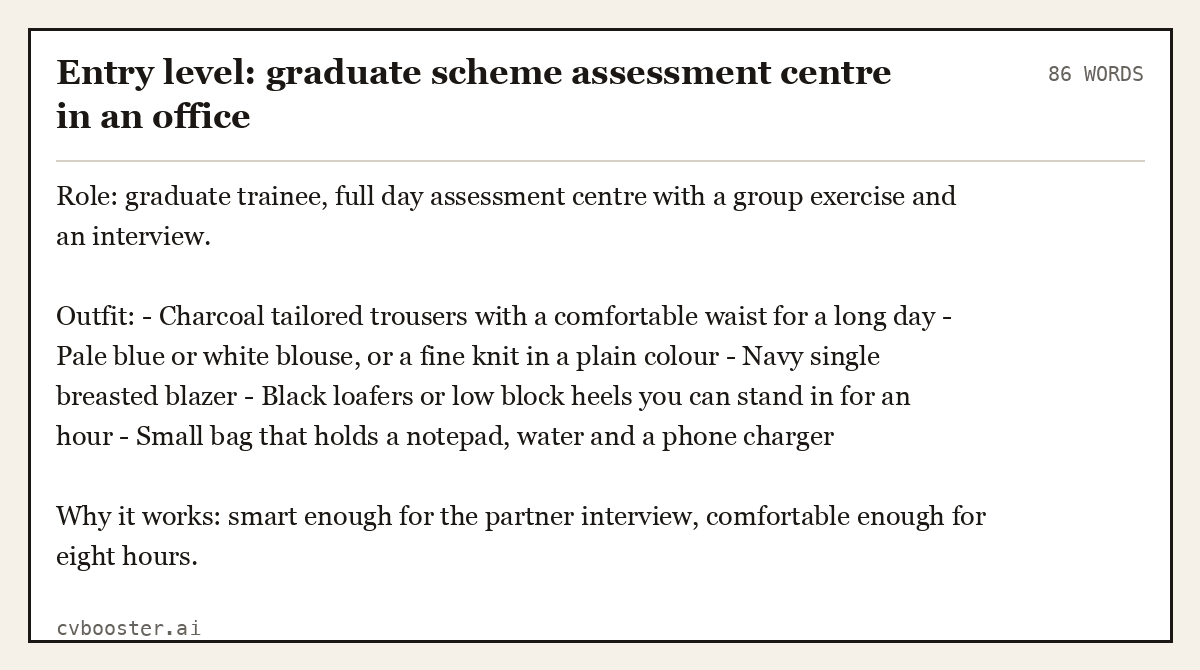
Entry level: graduate scheme assessment centre in an office (86 words)
Role: graduate trainee, full day assessment centre with a group exercise and an interview.
Outfit: - Charcoal tailored trousers with a comfortable waist for a long day - Pale blue or white blouse, or a fine knit in a plain colour - Navy single breasted blazer - Black loafers or low block heels you can stand in for an hour - Small bag that holds a notepad, water and a phone charger
Why it works: smart enough for the partner interview, comfortable enough for eight hours.
A creative agency, a start up or a tech company usually sits lower. A neat knit with tailored trousers, or a midi skirt with clean white leather trainers, reads as someone who understands the place. Before the day, our guide on how to prepare for an interview covers the research that tells you which kind of office you are walking into.
NHS, care and teaching interview outfits
Healthcare and school interviews often include a tour of a ward, a care home or a classroom, and sometimes a short practical task. Clothes need to look professional and let you move, kneel and walk long corridors.
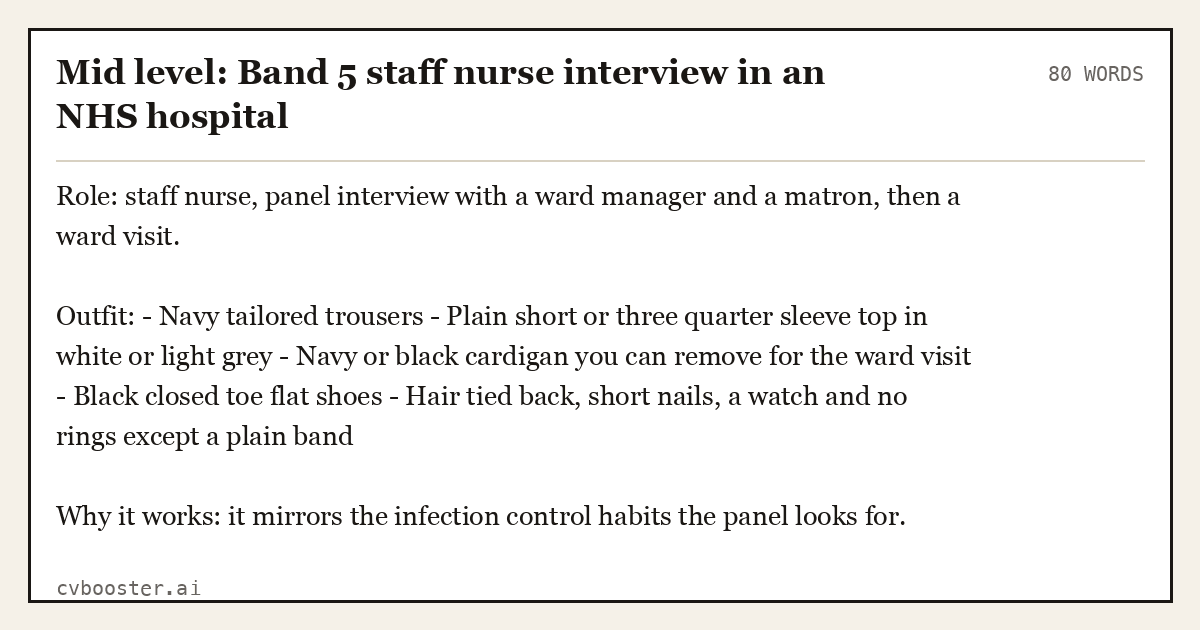
Mid level: Band 5 staff nurse interview in an NHS hospital (80 words)
Role: staff nurse, panel interview with a ward manager and a matron, then a ward visit.
Outfit: - Navy tailored trousers - Plain short or three quarter sleeve top in white or light grey - Navy or black cardigan you can remove for the ward visit - Black closed toe flat shoes - Hair tied back, short nails, a watch and no rings except a plain band
Why it works: it mirrors the infection control habits the panel looks for.
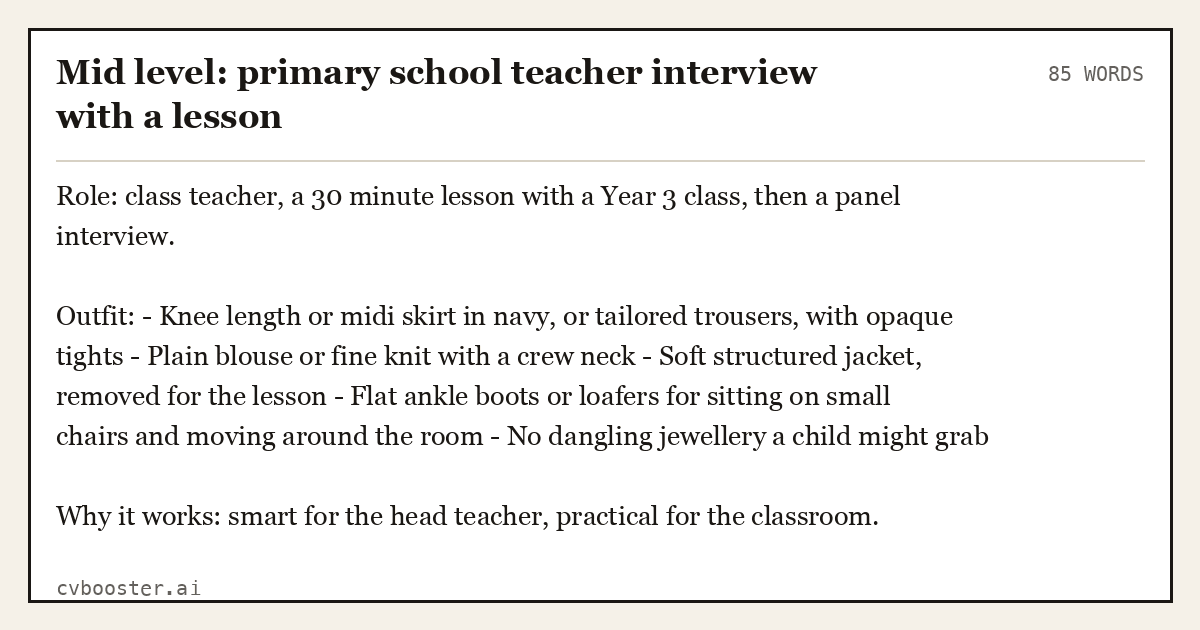
Mid level: primary school teacher interview with a lesson (85 words)
Role: class teacher, a 30 minute lesson with a Year 3 class, then a panel interview.
Outfit: - Knee length or midi skirt in navy, or tailored trousers, with opaque tights - Plain blouse or fine knit with a crew neck - Soft structured jacket, removed for the lesson - Flat ankle boots or loafers for sitting on small chairs and moving around the room - No dangling jewellery a child might grab
Why it works: smart for the head teacher, practical for the classroom.
Corporate and senior interview outfits
For law, finance, consultancy and senior public sector roles, the suit is still the expected answer. A trouser suit and a skirt suit are equally formal. What matters is fit: shoulders that sit right, trousers that reach the shoe, a skirt that stays put when you sit down.
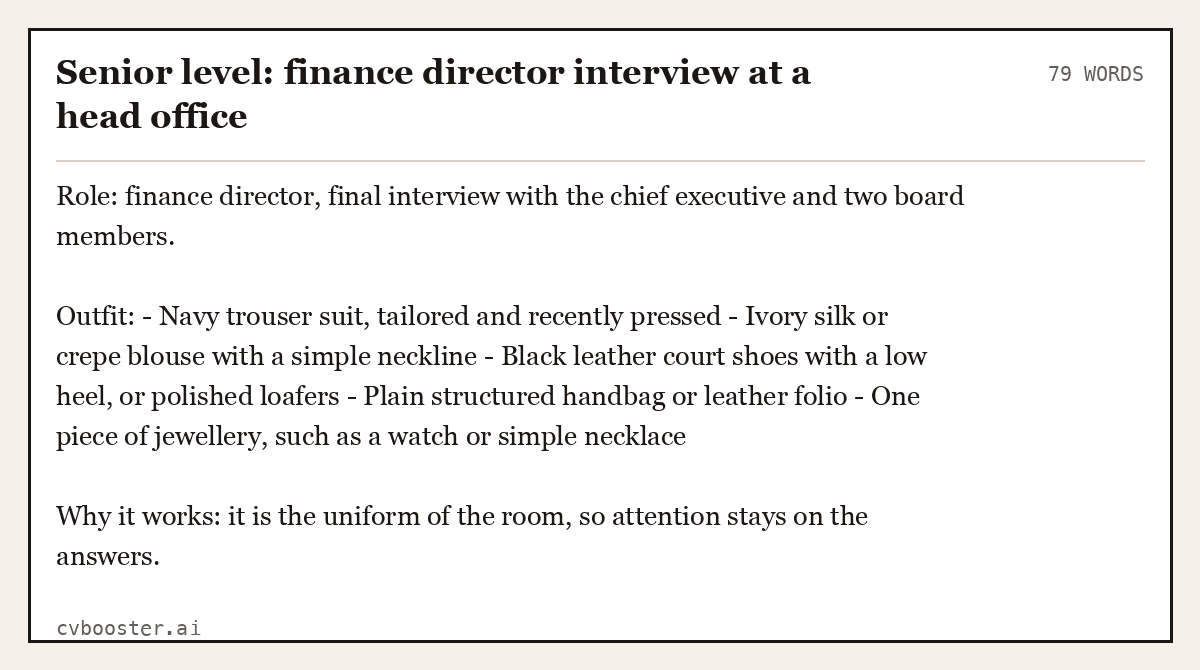
Senior level: finance director interview at a head office (79 words)
Role: finance director, final interview with the chief executive and two board members.
Outfit: - Navy trouser suit, tailored and recently pressed - Ivory silk or crepe blouse with a simple neckline - Black leather court shoes with a low heel, or polished loafers - Plain structured handbag or leather folio - One piece of jewellery, such as a watch or simple necklace
Why it works: it is the uniform of the room, so attention stays on the answers.
If you would like support with clothes and coaching, Smart Works is a UK charity that describes its work this way: "Smart Works provides the confidence, clothing and coaching to lift women into work." Referrals usually come through a job centre, charity or support worker.
What to wear for a video interview
On a video call the panel sees you from the chest up, on a small screen, under whatever light your room has. Plain colours work best. Very fine stripes and small checks can flicker on camera, and white can glow under a bright lamp.
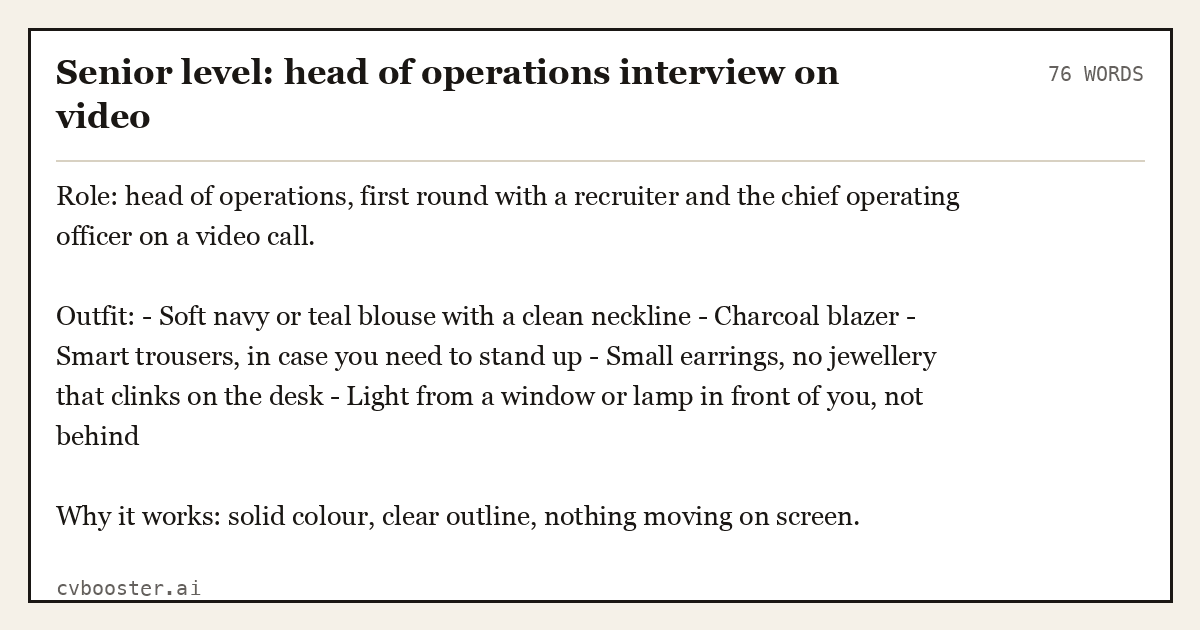
Senior level: head of operations interview on video (76 words)
Role: head of operations, first round with a recruiter and the chief operating officer on a video call.
Outfit: - Soft navy or teal blouse with a clean neckline - Charcoal blazer - Smart trousers, in case you need to stand up - Small earrings, no jewellery that clinks on the desk - Light from a window or lamp in front of you, not behind
Why it works: solid colour, clear outline, nothing moving on screen.
The National Careers Service also tells candidates to "check your computer and internet connection is working if your interview is online". Do a test call in the outfit, because a jacket that looked fine in the mirror can look grey and flat on camera.
What not to wear, and what an employer cannot demand
Most mistakes are not about style. They are about distraction: anything you will adjust, tug or worry about during a 45 minute conversation.
- Brand new shoes you have not walked in.
- Skirts or dresses you need to pull down when you sit.
- Strong perfume, especially for healthcare, care and small interview rooms.
- Bags so full that you need to dig for your CV at the table.
- Clothes with slogans, large logos or anything you would not wear to meet a client.
Employers can set dress codes, but they cannot set sexist ones. The GOV.UK guidance on dress codes and sex discrimination is written for employers "and employees and job applicants who may have to abide by them", and it says "Any requirement to wear make-up, skirts, have manicured nails, certain hairstyles or specific types of hosiery is likely to be unlawful". If an invitation demands heels or make up, you are entitled to question it. For the rest of your interview bag, see our checklist of what to bring to an interview, and for the conversation itself our job interview tips.
Frequently asked questions
What should a woman wear to a job interview in the UK?
Wear one step smarter than the people in the role wear day to day. For most offices that means tailored trousers or a midi skirt, a plain blouse or knit, a jacket and comfortable closed shoes. For retail and care, smart casual is right. For law, finance and senior roles, a trouser or skirt suit.
Is it OK to wear trousers to an interview as a woman?
Yes. Tailored trousers are as formal as a skirt and are often more practical for tours, tasks and long assessment days. A trouser suit is standard in law and finance. GOV.UK guidance says a requirement to wear skirts is likely to be unlawful, so no employer should expect one.
Can I wear jeans to a job interview?
Only where staff wear jeans every day, such as some retail, warehouse, hospitality or creative roles, and then only dark, clean jeans with no rips, paired with a smart top and jacket. For an office, school, NHS or corporate interview, choose tailored trousers instead. If you are unsure, ask the person who invited you.
What colours are best for interview clothes?
Navy, charcoal, black, grey, camel and soft blues are safe choices because they look smart and do not distract. Add one softer colour in the top if you like. For video interviews, avoid bright white and very fine patterns, which can glow or flicker on camera, and choose plain solid colours.
What shoes should I wear to an interview?
Wear clean, closed shoes you have already walked in for at least an hour: loafers, flats, low block heels, ankle boots or smart trainers for casual workplaces. You may walk from the station, tour a building or stand for a task. No employer can lawfully require you to wear high heels.
Should I wear a blazer to an interview?
For most office, public sector and senior interviews, yes, because it is the quickest way to look prepared. Choose one that fits across the shoulders. For retail, care and creative roles a cardigan or casual jacket works. You can take a blazer off if the room is relaxed, but you cannot add one.
Related articles
- Creative Interview Questions With 6 Sample Answers
- ED Nurse Interview Questions With 9 Full Sample Answers
- Interview Questions for an LPN: 9 Full Sample Answers
- Great Questions to Ask an Interviewee: 6 Ready Sets
More articles
- Film Industry Resume Samples: 6 Crew Resumes by Role
- How to Write a Resume for Your First Job (No Experience Needed)
- Flight Attendant Cover Letter: 6 Samples by Experience
Looking for a worked example for your job title? Browse the resume examples by job title.