Nurse Practitioner Interview Questions With 9 Full Answers
By Mustafa Tarabya, founder of CVBooster · Published · Updated
10 min read
Nurse practitioner interview questions check one thing above all: whether you can be trusted to make a diagnosis and a prescribing decision on your own, and to say when a case is beyond you. The constraint is scope. O*NET, the US Department of Labor's occupation database, describes the role as people who "Diagnose and treat acute, episodic, or chronic illness, independently or as part of a healthcare team", and every clinical question is a test of where you draw that line. Below are nine nurse practitioner interview questions with full sample answers, checked in October 2026, each tagged for a new grad NP or an experienced NP, plus the school interview version. Written by Mustafa Tarabya, who hired for his own company, read every application himself and now writes CVBooster's guides.
You spent years as a nurse being told to "call the provider". Now you are the provider, and the panel wants to know who you call. The answer is not nobody. That is the answer that ends the interview.
1. Tell me about yourself and why you became an NP
This is the warm-up, and most people waste it on a life story. Give three things: your nursing base, your NP training and population focus, and why this practice.
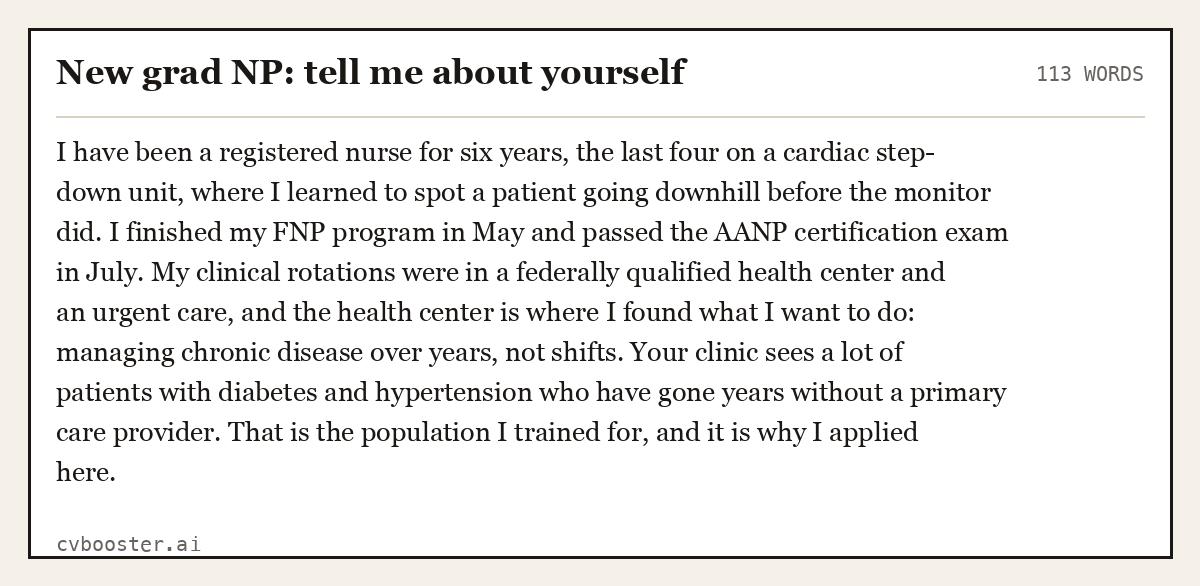
New grad NP: tell me about yourself (113 words)
I have been a registered nurse for six years, the last four on a cardiac step-down unit, where I learned to spot a patient going downhill before the monitor did. I finished my FNP program in May and passed the AANP certification exam in July. My clinical rotations were in a federally qualified health center and an urgent care, and the health center is where I found what I want to do: managing chronic disease over years, not shifts. Your clinic sees a lot of patients with diabetes and hypertension who have gone years without a primary care provider. That is the population I trained for, and it is why I applied here.
2. Walk me through how you would assess a patient with chest pain
This is the clinical case question. The panel is not checking that you know chest pain; they are checking that you put the dangerous causes first and that you know when the patient leaves your room in an ambulance.
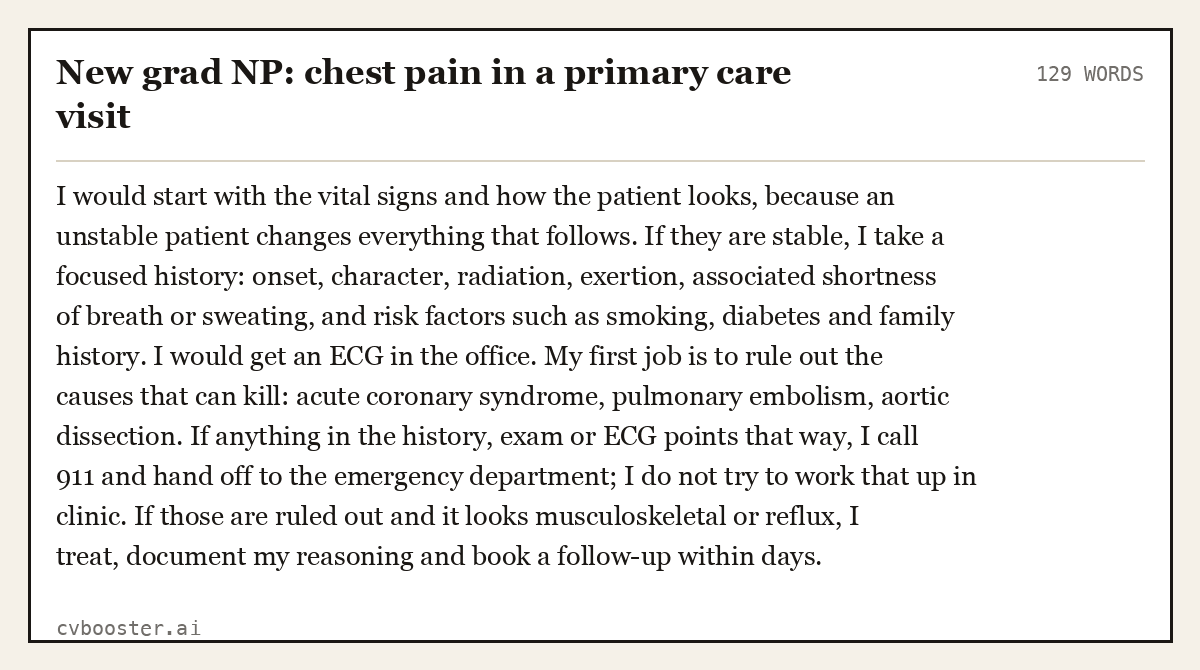
New grad NP: chest pain in a primary care visit (129 words)
I would start with the vital signs and how the patient looks, because an unstable patient changes everything that follows. If they are stable, I take a focused history: onset, character, radiation, exertion, associated shortness of breath or sweating, and risk factors such as smoking, diabetes and family history. I would get an ECG in the office. My first job is to rule out the causes that can kill: acute coronary syndrome, pulmonary embolism, aortic dissection. If anything in the history, exam or ECG points that way, I call 911 and hand off to the emergency department; I do not try to work that up in clinic. If those are ruled out and it looks musculoskeletal or reflux, I treat, document my reasoning and book a follow-up within days.
3. How do you decide when to consult or refer?
Every panel asks some version of this, because it is the question about safety. NCSBN, the national council of state boards of nursing, says APRNs "are prepared by education and certification to assess, diagnose and manage patient problems, order tests and prescribe medications". The answer shows you know that preparation has edges.
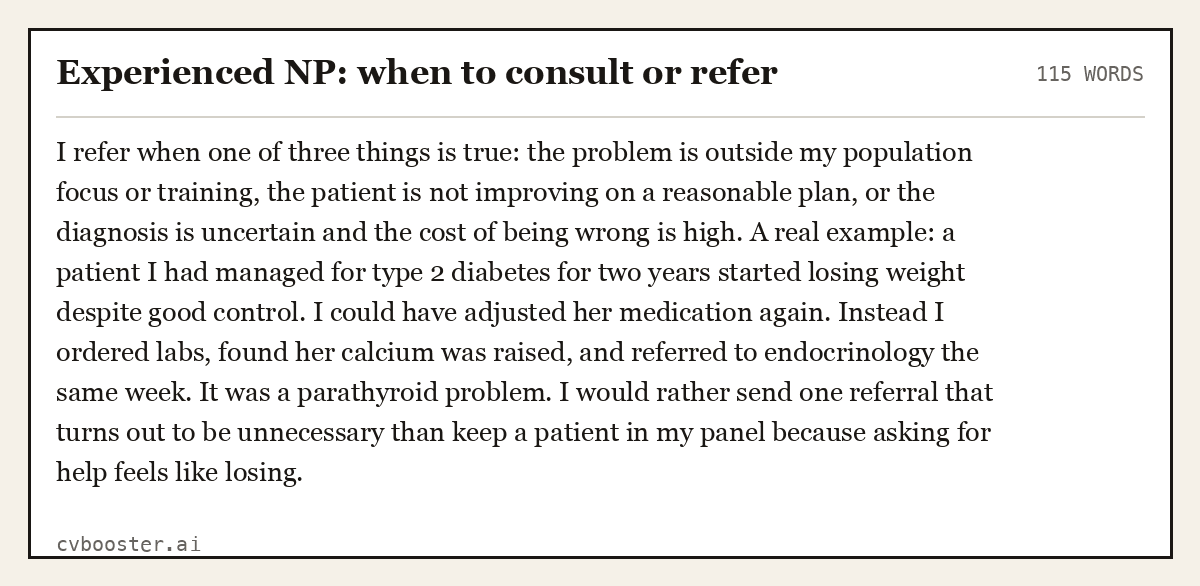
Experienced NP: when to consult or refer (115 words)
I refer when one of three things is true: the problem is outside my population focus or training, the patient is not improving on a reasonable plan, or the diagnosis is uncertain and the cost of being wrong is high. A real example: a patient I had managed for type 2 diabetes for two years started losing weight despite good control. I could have adjusted her medication again. Instead I ordered labs, found her calcium was raised, and referred to endocrinology the same week. It was a parathyroid problem. I would rather send one referral that turns out to be unnecessary than keep a patient in my panel because asking for help feels like losing.
4. How do you approach prescribing controlled substances?
The panel wants a process, not a personality. Name the state prescription monitoring check, the agreement, the follow-up interval, and what you do when something does not add up.
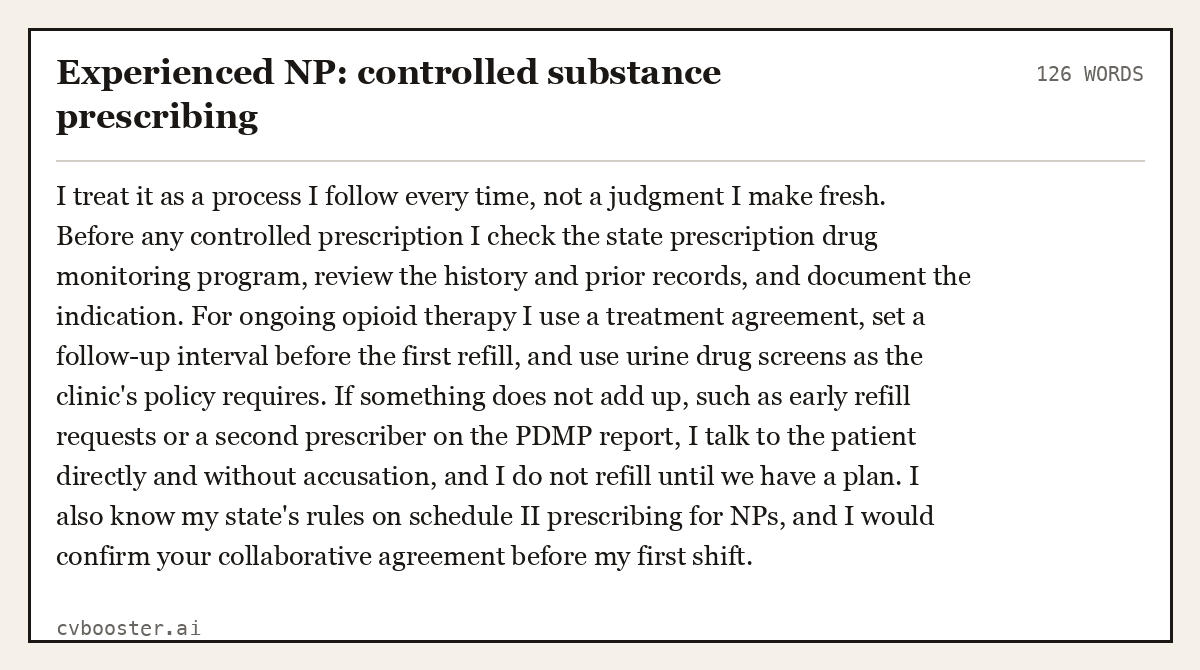
Experienced NP: controlled substance prescribing (126 words)
I treat it as a process I follow every time, not a judgment I make fresh. Before any controlled prescription I check the state prescription drug monitoring program, review the history and prior records, and document the indication. For ongoing opioid therapy I use a treatment agreement, set a follow-up interval before the first refill, and use urine drug screens as the clinic's policy requires. If something does not add up, such as early refill requests or a second prescriber on the PDMP report, I talk to the patient directly and without accusation, and I do not refill until we have a plan. I also know my state's rules on schedule II prescribing for NPs, and I would confirm your collaborative agreement before my first shift.
5. Tell me about a time you disagreed with a physician
Collaboration questions are about how you disagree, not whether you do. Use STAR: the situation, your task, what you did, and the result for the patient.
Experienced NP: disagreeing with a physician, STAR (125 words)
Situation. On a hospitalist team, the attending wanted to discharge a patient with pneumonia who still had a borderline oxygen saturation on walking. Task. I was the NP writing the discharge, and I was not comfortable sending her home. Action. I asked the attending for two minutes away from the patient, showed him the ambulatory saturation I had just measured, and suggested we keep her one more night with a repeat walk test in the morning. I kept it to the numbers and asked what he would want to see before discharge. Result. He agreed. Her saturation was better the next morning and she went home with a clear plan. We worked together for two more years, and he started asking for ambulatory saturations himself.
6. How would you handle a full schedule when a walk-in is sick?
Clinics ask this because the schedule is where good care meets reality. Show that you triage, communicate with the front desk and protect the sick patient.
New grad NP: a full schedule and a sick walk-in (105 words)
The sick patient comes first, but how sick decides how. I would ask the medical assistant to get vital signs straight away. If the patient is unstable, they are seen now and the next patient waits, with the front desk telling them why and how long. If the patient is stable but needs to be seen today, I would look for the shortest gap, often after a quick follow-up visit, and ask the front desk to tell the next patients we are running fifteen minutes late. What I would not do is send someone away to the emergency department just because my schedule is full.
7. How do you keep your clinical knowledge current?
A short, concrete answer works best: guidelines you read, a CE habit, and one recent change you applied.
Experienced NP: staying current (100 words)
I read the guideline updates that matter for my panel when they come out, mostly diabetes, hypertension and lipids, and I keep my continuing education well ahead of the renewal requirement rather than cramming it. I also bring one case a month to our team's case review, which is where I learn the most. A recent example: when the diabetes guidance moved further toward medications with heart and kidney benefits, I reviewed my panel, found patients who qualified, and talked to each of them at their next visit. Reading the update took an hour. Changing the plans took three months.
8. Why should we hire a new grad NP?
New grads get this in every interview, and it is fair. Do not apologize for being new. Point to your nursing years, your rotations and what you will do in the first ninety days.
New grad NP: why hire a new graduate (108 words)
You would be hiring a new NP, not a new nurse. I bring six years of RN experience, which means I already know how to read a sick patient, talk to a frightened family and work a busy day without losing track of results. My rotations gave me over 600 supervised clinical hours in primary care and urgent care. In my first ninety days I would want structured case review with a collaborating physician, a gradual increase in my schedule, and a clear list of conditions to discuss before treating. I would rather ask too many questions in my first quarter than too few in my first year.
9. Questions for nurse practitioner school interviews
Some searches for NP interview questions come from people applying to NP programs, not jobs. The school panel asks why NP, why now and why this program. The same rule applies: a real reason, a real example, a plan.
NP school applicant: why do you want to become a nurse practitioner (108 words)
On my unit, I watch the same patients come back every few months with heart failure that got worse at home. Each time, the cause is something that could have been caught earlier in primary care: a missed weight gain, a medication they stopped because of cost. I want to be the person who catches it in the clinic. I chose the family track because the patients I see are not just older adults; their children and grandchildren have the same risk factors. I chose this program because of its rural clinical placements, and I want to practice in a county like the one I grew up in.
What the panel is listening for
Every question above is the same test asked from a different side: do you know your scope, and will you act inside it under pressure. The AANP, the national NP professional body, describes NPs as clinicians who blend clinical expertise in diagnosing and treating health conditions with an added emphasis on disease prevention and health management; the best answers show both halves, the diagnosis and the follow-up.
Three habits separate strong answers from weak ones. Name the dangerous diagnosis first in any case question. Give a real patient example, with details changed, for every behavioural question. And end clinical answers with follow-up, because a plan without a follow-up date is half a plan.
Before the interview, check the employer's collaboration requirements for your state, the patient population and the visit length. If the advert says twenty-minute visits, prepare an answer about how you manage a complex patient in twenty minutes, because someone will ask.
Questions to ask at the end
Ask about the things that decide whether you will be safe and stay: how many patients a day for a new NP, how the collaborating physician arrangement works in practice, how much time is protected for charting, and what onboarding looks like. For more, see our list of questions to ask in an interview.
If the interview goes well, a short thank you letter the same day keeps your name in front of the panel. To prepare the behavioral answers, our guide to STAR interview questions walks through the method, and the nursing resume guide shows how to put your NP certification and clinical hours on the page.
Frequently asked questions
What questions are asked in a nurse practitioner interview?
Expect a mix of clinical case questions, such as chest pain or a child with a fever, scope and referral questions, prescribing questions, especially controlled substances, collaboration questions about disagreeing with a physician, and fit questions about the population and schedule. New grads also get asked why the practice should hire someone new to the role.
How do I prepare for a new grad NP interview?
Prepare one clinical case answer for the three most common conditions in the job's population, a referral story from your rotations, and a ninety-day plan. Know your state's practice rules, your clinical hours and your certification date. Practise saying the dangerous diagnosis first in every case answer, because panels listen for that order.
What are the most common NP school interview questions?
Program panels usually ask why you want to become a nurse practitioner, why this specialty track, why this program, how you handle stress, and where you see yourself in five years. Answer with a real patient situation from your nursing work and a specific reason for the program, such as its clinical placements or population focus.
How do you answer clinical scenario questions as an NP?
Start with stability and vital signs, take a focused history, name the life-threatening causes you must rule out, and say what sends the patient to the emergency department. Then give the treatment plan and the follow-up. Panels care more about the order of your thinking than about naming a rare diagnosis.
What should I wear to a nurse practitioner interview?
Wear business clothes unless the employer tells you otherwise; a suit or a jacket with smart trousers or a skirt is standard. Some clinics invite you to a shadow shift, in which case ask whether scrubs are expected. Bring copies of your licence, certification and resume in case the panel asks.
Related articles
- Bank Teller Interview Questions and 10 Full Sample Answers
- How to Cancel an Interview: 7 Emails That Keep Doors Open
- Java Interview Questions and Answers: 8 Worked Examples
- Pharmacist Interview Questions and Answers: UK Guide
More articles
- Nursing Recommendation Letter: 6 Samples for Nurses
- Nursing Resume: Objective Examples, Licences and Length
- CV Personal Statement Examples: 12 Written for Real Jobs
Looking for a worked example for your job title? Browse the resume examples by job title.