Seeing the Big Picture Civil Service Example: AO to G7
By Mustafa Tarabya, founder of CVBooster · Published · Updated
13 min read
Seeing the big picture is scored on one thing: whether a wider priority changed what you actually did. Most adverts cap the behaviour at 250 words, so the outside information and the decision it changed have to sit in about 160 of them.
The wording in this guide is taken from the gov.uk publication Success Profiles: Civil Service behaviours, at each grade band. Four complete statements follow, at AO, HEO, SEO and Grade 7, annotated line by line. Written by Mustafa Tarabya, who hired for his own company, read every application himself and now writes CVBooster's guides.
What the scoring actually rewards
The gov.uk definition asks you to "Understand how your role fits with and supports organisational objectives" and to "Recognise the wider Civil Service priorities and ensure work is in the national interest", which sets three tests.
Your job has to connect to the organisation's aim. You have to notice a priority you do not own. Someone outside your team has to feel the result.
Scope moves by grade band. At AA and AO you "understand what your responsibilities are and how these contribute to the priorities of your team". At HEO and SEO you "understand the strategic drivers for your area of work". At Grade 6 and Grade 7 you "adopt a government wide perspective to ensure alignment of activity and policy".
One indicator runs through every band and is nearly always missed. At AO you "gather information from both inside and outside of the organisation". At HEO and SEO you "remain alert to emerging issues and trends". Name the source: a report, a regulator, a consultation, a supplier, a customer forum.
Seeing the big picture at AO grade, annotated
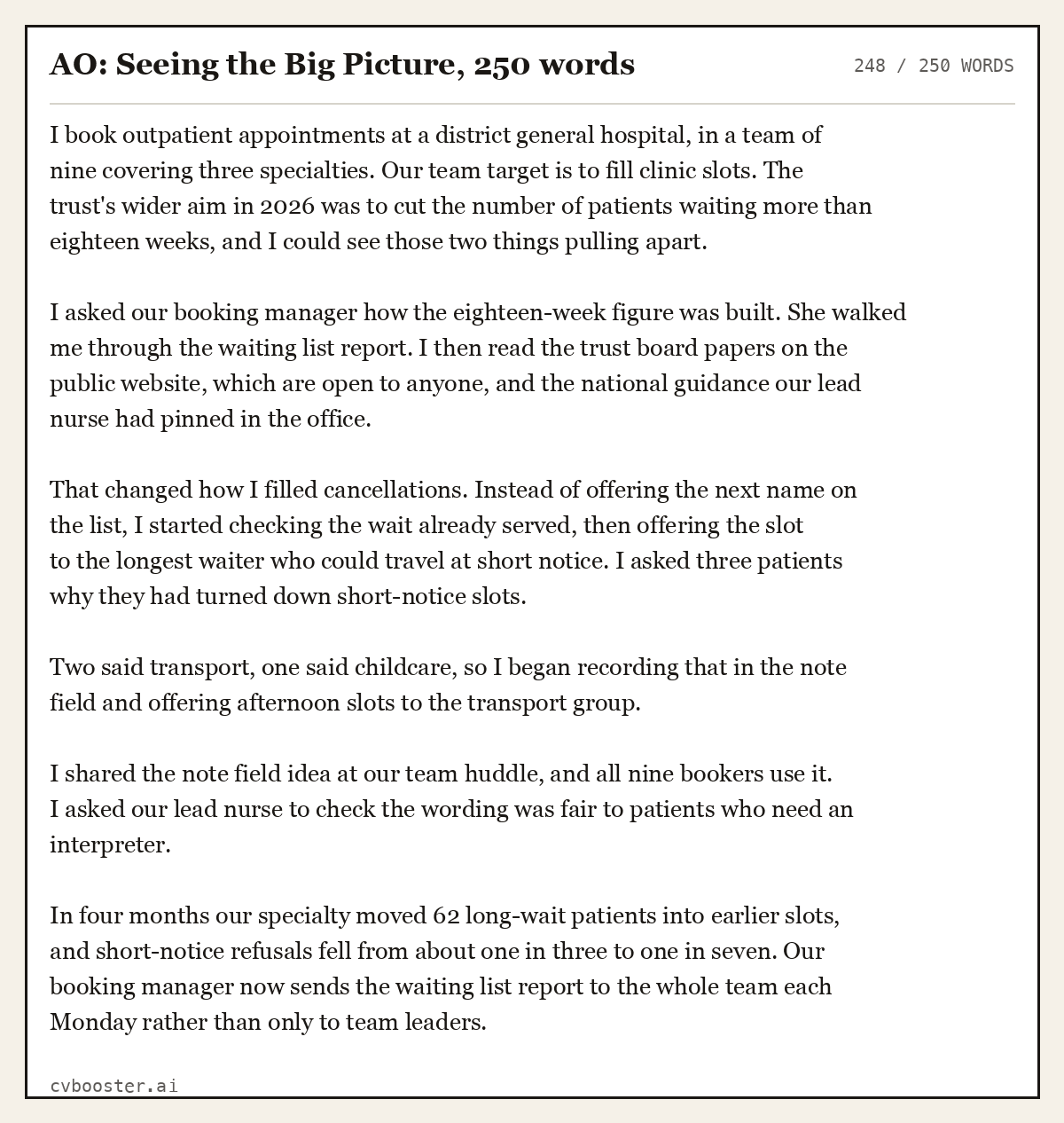
AO: Seeing the Big Picture, 250 words (248 words)
I book outpatient appointments at a district general hospital, in a team of nine covering three specialties. Our team target is to fill clinic slots. The trust's wider aim in 2026 was to cut the number of patients waiting more than eighteen weeks, and I could see those two things pulling apart.
I asked our booking manager how the eighteen-week figure was built. She walked me through the waiting list report. I then read the trust board papers on the public website, which are open to anyone, and the national guidance our lead nurse had pinned in the office.
That changed how I filled cancellations. Instead of offering the next name on the list, I started checking the wait already served, then offering the slot to the longest waiter who could travel at short notice. I asked three patients why they had turned down short-notice slots.
Two said transport, one said childcare, so I began recording that in the note field and offering afternoon slots to the transport group.
I shared the note field idea at our team huddle, and all nine bookers use it. I asked our lead nurse to check the wording was fair to patients who need an interpreter.
In four months our specialty moved 62 long-wait patients into earlier slots, and short-notice refusals fell from about one in three to one in seven. Our booking manager now sends the waiting list report to the whole team each Monday rather than only to team leaders.
What the sifter is scoring
- Indicator quoted: "understand what your responsibilities are and how these contribute to the priorities of your team" (gov.uk, AO). Shown by: naming the local target, the trust's eighteen-week aim, and the tension between them.
- Indicator quoted: "gather information from both inside and outside of the organisation to inform your area of work" (gov.uk, AO). Shown by: the waiting list report, the published board papers, and the national guidance.
- Indicator quoted: "consider the varied impact your work could have on individuals with different needs and from other backgrounds" (gov.uk, AO). Shown by: asking why short-notice slots were refused, then acting on transport and childcare.
- Definition quoted: "Understand how your role fits with and supports organisational objectives" (gov.uk, definition). Shown by: changing how cancellations are filled so the local task serves the trust aim.
Seeing the big picture at HEO grade, annotated
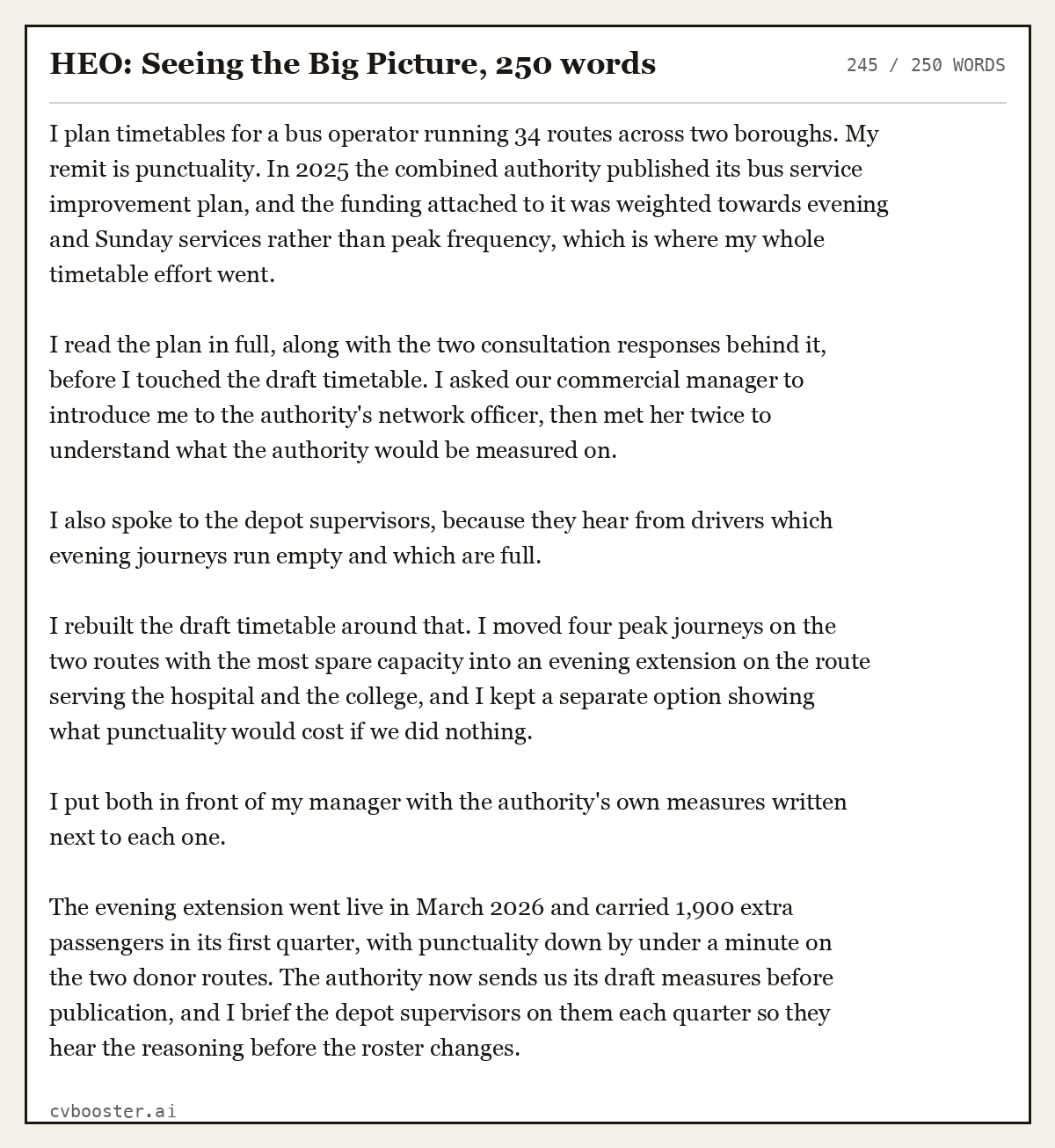
HEO: Seeing the Big Picture, 250 words (245 words)
I plan timetables for a bus operator running 34 routes across two boroughs. My remit is punctuality. In 2025 the combined authority published its bus service improvement plan, and the funding attached to it was weighted towards evening and Sunday services rather than peak frequency, which is where my whole timetable effort went.
I read the plan in full, along with the two consultation responses behind it, before I touched the draft timetable. I asked our commercial manager to introduce me to the authority's network officer, then met her twice to understand what the authority would be measured on.
I also spoke to the depot supervisors, because they hear from drivers which evening journeys run empty and which are full.
I rebuilt the draft timetable around that. I moved four peak journeys on the two routes with the most spare capacity into an evening extension on the route serving the hospital and the college, and I kept a separate option showing what punctuality would cost if we did nothing.
I put both in front of my manager with the authority's own measures written next to each one.
The evening extension went live in March 2026 and carried 1,900 extra passengers in its first quarter, with punctuality down by under a minute on the two donor routes. The authority now sends us its draft measures before publication, and I brief the depot supervisors on them each quarter so they hear the reasoning before the roster changes.
What the sifter is scoring
- Indicator quoted: "understand the strategic drivers for your area of work" (gov.uk, HEO/SEO). Shown by: reading the bus service improvement plan and the consultation responses, and learning what the authority is measured on.
- Indicator quoted: "align activities to contribute to wider organisational priorities" (gov.uk, HEO/SEO). Shown by: moving peak journeys into an evening extension weighted to the funded priority.
- Indicator quoted: "seek out and share experiences to develop knowledge of the team's business area" (gov.uk, HEO/SEO). Shown by: the depot supervisor conversations, and the quarterly briefing back to them.
- Indicator quoted: "remain alert to emerging issues and trends which might impact your work area" (gov.uk, HEO/SEO). Shown by: catching the funding shift at plan stage rather than at contract renewal.
Seeing the big picture at SEO grade, annotated
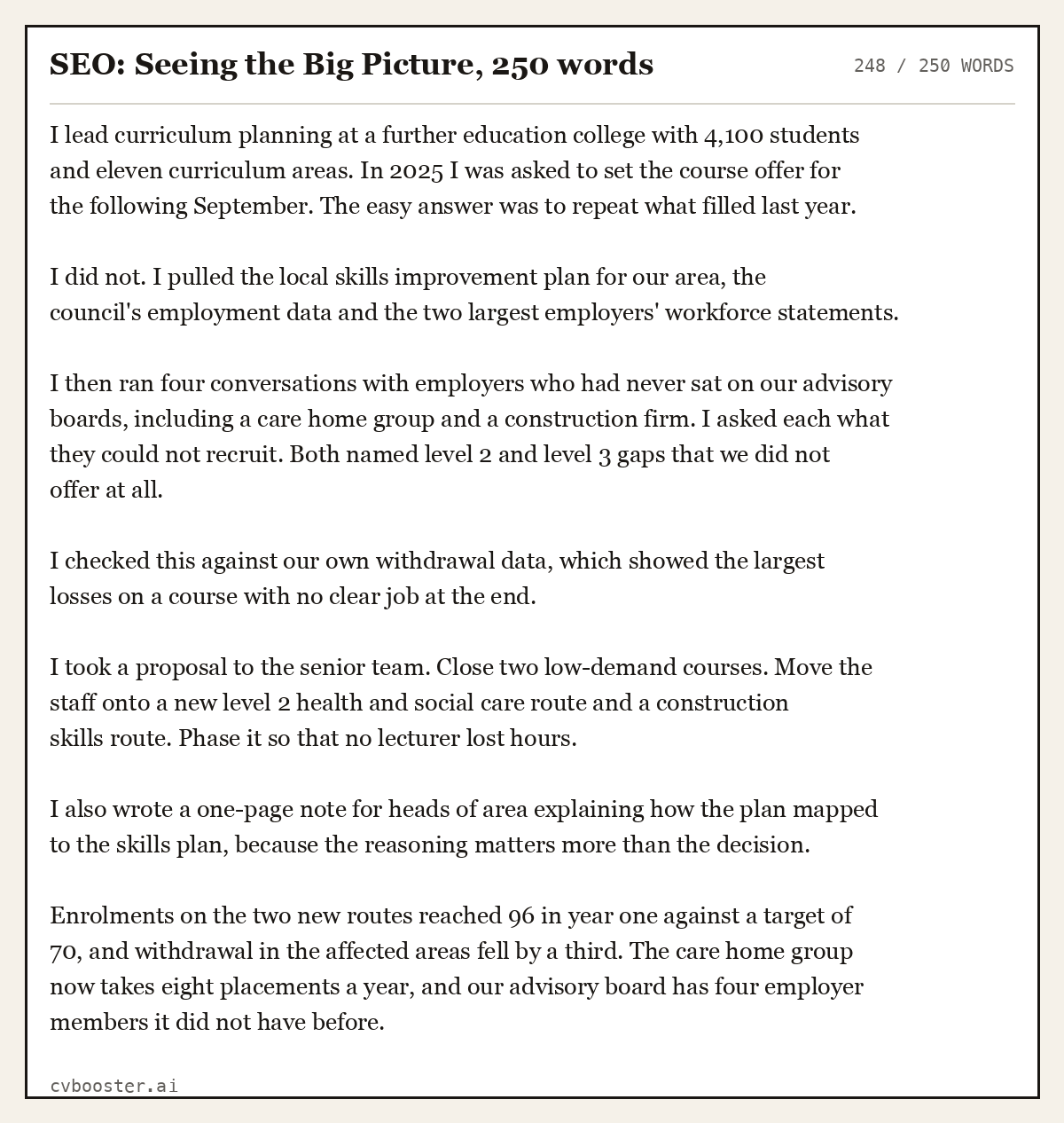
SEO: Seeing the Big Picture, 250 words (248 words)
I lead curriculum planning at a further education college with 4,100 students and eleven curriculum areas. In 2025 I was asked to set the course offer for the following September. The easy answer was to repeat what filled last year.
I did not. I pulled the local skills improvement plan for our area, the council's employment data and the two largest employers' workforce statements.
I then ran four conversations with employers who had never sat on our advisory boards, including a care home group and a construction firm. I asked each what they could not recruit. Both named level 2 and level 3 gaps that we did not offer at all.
I checked this against our own withdrawal data, which showed the largest losses on a course with no clear job at the end.
I took a proposal to the senior team. Close two low-demand courses. Move the staff onto a new level 2 health and social care route and a construction skills route. Phase it so that no lecturer lost hours.
I also wrote a one-page note for heads of area explaining how the plan mapped to the skills plan, because the reasoning matters more than the decision.
Enrolments on the two new routes reached 96 in year one against a target of 70, and withdrawal in the affected areas fell by a third. The care home group now takes eight placements a year, and our advisory board has four employer members it did not have before.
What the sifter is scoring
- Indicator quoted: "understand how the strategies and activities of the team create value and meet the diverse needs of all stakeholders" (gov.uk, HEO/SEO). Shown by: testing the course offer against employer need, withdrawal data and the local skills plan together.
- Indicator quoted: "align activities to contribute to wider organisational priorities" (gov.uk, HEO/SEO). Shown by: the one-page note mapping the new offer to the skills improvement plan.
- Indicator quoted: "remain alert to emerging issues and trends which might impact your work area" (gov.uk, HEO/SEO). Shown by: going to employers who had never sat on an advisory board, not the ones already in the room.
- Indicator quoted: "seek out and share experiences to develop knowledge of the team's business area" (gov.uk, HEO/SEO). Shown by: bringing employer workforce statements back into curriculum planning and onto the advisory board.
Seeing the big picture at Grade 7, annotated
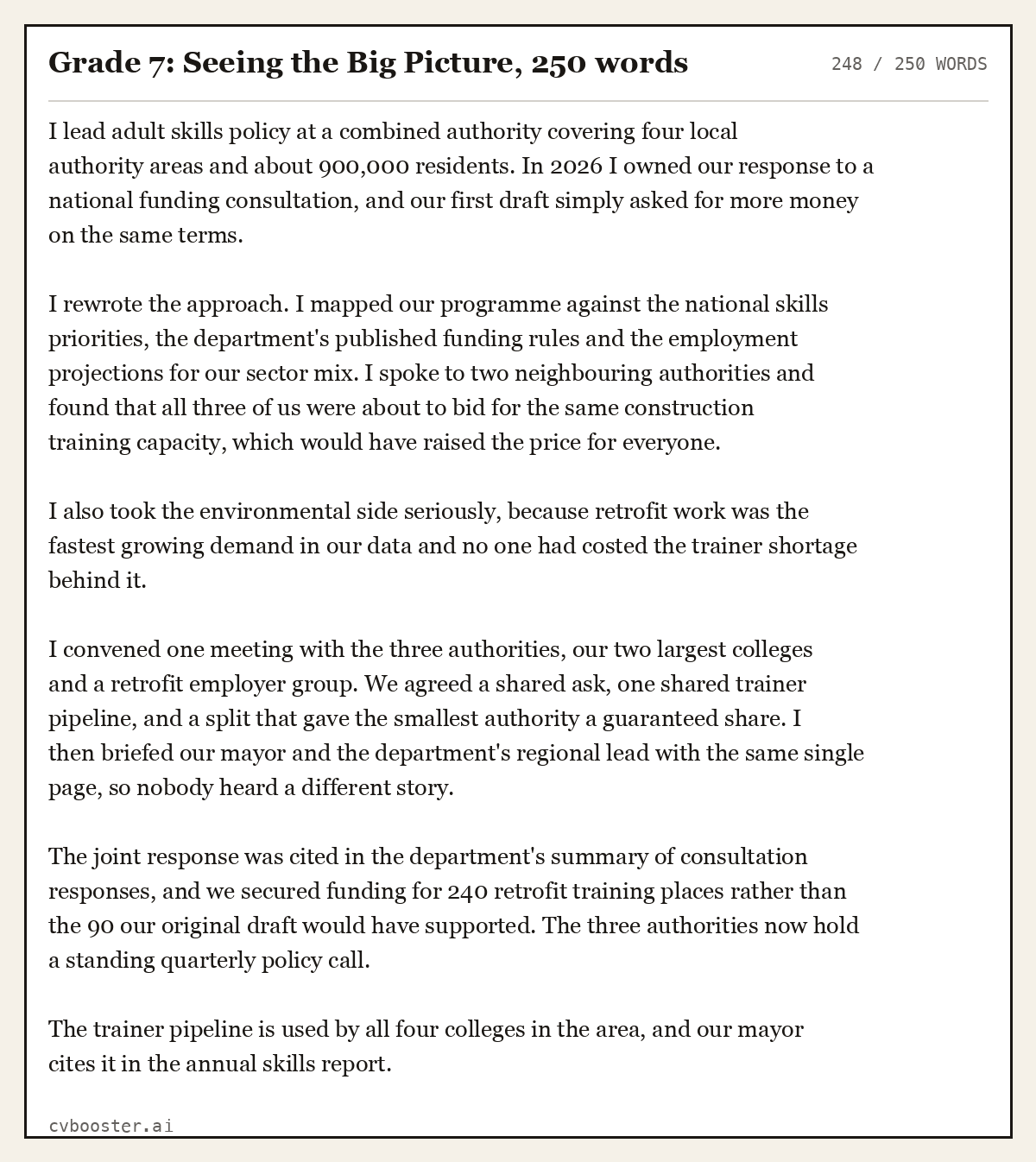
Grade 7: Seeing the Big Picture, 250 words (248 words)
I lead adult skills policy at a combined authority covering four local authority areas and about 900,000 residents. In 2026 I owned our response to a national funding consultation, and our first draft simply asked for more money on the same terms.
I rewrote the approach. I mapped our programme against the national skills priorities, the department's published funding rules and the employment projections for our sector mix. I spoke to two neighbouring authorities and found that all three of us were about to bid for the same construction training capacity, which would have raised the price for everyone.
I also took the environmental side seriously, because retrofit work was the fastest growing demand in our data and no one had costed the trainer shortage behind it.
I convened one meeting with the three authorities, our two largest colleges and a retrofit employer group. We agreed a shared ask, one shared trainer pipeline, and a split that gave the smallest authority a guaranteed share. I then briefed our mayor and the department's regional lead with the same single page, so nobody heard a different story.
The joint response was cited in the department's summary of consultation responses, and we secured funding for 240 retrofit training places rather than the 90 our original draft would have supported. The three authorities now hold a standing quarterly policy call.
The trainer pipeline is used by all four colleges in the area, and our mayor cites it in the annual skills report.
What the sifter is scoring
- Indicator quoted: "develop and maintain an understanding of economic, social, political, environmental and technological developments to ensure activity is relevant" (gov.uk, G6/G7). Shown by: retrofit demand, employment projections and the trainer shortage all being costed into the response.
- Indicator quoted: "adopt a government wide perspective to ensure alignment of activity and policy" (gov.uk, G6/G7). Shown by: mapping the programme to national skills priorities and the department's own funding rules before asking for anything.
- Indicator quoted: "bring together views, perspectives and diverse needs of stakeholders to gain a broader understanding of the issues surrounding policies and activities" (gov.uk, G6/G7). Shown by: the joint meeting with three authorities, two colleges and an employer group, and the guaranteed share for the smallest authority.
- Indicator quoted: "ensure plans and activities in your area of work reflect wider strategic priorities and communicate effectively with senior leaders to influence future strategies" (gov.uk, G6/G7). Shown by: the single page used with both the mayor and the department's regional lead.
The word budget: 40 / 40 / 120 / 50
Each statement above was cut to the same shape. At a 250-word cap it divides like this.
- 40 words on the situation, including the wider aim
- 40 words on the task you owned
- 120 words on your actions, with one named outside source
- 50 words on the result, including the effect beyond your team
Tip: if you delete the sentence naming the wider aim and your statement still makes sense, you have written Delivering at Pace by mistake.
Marks run on a seven-point scale that departments publish and gov.uk does not. COPFS sets out every point of it, and reserves a 6 for evidence that includes "some evidence of exceeding expectations at this level".
What changed between the four
The shape holds. The horizon moves outward.
| Level | Outside source used | What it changed | Who felt it |
|---|---|---|---|
| AO | Board papers and the waiting list report | How cancellations are filled | Patients waiting longest |
| HEO | A published improvement plan and its consultation | Where four journeys run | Evening passengers and depot staff |
| SEO | A local skills plan and employers not yet in the room | Two courses closed, two opened | Students, lecturers, employers |
| Grade 7 | National priorities, funding rules, neighbouring authorities | A joint ask instead of a solo bid | Four areas and a sector |
At AO you learn how your task serves the aim. At HEO you read the document that sets the aim. At SEO you change what your area offers because of it. At Grade 7 you coordinate with people who are not yours, and give something up to do it.
The sentences that cost marks
- Before: I have a good understanding of the organisation's strategic objectives. After: I read the trust board papers on the public website and asked our booking manager how the eighteen-week figure was built.
- Before: I always consider the bigger picture in my work. After: I kept a separate option showing what punctuality would cost if we did nothing, and put both in front of my manager.
- Before: We reviewed our courses in line with local need. After: I asked a care home group and a construction firm what they could not recruit. Both named level 2 gaps we did not offer.
- Before: I liaised with external stakeholders. After: I spoke to two neighbouring authorities and found all three of us were about to bid for the same construction training capacity.
- Before: This aligned with government priorities. After: I mapped the programme against the department's published funding rules before we asked for anything.
- Before: The outcome was very positive for the organisation. After: We secured funding for 240 retrofit places rather than the 90 our original draft would have supported.
Before you submit
- Name one source of information from outside your own team, with its actual name.
- Show the moment the wider priority changed your decision. Without it this is a task story.
- Check the grade. A Grade 7 statement that stops at your own directorate reads as SEO.
- Give the result a reach beyond your team, even if it is small.
- Keep the "national interest" wording out unless your work genuinely touched it. Sifters notice borrowed language.
Then write the other behaviours in the advert. Worked statements sit on the pages for Working Together, Making Effective Decisions, Managing a Quality Service, Delivering at Pace and Communicating and Influencing.
The behaviour statement hub carries one sample for each of the nine. The behaviours framework guide has the level tables. The Success Profiles guide covers the other four elements.
Frequently asked questions
What is seeing the big picture in the Civil Service?
It is one of the nine Civil Service behaviours. The gov.uk wording asks you to understand how your role "fits with and supports organisational objectives" and to keep work "in the national interest". In an application that means three moves: you looked beyond your own task, you used information from outside your team, and that information changed a decision you made.
What is a good example of seeing the big picture at work?
One where an outside document changed a routine choice. The AO statement above is the plainest version: a booking clerk reads published board papers, learns how the eighteen-week figure is built, and changes which patient gets the next cancelled slot. The behaviour shows in the change of method, not in the reading.
How do you show this behaviour at HEO and Grade 7?
At HEO you read the document that sets the aim and realign your own area to it, which is the level wording published in the behaviours framework PDF. At Grade 7 you take a government wide view and coordinate with people who do not report to you, usually giving something up to do it. A Grade 7 answer that stops at your own directorate reads as HEO and scores as one.
How long should Civil Service behaviour be?
As long as the advert says, and no longer. 250 words per behaviour is the most common limit, with 100 and 750 also used. The application box usually cuts you off mid-sentence at the cap. Write to within ten words of it, because each behaviour is scored on its own and unused words earn nothing.
What evidence counts for this behaviour?
Anything with a source you can name: a published plan, a regulator's report, a consultation, a supplier, a customer forum, a colleague in another team. The Success Profiles guidance also accepts evidence from outside paid work, including volunteering and hobbies. What does not count is a summary of your employer's strategy with no decision attached to it.
More in this series: Civil Service applications
- Civil Service Behaviours Framework: All 9, Level by Level
- Civil Service Behaviours: 9 Examples, One Per Behaviour
- Civil Service Judgement Test: 8 Questions and Answers
- Civil Service Success Profiles: the Five Elements, Explained
- Communicating and Influencing: 4 Civil Service Examples
- Delivering at Pace: 4 Civil Service Examples, EO to G7
- Making Effective Decisions: 4 Civil Service Examples
- Managing a Quality Service: 4 Worked Examples, EO to G7
- Working Together Civil Service Example: AO to Grade 7
Related articles
- Civil Service Behaviours Framework: All 9, Level by Level
- Working Together Civil Service Example: AO to Grade 7
- Civil Service Behaviours: 9 Examples, One Per Behaviour
- Civil Service Interview Questions and 15 Full Answers
More articles
- Selection Criteria Examples: 10 Full 250-Word Responses
- Selection Criteria Examples Administration: 3 Answers
- Selection Criteria Examples Nursing: 3 Full Responses
Looking for a worked example for your job title? Browse the resume examples by job title.