Security Guard Interview Questions and Answers to Print
By Mustafa Tarabya, founder of CVBooster · Published · Updated
8 min read
Security guard interview questions test whether you will observe, report and follow post orders when nobody is watching you, and the best answers describe the steps you would take in order, ending with the report you would write. The constraint is that a guard works under state rules: the BLS says "Most states require that security guards be licensed by the state in which they work." Below are the questions most security guard interviews ask, checked in October 2026, with five full sample answers tagged for first-time and experienced guards, quick answers for the phone screen, and the questions to ask back. Every answer on this page can be copied into your notes or printed with your browser's print command; there is no separate PDF to download. Written by Mustafa Tarabya, who hired for his own company, read every application himself and now writes CVBooster's guides.
The interviewer will describe a stranger who follows an employee through a locked door. You will want to say you would stop him. The better answer is slower and longer, and it ends with a report.
1. Tell me about yourself
Keep it to four sentences: your current work, the part of it that looks like security, your license or training, and why this site.
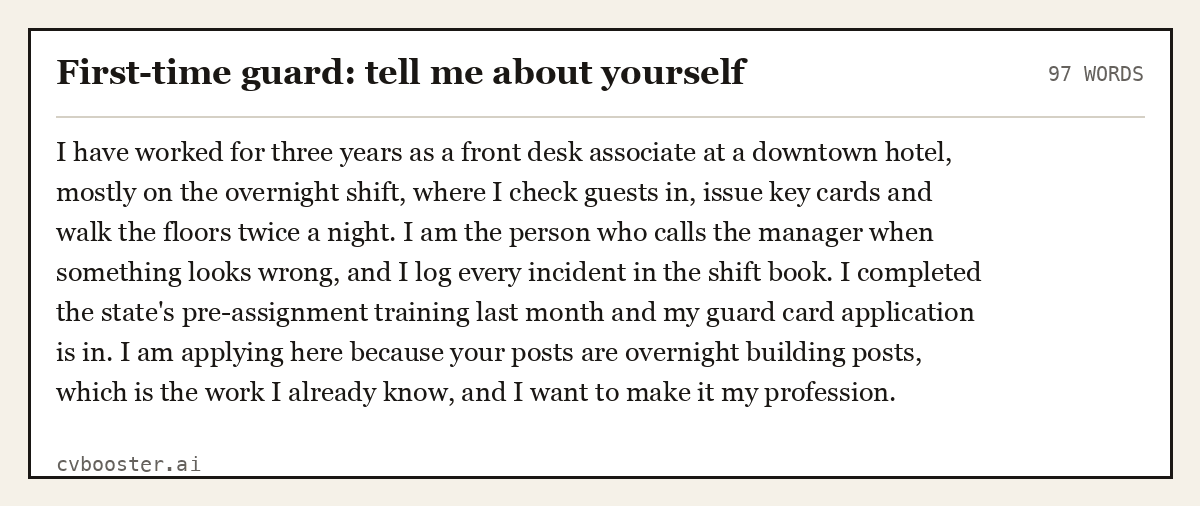
First-time guard: tell me about yourself (97 words)
I have worked for three years as a front desk associate at a downtown hotel, mostly on the overnight shift, where I check guests in, issue key cards and walk the floors twice a night. I am the person who calls the manager when something looks wrong, and I log every incident in the shift book. I completed the state's pre-assignment training last month and my guard card application is in. I am applying here because your posts are overnight building posts, which is the work I already know, and I want to make it my profession.
2. Someone without a badge follows an employee through the door. What do you do?
This is the access control question, and almost every security guard interview asks a version of it. O*NET lists the task directly: guards "Monitor and authorize entrance and departure of employees, visitors, and other persons to guard against theft and maintain security of premises."
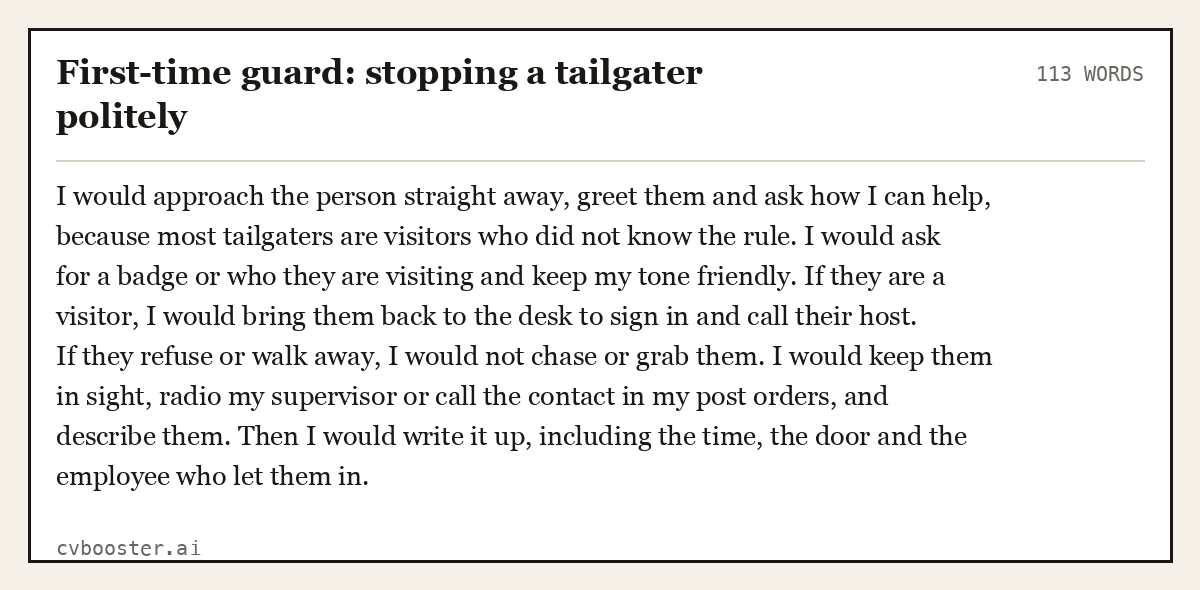
First-time guard: stopping a tailgater politely (113 words)
I would approach the person straight away, greet them and ask how I can help, because most tailgaters are visitors who did not know the rule. I would ask for a badge or who they are visiting and keep my tone friendly. If they are a visitor, I would bring them back to the desk to sign in and call their host. If they refuse or walk away, I would not chase or grab them. I would keep them in sight, radio my supervisor or call the contact in my post orders, and describe them. Then I would write it up, including the time, the door and the employee who let them in.
3. You see someone stealing. What happens next?
The interviewer is listening for observe and report. Unless your post orders, the written instructions for your site, say otherwise, a guard is not there to wrestle someone over merchandise.
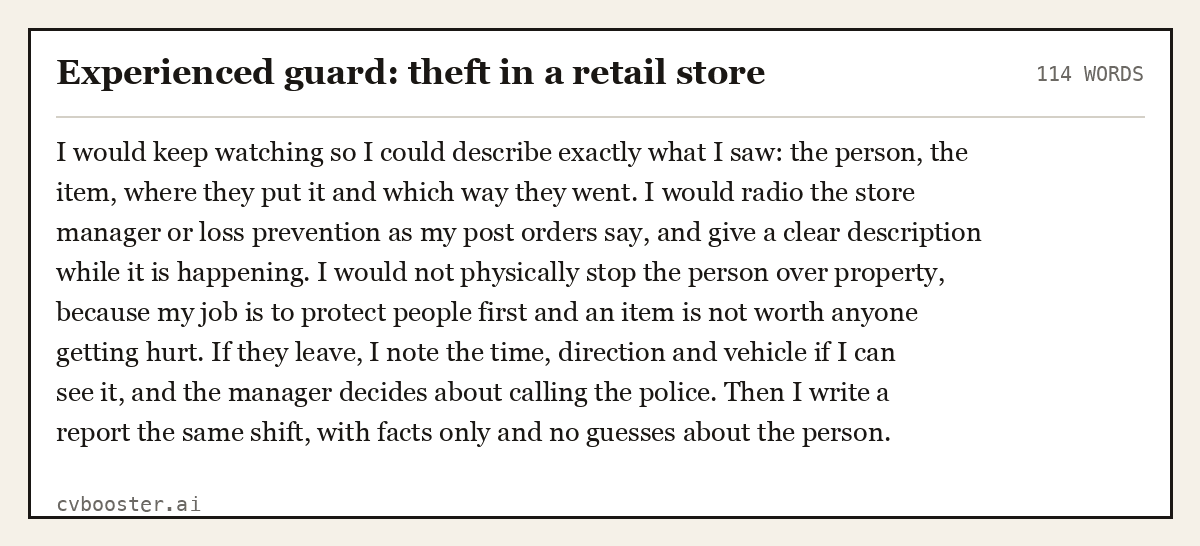
Experienced guard: theft in a retail store (114 words)
I would keep watching so I could describe exactly what I saw: the person, the item, where they put it and which way they went. I would radio the store manager or loss prevention as my post orders say, and give a clear description while it is happening. I would not physically stop the person over property, because my job is to protect people first and an item is not worth anyone getting hurt. If they leave, I note the time, direction and vehicle if I can see it, and the manager decides about calling the police. Then I write a report the same shift, with facts only and no guesses about the person.
4. How do you handle a fight or an aggressive visitor?
Show that you de-escalate first, call for help early and keep yourself and others safe. O*NET includes the duty to "Warn persons of rule infractions or violations, and apprehend or evict violators from premises, using force when necessary", and the interviewer wants to hear that force is the last step, used only within your training and the law.
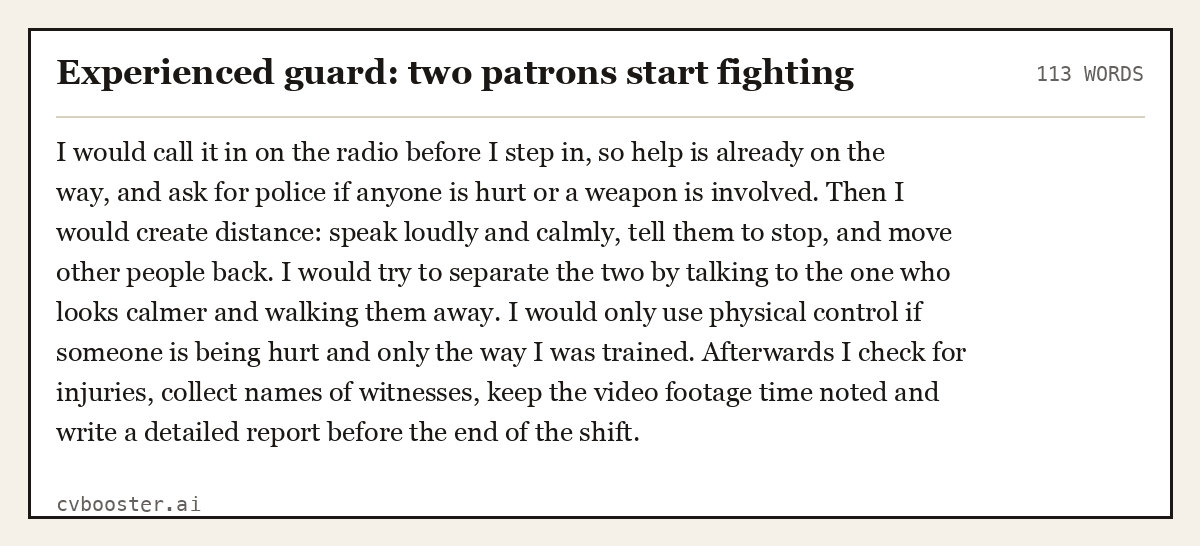
Experienced guard: two patrons start fighting (113 words)
I would call it in on the radio before I step in, so help is already on the way, and ask for police if anyone is hurt or a weapon is involved. Then I would create distance: speak loudly and calmly, tell them to stop, and move other people back. I would try to separate the two by talking to the one who looks calmer and walking them away. I would only use physical control if someone is being hurt and only the way I was trained. Afterwards I check for injuries, collect names of witnesses, keep the video footage time noted and write a detailed report before the end of the shift.
5. Tell me about a report you wrote
Report writing decides whether a guard keeps a contract. O*NET's task list says guards "Write reports of daily activities and irregularities, such as equipment or property damage, theft, presence of unauthorized persons, or unusual occurrences." Supervisors hiring for a lead role ask this one most.
Senior guard: lead officer on report quality (119 words)
At my current site I review every incident report before it goes to the client, so I care about this one. A good report answers who, what, where, when and what action was taken, in that order, with times from the log and no opinions. Last winter a pipe burst in a stairwell on my shift. My report gave the time I found it, the photos, the valve I closed under the engineer's instructions on the phone, who I called and when they arrived. The property manager used it for the insurance claim without asking a single follow-up question. I train new officers by having them rewrite one of their reports with me until every line is a fact.
Security guard interview questions with quick answers
Contract security companies often run a short phone screen before the interview. These are the one line answers to open with; the full answer follows if they ask.
- Do you have a guard card or license? Say yes and the state, or say where you are in the process and when you expect it.
- Can you work nights, weekends and holidays? Name exactly which, because the scheduler is filling posts as you talk.
- Can you stand or walk for a full shift? Yes, and mention the patrol work you already do.
- What would you do if the fire alarm went off? Follow the post orders: call it in, help evacuate, meet the fire department and point them to the panel.
- What would you do if you found a door propped open at night? Check the area, secure the door, log it and report it.
- Why do you want to be a security guard? One reason about protecting people and property, one about the type of site, one about reliability.
- Have you had first aid or CPR training? Name the course and when you took it. O*NET lists responding "to medical emergencies by administering basic first aid or by obtaining assistance from paramedics."
What interviewers score in a security guard interview
| Area | What they listen for | Where the duty comes from |
|---|---|---|
| Access control | Polite challenge, sign in, escalate, report | O*NET security guard tasks |
| Observe and report | Description first, no chasing over property | Post orders and company policy |
| Use of force | De-escalation first, force only as trained | O*NET tasks and state training |
| Report writing | Who, what, where, when, action, facts only | O*NET security guard tasks |
| Licensing and training | Guard card, first aid, armed qualification if needed | BLS licensing summary |
The BLS explains what training usually covers: "Employer-provided training typically covers emergency procedures, crime prevention, and proper communication." If you are new, say which of those you have done in another job; a hotel night shift, a stadium event or a retail closing shift all count. Read the BLS security guards profile and the O*NET security guard task list the night before, because interviewers often turn those tasks into scenario questions.
Questions to ask at the end
CareerOneStop's advice on common interview questions applies here: "Most interviewers ask if you have any questions. Have some ready to show your interest in the role and company."
- What does the post look like: fixed post, patrols or both?
- Who do I call first on this site when something happens at night?
- How are post orders shared, and how often are they updated?
- What training do new officers get before the first shift?
- How are schedules made, and how much notice do officers get?
For the application itself, the security guard resume page has a full sample, and the security guard cover letter page has letters for first-time and experienced guards. For scenario questions in other jobs, see situational interview questions, and for the morning of the interview, what to bring to an interview. Some contract companies interview with a site supervisor and an account manager together, and the panel interview questions guide shows how to answer two people at once.
Frequently asked questions
What questions are asked in a security guard interview?
Expect scenario questions on access control, theft, fights, alarms and medical emergencies, plus questions about your license, availability for nights and weekends, and report writing. Many interviews start with "tell me about yourself" and "why do you want to be a security guard". Answer scenarios step by step and end with the report you would write.
Is there a security guard interview questions and answers PDF?
There is no PDF to download here, but every question and sample answer on this page can be copied into your own notes or printed with your browser's print command. Printing the five full answers and the quick answer list gives you a one page study sheet for the night before the interview.
How do I answer "why do you want to be a security guard"?
Give one reason about the work, such as protecting people and keeping a site calm, one about the type of site you want, and one fact that shows you are reliable, such as a clean attendance record or overnight experience. Avoid saying the job is easy or quiet, because interviewers hear that as a warning sign.
What should I say if I have no security experience?
Use jobs where you watched a space, followed procedures and dealt with people: retail closing shifts, hotel front desk, event staff, the military or customer service. Name the procedures you followed and the incidents you reported. Then say where you are with your state license and training, since most states require a guard card.
What should I wear to a security guard interview?
Wear neat business casual: pressed trousers, a collared shirt and clean, closed shoes, with a tidy appearance overall. The interviewer is imagining you in uniform at their client's front desk, so looking organized matters more than looking formal. Bring your license, ID and any training certificates in a folder.
Related articles
- Case Manager Interview Questions: 7 Answers That Score
- Creative Interview Questions With 6 Sample Answers
- Critical Care Nursing Interview Questions and 9 Answers
- ED Nurse Interview Questions With 9 Full Sample Answers
More articles
- Seeing the Big Picture Civil Service Example: AO to G7
- Selection Criteria Examples: 10 Full 250-Word Responses
- Selection Criteria Examples Administration: 3 Answers
Looking for a worked example for your job title? Browse the resume examples by job title.