CNA Salary, Career Path and CV
By CVBooster TeamPublished Updated
The median CNA salary in the United States is $42,260 a year, or $20.32 an hour, according to the U.S. Bureau of Labor Statistics (BLS), OEWS May 2025. That is the national middle: states, employers and hours move it, and BLS publishes nothing by years of experience. BLS counts CNAs in the occupation nursing assistants. Its OOH page also covers orderlies, but every pay figure here is for nursing assistants alone. The training is short and the offer usually comes as an hourly rate, so the setting and the shift pattern decide more of your yearly pay than you might expect.
Below: a check of your own pay, the pay percentiles, hourly pay, pay in every state, the top-paying metro areas, what CNAs do, how to become a CNA, the skills that go on a CV, and a CV example.
- Median annual pay
- $42,260
- Median hourly pay
- $20.32
- Employed, May 2025
- 1,448,910
Am I underpaid as a CNA?
Pick your state and type your pay. You get your place in the BLS pay range for CNAs there, as a percentile.
CNA salary in the United States
The BLS counts CNAs in the occupation Nursing Assistants (SOC 31-1131). Half of them earn less than $42,260 a year and half earn more. The average, which a few very high earners pull up, is $42,700. The lowest-paid tenth earn $33,940 or less, and the highest-paid tenth earn $51,980 or more, which is about 1.5 times as much. The ratio is our arithmetic on two BLS figures.
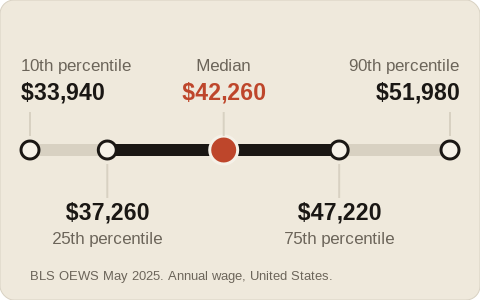
| Measure | Annual wage |
|---|---|
| 10th percentile | $33,940 |
| 25th percentile | $37,260 |
| Median (50th) | $42,260 |
| Mean (average) | $42,700 |
| 75th percentile | $47,220 |
| 90th percentile | $51,980 |
Source: U.S. Bureau of Labor Statistics, Occupational Employment and Wage Statistics (OEWS), May 2025, Nursing Assistants, retrieved 23 to 25 November 2026 from the BLS OEWS May 2025 national, state and metropolitan area files.
CNA hourly pay
The median hourly wage for CNAs is $20.32, as published by BLS for May 2025. That is the hourly view of the same national middle as the $42,260 annual median above, so use it when an employer quotes you a rate and not a salary. Annual pay for a job with part-time or shift work depends on the hours you are given, which no national table can tell you.
| Measure | Per hour |
|---|---|
| 10th percentile | $16.32 |
| 25th percentile | $17.91 |
| Median (BLS hourly figure) | $20.32 |
| 75th percentile | $22.70 |
| 90th percentile | $24.99 |
For CNAs the median is the hourly wage BLS publishes. The other rows are our division of the BLS annual percentiles by 2,080 hours, the full-time year BLS uses to turn hourly pay into annual pay.
CNA salary by state
Where you work changes the number more than most things. The highest median is in Oregon, at $49,830. The lowest published median is in Louisiana, at $30,510, a gap of $19,320 a year between two states. The gap is our subtraction of two BLS state medians. All figures below are the annual median wage in each state for May 2025.
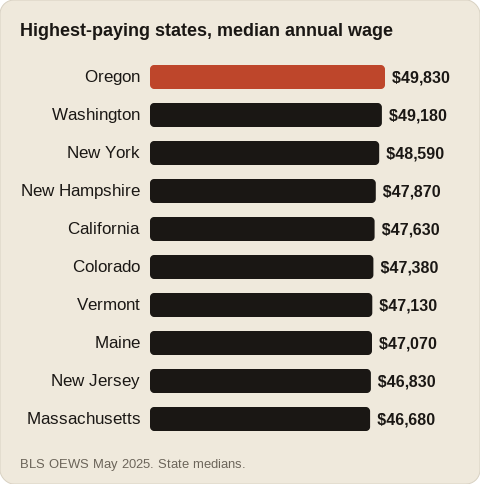
Top-paying states for CNAs
| Rank | State | Median wage | vs US median |
|---|---|---|---|
| 1 | Oregon | $49,830 | +$7,570 |
| 2 | Washington | $49,180 | +$6,920 |
| 3 | New York | $48,590 | +$6,330 |
| 4 | New Hampshire | $47,870 | +$5,610 |
| 5 | California | $47,630 | +$5,370 |
| 6 | Colorado | $47,380 | +$5,120 |
| 7 | Vermont | $47,130 | +$4,870 |
| 8 | Maine | $47,070 | +$4,810 |
| 9 | New Jersey | $46,830 | +$4,570 |
| 10 | Massachusetts | $46,680 | +$4,420 |
CNA salary in all 50 states
| State | Median annual wage |
|---|---|
| Oregon | $49,830 |
| Washington | $49,180 |
| New York | $48,590 |
| New Hampshire | $47,870 |
| California | $47,630 |
| Colorado | $47,380 |
| Vermont | $47,130 |
| Maine | $47,070 |
| New Jersey | $46,830 |
| Massachusetts | $46,680 |
| Minnesota | $46,680 |
| Rhode Island | $46,440 |
| Alaska | $46,370 |
| Illinois | $45,960 |
| North Dakota | $45,820 |
| Nevada | $45,490 |
| Hawaii | $45,350 |
| Wisconsin | $45,130 |
| Connecticut | $44,790 |
| Arizona | $44,780 |
| Pennsylvania | $44,590 |
| Maryland | $43,240 |
| Virginia | $43,200 |
| Delaware | $42,030 |
| Montana | $40,900 |
| Nebraska | $40,000 |
| Utah | $39,840 |
| Michigan | $39,570 |
| New Mexico | $39,390 |
| Iowa | $39,350 |
| Wyoming | $39,160 |
| Ohio | $39,010 |
| South Dakota | $38,800 |
| Idaho | $38,650 |
| North Carolina | $38,460 |
| Kentucky | $38,370 |
| Indiana | $38,330 |
| Kansas | $38,010 |
| Tennessee | $37,990 |
| Georgia | $37,680 |
| Missouri | $37,680 |
| Florida | $37,510 |
| Texas | $37,500 |
| South Carolina | $37,220 |
| West Virginia | $36,720 |
| Oklahoma | $35,930 |
| Arkansas | $34,430 |
| Alabama | $34,140 |
| Mississippi | $31,520 |
| Louisiana | $30,510 |
Top-paying metro areas for CNAs
| Metro area | Median wage | Employed |
|---|---|---|
| San Jose-Sunnyvale-Santa Clara, CA | $56,840 | 5,350 |
| San Francisco-Oakland-Fremont, CA | $56,080 | 11,790 |
| Seattle-Tacoma-Bellevue, WA | $51,990 | 16,530 |
| Napa, CA | $50,370 | 460 |
| Portland-Vancouver-Hillsboro, OR-WA | $50,350 | 8,890 |
| Bend, OR | $50,080 | 620 |
| Boulder, CO | $49,860 | 1,030 |
| Grants Pass, OR | $49,770 | 420 |
| New York-Newark-Jersey City, NY-NJ | $49,270 | 79,480 |
| Santa Rosa-Petaluma, CA | $49,240 | 1,250 |
BLS publishes the CNA median for 385 metro areas; the national median is $42,260. Source: U.S. Bureau of Labor Statistics, OEWS May 2025, metropolitan area estimates.
Compare CNA pay
Put two states side by side, or set CNAs next to another job. Every figure is from BLS OEWS May 2025.
| Measure | Oregon | Louisiana |
|---|---|---|
| Median annual wage | $49,830 | $30,510 |
| Median hourly wage | $23.96 | $14.67 |
| 10th percentile | $43,210 | $27,980 |
| 25th percentile | $47,480 | $29,070 |
| 75th percentile | $59,080 | $35,100 |
| 90th percentile | $61,310 | $37,390 |
| Employed, May 2025 | 14,800 | 20,690 |
The Oregon median is $19,320 a year higher. That difference is our subtraction of two BLS state medians. n/a means this page has only the BLS median for that state so far, or BLS released no figure for it. Source: BLS OEWS May 2025, Nursing Assistants.
Starting pay for CNAs
BLS does not publish pay by years of experience, so nobody can honestly quote an official entry-level CNA salary. What the data gives is the bottom of the market. One in ten CNAs earns $33,940 or less, and one in four earns $37,260 or less. Read those as the low end of the national range, not as what a new graduate will be offered, because older workers sit in the bottom tenth too.
Which employers pay nursing assistants the most
BLS publishes medians for nursing assistants in their five biggest industries, and the order is not the one most people guess. Government, excluding state and local education and hospitals, leads at $47,050. Nursing care facilities come next at $43,000, then hospitals at $42,310, continuing care retirement communities and assisted living at $39,490, and home healthcare services at $38,040.
So the skilled nursing facility edges out the hospital, by $690 a year at the median by our subtraction, and it is the bigger employer too, with 36 percent of nursing assistants against 32 percent. Government work pays best but holds only 3 percent of the jobs. BLS does not say why the settings pay what they do, so use the order as a starting point and weigh the real offers in front of you.
The federal training rules behind the CNA title
States run CNA training and testing, but federal rules for long-term care facilities set the minimum every state program has to meet. Under federal rule 42 CFR 483.152, a state-approved nurse aide training program must be no less than 75 clock hours, with at least 16 hours of supervised practical training under a registered nurse or a licensed practical nurse. The same rule asks for at least 16 hours of training in areas such as communication, infection control and safety before a trainee has any direct contact with a resident.
Under federal rule 42 CFR 483.35, a facility may not use someone as a nurse aide for more than 4 months full time unless that person is competent and has completed a state-approved training and competency evaluation program or competency evaluation program. You can start as a trainee, in other words, but not stay one.
Federal rule 42 CFR 483.35 also covers a gap in work. If 24 consecutive months go by with no paid nursing or nursing-related work since your last program, you need a new training and competency evaluation program or a new competency evaluation. States can add their own rules on top, so check with your state registry before you plan a break.
Turning an hourly CNA offer into a yearly figure
Most CNA jobs are offered by the hour. For a full-time year, multiply the rate by 2,080 hours. At the national median of $20.32 that is $42,266, in line with the $42,260 annual median BLS publishes. If the schedule is three 12-hour shifts a week, the week is 36 hours and the year 1,872 hours, so the same median rate comes to $38,039 before any overtime.
Before you compare two offers, ask whether the night or weekend differential is already inside the quoted base rate or paid on top of it. BLS publishes no data on shift differentials, so only the employer can answer that, and nights, weekends and holidays are a normal part of this job.
Related jobs
- LPN salary and career path: Licensed practical and vocational nurses supervise nursing assistants day to day, and BLS lists them as a similar occupation.
- Registered Nurse salary and career path: Registered nurses also supervise CNAs, and the job is on the BLS list of similar occupations.
- Medical Assistant salary and career path: On the BLS similar list as well, a job that also measures patients' vital signs.
What CNAs do
Nursing assistants, also called nursing aides, give basic care and help patients with the activities of daily living, such as eating, bathing and dressing. Certified Nursing Assistant, or CNA, is the title some states give an aide who has passed the state competency exam, and BLS notes that the title differs from state to state.
They work on a healthcare team under licensed practical or vocational nurses and registered nurses. In nursing and residential care facilities they are often the principal caregivers, and because some residents stay for months or years, aides tend to know them well.
Duties BLS lists
- Clean and bathe patients
- Help patients use the toilet and get dressed
- Turn and reposition patients, and transfer them between beds and wheelchairs
- Listen to patients' health concerns, record them and report them to the nurses
- Measure vital signs such as blood pressure and temperature
- Serve meals and help patients eat
- In some states, with the right training level, dispense medication
A typical day
Most of a CNA shift is hands-on care: bathing residents, helping them dress and use the toilet, turning people in bed and moving them to and from wheelchairs, and serving meals to those who need help eating. Between rounds come vital signs, and noting any health concern a patient raises so the nurse hears about it. You are on your feet most of the time and lifting people is routine, which is why aides are trained in how to lift safely.
Where they work
- Nursing care facilities (skilled nursing facilities) employed 36 percent of nursing assistants, hospitals 32 percent, continuing care retirement communities and assisted living 11 percent, home healthcare services 5 percent and government 3 percent.
- BLS says nursing assistants and orderlies have one of the highest rates of injuries and illnesses of all occupations, largely from moving patients and other physically demanding tasks.
- Most work full time and some part time. Nursing homes and hospitals give care at all hours, so nights, weekends and holidays come with the job.
- An aide who has passed the competency exam is placed on the state registry, and only aides on the registry can work in a nursing home.
Source: U.S. Bureau of Labor Statistics, Occupational Outlook Handbook, Nursing Assistants and Orderlies, read 25 November 2026. BLS counted about 1,505,900 jobs in 2025 and projects 3% growth from 2025 to 2035, about as fast as the average for all occupations.
How to become a CNA: the career path
Typical entry-level education, according to BLS: a state-approved education program. BLS gives no program length. It says nursing assistants finish a state-approved program, pass the state competency exam to get on the registry, and then learn the employer's own policies in a brief period of on-the-job training. Each step below comes from the BLS Occupational Outlook Handbook, and the last step is the pay.
- 1Train
State-approved nursing assistant program
The program combines instruction in the principles of nursing with supervised clinical work. BLS lists high schools, community colleges, vocational and technical schools, hospitals and nursing homes as places that offer one.
- 2Certify
Pass the state competency exam
Passing lets you use the state title, CNA in some states, and puts you on the state registry. Some states also require continuing education or a criminal background check, so check with your state certifying agency.
- 3Start
Learn the employer's procedures
New nursing assistants typically go through a brief period of on-the-job training on that employer's policies and procedures.
- 4Work
Nursing homes and hospitals
Skilled nursing facilities and hospitals together employ about two thirds of nursing assistants. Assisted living, home healthcare and government follow.
- 5Credential
Certified Medication Assistant (CMA)
In some states nursing assistants can add credentials such as Certified Medication Assistant. A CMA may dispense medications.
- 6Pay
Median $42,260 a year
BLS median annual wage for CNAs. The lowest-paid tenth earn $33,940 or less and the highest-paid tenth earn $51,980 or more.
Steps 1 to 5 for CNAs: U.S. Bureau of Labor Statistics, Occupational Outlook Handbook, Nursing Assistants and Orderlies, "How to Become One", read 25 November 2026. Pay step: U.S. Bureau of Labor Statistics, OEWS May 2025.
CNA skills and certifications
These come from the CVBooster CNA resume guide, which lists what employers look for on a CNA CV. Put the ones you really have near the top of your CV, in the words the job ad uses.
Core skills
People skills
Licenses and certifications
- Certified Nursing Assistant (CNA), State nurse aide registry
- Basic Life Support (BLS), American Heart Association
- Certified Medication Aide, State board of nursing
- Certified Dementia Practitioner (CDP), National Council of Certified Dementia Practitioners
CNA salary questions
How much does a CNA make a year?
Nursing assistants have a national median of $42,260 a year and a mean of $42,700, from BLS OEWS for May 2025. The lowest-paid tenth earn $33,940 or less, and the top tenth $51,980 or more. The state tables above show how much the figure moves with location.
How much do CNAs make an hour?
The median hourly wage for nursing assistants is $20.32. Worked over a full-time year of 2,080 hours that is $42,266, by our multiplication. BLS does not publish night, weekend or overtime rates, so ask how those are paid before you accept.
Do hospitals pay CNAs more than nursing homes?
Not at the median. BLS puts nursing assistants in nursing care facilities at $43,000 and those in hospitals at $42,310, for May 2025. Government jobs, excluding state and local education and hospitals, were highest at $47,050, and home healthcare services lowest of the five at $38,040.
How many hours of training does a CNA need?
Under federal rule 42 CFR 483.152, a state-approved nurse aide training program must be no less than 75 clock hours, including at least 16 hours of supervised practical training. That is the floor, and states set their own programs on top of it, so the hours where you live can be higher.
Can I work as a nurse aide before I am certified?
For a short time. Under federal rule 42 CFR 483.35, a facility may not use anyone as a nurse aide for more than 4 months full time unless they are competent and have completed a state-approved training and competency evaluation program or competency evaluation program.
Does CNA certification lapse if I stop working?
It can. Under federal rule 42 CFR 483.35, after 24 consecutive months without paid nursing or nursing-related work since your last program, you need a new training and competency evaluation program or a new competency evaluation. Your state registry may have further rules, such as continuing education.
Sources and method
- Pay: U.S. Bureau of Labor Statistics, Occupational Employment and Wage Statistics (OEWS), May 2025, Nursing Assistants (SOC 31-1131), national, state and metro area estimates, retrieved 23 to 25 November 2026 from the BLS OEWS May 2025 national, state and metropolitan area files. Wages are before tax. BLS defines what its wage figure includes and leaves out in the OEWS technical notes.
- The job, the route in and the outlook: U.S. Bureau of Labor Statistics, Occupational Outlook Handbook, Nursing Assistants and Orderlies, read 25 November 2026.
- Skills and certifications: the CVBooster CNA resume guide.
- Where we subtract or divide two BLS figures on this CNA page, the page says so. The pay check is an estimate between the published BLS percentiles for CNAs and says so. Nothing else here is estimated.
CNA CV example
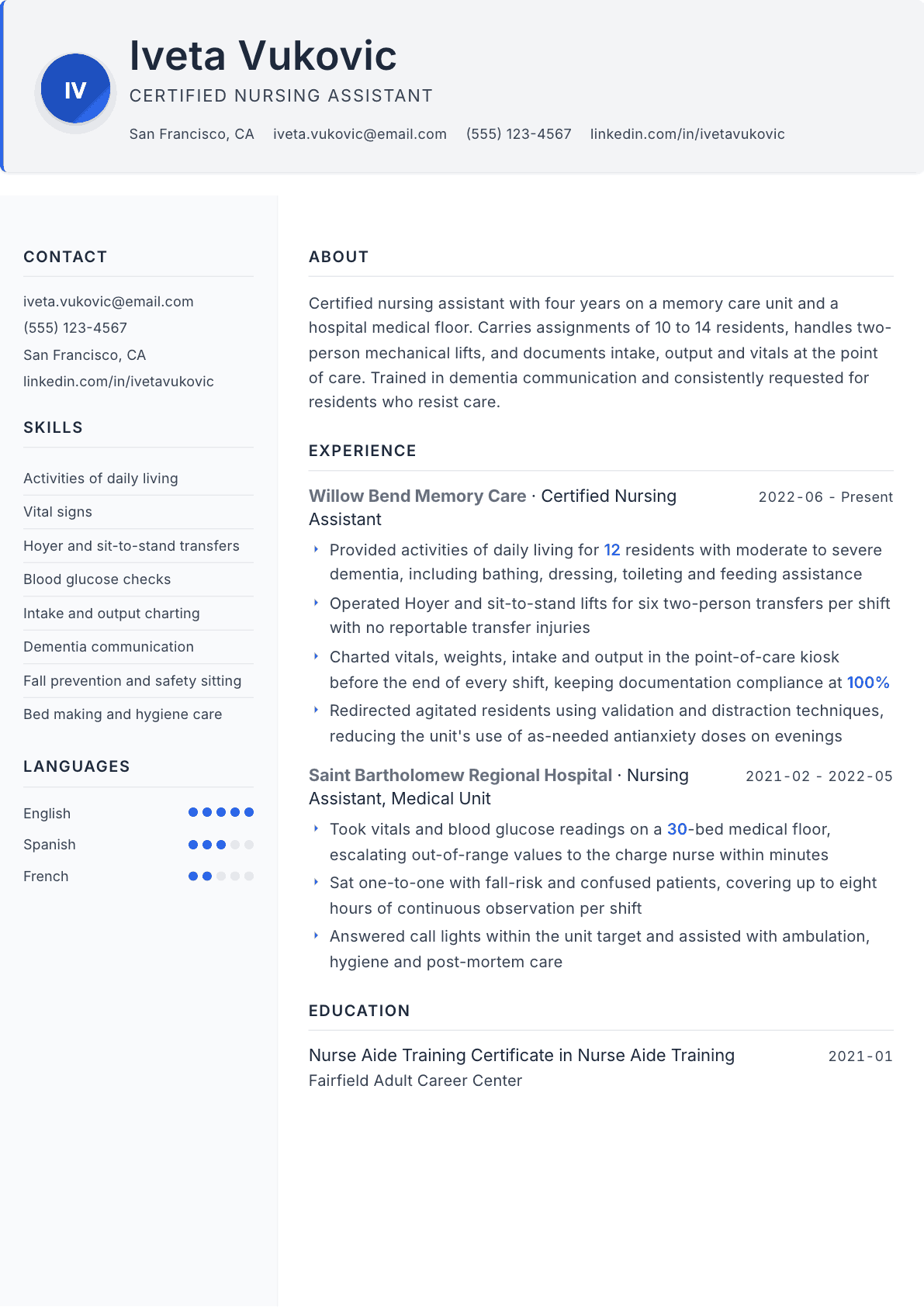
The CVBooster CNA resume guide has a finished example, three written summaries, before and after bullets and answers to the questions people ask.
Build your CNA CV
Create my CV