CRNA Salary, Career Path and CV
By CVBooster TeamPublished Updated
The median CRNA salary in the United States is $236,590 a year, or $113.75 an hour, according to the U.S. Bureau of Labor Statistics (BLS), OEWS May 2025. That is the national middle: states, employers and hours move it, and BLS publishes nothing by years of experience. BLS calls the job nurse anesthetist. If you are an ICU nurse doing the maths on anesthesia school, that figure is $139,040 above the median registered nurse, and the route to it is set out below.
Below: a check of your own pay, the pay percentiles, hourly pay, pay by state, the top-paying metro areas, what CRNAs do, how to become a CRNA, the skills that go on a CV, and a CV example.
- Median annual pay
- $236,590
- Median hourly pay
- $113.75
- Employed, May 2025
- 51,840
Am I underpaid as a CRNA?
Pick your state and type your pay. You get your place in the BLS pay range for CRNAs there, as a percentile.
CRNA salary in the United States
The BLS counts CRNAs in the occupation Nurse Anesthetists (SOC 29-1151). Half of them earn less than $236,590 a year and half earn more. The average, which a few very high earners pull up, is $248,320. The lowest-paid tenth earn $155,250 or less, and the highest-paid tenth earn $339,500 or more, which is about 2.2 times as much. The ratio is our arithmetic on two BLS figures.
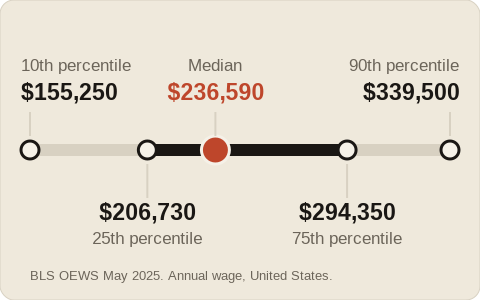
| Measure | Annual wage |
|---|---|
| 10th percentile | $155,250 |
| 25th percentile | $206,730 |
| Median (50th) | $236,590 |
| Mean (average) | $248,320 |
| 75th percentile | $294,350 |
| 90th percentile | $339,500 |
Source: U.S. Bureau of Labor Statistics, Occupational Employment and Wage Statistics (OEWS), May 2025, Nurse Anesthetists, retrieved 23 to 25 November 2026 from the BLS OEWS May 2025 national, state and metropolitan area files.
CRNA hourly pay
The median hourly wage for CRNAs is $113.75, as published by BLS for May 2025. That is the hourly view of the same national middle as the $236,590 annual median above, so use it when an employer quotes you a rate and not a salary. Annual pay for a job with part-time or shift work depends on the hours you are given, which no national table can tell you.
| Measure | Per hour |
|---|---|
| 10th percentile | $74.64 |
| 25th percentile | $99.39 |
| Median (BLS hourly figure) | $113.75 |
| 75th percentile | $141.51 |
| 90th percentile | $163.22 |
For CRNAs the median is the hourly wage BLS publishes. The other rows are our division of the BLS annual percentiles by 2,080 hours, the full-time year BLS uses to turn hourly pay into annual pay.
CRNA salary by state
Where you work changes the number more than most things. The highest published median is in Alaska, at $341,210. The lowest published median is in Utah, at $126,600, a gap of $214,610 a year between two states. The gap is our subtraction of two BLS state medians. All figures below are the annual median wage in each state for May 2025.
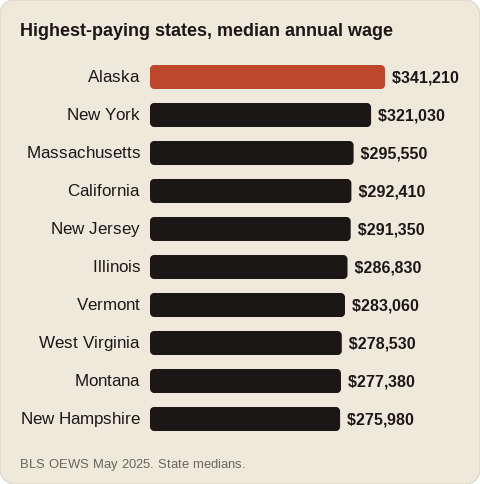
Top-paying states for CRNAs
| Rank | State | Median wage | vs US median |
|---|---|---|---|
| 1 | Alaska | $341,210 | +$104,620 |
| 2 | New York | $321,030 | +$84,440 |
| 3 | Massachusetts | $295,550 | +$58,960 |
| 4 | California | $292,410 | +$55,820 |
| 5 | New Jersey | $291,350 | +$54,760 |
| 6 | Illinois | $286,830 | +$50,240 |
| 7 | Vermont | $283,060 | +$46,470 |
| 8 | West Virginia | $278,530 | +$41,940 |
| 9 | Montana | $277,380 | +$40,790 |
| 10 | New Hampshire | $275,980 | +$39,390 |
CRNA salary by state
| State | Median annual wage |
|---|---|
| Alaska | $341,210 |
| New York | $321,030 |
| Massachusetts | $295,550 |
| California | $292,410 |
| New Jersey | $291,350 |
| Illinois | $286,830 |
| Vermont | $283,060 |
| West Virginia | $278,530 |
| Montana | $277,380 |
| New Hampshire | $275,980 |
| Washington | $274,390 |
| Wisconsin | $273,170 |
| Iowa | $273,070 |
| Oregon | $272,330 |
| Minnesota | $266,190 |
| South Carolina | $265,480 |
| South Dakota | $263,930 |
| Idaho | $263,130 |
| Wyoming | $255,250 |
| Virginia | $252,110 |
| Arizona | $248,660 |
| Maine | $247,470 |
| Michigan | $247,010 |
| Nebraska | $246,730 |
| Texas | $244,990 |
| North Dakota | $244,240 |
| Missouri | $242,630 |
| Connecticut | $236,960 |
| Ohio | $231,810 |
| Georgia | $224,630 |
| North Carolina | $224,610 |
| Arkansas | $224,280 |
| Maryland | $223,140 |
| Kentucky | $222,520 |
| Louisiana | $222,130 |
| Pennsylvania | $221,530 |
| Kansas | $212,090 |
| Tennessee | $211,450 |
| Florida | $210,570 |
| Mississippi | $198,410 |
| Alabama | $190,300 |
| Oklahoma | $156,830 |
| New Mexico | $129,370 |
| Utah | $126,600 |
| Colorado | Not published by BLS |
| Delaware | Not published by BLS |
| Hawaii | Not published by BLS |
| Indiana | Not published by BLS |
| Nevada | Not published by BLS |
| Rhode Island | Not published by BLS |
BLS does not publish a figure for Colorado, Delaware, Hawaii, Indiana, Nevada, Rhode Island, usually because there are too few CRNAs in the survey sample to report one safely.
Top-paying metro areas for CRNAs
| Metro area | Median wage | Employed |
|---|---|---|
| Jacksonville, FL | $416,000 | 340 |
| Springfield, MA | $357,740 | n/a |
| Fayetteville, NC | $331,760 | 90 |
| New York-Newark-Jersey City, NY-NJ | $321,030 | 2,310 |
| Peoria, IL | $310,930 | 100 |
| Columbia, MO | $310,170 | 90 |
| Hammond, LA | $304,640 | 40 |
| Riverside-San Bernardino-Ontario, CA | $298,910 | 140 |
| Idaho Falls, ID | $298,560 | n/a |
| Greensboro-High Point, NC | $297,560 | 100 |
BLS publishes the CRNA median for 131 metro areas; the national median is $236,590. 5 of these ten count fewer than 100 CRNAs or have no published headcount, so treat them as rough. In 11 more metro areas BLS shows the median only as $239,200 or more, so they cannot be ranked here. Source: U.S. Bureau of Labor Statistics, OEWS May 2025, metropolitan area estimates.
Compare CRNA pay
Put two states side by side, or set CRNAs next to another job. Every figure is from BLS OEWS May 2025.
| Measure | Alaska | Utah |
|---|---|---|
| Median annual wage | $341,210 | $126,600 |
| Median hourly wage | $164.04 | n/a |
| 10th percentile | $212,150 | n/a |
| 25th percentile | $289,820 | n/a |
| 75th percentile | $366,160 | n/a |
| 90th percentile | $366,160 | n/a |
| Employed, May 2025 | 90 | n/a |
The Alaska median is $214,610 a year higher. That difference is our subtraction of two BLS state medians. n/a means this page has only the BLS median for that state so far, or BLS released no figure for it. Source: BLS OEWS May 2025, Nurse Anesthetists.
Starting pay for CRNAs
BLS does not publish pay by years of experience, so nobody can honestly quote an official entry-level CRNA salary. What the data gives is the bottom of the market. One in ten CRNAs earns $155,250 or less, and one in four earns $206,730 or less. Read those as the low end of the national range, not as what a new graduate will be offered, because older workers sit in the bottom tenth too.
Why CRNAs out-earn the other advanced practice nurses
BLS puts nurse anesthetists, nurse midwives and nurse practitioners on one OOH page, and the combined median there is $134,920. Split the group and the picture changes. Nurse midwives sit at $134,040 and nurse practitioners at $132,300, while nurse anesthetists earn a median of $236,590, about $104,290 a year above nurse practitioners. That gap is our subtraction of two BLS medians.
The route explains part of it. Every APRN needs an RN license and a graduate degree, but only the anesthesia track asks for 1 year of critical care nursing before the program will even look at you. BLS does not say how employers set CRNA pay, so read the gap as a fact about the market, not a promise for any one job.
CRNA or anesthesiologist
Both give anesthesia and watch the patient through the procedure, and the pay is far apart. The median anesthesiologist earns $391,490, which is $154,900 more than the median CRNA. The cost is time: an anesthesiologist needs a bachelor's degree, 4 years of medical school and a residency, which BLS says lasts 3 to 9 years depending on the specialty.
The CRNA route is an RN license, a year in critical care and a master's degree, then the national exam. BLS projects nurse anesthetist jobs to grow 10 percent from 2025 to 2035, against 4 percent for anesthesiologists.
Where the CRNA medians are highest
Among the 44 states with a published median, Alaska leads at $341,210 and New York follows at $321,030. At the bottom, Utah shows $126,600. BLS published no state figure for 6 states.
The top metro areas are Jacksonville, FL at $416,000, with about 340 employed, Springfield, MA at $357,740, where BLS does not publish how many work, and Fayetteville, NC at $331,760, with about 90 employed. Metro medians built on a few dozen or a few hundred workers are estimates, and they can move a lot from one year to the next.
Related jobs
- Anesthesiologist salary and career path: The physician route into anesthesia, with a longer road and a higher median.
- Nurse Practitioner salary and career path: The largest advanced practice nursing job, on the same BLS page.
- Registered Nurse salary and career path: The license every CRNA holds first.
What CRNAs do
Nurse anesthetists, the CRNAs, give anesthesia and care for patients before, during and after surgical, therapeutic, diagnostic and obstetrical procedures. They also provide pain management and some emergency services.
Before a procedure the CRNA goes over the medications, allergies and illnesses the patient has so the anesthesia can be given safely. Then comes general anesthesia to put the patient to sleep, or a regional or local anesthetic to numb one area, with the vital signs watched and the dose adjusted until the case is done.
Duties BLS lists
- Take and record medical histories, current medications, allergies and symptoms
- Examine and observe patients before a procedure
- Give general, regional or local anesthesia
- Operate and monitor medical equipment
- Watch vital signs during the procedure and adjust the anesthesia
- Evaluate the patient's response to medicines and treatments
- Provide pain management and some emergency services
- Consult with doctors and other healthcare professionals as needed
A typical day
A CRNA day follows the procedure list. Each case starts with a talk with the patient about medicines, allergies and illnesses, then the anesthetic, then close watch on the monitors with small changes to the dose until the patient is through and recovering. Hospital CRNAs can work nights, weekends and holidays, and those in critical care may be on call.
Where they work
- Nurse anesthetists held 54,500 of the 399,000 jobs BLS counts for nurse anesthetists, nurse midwives and nurse practitioners together. The employer list below is for that combined group, not for CRNAs alone.
- For the combined group, offices of physicians employed 46 percent, hospitals 25 percent, outpatient care centers 9 percent, offices of other health practitioners 5 percent and home healthcare services 3 percent.
- Most advanced practice nurses work full time. In hospitals they may work shifts that include nights, weekends and holidays, and some in critical care need to be on call.
- BLS says the work can be physically and emotionally demanding, with time on your feet, the risk of back injury from moving patients, contact with infectious disease and needle sticks.
Source: U.S. Bureau of Labor Statistics, Occupational Outlook Handbook, Nurse Anesthetists, Nurse Midwives, and Nurse Practitioners, read 25 November 2026. BLS counted about 54,500 jobs in 2025 and projects 10% growth from 2025 to 2035, much faster than the average for all occupations.
How to become a CRNA: the career path
Typical entry-level education, according to BLS: master's degree. BLS says nurse anesthetists need at least a master's degree, and an accredited nurse anesthetist program admits only registered nurses with 1 year of critical care experience. Each step below comes from the BLS Occupational Outlook Handbook, and the last step is the pay.
- 1Start
Registered nurse license
You need an RN license before any advanced practice program. Most programs prefer a bachelor's degree in nursing, and some schools offer bridge programs for nurses with an associate's degree or diploma.
- 2Experience
1 year in critical care
BLS says prospective nurse anesthetists must have 1 year of experience as a registered nurse in a critical care setting before an accredited nurse anesthetist program will admit them.
- 3Study
Master's degree in nurse anesthesia
At least a master's degree from an accredited program, with classroom education and clinical experience. Courses such as advanced health assessment, pathophysiology and pharmacology are common. Some APRNs go on to a Doctor of Nursing Practice (DNP) or a Ph.D.
- 4Certify
National certification exam
To be licensed and use an APRN title, most states require national certification. Jobs may also ask for CPR, basic life support (BLS) or advanced cardiac life support (ACLS) certification.
- 5License
State APRN license
On top of the RN license you need a state APRN license. Requirements vary, and each state board of nursing publishes its own.
- 6Pay
Median $236,590 a year
BLS median annual wage for CRNAs. The lowest-paid tenth earn $155,250 or less and the highest-paid tenth earn $339,500 or more.
Steps 1 to 5 for CRNAs: U.S. Bureau of Labor Statistics, Occupational Outlook Handbook, Nurse Anesthetists, Nurse Midwives, and Nurse Practitioners, "How to Become One", read 25 November 2026. Pay step: U.S. Bureau of Labor Statistics, OEWS May 2025.
CRNA skills and certifications
These come from the CVBooster CRNA resume guide, which lists what employers look for on a CRNA CV. Put the ones you really have near the top of your CV, in the words the job ad uses.
Core skills
People skills
Licenses and certifications
- Certified Registered Nurse Anesthetist (CRNA), National Board of Certification and Recertification for Nurse Anesthetists
- Advanced Cardiovascular Life Support (ACLS), American Heart Association
- Pediatric Advanced Life Support (PALS), American Heart Association
- Basic Life Support (BLS), American Heart Association
Interview questions
CRNA salary questions
How much does a CRNA make a year?
Nurse anesthetists have a median of $236,590 a year in the United States, and the mean is $248,320. One in ten earns $155,250 or less and one in ten earns $339,500 or more. These are BLS OEWS figures for May 2025.
Do I need ICU experience to become a CRNA?
Yes. BLS says prospective nurse anesthetists must have 1 year of experience working as a registered nurse in a critical care setting before an accredited nurse anesthetist program will admit them. You also need the RN license first.
Is a doctorate required to be a CRNA?
The OOH page lists a master's degree as the typical entry-level education for nurse anesthetists, and says APRNs may choose to earn a Doctor of Nursing Practice (DNP) or a Ph.D. BLS does not describe any change to the requirement, so check the programs you apply to.
How much do CRNAs make an hour?
The BLS median hourly wage for nurse anesthetists is $113.75. Hospital CRNAs can work nights, weekends and holidays, and some are on call, so the hours behind a yearly figure vary from job to job.
Which state pays CRNAs the most?
Of the states with a published BLS median, Alaska is highest at $341,210, then New York at $321,030 and Massachusetts at $295,550. The state table above has every published figure for May 2025.
How many CRNA jobs are there?
BLS counted 54,500 nurse anesthetist jobs in 2025 and projects 59,800 by 2035, a rise of 5,300 or 10 percent. That is much slower than the 41 percent BLS projects for nurse practitioners.
Sources and method
- Pay: U.S. Bureau of Labor Statistics, Occupational Employment and Wage Statistics (OEWS), May 2025, Nurse Anesthetists (SOC 29-1151), national, state and metro area estimates, retrieved 23 to 25 November 2026 from the BLS OEWS May 2025 national, state and metropolitan area files. Wages are before tax. BLS defines what its wage figure includes and leaves out in the OEWS technical notes.
- The job, the route in and the outlook: U.S. Bureau of Labor Statistics, Occupational Outlook Handbook, Nurse Anesthetists, Nurse Midwives, and Nurse Practitioners, read 25 November 2026.
- Skills and certifications: the CVBooster CRNA resume guide.
- Where we subtract or divide two BLS figures on this CRNA page, the page says so. The pay check is an estimate between the published BLS percentiles for CRNAs and says so. Nothing else here is estimated.
CRNA CV example
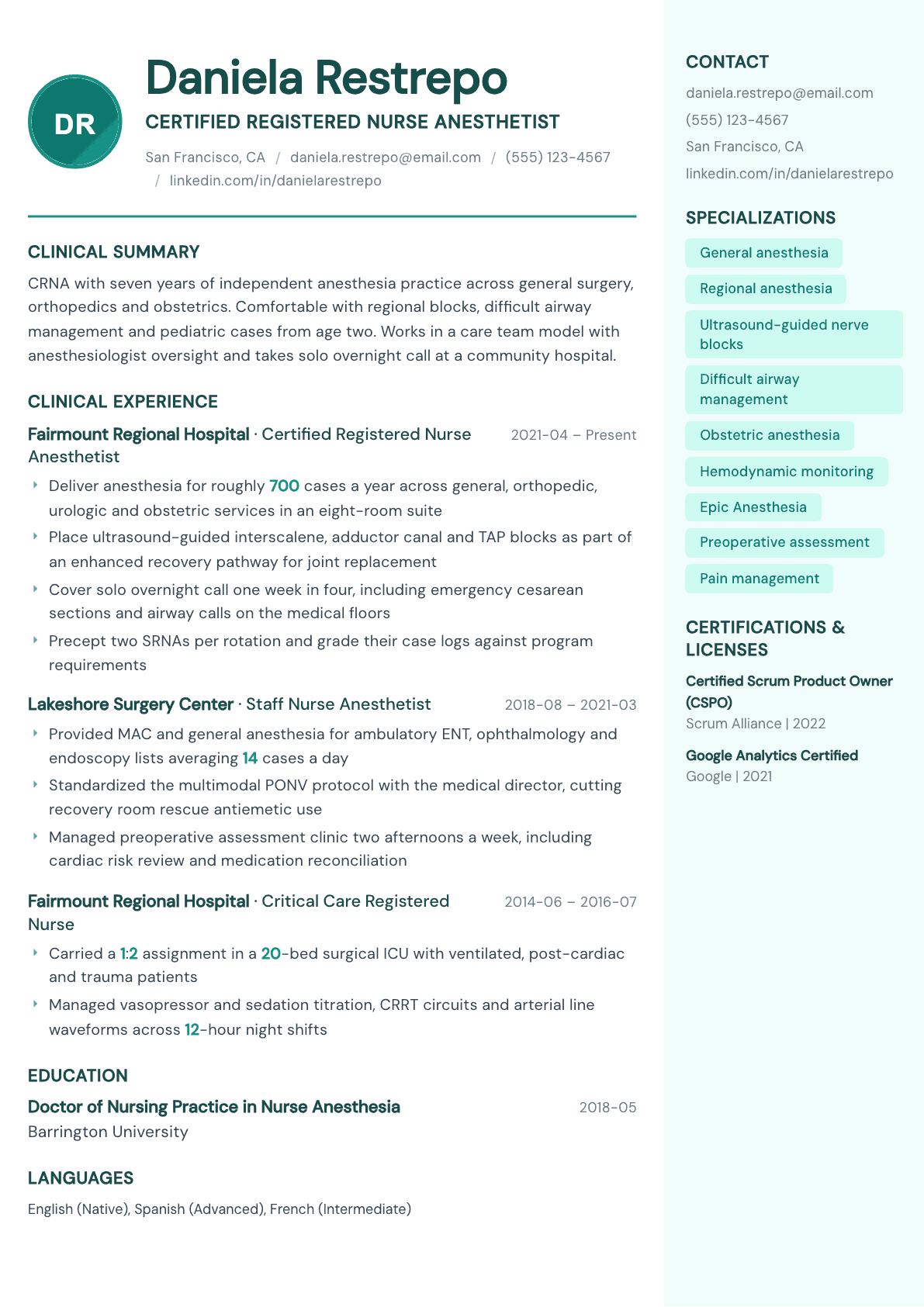
The CVBooster CRNA resume guide has a finished example, three written summaries, before and after bullets and answers to the questions people ask.
Build your CRNA CV
Create my CV