Nurse Anesthetist Interview Questions With 8 Full Answers
By Mustafa Tarabya, founder of CVBooster · Published · Updated
8 min read
Nurse anesthetist interview questions test three things: how you think through an anesthesia crisis, how you work inside the practice model of that hospital or group, and whether the chief CRNA would trust you alone in a room at night. The constraint is that every candidate has passed the same boards, so the panel listens for judgment, not facts. O*NET, the US Department of Labor's occupation database, sums the job up as: "Administer anesthesia, monitor patient's vital signs, and oversee patient recovery from anesthesia." Below are the questions staff CRNA panels ask most, eight complete sample answers, the CRNA school interview version, and what to ask them. Written by Mustafa Tarabya, who hired for his own company, read every application himself and now writes CVBooster's guides.
You have intubated patients at three in the morning with a surgeon tapping his foot. A panel of four people with coffee should be the easy part.
The questions CRNA job panels ask most
Most staff CRNA interviews mix four kinds of question:
- Clinical scenarios: a difficult airway, malignant hyperthermia, local anesthetic toxicity, a hemorrhage, a desaturation in recovery.
- Practice model: how you work in a care team with anesthesiologists, or alone in an opt-out state or a rural hospital.
- Teamwork and conflict: a surgeon who wants to start before you are ready, a resident who disagrees with your plan.
- Fit and motivation: why this setting, which cases you like and which you still want more of.
Answer the scenario questions in order: recognize, call for help, act, then say what you would document and debrief. Panels listen for that sequence more than for drug doses.
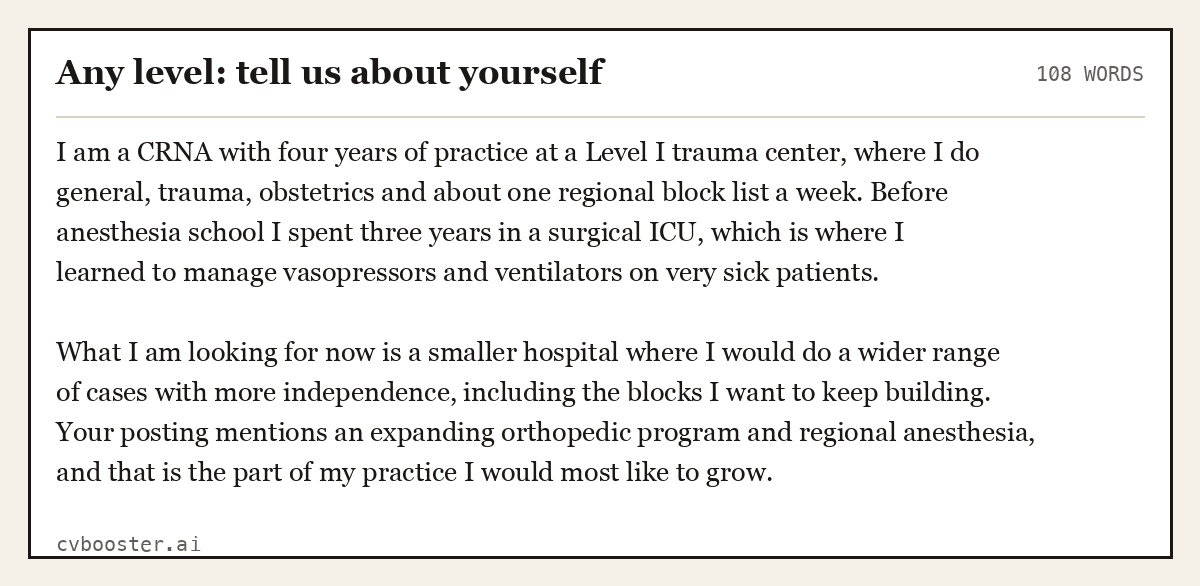
Any level: tell us about yourself (108 words)
I am a CRNA with four years of practice at a Level I trauma center, where I do general, trauma, obstetrics and about one regional block list a week. Before anesthesia school I spent three years in a surgical ICU, which is where I learned to manage vasopressors and ventilators on very sick patients.
What I am looking for now is a smaller hospital where I would do a wider range of cases with more independence, including the blocks I want to keep building. Your posting mentions an expanding orthopedic program and regional anesthesia, and that is the part of my practice I would most like to grow.
Clinical scenario questions
The panel does not want a lecture. It wants to hear you stay calm, call for help early and work through the problem in an order that would keep the patient safe.
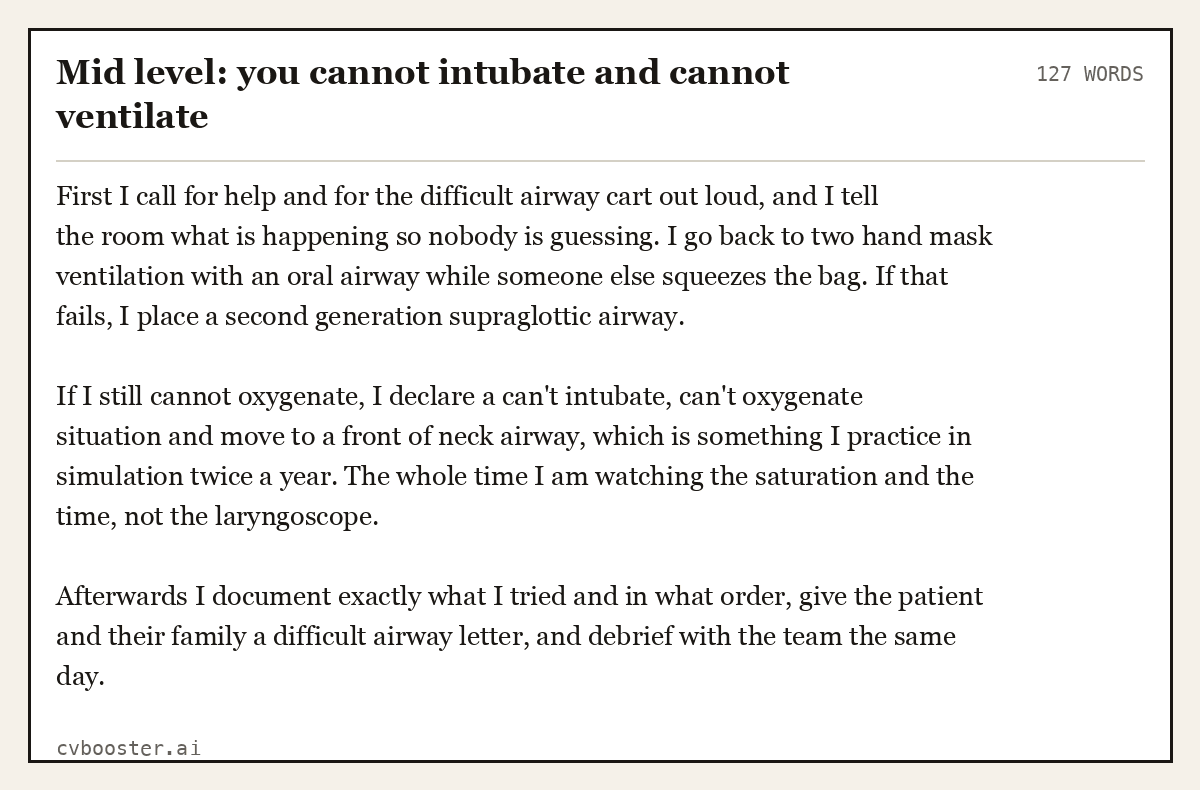
Mid level: you cannot intubate and cannot ventilate (127 words)
First I call for help and for the difficult airway cart out loud, and I tell the room what is happening so nobody is guessing. I go back to two hand mask ventilation with an oral airway while someone else squeezes the bag. If that fails, I place a second generation supraglottic airway.
If I still cannot oxygenate, I declare a can't intubate, can't oxygenate situation and move to a front of neck airway, which is something I practice in simulation twice a year. The whole time I am watching the saturation and the time, not the laryngoscope.
Afterwards I document exactly what I tried and in what order, give the patient and their family a difficult airway letter, and debrief with the team the same day.
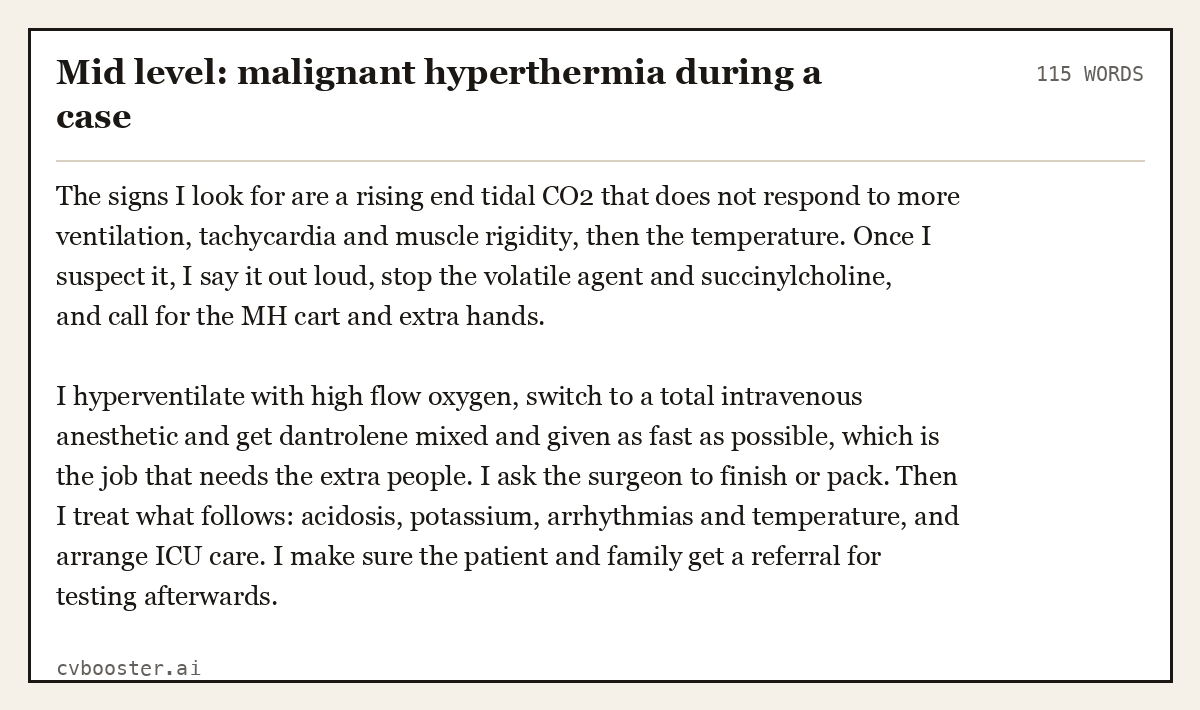
Mid level: malignant hyperthermia during a case (115 words)
The signs I look for are a rising end tidal CO2 that does not respond to more ventilation, tachycardia and muscle rigidity, then the temperature. Once I suspect it, I say it out loud, stop the volatile agent and succinylcholine, and call for the MH cart and extra hands.
I hyperventilate with high flow oxygen, switch to a total intravenous anesthetic and get dantrolene mixed and given as fast as possible, which is the job that needs the extra people. I ask the surgeon to finish or pack. Then I treat what follows: acidosis, potassium, arrhythmias and temperature, and arrange ICU care. I make sure the patient and family get a referral for testing afterwards.
Care team and practice model questions
Practice models differ a lot between states and hospitals. The American Association of Nurse Anesthesiology notes that "25 states and Guam have opted-out of the federal requirement for CRNAs to be supervised by a physician, dentist or podiatrist." Before your interview, find out whether the job is a care team, a supervised model or independent practice, and answer for that model.
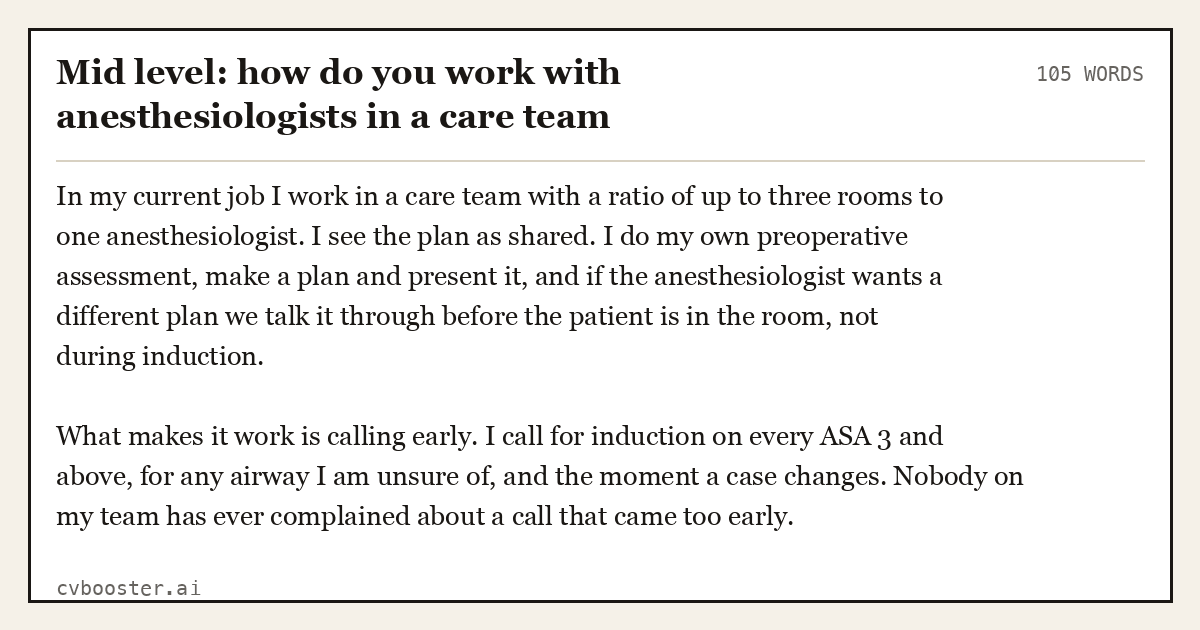
Mid level: how do you work with anesthesiologists in a care team (105 words)
In my current job I work in a care team with a ratio of up to three rooms to one anesthesiologist. I see the plan as shared. I do my own preoperative assessment, make a plan and present it, and if the anesthesiologist wants a different plan we talk it through before the patient is in the room, not during induction.
What makes it work is calling early. I call for induction on every ASA 3 and above, for any airway I am unsure of, and the moment a case changes. Nobody on my team has ever complained about a call that came too early.
Senior: why do you want to work in a rural or independent practice (111 words)
Because I want to be the person who decides. I have spent six years in a care team, and I am grateful for it, but I now do most of my cases without needing help, and I want a practice where I carry the whole plan.
I also know what that means at night. There is no one down the hall, so I would want to spend my first weeks learning your OB coverage, your difficult airway equipment and how transfers to the regional center work. I have done independent call at a critical access hospital as a locum tenens CRNA twice, and I liked the responsibility more than I expected.
Teamwork, conflict and judgment questions
Mid level: a surgeon wants to start before you are ready (100 words)
This happened on a trauma case. The surgeon wanted to make the incision while I was still placing a second large bore line and the arterial line. I told him in one sentence what I needed and how long it would take, which was three minutes, and why: the patient was likely to bleed and I needed access before we opened.
He was not happy, but he waited. We opened, the patient did bleed, and the lines were in. Afterwards I thanked him for waiting. The next time we worked together he asked me what I needed before he scrubbed.
Any level: tell us about a mistake or near miss (105 words)
In my second year as a CRNA, I nearly gave the wrong dose of a vasopressor because two syringes had similar labels after a busy turnover. I caught it when I read the label aloud before giving it, which is a habit I had from the ICU.
I reported it the same day as a near miss. The department changed to color coded prefilled syringes for that drug the next quarter. I still read every label out loud, and I tell students why. The point of telling this story is not that I am careful. It is that the system changed because someone reported it.
CRNA school interview questions
CRNA school interviews ask many of the same scenario questions, at ICU level, plus questions about why anesthesia. The Bureau of Labor Statistics occupation profile notes: "Prospective nurse anesthetists must have 1 year of experience working as registered nurse in a critical care setting as a prerequisite for admission to an accredited nurse anesthetist program." The AANA says "CRNAs are the only anesthesia professionals with an average of three years critical care experience before beginning formal anesthesia education." Expect detailed questions on the drips, ventilators and patients you manage in your ICU.
Entry level: CRNA school, why nurse anesthesia (111 words)
I have spent three years in a cardiovascular ICU. The part of my day I like most is the hour after a patient comes back from the OR, when I am titrating pressors, warming and weaning sedation, and I can see how the anesthesia plan shaped the patient I am now caring for.
I have shadowed two CRNAs for a total of three days, and what stayed with me was how much of the job is preparation before the patient arrives. I want to own that whole arc, from the plan to the recovery. I also know the program is hard, and I have arranged my finances to study full time.
Questions to ask at a CRNA interview
- What is the practice model, and how is it changing in the next few years?
- What is the case mix, and how are blocks, hearts and OB shared out?
- How does call work, and who is in house at night?
- What does orientation look like for a new staff CRNA?
- How are near misses reported, and what changed after the last one?
Every new CRNA also has to be certified. The NBCRNA states: "To begin a career as a CRNA, students need to take and pass the National Certification Examination (NCE)." Put your certification, state license and any regional or point of care ultrasound training at the top of your resume; our nurse anesthetist resume shows how. For related panels, see nurse practitioner interview questions and ED nurse interview questions, and for the answer structure, read STAR interview questions. CVBooster helps with the resume before the interview: you need an account, the free plan lets you fill in your resume by hand and see your ATS score and missing keywords, and the AI tailoring, templates and the finished file are Pro.
Frequently asked questions
What questions are asked in a CRNA interview?
Clinical scenarios such as a difficult airway, malignant hyperthermia or hemorrhage, questions about the practice model and care team, conflict questions about surgeons and colleagues, and fit questions about the setting and case mix. Expect at least one question about a mistake or near miss and how you reported it.
How do I prepare for a nurse anesthetist interview?
Find out the practice model, case mix and call structure before the day. Prepare three scenario answers in the order recognize, call for help, act, document. Prepare two stories about teamwork and one about a near miss. Bring questions about orientation and call, because they show you are thinking about the actual job.
What are common CRNA school interview questions?
Why nurse anesthesia, what you do in your ICU, and scenarios on drips, ventilators and unstable patients. Panels also ask about stress, failure and how you will manage the workload. Answer clinical questions at the level of your ICU practice, and be honest about what you have not done yet.
How should I answer clinical scenario questions?
Say what you see, call for help early, then act in a safe order and say what you would document and debrief. Panels listen for judgment and communication more than doses. If you are unsure of a detail, say how you would check it in the room rather than guessing.
What should a CRNA ask at the end of an interview?
Ask about the practice model, the case mix, how call works and who is in house at night, what orientation looks like and how near misses are reported. Each of these tells you what your first year would be like, and each shows the panel you are already thinking like a colleague.
Related articles
- Case Manager Interview Questions: 7 Answers That Score
- Creative Interview Questions With 6 Sample Answers
- Critical Care Nursing Interview Questions and 9 Answers
- ED Nurse Interview Questions With 9 Full Sample Answers
More articles
- Nurse Manager Interview Questions With 8 Full Sample Answers
- Nurse Practitioner Interview Questions With 9 Full Answers
- Nursery Teacher Interview Questions: 7 Model Answers
Looking for a worked example for your job title? Browse the resume examples by job title.