Air Traffic Controller Salary, Career Path and CV
By CVBooster TeamPublished Updated
The median air traffic controller salary in the United States is $148,080 a year, or $71.19 an hour, according to the U.S. Bureau of Labor Statistics (BLS), OEWS May 2025. That is the national middle: states, employers and hours move it, and BLS publishes nothing by years of experience. Nearly every controller works for one employer, the federal government, so the hiring rules matter as much as the pay table.
Below: a check of your own pay, the pay percentiles, hourly pay, pay by state, the top-paying metro areas, what air traffic controllers do, how to become an air traffic controller, the skills that go on a CV, and a CV example.
- Median annual pay
- $148,080
- Median hourly pay
- $71.19
- Employed, May 2025
- 22,510
Am I underpaid as an air traffic controller?
Pick your state and type your pay. You get your place in the BLS pay range for air traffic controllers there, as a percentile.
Air Traffic Controller salary in the United States
The BLS counts air traffic controllers in the occupation Air Traffic Controllers (SOC 53-2021). Half of them earn less than $148,080 a year and half earn more. The average, which a few very high earners pull up, is $146,490. The lowest-paid tenth earn $78,420 or less, and the highest-paid tenth earn $215,610 or more, which is about 2.7 times as much. The ratio is our arithmetic on two BLS figures.
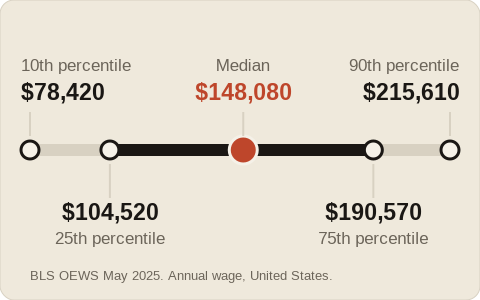
| Measure | Annual wage |
|---|---|
| 10th percentile | $78,420 |
| 25th percentile | $104,520 |
| Median (50th) | $148,080 |
| Mean (average) | $146,490 |
| 75th percentile | $190,570 |
| 90th percentile | $215,610 |
Source: U.S. Bureau of Labor Statistics, Occupational Employment and Wage Statistics (OEWS), May 2025, Air Traffic Controllers, retrieved 23 to 25 November 2026 from the BLS OEWS May 2025 national, state and metropolitan area files.
Air Traffic Controller hourly pay
The median hourly wage for air traffic controllers is $71.19, as published by BLS for May 2025. That is the hourly view of the same national middle as the $148,080 annual median above, so use it when an employer quotes you a rate and not a salary. Annual pay for a job with part-time or shift work depends on the hours you are given, which no national table can tell you.
| Measure | Per hour |
|---|---|
| 10th percentile | $37.70 |
| 25th percentile | $50.25 |
| Median (BLS hourly figure) | $71.19 |
| 75th percentile | $91.62 |
| 90th percentile | $103.66 |
For air traffic controllers the median is the hourly wage BLS publishes. The other rows are our division of the BLS annual percentiles by 2,080 hours, the full-time year BLS uses to turn hourly pay into annual pay.
Air Traffic Controller salary by state
Where you work changes the number more than most things. The highest published median is in Virginia, at $191,820. The lowest published median is in Mississippi, at $88,110, a gap of $103,710 a year between two states. The gap is our subtraction of two BLS state medians. All figures below are the annual median wage in each state for May 2025.
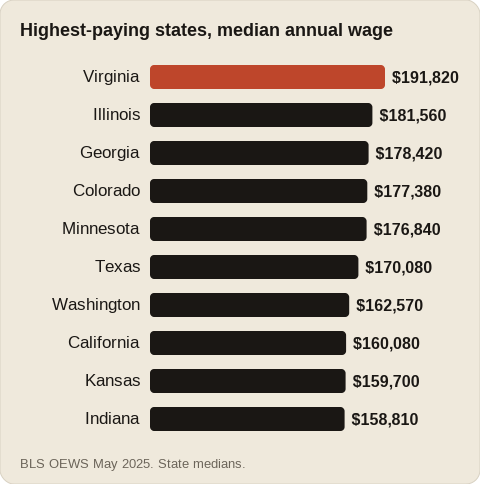
Top-paying states for air traffic controllers
| Rank | State | Median wage | vs US median |
|---|---|---|---|
| 1 | Virginia | $191,820 | +$43,740 |
| 2 | Illinois | $181,560 | +$33,480 |
| 3 | Georgia | $178,420 | +$30,340 |
| 4 | Colorado | $177,380 | +$29,300 |
| 5 | Minnesota | $176,840 | +$28,760 |
| 6 | Texas | $170,080 | +$22,000 |
| 7 | Washington | $162,570 | +$14,490 |
| 8 | California | $160,080 | +$12,000 |
| 9 | Kansas | $159,700 | +$11,620 |
| 10 | Indiana | $158,810 | +$10,730 |
Air Traffic Controller salary by state
| State | Median annual wage |
|---|---|
| Virginia | $191,820 |
| Illinois | $181,560 |
| Georgia | $178,420 |
| Colorado | $177,380 |
| Minnesota | $176,840 |
| Texas | $170,080 |
| Washington | $162,570 |
| California | $160,080 |
| Kansas | $159,700 |
| Indiana | $158,810 |
| Hawaii | $158,700 |
| Utah | $158,310 |
| Tennessee | $157,330 |
| New Mexico | $148,550 |
| Florida | $147,530 |
| New York | $144,960 |
| Connecticut | $140,940 |
| Nevada | $140,920 |
| Arizona | $136,800 |
| Pennsylvania | $132,350 |
| New Jersey | $132,230 |
| Maryland | $131,290 |
| North Carolina | $129,230 |
| Kentucky | $127,800 |
| Rhode Island | $126,300 |
| Massachusetts | $125,060 |
| Alaska | $123,950 |
| Oklahoma | $123,220 |
| Missouri | $122,200 |
| Michigan | $118,930 |
| Alabama | $114,960 |
| South Carolina | $112,030 |
| Nebraska | $111,710 |
| Arkansas | $109,760 |
| Vermont | $109,140 |
| North Dakota | $107,990 |
| Maine | $107,270 |
| Montana | $101,380 |
| Louisiana | $99,810 |
| Wyoming | $93,580 |
| Iowa | $90,790 |
| Mississippi | $88,110 |
| Delaware | Not published by BLS |
| Idaho | Not published by BLS |
| New Hampshire | Not published by BLS |
| Ohio | Not published by BLS |
| Oregon | Not published by BLS |
| South Dakota | Not published by BLS |
| West Virginia | Not published by BLS |
| Wisconsin | Not published by BLS |
BLS does not publish a figure for Delaware, Idaho, New Hampshire, Ohio, Oregon, South Dakota, West Virginia, Wisconsin, usually because there are too few air traffic controllers in the survey sample to report one safely.
Top-paying metro areas for air traffic controllers
| Metro area | Median wage | Employed |
|---|---|---|
| Philadelphia-Camden-Wilmington, PA-NJ-DE-MD | $198,590 | 220 |
| Sacramento-Roseville-Folsom, CA | $196,290 | 240 |
| San Francisco-Oakland-Fremont, CA | $193,360 | 430 |
| Chicago-Naperville-Elgin, IL-IN | $189,780 | 850 |
| Atlanta-Sandy Springs-Roswell, GA | $186,640 | 810 |
| Dallas-Fort Worth-Arlington, TX | $186,510 | 800 |
| Minneapolis-St. Paul-Bloomington, MN-WI | $179,670 | 620 |
| Detroit-Warren-Dearborn, MI | $178,310 | 180 |
| Seattle-Tacoma-Bellevue, WA | $175,280 | 510 |
| Washington-Arlington-Alexandria, DC-VA-MD-WV | $174,870 | 1,800 |
BLS publishes the air traffic controller median for 37 metro areas; the national median is $148,080. Source: U.S. Bureau of Labor Statistics, OEWS May 2025, metropolitan area estimates.
Compare air traffic controller pay
Put two states side by side, or set air traffic controllers next to another job. Every figure is from BLS OEWS May 2025.
| Measure | Virginia | Mississippi |
|---|---|---|
| Median annual wage | $191,820 | $88,110 |
| Median hourly wage | $92.22 | $42.36 |
| 10th percentile | $94,330 | $64,380 |
| 25th percentile | $140,480 | $79,700 |
| 75th percentile | $214,360 | $113,300 |
| 90th percentile | $225,680 | $127,170 |
| Employed, May 2025 | 1,120 | 160 |
The Virginia median is $103,710 a year higher. That difference is our subtraction of two BLS state medians. n/a means this page has only the BLS median for that state so far, or BLS released no figure for it. Source: BLS OEWS May 2025, Air Traffic Controllers.
Starting pay for air traffic controllers
BLS does not publish pay by years of experience, so nobody can honestly quote an official entry-level air traffic controller salary. What the data gives is the bottom of the market. One in ten air traffic controllers earns $78,420 or less, and one in four earns $104,520 or less. Read those as the low end of the national range, not as what a new graduate will be offered, because older workers sit in the bottom tenth too.
One employer sets the pay
With the federal government holding 92 percent of the jobs, the controller wage is mostly the FAA pay system. BLS puts the federal government median at $156,250 and support activities for air transportation at $83,890. BLS does not say which towers fall in the second group, so ask any non-FAA employer how its pay compares.
Inside the FAA, BLS says developmental controller salaries rise as each level of training is completed. For fully trained controllers, pay varies with the location of the facility and the complexity of its flight paths, among other factors, and the FAA Pay & Benefits page sets out the ranges. Across all controllers, the range runs from a tenth earning $78,420 or less to a tenth earning $215,610 or more.
The career has a clock on it
Two age rules frame the whole route. Candidates must apply before the FAA age cutoff, and controllers must retire at 56. BLS does not state the cutoff age on its page, so check FAA Aviation Careers before you plan a degree around it. One exception BLS names: controllers trained in the military can become civilian controllers even when they are past the cutoff.
Getting hired is also not the finish line. After the Academy comes more than 12 months of on-the-job training at a facility, then a yearly physical, a performance exam twice a year and drug screenings for as long as you work. Controllers can retrain to move between specialties, for example from an en route center to a tower.
Where controllers earn the most
Virginia has the highest state median at $191,820, ahead of Illinois at $181,560. By metro area, Philadelphia-Camden-Wilmington, PA-NJ-DE-MD leads at $198,590, then Sacramento-Roseville-Folsom, CA at $196,290 and San Francisco-Oakland-Fremont, CA at $193,360. Those first two employ only about 220 and 240 controllers, so treat their medians as estimates.
The largest group among the top-paying metros is Washington-Arlington-Alexandria, DC-VA-MD-WV, with about 1,800 controllers and a median of $174,870. BLS notes many tower and approach controllers work near large airports, while en route centers sit in secure buildings away from them.
Related jobs
- Flight Attendant salary and career path: Same aircraft, other end of the radio: an airline job where seniority decides routes and pay.
- Firefighter salary and career path: Another public safety job with an academy before the first shift and work around the clock.
What air traffic controllers do
Air traffic controllers coordinate the movement of aircraft so that they keep safe distances from each other, on the ground near airports, between altitude sectors and between control centers. Safety comes first, but they also have to move traffic efficiently to keep delays down.
BLS describes three main kinds. Tower controllers run runways and taxiways, usually out to 3 to 30 miles. Approach and departure controllers work in TRACONs and handle aircraft to about 20 to 50 miles from the airport and up to about 17,000 feet. En route controllers guide aircraft for the bulk of the flight from centers that are usually not at airports.
Duties BLS lists
- Monitor and direct aircraft on the ground and in the air
- Control all ground traffic on runways and taxiways, including vehicles such as snowplows
- Give pilots takeoff and landing instructions and clearances
- Hand off departing flights to other control centers and accept arriving ones
- Tell pilots about weather, runway closures and other critical information
- Alert airport response staff when an aircraft has an emergency
A typical day
A shift is spent at a radar screen or tower window, usually in a semidark room so the screens stay readable, managing several aircraft at once by radio: one on approach, another asking about the weather, a third waiting to be handed to the next sector. FAA rules cap a shift at 10 straight hours, breaks included, with 9 hours of rest before the next one.
Where they work
- The federal government employed 92 percent of air traffic controllers and support activities for air transportation 4 percent. Most controllers work for the Federal Aviation Administration (FAA).
- Major airports may run towers 24 hours a day, so day, evening and night shifts with weekends and holidays are common there. Smaller, quieter airports may have standard schedules.
- BLS says the responsibility can be stressful and exhausting, and the FAA requires controllers to retire at age 56 to prevent burnout.
Source: U.S. Bureau of Labor Statistics, Occupational Outlook Handbook, Air Traffic Controllers, read 25 November 2026. BLS counted about 24,000 jobs in 2025 and projects 2% growth from 2025 to 2035, slower than the average for all occupations.
How to become an air traffic controller: the career path
Typical entry-level education, according to BLS: associate's degree. AT-CTI schools offer 2- or 4-year degrees, and after the FAA Academy new controllers typically spend more than 12 months in on-the-job training. Each step below comes from the BLS Occupational Outlook Handbook, and the last step is the pay.
- 1Study
AT-CTI degree, any bachelor's, or experience
An associate's degree qualifies only through an FAA-approved Air Traffic Collegiate Training Initiative (AT-CTI) program. A bachelor's degree can be in any field. Or up to 3 years of progressively responsible work experience, or specialized air traffic control experience in the military or a civilian facility.
- 2Requirements
Citizenship, checks and the ATSA
U.S. citizenship, a medical evaluation, a background check and the FAA preemployment tests, including the Air Traffic Controller Specialists Skills Assessment Battery (ATSA). You must apply before the FAA age cutoff.
- 3Train
FAA Academy
Most new hires train at the FAA Academy in Oklahoma City. The length varies with the candidate's background.
- 4Start
Developmental controller
Assigned to a facility, you start by giving pilots basic flight data and airport information, then move to positions with more responsibility. On-the-job training typically lasts more than 12 months.
- 5Certify
Air Traffic Control Tower Operator Certificate
Required of all controllers, unless appropriately qualified and supervised under Title 14 of the Code of Federal Regulations, Part 65. A physical exam every year, a job performance exam twice a year and periodic drug screenings follow.
- 6Pay
Median $148,080 a year
BLS median annual wage for air traffic controllers. The lowest-paid tenth earn $78,420 or less and the highest-paid tenth earn $215,610 or more.
Steps 1 to 5 for air traffic controllers: U.S. Bureau of Labor Statistics, Occupational Outlook Handbook, Air Traffic Controllers, "How to Become One", read 25 November 2026. Pay step: U.S. Bureau of Labor Statistics, OEWS May 2025.
Air Traffic Controller skills and certifications
These come from the CVBooster air traffic controller resume guide, which lists what employers look for on a air traffic controller CV. Put the ones you really have near the top of your CV, in the words the job ad uses.
Core skills
People skills
Licenses and certifications
- Control Tower Operator (CTO) Certificate, Federal Aviation Administration
- Air Traffic Control Specialist Certificate, Federal Aviation Administration
- Airman Medical Certificate, Second Class, Federal Aviation Administration
- Private Pilot Certificate, Federal Aviation Administration
Air Traffic Controller salary questions
How much do air traffic controllers make?
The median is $148,080 a year, or $71.19 an hour, and the mean is $146,490. The top tenth earn $215,610 or more. In the federal government, which employs most controllers, BLS puts the median at $156,250.
Is there an age limit to become an air traffic controller?
Yes. BLS says you must apply before the FAA age cutoff, and controllers must retire at age 56. The OOH page does not give the cutoff age itself, so check FAA Aviation Careers. Controllers who learned the job in the military can be hired even past the cutoff.
Do you need a degree to be an air traffic controller?
Not always. An associate's degree counts only through an AT-CTI program, and a bachelor's can be in any field. Instead of a degree, up to 3 years of progressively responsible work experience, or specialized air traffic control experience in the military or a civilian facility, can qualify you.
How much do trainee air traffic controllers make?
BLS does not publish a trainee figure. It says developmental controller salaries rise as each training level is completed and points to the FAA Pay & Benefits page for the ranges. The lowest-paid tenth of all controllers earn $78,420 or less.
Which state pays air traffic controllers the most?
Virginia leads at $191,820, followed by Illinois at $181,560 and Georgia at $178,420. BLS publishes a controller median for 42 states, and pay at each facility also depends on how complex its traffic is.
Is air traffic control a growing job?
BLS projects 2% growth from 2025 to 2035, slower than average, about 400 jobs. NextGen, the satellite-based system, lets each controller handle more traffic. Still, about 2,100 openings a year are projected, mostly to replace controllers who retire or change jobs.
Sources and method
- Pay: U.S. Bureau of Labor Statistics, Occupational Employment and Wage Statistics (OEWS), May 2025, Air Traffic Controllers (SOC 53-2021), national, state and metro area estimates, retrieved 23 to 25 November 2026 from the BLS OEWS May 2025 national, state and metropolitan area files. Wages are before tax. BLS defines what its wage figure includes and leaves out in the OEWS technical notes.
- The job, the route in and the outlook: U.S. Bureau of Labor Statistics, Occupational Outlook Handbook, Air Traffic Controllers, read 25 November 2026.
- Skills and certifications: the CVBooster air traffic controller resume guide.
- Where we subtract or divide two BLS figures on this air traffic controller page, the page says so. The pay check is an estimate between the published BLS percentiles for air traffic controllers and says so. Nothing else here is estimated.
Air Traffic Controller CV example

The CVBooster air traffic controller resume guide has a finished example, three written summaries, before and after bullets and answers to the questions people ask.
Build your air traffic controller CV
Create my CV