Wildland Firefighter Resume Examples: what gets the call
Build a Wildland Firefighter Resume Around Your Red Card
By Mustafa Tarabya, founder of CVBooster · Published · Updated
Wildland firefighter resume example with red card qualifications, crew type, fireline experience and a guide to writing assignments and pack test results.
Sample resumes for a wildland firefighter
The same wildland firefighter content laid out in three CVBooster templates, so you can see what the finished document looks like before you write a word.
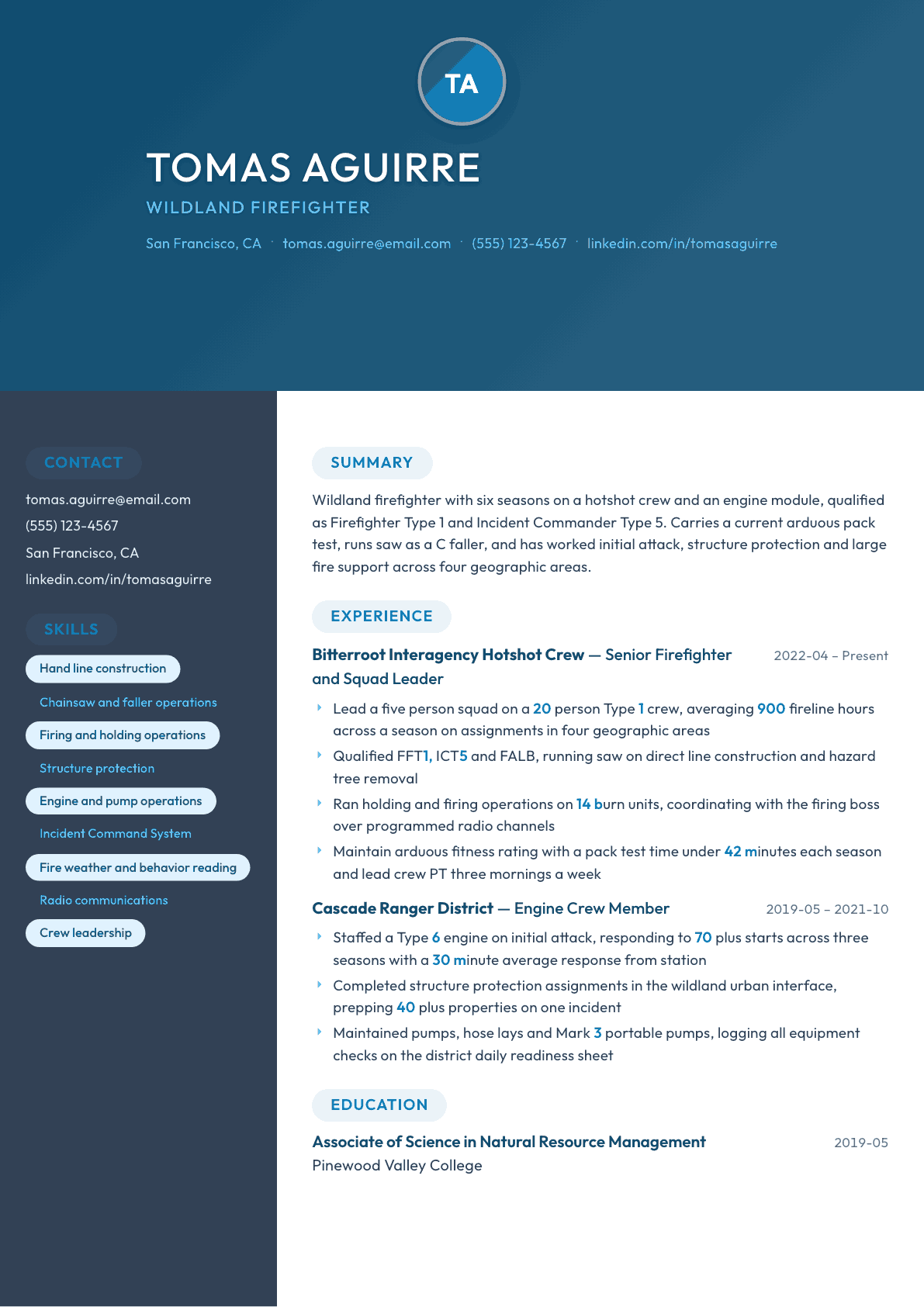
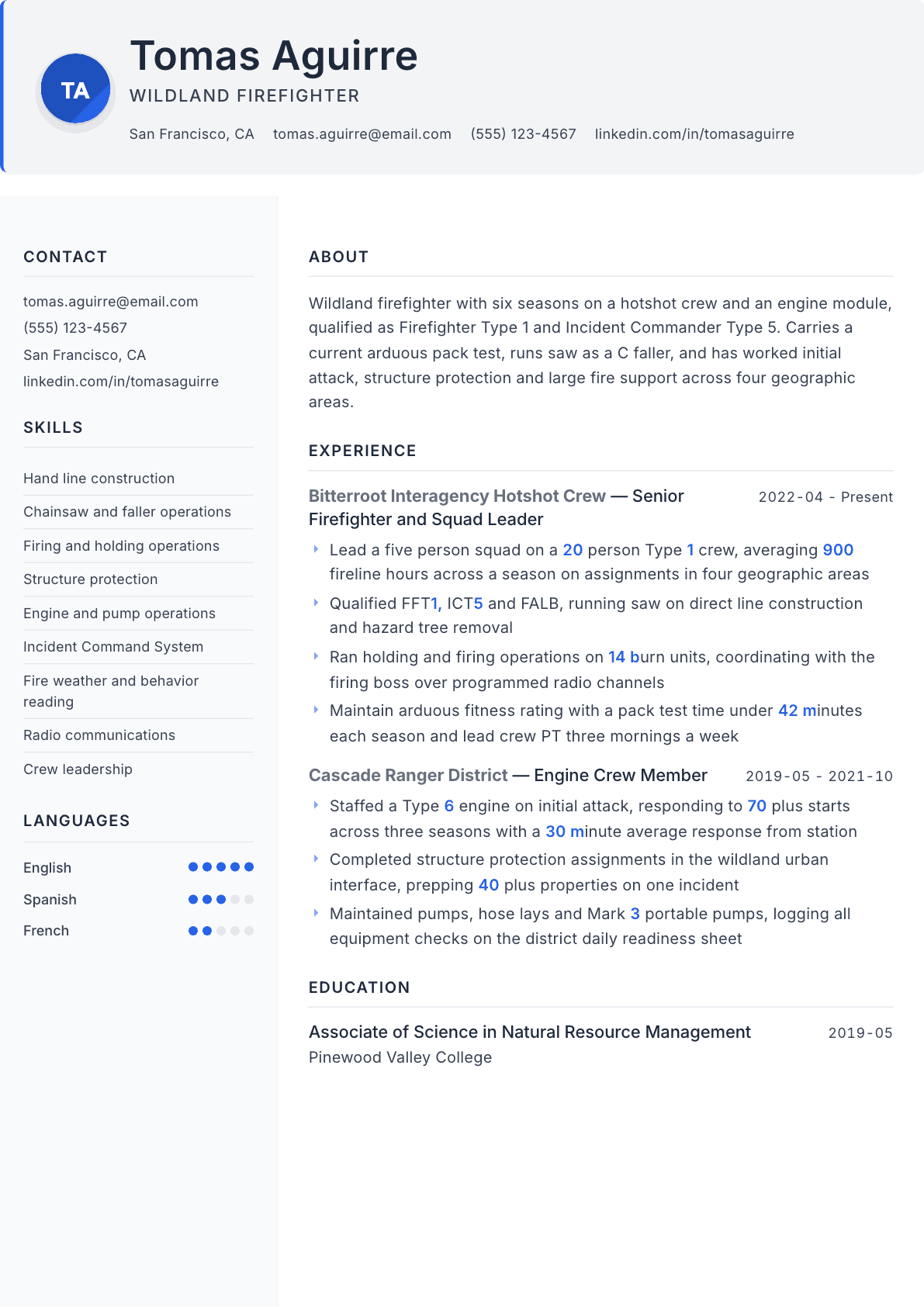
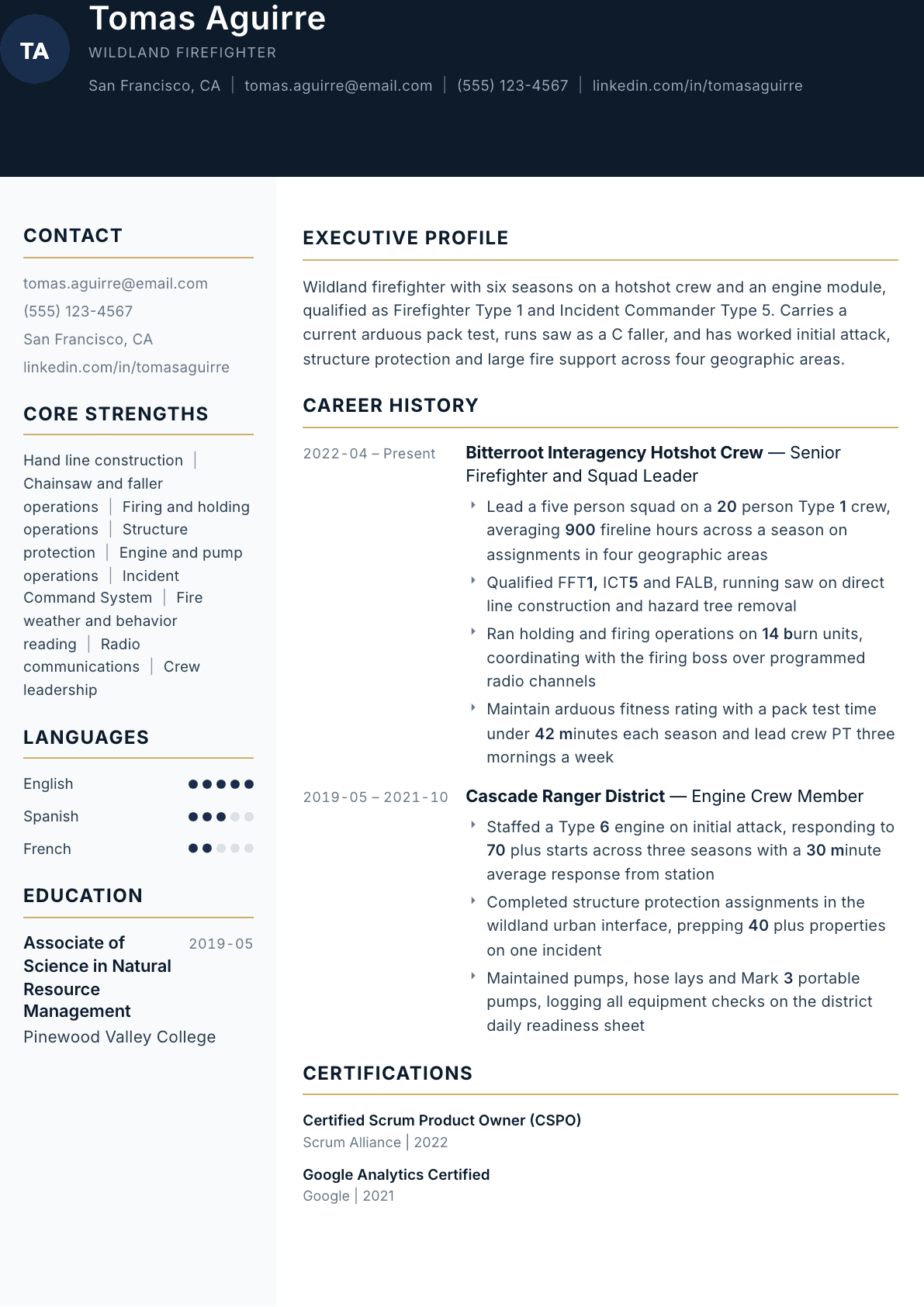
Example Wildland Firefighter summary
Wildland firefighter with six seasons across a Type 1 hotshot crew and a Type 6 engine module, qualified as Firefighter Type 1, Incident Commander Type 5 and B faller. Has worked initial attack, firing operations, structure protection and large fire support in four geographic areas, and holds a current arduous fitness rating. Leads a five person squad and runs crew physical training.
Skills to list on a Wildland Firefighter resume
- Incident Qualification Card management
- Hand crew line construction
- Chainsaw operations and felling
- Firing operations with drip torch
- Holding and mop up
- Structure protection in the interface
- Type 6 engine operations
- Portable pump and hose lay setup
- Fire behavior and weather observation
- Incident Command System 200 and 300
- Lookouts, communications, escape routes, safety zones
- Progressive hose lay
- Helicopter operations support
- Prescribed burn support
- Arduous fitness maintenance
What actually gets this resume read
- Put your red card qualifications on the first page as codes, because a crew boss reads FFT1 faster than any paragraph.
- Give your seasons, your crew type and the geographic areas you have worked, since resource orders travel widely.
- State your current fitness rating and pack test status, because an expired arduous rating stops you at check-in.
- Name your saw certification level and whether you carry a current faller evaluation from a qualified evaluator.
- List the incident positions you have held in trainee status separately from the ones you are fully qualified in.
- Include fireline hours or assignment counts per season so a hiring official can size your real exposure.
- Mention any prescribed fire, engine or helitack time, since off season assignments show breadth beyond suppression.
How to write a wildland firefighter resume
Hiring for a wildland firefighter position runs on a card. A superintendent or engine captain looks at your qualifications, your fitness rating and your seasons before anything else, because those three decide whether you can be ordered onto an assignment at all. A beautifully written page with an expired arduous rating is unusable.
The applications that get pushed aside describe hard work in general terms: dedicated, physically fit, team oriented, passionate about protecting communities. A crew boss reads that and learns nothing about whether you have run saw on a hazard tree, held a line at night in cured grass, or carried a full season without a lost time injury.
This guide sets out how to build the page around your incident qualification card, how to write assignments so a captain can picture the ground you worked, and how to present a first season honestly when your only fireline hours came from a training fire and a couple of local starts.
Format: qualifications first, seasons second, everything else after
One page. Federal and state applications often ask for far more detail in their own systems, but the resume that lands in a captain inbox needs to be readable in twenty seconds. Put a qualifications block at the top with your card positions written as the codes the fire community uses, and add the trainee positions in a separate line so nobody mistakes an open task book for a signed one.
Below that, list seasons rather than tidy calendar jobs. Wildland work is seasonal by nature, and a captain reads six seasons across a hotshot crew, an engine and a helitack module as a stronger record than three continuous years in one module. Name the crew type, the module, the host unit and the geographic area for each.
- Qualifications line: signed card positions with codes, then a separate line for positions with open task books.
- Fitness line: current arduous, moderate or light rating and the date of your most recent pack test.
- Each season: crew or module name, crew type, host agency, months worked, and the geographic areas you were ordered into.
- Training line: the wildland courses you have completed, plus annual refresher and fire shelter deployment practice.
- Certifications and licenses that get you used: commercial driver license class, faller evaluation level, medical certification.
Summary: seasons, crew type, card, fitness
Three lines is plenty. Say how many seasons you have, the crew types you have worked, the two or three card positions that matter most, and that your arduous rating is current. A superintendent who reads that and needs a squad leader will keep going.
Avoid the temptation to open with motivation. Everyone applying wants to be on a crew. The differentiator is what you are qualified to do on the first assignment, and it belongs in the first sentence, not the last.
Experience: the ground, the tactic, the hours
A wildland bullet should let a captain picture the assignment. Name the tactic and the conditions, not the mission statement. Direct line construction in steep timber is a different day from holding a road on the flank of a grass fire in wind, and a resume that never distinguishes the two reads as though it was written from a training slide.
Give hours or assignment counts per season. Fireline hours are how the community measures exposure, and a firefighter with nine hundred hours in a season has seen things one with two hundred has not. If your unit tracks assignments instead, count those and name the incident types.
Cover the full range you can be ordered into: initial attack, extended attack, large fire support, structure protection in the interface, mop up and patrol, prescribed fire and severity assignments. Off season work counts too. Fuels reduction, thinning, pile burning and fence or trail projects show a captain that you are useful in April, not only in August.
Saw work deserves its own bullets if you carry it. State your faller level, whether you have a current evaluation, and the kind of cutting you have done: brushing line, bucking, felling snags in a burned stand. Saw qualification is one of the few things a crew genuinely cannot have too much of.
Fitness, safety and the things that get you sent home
The arduous pack test is not a formality, and a resume should treat it as a live credential. Give your rating, the date and, if you are proud of it, your time. Crews run physical training daily and a firefighter who leads it rather than survives it should say so.
Safety belongs on the page in specifics, not slogans. Lookouts, communications, escape routes and safety zones is a doctrine, and a bullet that describes actually setting a lookout on a bad afternoon or calling a shift down because the escape route closed shows judgment. Include your annual refresher, shelter deployment practice and any incident within an incident you were part of and learned from.
- Current arduous rating with the pack test date, and the physical training you run or complete.
- Annual fireline safety refresher and fire shelter deployment practice.
- One example of a tactical decision made for safety reasons, with what triggered it.
- Injury and vehicle accident record, stated plainly when it is clean across seasons.
- Any medical qualification you hold, since a crew with a medically trained member is a better resource.
Skills and keywords a hiring official screens on
Wildland postings recycle the same vocabulary: initial attack, hand line, mop up, holding, firing operations, mobile attack, structure protection, chainsaw operations, incident command system, fire behavior, wildland urban interface. Use the terms exactly, because the codes and phrases are also how a resource order gets matched to a person.
Do not pad the skills block with generic labels. A hiring official will not be impressed by teamwork appearing above chainsaw operations. Keep the list to things you can be assigned to do tomorrow, and let the seasons underneath prove each one.
Wildland Firefighter resume summary examples
First season applicant
Wildland firefighter candidate with S-130 and S-190 complete, a current arduous pack test at 44 minutes, and one seasonal fuels crew assignment covering thinning, pile burning and two local initial attack responses in 2024. Chainsaw trained, seeking a Type 2 initial attack crew position.
Four seasons in
Wildland firefighter with four seasons across a Type 6 engine and a Type 2 initial attack crew, qualified FFT1 and FALB with a current arduous rating. Averages 700 fireline hours a season across four geographic areas, with initial attack, holding and structure protection assignments in the interface.
Squad leader on a hotshot crew
Senior firefighter and squad leader on a Type 1 hotshot crew, seven seasons, qualified FFT1, ICT5, FALB and open on a Crew Boss task book. Leads a five person squad on direct line and firing assignments, runs crew physical training, and mentors first year firefighters through their first season.
Work experience bullets: before and after
Before: Fought wildfires as part of a hand crew.
After: Built direct hand line in steep mixed conifer on a 20 person Type 1 crew, working the tool order behind saws and averaging 900 fireline hours across the season in four geographic areas.
The fuel type, the crew type, the position in the tool order and the hours give a captain a real picture of your exposure.
Before: Used a chainsaw on the fireline.
After: Ran saw as a B faller on line construction and hazard tree removal, felling snags in a burned stand under a swamper and completing a faller evaluation each season since 2022.
Faller level, the type of cutting and a current evaluation turn a tool mention into an orderable qualification.
Before: Helped with burnout operations.
After: Ran drip torch on the holding side of 14 firing units, coordinating ignition spacing with the firing boss over an assigned tactical channel and calling two pauses when the wind shifted across the line.
Unit count, radio coordination and the decision to pause show firing work as a judgment task, not a torch task.
Before: Worked on an engine responding to fires.
After: Staffed a Type 6 engine on initial attack, responding to more than 70 starts across three seasons with progressive hose lays, mobile attack in grass and pump and roll on two road side fires.
Naming the engine type, the response count and three specific tactics separates engine work from generic response duty.
Before: Kept crew members safe on the fireline.
After: Set lookouts and confirmed escape routes at every shift briefing, and called a squad off a slope when the primary escape route filled with smoke, relocating to the identified safety zone without incident.
A doctrine applied in a specific moment proves safety judgment where a claim of keeping people safe cannot.
Hard skills
- Incident qualification card management
- Hand line construction and tool order discipline
- Chainsaw operations and felling
- Firing operations with drip torch and fusee
- Holding, mop up and patrol
- Progressive hose lay and pump operations
- Type 6 engine and mobile attack
- Structure protection in the wildland urban interface
- Fire weather and fire behavior observation
- Incident Command System 100 through 300
- Helicopter operations support and longline awareness
- Prescribed fire and fuels reduction
- Portable pump setup and water handling
- Fire shelter deployment practice
Soft skills
- Working a fourteen day roll without dropping standards on day twelve
- Taking direction on a hot line without argument, then raising the concern at debrief
- Living with nineteen other people in close quarters for a season
- Coaching a first year firefighter through the first bad shift
- Speaking up when something on the line does not look right
Certifications worth listing
- Firefighter Type 2 (FFT2) (National Wildfire Coordinating Group)
- Firefighter Type 1 (FFT1) (National Wildfire Coordinating Group)
- Incident Commander Type 5 (ICT5) (National Wildfire Coordinating Group)
- Emergency Medical Technician (National Registry of Emergency Medical Technicians)
Mistakes that cost wildland firefighter candidates the interview
- Leaving the incident qualification card positions off the page and writing paragraphs about passion for the outdoors instead.
- Failing to state the current fitness rating and pack test date, which a hiring official has to have before ordering you.
- Listing an open task book position as though it were signed, which is the fastest way to lose credibility on a crew.
- Describing every assignment as fighting fire, with no distinction between direct line, holding, mop up and structure protection.
- Omitting fireline hours or assignment counts, leaving a captain unable to judge how much ground you have actually covered.
- Hiding the off season work when fuels, thinning and prescribed fire time is exactly what makes a candidate useful early.
- Padding the skills block with generic traits above chainsaw, engine and firing qualifications.
Wildland Firefighter resume questions
How do I write a resume for my first wildland season?
Lead with your completed courses, your pack test result and your fitness rating, then show any physical outdoor work you have done: trail crew, logging, farm labor, ranch work or military field time. A captain hiring first year firefighters is buying fitness, attitude and the ability to live rough.
Should I list every course I have taken?
List the ones that carry qualifications and the annual refresher, then stop. A long list of courses with no assignments behind them reads as a classroom record. Two lines of training and five lines of real assignments beat the reverse every time.
How do I show experience if my seasons were all on the same forest?
Describe the variety within it: fuel types, terrain, initial attack versus project fire, prescribed burns, severity assignments and any off unit orders you took. Depth on one unit is respected as long as the page shows range of tactic rather than range of address.
Does structure fire experience help a wildland application?
It helps for interface assignments and for engine modules, where structure protection is a real part of the season. Say so directly and keep it proportionate, because a captain hiring for a hand crew cares far more about your line construction and saw time.
What should I say about injuries or a season I did not finish?
Do not editorialize on the resume. State the season dates accurately and be ready to explain in the interview. Trying to disguise a short season creates a gap a hiring official will ask about anyway, and a straight answer costs you far less than a vague page.
Related resume examples
- Fire Chief Resume example
- Paramedic Resume example
- Firefighter Resume example
- Fire Captain Resume example
- Park Ranger Resume example
- Coast Guard Resume example