Firefighter Resume Examples: free ATS score and gap list
Build a Firefighter Resume That Survives the Hiring Board
By Mustafa Tarabya, founder of CVBooster · Published · Updated
Firefighter resume example with certification block, call volume and a keyword list for career and volunteer department applications.
Sample resumes for a firefighter
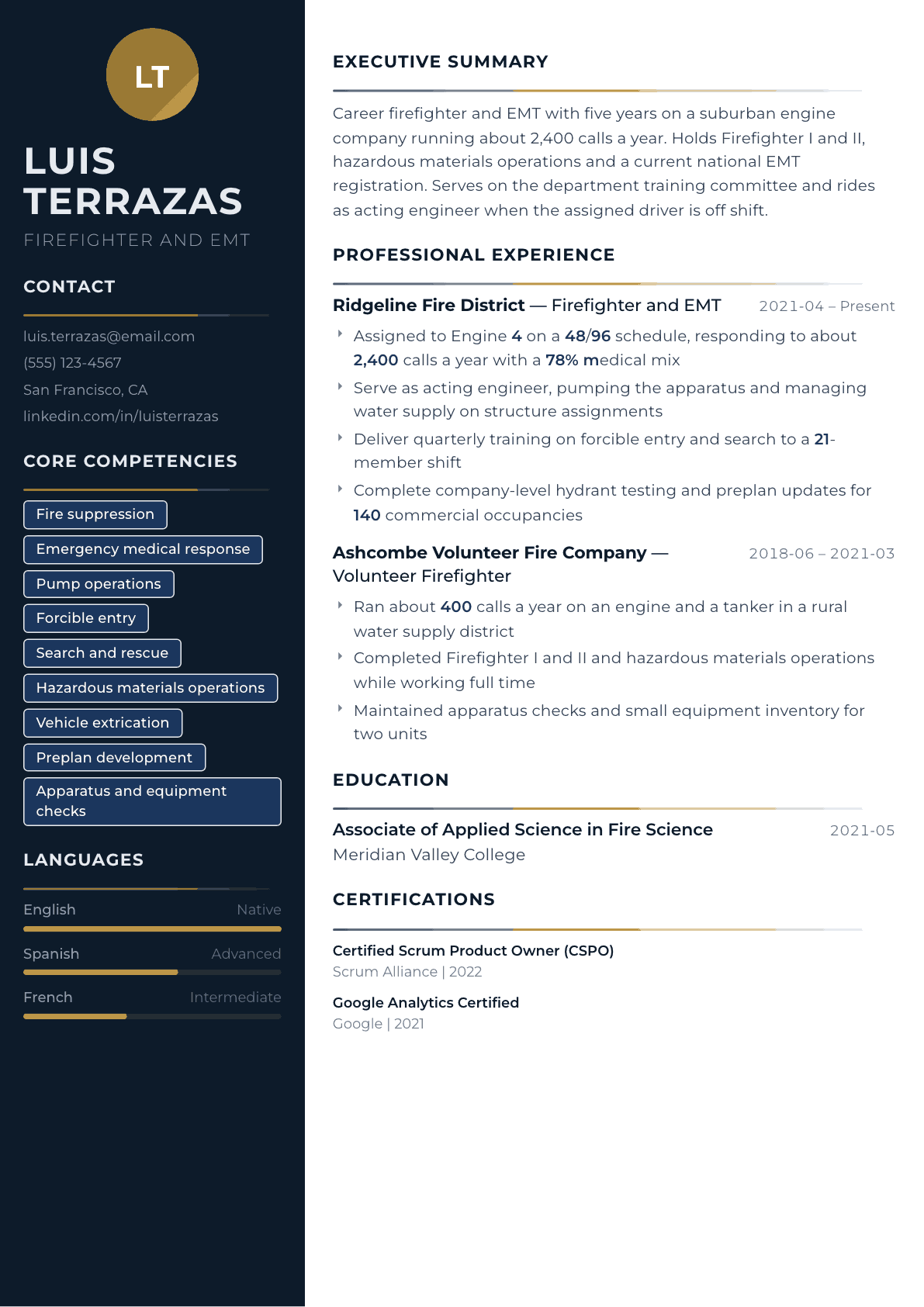
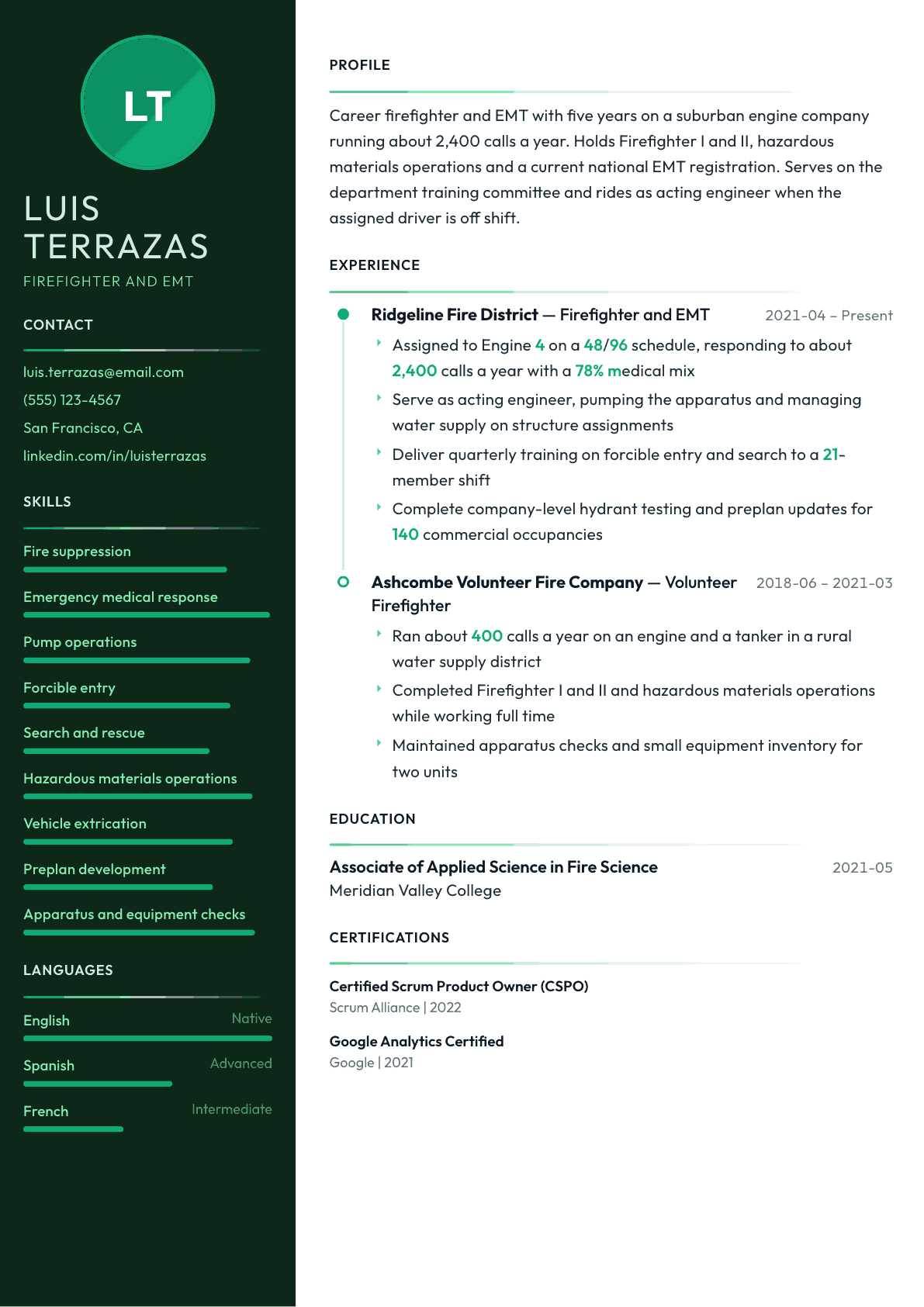
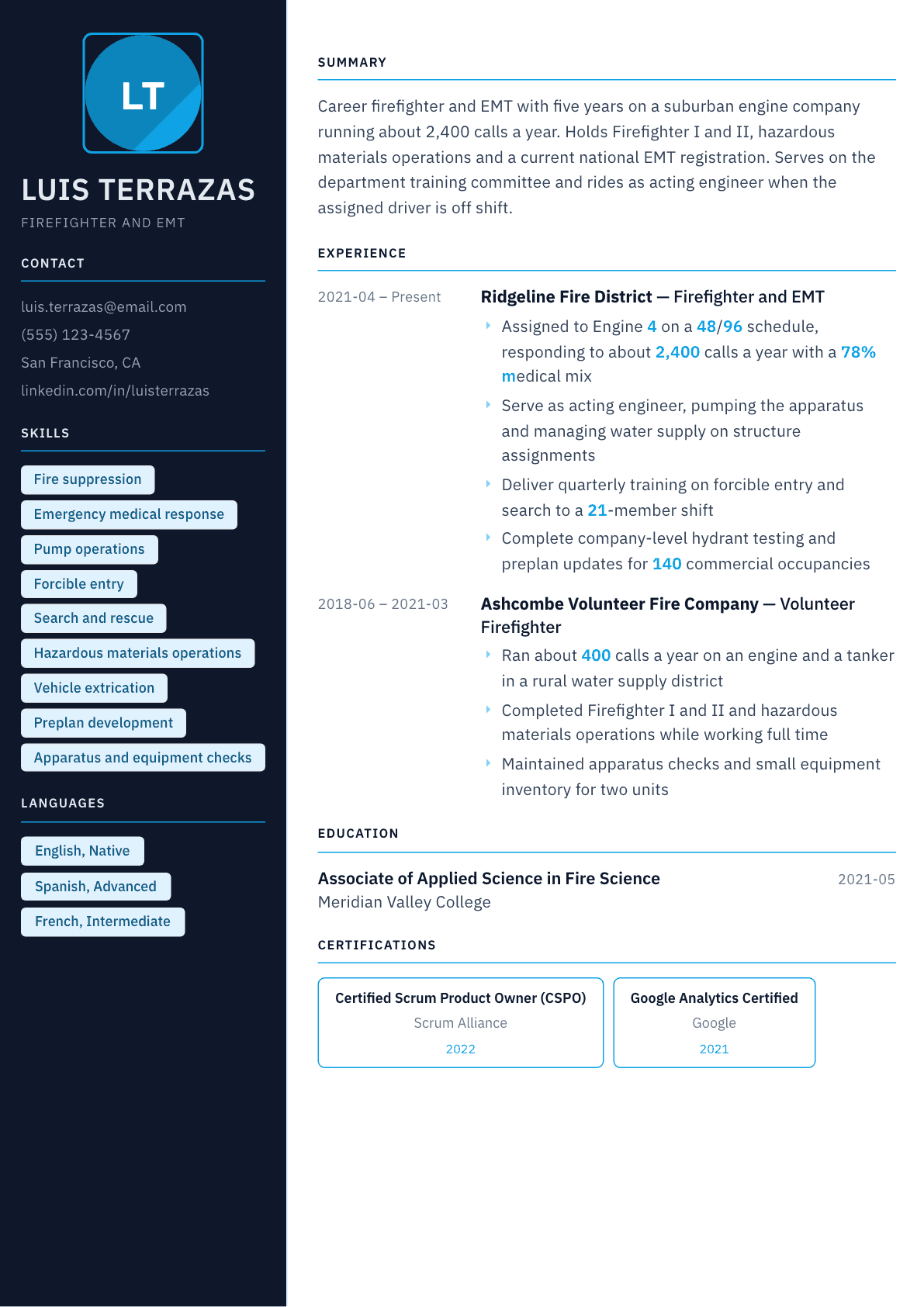
The same firefighter content laid out in three CVBooster templates, so you can see what the finished document looks like before you write a word.
Example Firefighter summary
Career firefighter and EMT with five years on a suburban engine company running about 2,400 calls a year, plus three earlier years as a volunteer in a rural water supply district. Holds Firefighter I and II, hazardous materials operations and a current national EMT registration, and rides as acting engineer. Delivers quarterly company training to a 21-member shift. Seeking a career firefighter position with a metropolitan department.
Skills to list on a Firefighter resume
- Fire suppression operations
- Emergency medical technician care
- Pump and apparatus operation
- Forcible entry
- Primary and secondary search
- Ventilation techniques
- Vehicle extrication
- Hazardous materials operations
- Rapid intervention team duties
- Hose deployment and water supply
- Preincident planning
- Fire hydrant testing
- Company level training delivery
- Self-contained breathing apparatus maintenance
What actually gets this resume read
- Put certifications in their own block with the issuing body and expiration date, because a board checks that first.
- Give annual call volume and the medical share, since the two numbers describe the work you have actually done.
- Name the apparatus you have ridden and any acting engineer or acting officer time you have logged.
- List physical ability test results and any candidate testing you have already passed for other departments.
- Include community risk reduction work such as inspections, preplans or public education, which boards ask about.
- Keep volunteer service on the resume with its call volume, because it is real experience a hiring board counts.
How to write a firefighter resume
Firefighter hiring is a process rather than a decision. An application is scored, a written test and a physical ability test follow, then an oral board, a background investigation, a medical and a psychological evaluation. Your resume sits at the front of that pipeline, and its job is narrow: prove you meet every posted minimum, then give the oral board something specific to ask you about.
That makes the certification block the most important part of the page. Firefighter I and II, hazardous materials operations, emergency medical certification and their issuing bodies get checked against the posting before anyone reads a bullet. A resume that scatters those credentials through the job descriptions makes a reviewer hunt, and a reviewer with two hundred files does not hunt.
This guide covers the format a fire department reviewer expects, how to write call volume and company work, how to present volunteer and part-time service honestly, and the questions candidates ask when they are testing with several departments at once.
Format: certifications in a block, everything else in service of them
One page for candidates, two once you have a decade on the job. Under the name goes the target title, then a summary of three lines, then the certification block, then experience. The certification block sits high because it is the pass or fail gate for the application.
List each credential with its issuing body and its expiration or renewal date. A reviewer needs the accrediting organization, not just the course name, because reciprocity between states depends on which body issued it.
- Certification block: firefighter levels, hazardous materials level, medical certification, technical rescue disciplines, each with issuer and date.
- Every position gets a scope line: department type, apparatus assigned, shift schedule, and annual call volume with the medical share.
- Physical ability test results and any candidate testing already passed go in their own short line.
- Volunteer service is listed as employment with its call volume, never as a hobby section at the bottom.
Call volume, apparatus and the shape of your experience
Annual call volume with the medical proportion tells a reviewer what your days have looked like. An engine company running about 2,400 calls a year at a high medical mix is a different candidate from one running 400 calls in a rural district, and both have value, but only if the numbers are stated.
Name the apparatus you have ridden and any seat you have covered. Acting engineer time, acting officer time and riding a truck company rather than an engine all describe capability a department can use immediately, and they are common oral board questions.
Add the district type. Mixed commercial, residential, rural water supply, industrial or wildland interface all shape what a firefighter has actually seen, and a department hiring for its own risk profile is looking for the closest match it can find.
The work between calls, which most candidates leave out
A firefighter spends far more hours on training, maintenance, inspections and preplanning than on fire attack, and departments know it. Company level training you delivered, hydrant testing, preplan updates for commercial occupancies, apparatus checks and small equipment inventory all belong on the page.
Community risk reduction is increasingly weighted in hiring. Public education, smoke alarm programs, school visits and station tours show a candidate who understands the modern job rather than only the emergency half of it.
If you have taken on a collateral duty, name it: training committee, safety committee, recruitment, apparatus specification, or maintaining a piece of the department program. Collateral work is how a department judges who will become an officer.
Volunteer, part-time and the path into a career department
Volunteer service counts and should be written exactly like paid work: department, position, dates, call volume, apparatus. Many career firefighters started there, and reviewers read it as evidence of commitment rather than as a lesser form of experience.
If you funded and completed your own certifications while working another job, say so in a single clause. It answers a motivation question the oral board will ask and demonstrates the same persistence the academy demands.
Where your paid work has been outside the fire service, keep the parts that transfer: physical trades, emergency medical work, mechanical skills, customer contact under stress. Cut the rest to a line so the page stays focused on the fire service case.
Preparing the page for a background investigation
Everything on a firefighter resume gets verified. Dates, certifications, call volumes, education and every employer. Write only what you can prove with a record, because a background investigator finding an inflated number ends the process regardless of how good the rest of the file is.
Keep employment gaps explained in a neutral line and keep your dates exact to the month. Investigators build a timeline, and small inconsistencies between the resume and the personal history statement create work that reflects badly on you.
Have your certification cards, transcripts and test results organized before you apply. Departments often ask for them within days of the written test, and a candidate who can produce them immediately moves through the pipeline faster.
Firefighter resume summary examples
Certified candidate, no career time
Certified firefighter candidate holding Firefighter I and II, hazardous materials operations and a current emergency medical technician registration, all completed while working full time. Three years volunteering on an engine and tanker in a rural district running about 400 calls a year. Passed the candidate physical ability test.
Five years career
Career firefighter and emergency medical technician with five years on a suburban engine company running about 2,400 calls a year at a 78% medical mix. Rides as acting engineer, delivers quarterly company training to a 21-member shift, and maintains preplans for 140 commercial occupancies.
Twelve years, testing for officer
Firefighter and paramedic with twelve years in a metropolitan department, assigned to a truck company in a dense commercial district. Serves on the training committee, instructs recruit classes in forcible entry and search, and holds technical rescue certification in rope and confined space. Testing for lieutenant this cycle.
Work experience bullets: before and after
Before: Responded to fire and medical emergencies as part of an engine company.
After: Assigned to Engine 4 on a 48/96 schedule, responding to about 2,400 calls a year with a 78% medical mix across a mixed residential and commercial district.
Apparatus, schedule, annual volume, call mix and district type give a reviewer the whole shape of your experience in one line.
Before: Operated the fire apparatus when needed.
After: Served as acting engineer on 40 shifts, pumping the apparatus and managing water supply on structure assignments including two working fires.
A shift count and named responsibilities make acting time verifiable, and it is a standard oral board question.
Before: Participated in regular department training.
After: Delivered quarterly company training on forcible entry and search to a 21-member shift, documenting attendance and skill checks for the training officer.
Delivering training with a headcount and documentation shows officer potential, where attending training shows nothing.
Before: Helped with fire prevention activities in the community.
After: Completed hydrant testing and preplan updates for 140 commercial occupancies, and ran station tours and smoke alarm installs during fire prevention week.
Community risk reduction with counts covers a part of the modern job that many candidate resumes leave blank.
Before: Maintained equipment and kept the apparatus ready for service.
After: Completed daily apparatus and self-contained breathing apparatus checks, tracked small equipment inventory for two units, and cleared every deficiency before the shift went in service.
The specific checks and the standard held describe readiness discipline rather than routine housekeeping.
Hard skills
- Fire suppression and hose deployment
- Pump and apparatus operation
- Forcible entry
- Primary and secondary search
- Ventilation techniques
- Vehicle extrication
- Hazardous materials operations
- Emergency medical care at technician level
- Rapid intervention team duties
- Preincident planning and hydrant testing
- Self-contained breathing apparatus maintenance
- Company level training delivery
Soft skills
- Working inside a crew where trust is the safety system
- Staying disciplined on the two hundredth routine call
- Talking to people on the worst day of their year
- Taking correction from an officer without friction
- Sleeping, waking and performing at any hour
Certifications worth listing
- Firefighter I and II (International Fire Service Accreditation Congress)
- Hazardous Materials Operations (National Board on Fire Service Professional Qualifications)
- Emergency Medical Technician (National Registry of Emergency Medical Technicians)
- Candidate Physical Ability Test (International Association of Fire Fighters)
Mistakes that cost firefighter candidates the interview
- Scattering certifications through job descriptions instead of grouping them where a reviewer checks them.
- Naming a certification without its issuing body, which is the detail reciprocity depends on.
- Leaving out annual call volume, so a reviewer cannot judge how much work you have actually seen.
- Listing volunteer service at the bottom as an activity rather than as employment with real numbers.
- Writing only about emergency response and ignoring training, inspections and preplanning.
- Rounding numbers upward on a page that a background investigator will verify line by line.
Firefighter resume questions
How long should a firefighter resume be?
One page while you are a candidate, two once you have a decade of career service and officer or instructor work. Many applications also require a separate personal history statement, so keep the resume tight and let that document carry the exhaustive detail.
Does volunteer experience count for career hiring?
Yes, particularly when you give call volume, apparatus and the district type. Reviewers use it to judge exposure and commitment, and candidates who present it as real experience with numbers score better than those who mention it in passing.
Should I list every technical rescue class I have taken?
List the ones you are certified in with the issuing body, and group short awareness level classes into a single line. A long list of unaccredited courses dilutes the block a reviewer is scanning for accredited certifications.
How do I apply to several departments at once?
Keep one master document and adjust the summary and the certification order for each posting, matching the department type and risk profile. Track application dates, test dates and document requests carefully, because the processes run on fixed deadlines that do not move.
What if I do not have my medical certification yet?
Apply anyway where the posting allows it, and list the course you are enrolled in with the expected completion date. Many departments hire candidates who will certify before or during the academy, but only when the timeline is clearly stated.
Related resume examples
- Paramedic Resume example
- Fire Chief Resume example
- Fire Captain Resume example
- Combat Medic Resume example
- Security Guard Resume example
- Military Resume example