Resume Review: The Order to Check Things In
By Mustafa Tarabya, founder of CVBooster · Published · Updated
12 min read
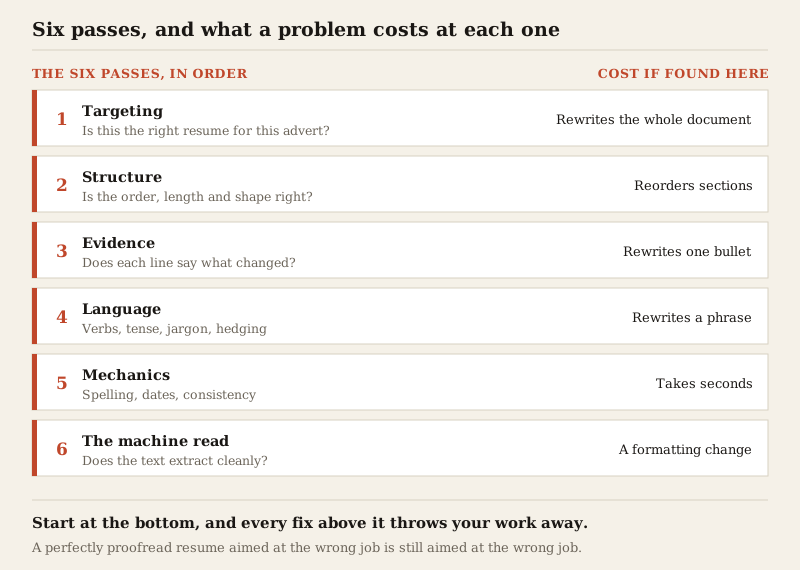
A resume review means reading your own document six times, each time for one thing, in a fixed order: targeting, structure, evidence, language, mechanics, then the machine read. The order is the whole method, because each pass can invalidate the work of every pass after it.
Most self-reviews fail for one reason. People open the file, start at the top, and begin fixing whatever they notice — a comma here, a stronger verb there — and forty minutes later they have polished a document that is aimed at the wrong job. Every one of those edits was thrown away the moment the real problem was found.
Why does the order matter?
Because the passes are not independent. They sit in a hierarchy, and the cost of a problem depends entirely on where in that hierarchy it lives.
If the targeting is wrong — if this resume is aimed at a job the advert is not describing — then the summary, the skills section, the order of the bullets and most of the wording all change. Everything below the problem gets rewritten. If a bullet has no evidence in it, the fix rewrites one line. If a comma is wrong, the fix takes two seconds and touches nothing else.
So work top-down. Find the expensive problems while they are still cheap to fix, and only proofread text that has survived every earlier decision. That is the whole argument, and it is why the last pass is the one everybody starts with.
Pass one: is this the right resume for this job?
Put the advert next to the document and answer three questions honestly.
- If a stranger read this resume with the advert covered up, what job would they say you were applying for? If the answer is not the job in the advert, stop here. Nothing else on this page matters yet.
- Which of the advert's stated requirements are answered somewhere in the top third of page one? Not answered anywhere — answered where a hurried reader will find them.
- What is on this resume purely because it was on the last version? Every tailored resume accumulates leftovers, and leftovers are the space your relevant experience needed.
The most common finding at this stage is not an error, it is drift: a resume written for a role you were applying for in March, quietly reused since. The fix is a rewrite of the summary and a reorder of the bullets, which is half an hour of work and worth more than everything in passes two to six combined. Tailoring a resume to a job application covers how to do the tailoring itself.
Pass two: does it hold together structurally?
Now stop reading the words. Zoom the document out until you cannot read it, or print it and stand back, and look only at the shape.
- Can you tell where the sections are without reading them? If the headings do not survive being blurred, they are not doing their job.
- Is anything important below the fold of page one? A reader's attention is not distributed evenly and the bottom of page two is close to unread.
- Is the page count defensible? One page early in a career, two once there is enough to say, and a third only for academic or specialist formats.
- Is the white space even? A page with three dense paragraphs and a large empty block at the bottom reads as unfinished before a word has been read.
- Does every job entry have the same shape — same order of title, employer, dates, location? Inconsistency here is read as carelessness even when the reader cannot say why.
This is also the pass where you decide whether the format itself is right for your situation, which is a bigger question than layout. The resume format guide covers the three formats and when each one genuinely helps.
Pass three: does every line carry evidence?
Now read the words, one bullet at a time, and ask a single question of each: what changed because this person was there? If the bullet answers only what they were responsible for, it is describing a job description rather than a person.
Weak: "Responsible for managing the customer support inbox." That is a duty. Any of the four people who held that job could have written it.
Rewritten: "Rebuilt how the support inbox was triaged after complaints about response times; first-reply time went from two days to under four hours and stayed there." Same job, and now it is about a decision somebody made.
Weak: "Excellent communication skills demonstrated across multiple stakeholder groups." Unfalsifiable, and it takes a line that could have carried a fact.
Rewritten: "Ran the monthly service review with our nine largest clients, including the two that had escalated." The communication claim is now implied by something checkable, which is the only way that kind of claim is worth making.
Tip: A test for this pass. Cover the employer name and the job title, and read a bullet on its own. If it could belong to anybody who has ever held that title, it is not evidence. It is a role description you have transcribed.
Not every bullet can carry a number, and inventing one is the worst possible outcome of this pass. Where there is no number, be specific instead: what you changed, who it affected, what happened afterwards. Specificity is the goal; numbers are just one form of it.
Pass four: is the language doing any work?
This pass is fast, because by now the content is settled and you are only choosing words.
- Does every bullet start with a verb that describes a specific action? "Rebuilt", "negotiated", "filed" are actions. "Responsible for", "involved in", "helped with" are positions in an organisation chart.
- Are the tenses consistent — past for previous roles, present for the current one — and consistent within each entry? The resume tense guide covers the tricky cases.
- Is there jargon that only your last employer understood? Internal system names, project codenames and team names mean nothing to a reader and cost you a line each.
- Is anything hedged? "Assisted in helping to support" is three verbs describing no action at all.
- Is any sentence longer than about two lines? On a resume that is a paragraph, and it will be skimmed rather than read.
One caution about verb lists. Reaching for an unusual verb because it sounds impressive — "spearheaded", "orchestrated", "championed" — usually makes a small thing sound inflated rather than making it sound bigger. The plain verb is nearly always better. Resume action verbs has the fuller treatment.
Pass five: mechanics
Only now. Spelling, dates, punctuation consistency, capitalisation, phone number, email address, the spelling of your own name, and — the one that ends applications — the name of a different company left in from the last version.
The single most useful technique here is to break the reading order your brain has memorised: read it bottom to top, one line at a time, so that each line arrives without context. Errors you have read past forty times become visible immediately. Resume proofreading covers this pass properly, including the errors spellcheck cannot catch because they are real words in the wrong place.
Pass six: does it survive being read by software?
Last, because it is a formatting question and formatting should not be settled until the content is.
The test takes fifteen seconds and needs no tool. Open the finished PDF, select all, copy, and paste into a plain text editor. What you are looking at is roughly what software reads. Check that your name and contact details come out first and in order, that the section headings are still recognisable, that nothing has been reordered across columns, and that nothing has vanished — a contact block placed in a Word page-header region often disappears entirely, which is covered in the resume header.
Then check the file itself: a sensible filename with your name in it, a PDF unless the advert asks for something else, and no password protection. What ATS software actually does explains the mechanism underneath all of this.
What does a good reviewer actually look for?
The problem with asking someone to review your resume is that "what do you think?" is an invitation to line-edit. You will get commas back. Commas are the cheapest possible feedback and you can find them yourself.
Ask instead for the things you cannot get on your own, which are all judgements about a first impression you can no longer have. Send the advert with the resume, and ask exactly these four questions.
- "After reading this for twenty seconds, what job do you think I am applying for?" This tests targeting from the outside, and it is the most valuable question on the list.
- "Which line did you not quite believe?" People are surprisingly good at spotting an inflated claim and will almost never volunteer it unasked.
- "Where did you stop reading, or start skimming?" That point is where your document actually ends, whatever is below it.
- "What would you ask me about in an interview?" If the answer is not the thing you most want to be asked about, that thing is not prominent enough.
Two reviewers are better than one, and they should be different kinds of person. Someone in your field can tell you whether a claim is impressive or ordinary, and whether you have used the word the industry uses. Someone outside it can tell you whether the document is comprehensible, which is exactly the test a first-round recruiter applies, because that recruiter is very often not a specialist either.
And take structural feedback more seriously than wording feedback, even when the wording feedback is more confident. People find it easier to say "I would use a different word here" than "I could not tell what you do", so the second is usually buried in a hesitation rather than stated.
What can automated resume checkers tell you?
Some genuinely useful things, and it is worth being precise about which, because the category is oversold in both directions.
- Whether the text extracts cleanly from your file. This is the single most useful thing a tool does, and it is a real mechanical fact rather than an opinion.
- Whether the standard sections can be identified, and whether your contact details and dates are being read as fields rather than as prose.
- Which words from a job advert do not appear anywhere in your resume. Useful as a prompt for things you genuinely have and forgot to mention.
- Length, and mechanical measures like sentence length or an unusually low count of action verbs.
- File-level problems: an image-only PDF, an unusual file type, a password, a filename that says "resume-final-v3".
And here is the part that is worth saying plainly. A checker cannot tell you whether anything on your resume is true, whether your evidence is any good, whether the achievement you are proudest of is impressive in your field, whether this is the right job for you, or whether a human being will find you interesting.
It also cannot tell you how a particular employer's system is configured. Applicant tracking systems are set up per company and often per vacancy, by the people doing the hiring, and none of that configuration is visible from outside. Which means a score out of a hundred is the tool's own scale, computed by the tool's own rules. It is not a number any employer sees, and no vendor has access to the settings that would let it be one. Treat a score as a prompt to look at something, never as a grade.
The failure mode this creates is specific and common: chasing the score. Keywords get stuffed in to raise a number, and the resume gets worse for the human who eventually reads it, because keyword density is not a thing readers value. Use the missing-keyword list as a memory aid for skills you actually have — Which skills to put on a resume covers where the line sits — and ignore the score itself.
Free CV review in the UK: where to get one
A free CV review in the UK is easiest to get from a public careers service, your university careers team or an automated checker, and each one reviews a different part of the six passes above. A free CV review is the same exercise as a resume review, only with the British name for the document. What changes is who reads it and what they are able to tell you.
- The National Careers Service in England offers free advice from careers advisers, including help with your CV; Scotland has My World of Work, Wales has Careers Wales and Northern Ireland has the Careers Service. An adviser is good at passes one and two: is this the right CV for the job, and does it hold together
- University careers services review CVs for current students and, at many universities, for recent graduates; they know which employers recruit from your course
- If you claim Universal Credit or another benefit, your Jobcentre work coach can look over your CV and point you to local support
- An automated checker covers pass six. CVBooster's free account gives you an ATS score and a keyword gap list against a job advert, alongside manual CV filling; the AI rewrite, templates and the finished CV are part of Pro
- Many CV writing services offer a free CV review that ends with a quote for a rewrite. The feedback can still be useful; read it as a sales letter with some advice inside
Whichever free review you use, bring the job advert. A reviewer who sees only the CV can tell you whether it reads well, never whether it fits. If you want a UK layout to check against, our CV examples show the order a strong CV follows, and the free ATS resume checker guide explains what the machine read can and cannot see.
One entry, taken through all six passes
The starting version, invented as an example: "Customer Service Rep, Loopfern, 2021-2024. Responsible for handling customer enquiries via email and phone. Assisted in helping to improve team processes. Excellent communication skills. Utilised Zendesk and internal CRM tool (FERNBASE) on a daily basis."
Pass one, targeting. The advert is for a support team lead. Nothing in this entry mentions anyone being led, and the entry sits third on the page behind two older jobs. Both are structural problems and both are found before a single word is edited.
Pass two, structure. The role moves to the top of the experience section. The dates need months, because "2021-2024" could mean thirteen months or forty-seven.
Pass three, evidence. "Responsible for handling enquiries" is a duty. What actually happened is that she reorganised how the inbox was triaged and reply times fell. "Assisted in helping to improve team processes" is hiding the only thing on the entry that speaks to leading a team: she trained the two people who joined after her.
Pass four, language. "Responsible for", "assisted in helping to" and "utilised on a daily basis" all go. "Excellent communication skills" goes, because pass three has now given it something to stand on.
Pass five, mechanics. FERNBASE means nothing outside that company and becomes "internal CRM". The date range is fixed and the dash style is made consistent with the rest of the page.
Pass six, the machine read. The entry pastes out cleanly in the right order, so nothing changes.
The result: "Customer Support Representative, Loopfern, March 2021 - June 2024. Rebuilt inbox triage after complaints about response times; first-reply time went from two days to under four hours and held there for the following year. Trained the two representatives who joined after me, and wrote the onboarding notes the team still uses. Handled around sixty enquiries a day by email and phone. Zendesk and an internal CRM."
Four lines instead of five, and every one of them is now something an interviewer can ask a follow-up question about. Note that no new facts were invented at any stage. Everything in the final version was already true of the job; it was buried under language that described the role instead of the person.
The review, as a checklist
- A stranger reading it with the advert covered would name the right job.
- The advert's main requirements are answered in the top third of page one.
- The sections are identifiable at a glance, with even white space and a consistent entry shape.
- Every bullet says what changed, not what you were responsible for.
- Every bullet starts with a plain, specific verb, and the tenses are consistent.
- It has been read bottom to top for mechanics, and no other company's name survives from the last version.
- It pastes out of the PDF cleanly, with your name and contact details first.
- One person in your field and one outside it have answered the four questions above.
Six passes, and only one of them is proofreading. If you have time for a single pass before a deadline, make it the first one, because a well-proofread resume aimed at the wrong job is still aimed at the wrong job.
Related articles
- Accounting Executive Resume: 5 Examples by Career Level
- Administration Resume Examples: 8 Samples, Entry to Manager
- Aged Care Resume: 6 Australian Examples and a Template
- Another Word for Resume: CV, Bio and 10 More Options
More articles
- How to List Skills on a Resume (With 50+ Examples)
- Resume Skills Section: Layout and Placement
- Resume Summary Examples: 12 Opening Statements by Level
Looking for a worked example for your job title? Browse the resume examples by job title.