Finance Intern Resume Examples: the lines they read
Write a Finance Intern Resume With No Full-Time Experience Yet
By Mustafa Tarabya, founder of CVBooster · Published · Updated
Finance intern resume examples built from coursework, modeling projects and campus roles, with the keywords internship screeners and recruiters look for.
Sample resumes for a finance intern
The same finance intern content laid out in three CVBooster templates, so you can see what the finished document looks like before you write a word.
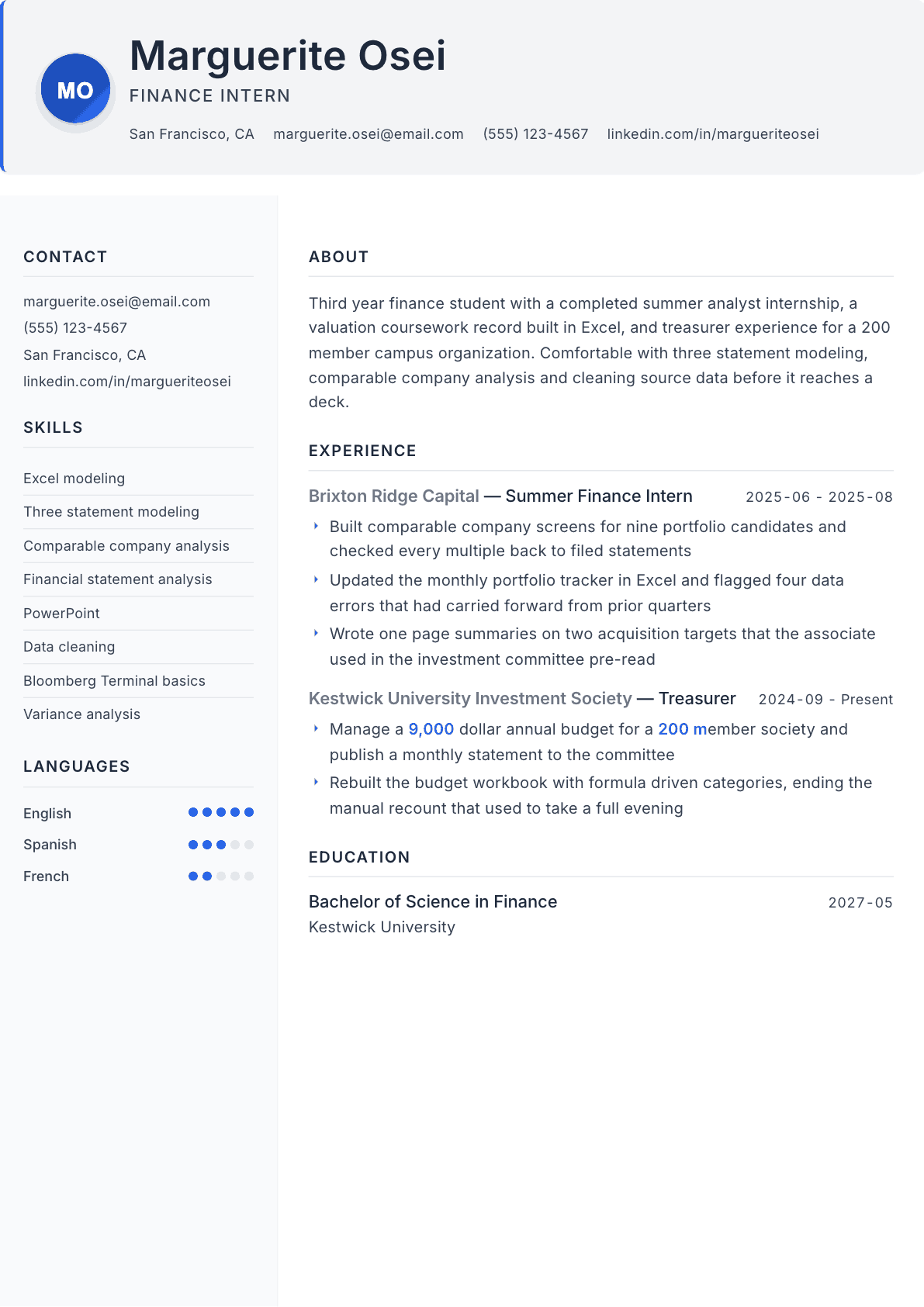
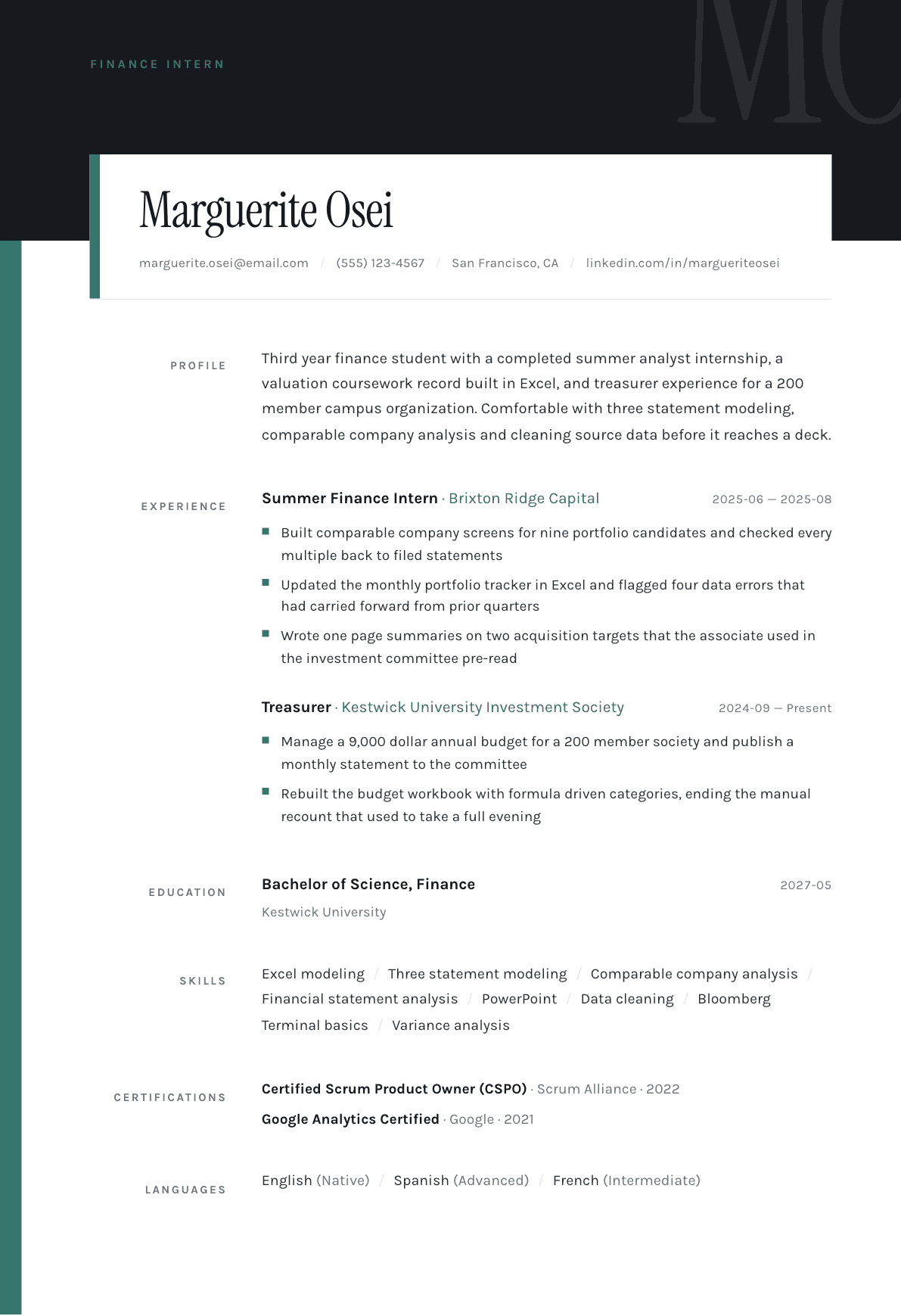
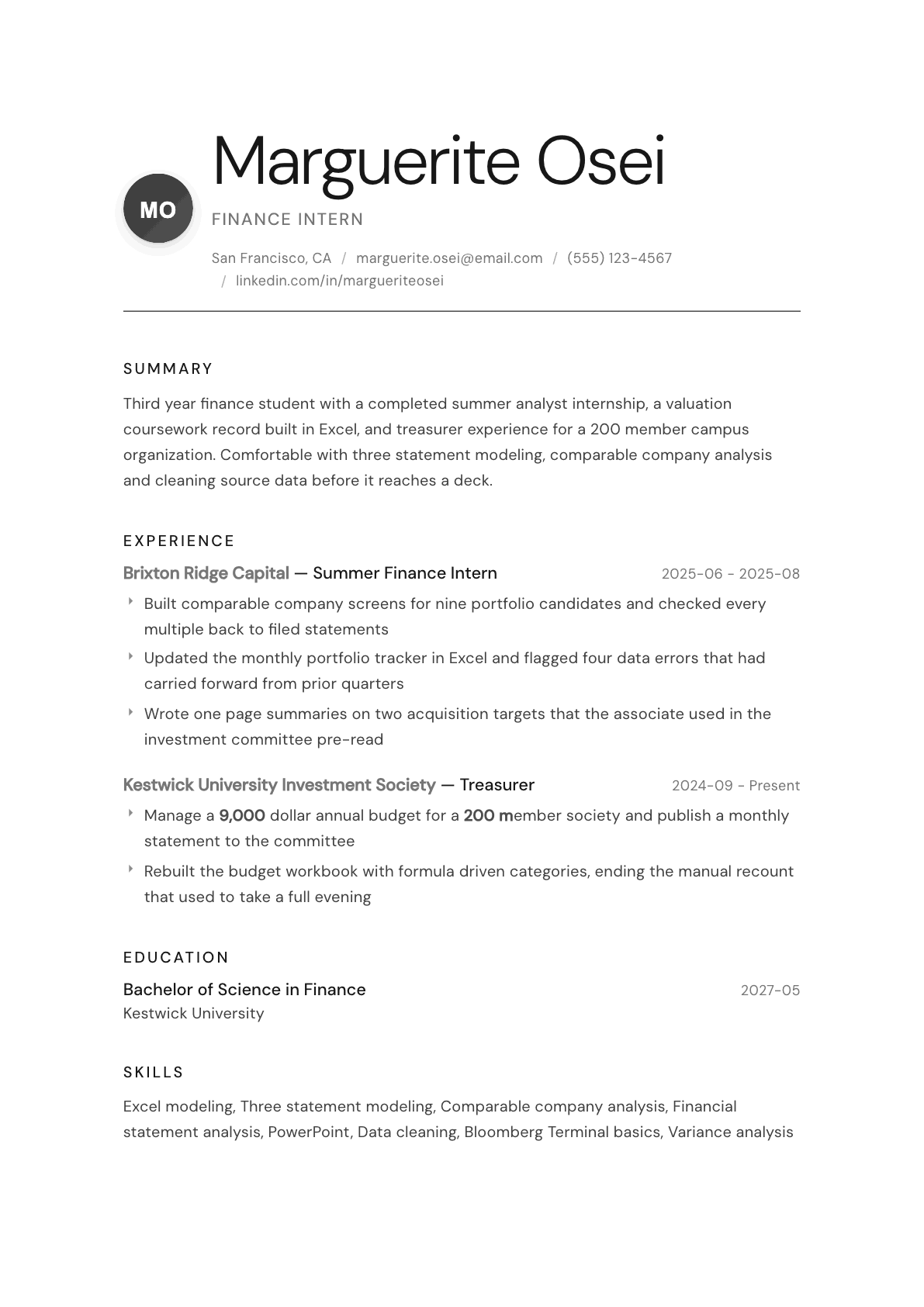
Example Finance Intern summary
Third year finance student seeking a summer analyst internship. Completed a summer program at an investment firm building comparable company screens and portfolio tracking in Excel, and serves as treasurer for a 200 member campus society. Coursework covers three statement modeling, valuation and financial accounting. Careful with source data and comfortable presenting a one page summary to people senior to me.
Skills to list on a Finance Intern resume
- Excel modeling
- Three statement modeling
- Comparable company analysis
- Discounted cash flow basics
- Financial statement analysis
- Variance analysis
- PowerPoint
- Data cleaning
- Bloomberg Terminal basics
- Accounting fundamentals
- Budget tracking
- Research and summarization
What actually gets this resume read
- Put education first with your expected graduation date, major, and any finance coursework the posting names directly.
- Turn coursework into projects with a company, a method and an output, because a named valuation exercise reads as real work.
- List Excel skills at function level, naming index match, lookups, pivot tables and any modeling you have actually built yourself.
- Include campus treasurer, case competition and student fund roles, since they are the closest thing to finance responsibility you have.
- Keep the resume to one page and remove high school entries once you are past your first year of university.
- Say which internship season you are targeting so a recruiter sorting hundreds of applications knows where your file belongs.
How to write a finance intern resume
A finance intern resume is judged on potential rather than track record, which sounds forgiving until you realize how narrow the evidence window is. The reader has your degree, your graduation timing, a handful of coursework lines, whatever campus responsibility you took on, and possibly one prior internship. Everything on the page has to earn its space against that constraint.
The people screening intern applications are usually early career analysts working through hundreds of files in a compressed recruiting window. They check graduation date, major, technical coursework and Excel evidence, in roughly that order, before they read a single bullet. If any of those is hard to find, your file loses the seconds it needed.
This guide covers the section order intern recruiters expect, three summaries for different stages of a student career, before and after bullets that turn coursework and campus roles into something a hiring team can assess, and the questions students ask most when they have never held a finance job.
Format: one page, education on top, no exceptions
One page, single column, reverse chronological within each section. Education goes first with your institution, degree, major, expected graduation month and year, and relevant coursework listed as a single line rather than a block. Grade point average is included when it is competitive and simply left off when it is not, without commentary either way.
Keep the layout plain. Intern applications flow through applicant tracking systems more often than students expect, and a two column layout with icons is the reason a perfectly good file arrives with the dates scrambled.
- Header: name, city, phone, email and a professional profile link. Nothing else.
- Sections: education, experience, projects, skills and interests, in that order.
- Expected graduation date is mandatory. Recruiters sort by it before they sort by anything else.
Summary: only if it says something a bullet cannot
A student summary is optional and only earns its lines when it establishes direction. Year of study, the internship season you are targeting, the finance area you are aiming at, and one honest technical strength is the entire useful content. If you cannot write it without describing yourself as passionate and hardworking, cut the summary and give the space to a project.
Direction matters more than students think. Investment banking, corporate finance, asset management and financial planning recruit on different timelines and screen for different evidence, and naming the target tells a reviewer which pile you belong in.
Experience and projects: give coursework a shape
Coursework becomes credible the moment it acquires a subject, a method and an output. Building a three statement model for a named public company from filed statements, running a comparable company screen and checking every multiple back to source, or preparing a discounted cash flow with a documented assumption page are all real analytical tasks, and they read as work rather than as attendance.
Campus responsibility counts, especially where money is involved. Treasurer of a society, portfolio member of a student investment fund, and case competition placements all involve decisions someone relied on. Write them with the same discipline as a job: what you owned, how large it was, and what you changed.
Any non-finance job you have held is worth keeping if you can write it in terms of reliability, accuracy or volume. A recruiter reading about reconciled cash drawers and inventory counts sees someone who handled other people's money carefully, which is not nothing when the alternative is a blank section.
Skills: be specific about Excel or do not mention it
Everyone writes Excel, so the word alone carries no information. State the functions and structures you use unaided: lookups, index and match, pivot tables, data tables, scenario toggles, or the fact that you have built a model with linked statements. If you have used a terminal, a database or a statistical package, name it and say at what depth.
Do not pad the section with software you touched once. Intern interviews frequently open with a technical screen, and a claim you cannot support in the first ten minutes costs more than the line ever gained.
- Excel at function level, plus any modeling you have built rather than copied.
- Data and research tools you have actually operated, with honest depth.
- Languages, and any certificate program you completed with the issuing body named.
Keywords intern postings screen for
Intern descriptions repeat a compact set of terms: financial modeling, valuation, comparable company analysis, discounted cash flow, financial statement analysis, variance analysis, forecasting, and the software names. Mirror the ones that are true of you inside a project or experience bullet where the evidence sits next to the phrase. A student who writes valuation once, attached to a named exercise, reads far stronger than one who lists it three times with nothing behind it.
Finance Intern resume summary examples
First or second year student
Second year finance student seeking a summer internship in corporate finance. Coursework covers financial accounting and corporate valuation, and I maintain the budget workbook for a campus society. Comfortable with lookups, pivot tables and building a clean assumption page before touching any output.
Penultimate year, one internship done
Third year finance student with a completed summer internship building comparable company screens and portfolio tracking in Excel, plus treasurer responsibility for a 200 member society. Coursework through three statement modeling and valuation. Targeting a summer analyst seat where model accuracy matters more than volume.
Final year, converting to full time
Final year finance student with two internships, the most recent supporting acquisition screening and investment committee pre-reads. Built the portfolio tracker still in use by the deal team and caught four carried-forward data errors. Seeking a graduate analyst position in corporate development or investment analysis.
Work experience bullets: before and after
Before: Took a corporate finance class and learned valuation.
After: Built a three statement model and discounted cash flow valuation for a listed retailer from filed statements, documenting every growth and margin assumption on a separate input page.
A named exercise with a method and a documentation habit turns a course listing into demonstrable analytical work.
Before: Helped the team with Excel work during my internship.
After: Updated the monthly portfolio tracker in Excel and flagged four data errors that had carried forward from prior quarters before the associate circulated the file.
Catching errors before distribution is a concrete contribution, and it shows the care that intern hiring is actually screening for.
Before: Treasurer of a student society.
After: Manage the annual budget for a 200 member society, publish a monthly statement to the committee, and rebuilt the workbook with formula driven categories that ended a manual recount.
Ownership, reporting cadence and a process improvement give a campus role the same structure as a professional one.
Before: Did research on companies for the investment team.
After: Wrote one page summaries on two acquisition targets covering revenue mix, customer concentration and margin trend, used by the associate in the investment committee pre-read.
Naming the analysis dimensions and where the output landed proves the research was used rather than filed.
Before: Worked part time as a cashier while studying.
After: Reconciled a cash drawer against the point of sale system at close each shift across two years of part-time work, with no unexplained variance recorded.
Reframing a retail job around accuracy and accountability makes it relevant evidence instead of filler.
Hard skills
- Excel modeling
- Three statement modeling
- Comparable company analysis
- Discounted cash flow analysis
- Financial statement analysis
- Variance analysis
- Budget tracking
- PowerPoint deck building
- Data cleaning and validation
- Research and summarization
- Accounting fundamentals
- Terminal and database research
Soft skills
- Accuracy under deadline
- Asking clarifying questions early
- Written brevity
- Receiving direct feedback
- Reliability on small tasks
- Working with people senior to you
Certifications worth listing
- Bloomberg Market Concepts (Bloomberg)
- CFA Institute Investment Foundations (CFA Institute)
Mistakes that cost finance intern candidates the interview
- Hiding the expected graduation date, which is the first field an intern recruiter sorts on.
- Listing course titles with no project, method or output attached to any of them.
- Writing Excel as a bare skill when the interview will immediately test which functions you actually use.
- Filling the page with adjectives about work ethic instead of a second concrete project.
- Applying to investment banking and corporate finance with an identical file, which reads as undirected to both.
- Keeping high school achievements past the first year of university, where they crowd out relevant material.
Finance Intern resume questions
What do I put on a finance intern resume with no experience?
Coursework rewritten as projects, campus roles that involved money or responsibility, and any job that demonstrates accuracy. A modeling exercise on a real company, a society treasurer position and a part-time job with reconciliation duties fill a page credibly without inventing anything.
Should I include my grade point average?
Include it when it is competitive for the roles you are targeting and leave it off otherwise, with no explanation. Recruiters at firms that filter on it will ask directly, and a strong technical project section does more to compensate than any note about coursework difficulty.
How long should a finance intern resume be?
One page, without exception, until you have several years of full-time experience. Intern reviewers work through large volumes in short windows, and a second page signals that you cannot prioritize, which is a poor first impression in this field.
Do I need modeling certificates to get a finance internship?
They help at the margin but never substitute for a model you built yourself. If you complete a program, list it with the issuing body and then show one exercise you produced afterward, because the output is what an interviewer will actually ask you to walk through.
How do I write about a class project without overstating it?
Describe exactly what you did and where the data came from. Saying you built a valuation from filed statements for a course assignment is honest and still impressive. Implying it was client work is the one thing that reliably ends an interview early.
Related resume examples
- Financial Analyst Resume example
- Accounting Intern Resume example
- Investment Analyst Resume example
- Budget Analyst Resume example
- Investment Banking Analyst Resume example
- Equity Research Analyst Resume example