Tax Preparer Resume Examples: free ATS score and gap list
Build a Tax Preparer Resume That Survives Season Hiring
By Mustafa Tarabya, founder of CVBooster · Published · Updated
Tax preparer resume example with return volume, form types and software bullets, PTIN placement, ATS keywords and a section by section guide.
Sample resumes for a tax preparer
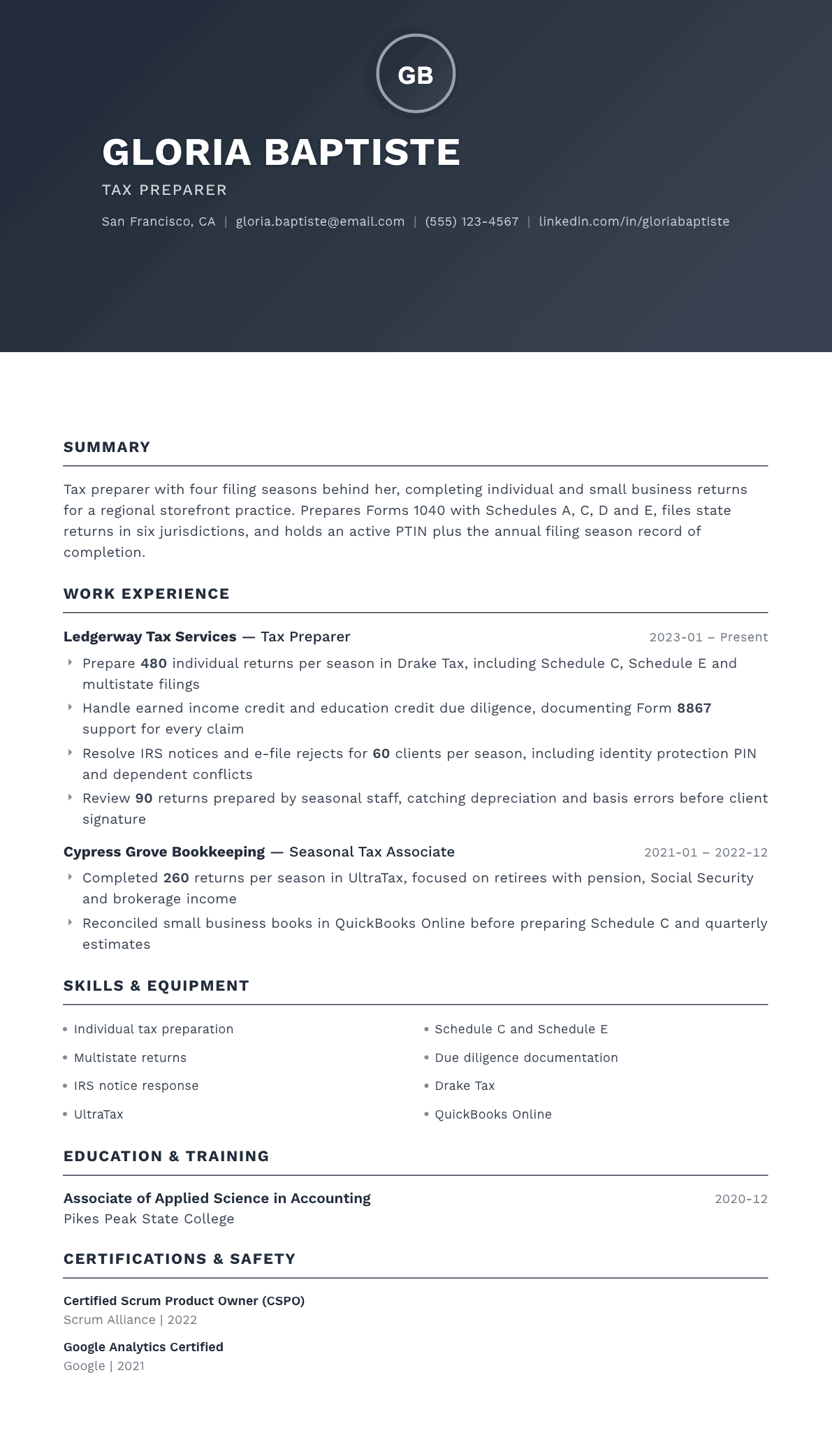
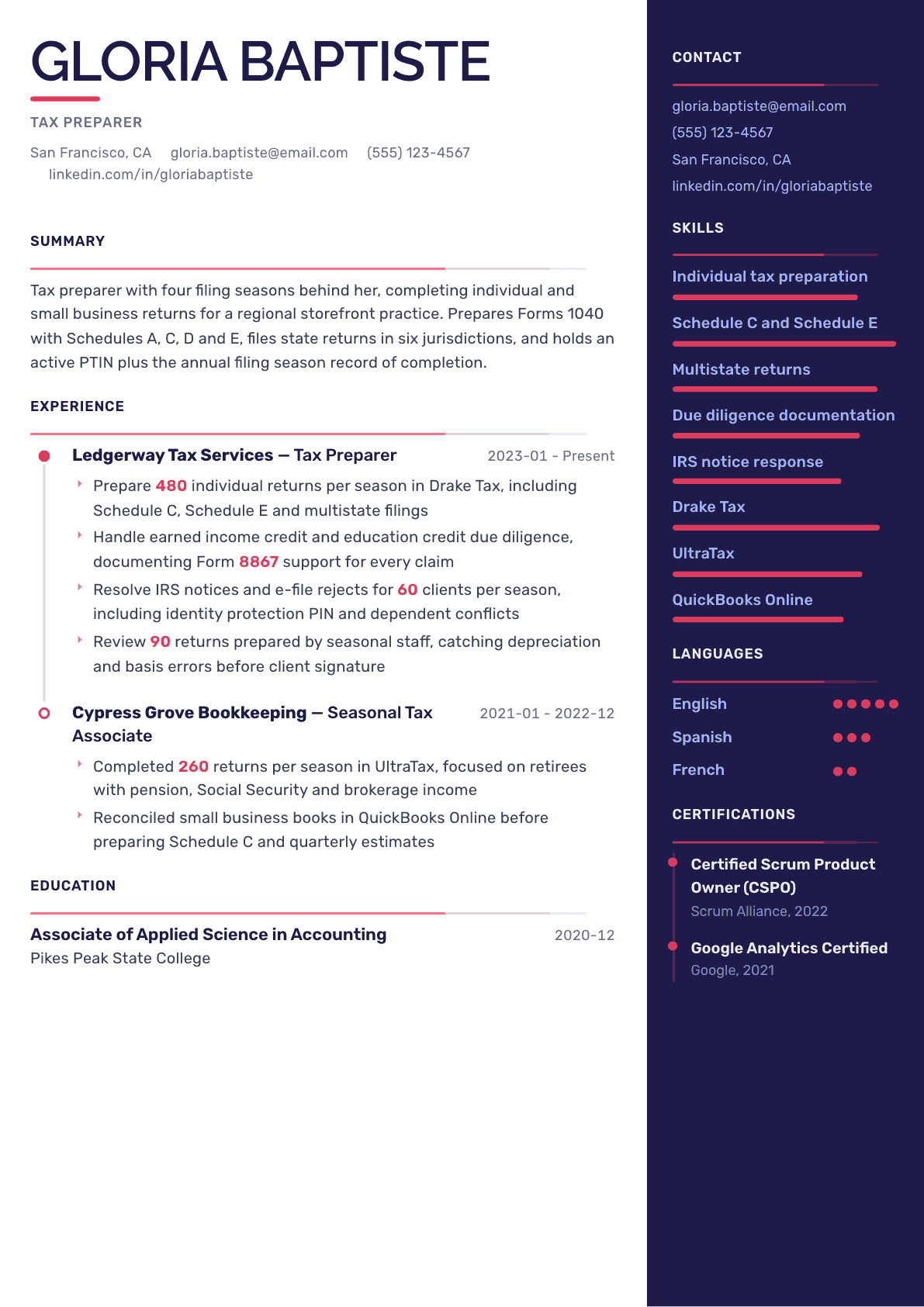
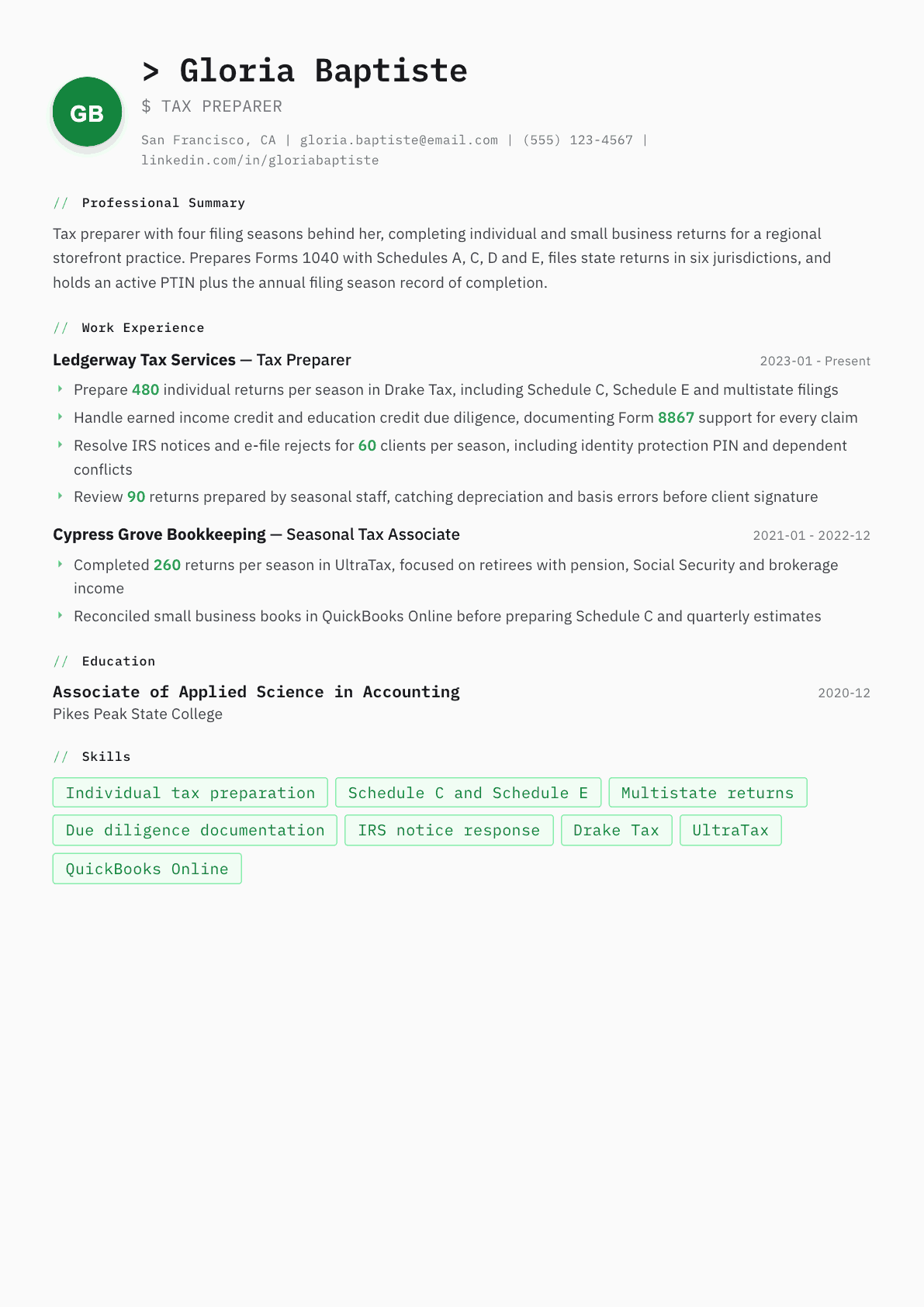
The same tax preparer content laid out in three CVBooster templates, so you can see what the finished document looks like before you write a word.
Example Tax Preparer summary
Tax preparer with four filing seasons preparing individual and sole proprietor returns for a regional practice. Completes roughly 480 returns a season in Drake Tax, covering Schedules A, C, D and E plus multistate filings, and documents refundable credit due diligence on every eligible return. Holds an active PTIN, resolves IRS notices for clients, and reviews seasonal staff work before signature.
Skills to list on a Tax Preparer resume
- Individual income tax preparation
- Form 1040 and schedules
- Schedule C small business returns
- Rental and Schedule E income
- Capital gains and basis tracking
- Multistate and part-year returns
- Refundable credit due diligence
- IRS notice and correspondence
- Estimated tax planning
- Drake Tax
- UltraTax
- Lacerte
- QuickBooks Online
- Client intake and document review
What actually gets this resume read
- Put your PTIN status and any annual filing season record of completion in the header, because a firm cannot hire you without it.
- Count the returns you prepared per season and split them by type, individual, sole proprietor, partnership or trust returns.
- Name the tax software you have actually keyed returns in, such as Drake, UltraTax, Lacerte, ProSeries or ProConnect.
- List the schedules and forms you handle confidently, since a firm staffing a season is matching your forms to their client mix.
- Show due diligence work on refundable credits and the notice responses you handled, as both prove you understand preparer liability.
- If you are working toward the enrolled agent exam or a CPA license, say which parts you have passed and the expected completion.
How to write a tax preparer resume
Tax preparer hiring runs on a compressed calendar. A firm staffing the season has weeks, not months, and reads every resume for one thing: how many returns can this person complete without a partner reworking them? The answer lives in your return count, the forms you handle and the software you already know.
The second filter is credential status. An active preparer tax identification number is not optional, and the annual filing season record of completion, an enrolled agent license or a CPA license change what a firm can let you sign and represent. Those facts belong at the top, not in a footnote.
This guide covers the section order a tax practice expects, how to describe return volume and complexity honestly, three summaries for different levels of preparer, before and after bullets, and the questions preparers ask when they want a better seat next season.
Format: one page, season by season
Keep the tax preparer resume to a page. A single column with a short credentials line under your name reads fastest, and applicant tracking systems used by regional firms handle it without dropping dates.
Because the work is seasonal, organize experience by filing season rather than by calendar employment where that is clearer. A preparer who lists four seasons with the return count for each is easier to evaluate than one who lists two employers and no volume.
- Header: name, city and state, phone, email, PTIN status and any license.
- Order: summary, software and forms, seasonal experience, education, continuing education.
- Give every season a return count and a return mix.
Summary: seasons, volume, and the returns you own
Three lines. Say how many filing seasons you have completed, the volume you carry, the return types, and your credential. A preparer who states four seasons, roughly five hundred individual returns a season, heavy on sole proprietors and rentals, has said more than a paragraph of adjectives ever will.
If you are entering the field from bookkeeping or accounts payable, name the transferable ground: reconciliations, depreciation schedules, payroll filings and the software you already use. Then state the credential you hold or are completing.
Experience: forms, complexity and review
Lead each season with the count and the mix. Then write bullets around complexity rather than activity. Multistate and part-year returns, Schedule C with depreciation and vehicle expense, Schedule E rentals with passive loss limitations, capital gains with basis reconstruction, retirement distributions and household employees all say something different about your ceiling.
Include the work that follows filing. Responding to notices, correcting e-file rejects, handling identity protection issues, amending returns and preparing estimated payment schedules show that you carry a client through the year rather than only through the appointment.
If you reviewed returns prepared by others, say how many and what you caught. Review capacity is the difference between a seasonal seat and a permanent one.
Due diligence and accuracy: the risk a firm is hiring against
Refundable credit due diligence is where preparer penalties live, so a firm reads carefully for evidence that you document support for earned income, child and education credits. Name the questions you ask, the records you keep and the form you complete.
Accuracy claims should be specific rather than boastful. A clean record on notices, a low amendment rate, or a review checklist you follow before a return goes out are all more convincing than calling yourself detail oriented.
Software and keywords
Name every tax package you have actually keyed returns in, whether Drake, UltraTax, Lacerte, ProSeries, ProConnect, ATX or TaxWise, and add the bookkeeping systems you clean up before preparing a business return. Then mirror the posting language once each: individual tax preparation, small business returns, multistate filings, notice response, estimated payments, client intake and document review. Support each with a bullet.
Tax Preparer resume summary examples
First filing season
Bookkeeper with an active PTIN and the annual filing season record of completion, moving into tax preparation. Prepared 90 simple individual returns during a volunteer program and reconciles small business books in QuickBooks Online. Comfortable with intake, document review and basic Schedule C work.
Four seasons in
Tax preparer completing about 480 individual returns per season in Drake Tax, covering Schedules A, C, D and E plus filings in six states. Documents refundable credit due diligence on every eligible return, resolves client notices, and reviews 90 returns prepared by seasonal staff before signature.
Enrolled agent and lead preparer
Enrolled agent with nine seasons preparing individual, partnership and S corporation returns for a small firm. Carries the complex files, including rental portfolios, basis reconstruction and multistate apportionment, represents clients in examination, and trains four seasonal preparers each January.
Work experience bullets: before and after
Before: Prepared tax returns for individual clients.
After: Prepared 480 individual returns per season in Drake Tax, including Schedule C sole proprietors, Schedule E rental portfolios and filings across six states.
Volume, software and return mix let a firm judge whether you can carry their client base.
Before: Made sure returns followed the rules for credits.
After: Completed earned income and education credit due diligence on 140 returns a season, documenting Form 8867 support and retaining the source records in the client file.
The count, the form and the retention practice show real penalty exposure being managed.
Before: Helped clients who received letters from the IRS.
After: Resolved 60 client notices and e-file rejects per season, including dependent conflicts, identity protection PIN issues and underreported brokerage income, drafting the written response for each.
Naming the notice types proves range, and drafting the response shows ownership through resolution.
Before: Checked other preparers work during busy season.
After: Reviewed 90 returns prepared by seasonal staff, catching depreciation method errors, missing basis on inherited stock and misclassified home office expense before client signature.
The specific errors caught demonstrate technical depth, which is what review capacity really tests.
Before: Used accounting software to prepare business returns.
After: Reconciled small business books in QuickBooks Online before preparing Schedule C, adjusting owner draws, unrecorded loans and personal expenses so the return tied to the trial balance.
It shows the cleanup work that precedes the return, which most preparer resumes leave out entirely.
Hard skills
- Individual income tax preparation
- Form 1040 and supporting schedules
- Schedule C sole proprietor returns
- Schedule E rental and passive activity
- Capital gains and basis tracking
- Multistate and part-year filings
- Refundable credit due diligence
- Notice response and amended returns
- Estimated tax planning
- Depreciation and vehicle expense
- Drake, UltraTax and Lacerte
- QuickBooks Online cleanup
Soft skills
- Client interviewing
- Explaining a balance due calmly
- Working long seasonal hours
- Document chasing without friction
- Accuracy under deadline
- Confidentiality
Certifications worth listing
- Annual Filing Season Program Record of Completion (Internal Revenue Service)
- Enrolled Agent (EA) (Internal Revenue Service)
- Certified Public Accountant (CPA) (State Board of Accountancy)
- Accredited Tax Preparer (ATP) (Accreditation Council for Accountancy and Taxation)
- QuickBooks Online Certified ProAdvisor (Intuit)
Mistakes that cost tax preparer candidates the interview
- Leaving out the return count, which is the one number a firm uses to plan season staffing.
- Not naming the tax software, since a preparer fluent in the firm package starts producing on day one.
- Listing only simple returns when you have handled rentals, basis and multistate work that would move you up a tier.
- Omitting PTIN status, which forces the hiring firm to ask before they can even schedule you.
- Describing client service in general terms rather than the notice work, amendments and planning you actually delivered.
- Presenting a seasonal history as a series of short jobs with no volume, which reads as instability instead of the normal rhythm of the trade.
Tax Preparer resume questions
Do I need a PTIN listed on my tax preparer resume?
List the status rather than the number itself. Saying that you hold an active preparer tax identification number and, if applicable, the annual filing season record of completion tells the firm you can be scheduled without a delay for registration.
How do I count returns if I only assisted on some of them?
Separate the two figures. Report returns you prepared and signed, then report returns you supported or reviewed as a distinct number. Inflating a single combined count is the fastest way to lose credibility in a technical interview.
Is seasonal-only experience a problem on a resume?
No, because seasonal work is how the industry staffs. Present each season as its own line with the return count and mix, and describe the off-season work you did, whether bookkeeping, payroll, notice resolution or planning appointments.
Should I mention that I am studying for the enrolled agent exam?
Yes, and say which parts you have passed. Firms weigh candidates on where they will be next season, so a preparer partway through the examination series reads as an investment rather than a temporary hire.
What makes a tax preparer resume stand out to a small firm?
Complexity and reliability. Show the harder returns you handle, the notices you closed and the review work you carried, then make the availability window explicit so the partner can see you cover the weeks they need most.
Related resume examples
- Tax Accountant Resume example
- Bookkeeper Resume example
- Tax Manager Resume example
- Staff Accountant Resume example
- Accounting Intern Resume example
- CPA Resume example