Pricing Analyst Resume Examples: the lines they read
Build a Pricing Analyst Resume Around Margin Decisions
By Mustafa Tarabya, founder of CVBooster · Published · Updated
Pricing analyst resume examples with elasticity, discount governance and margin bullets, plus a guide to the analytics keywords pricing teams screen for.
Sample resumes for a pricing analyst
The same pricing analyst content laid out in three CVBooster templates, so you can see what the finished document looks like before you write a word.
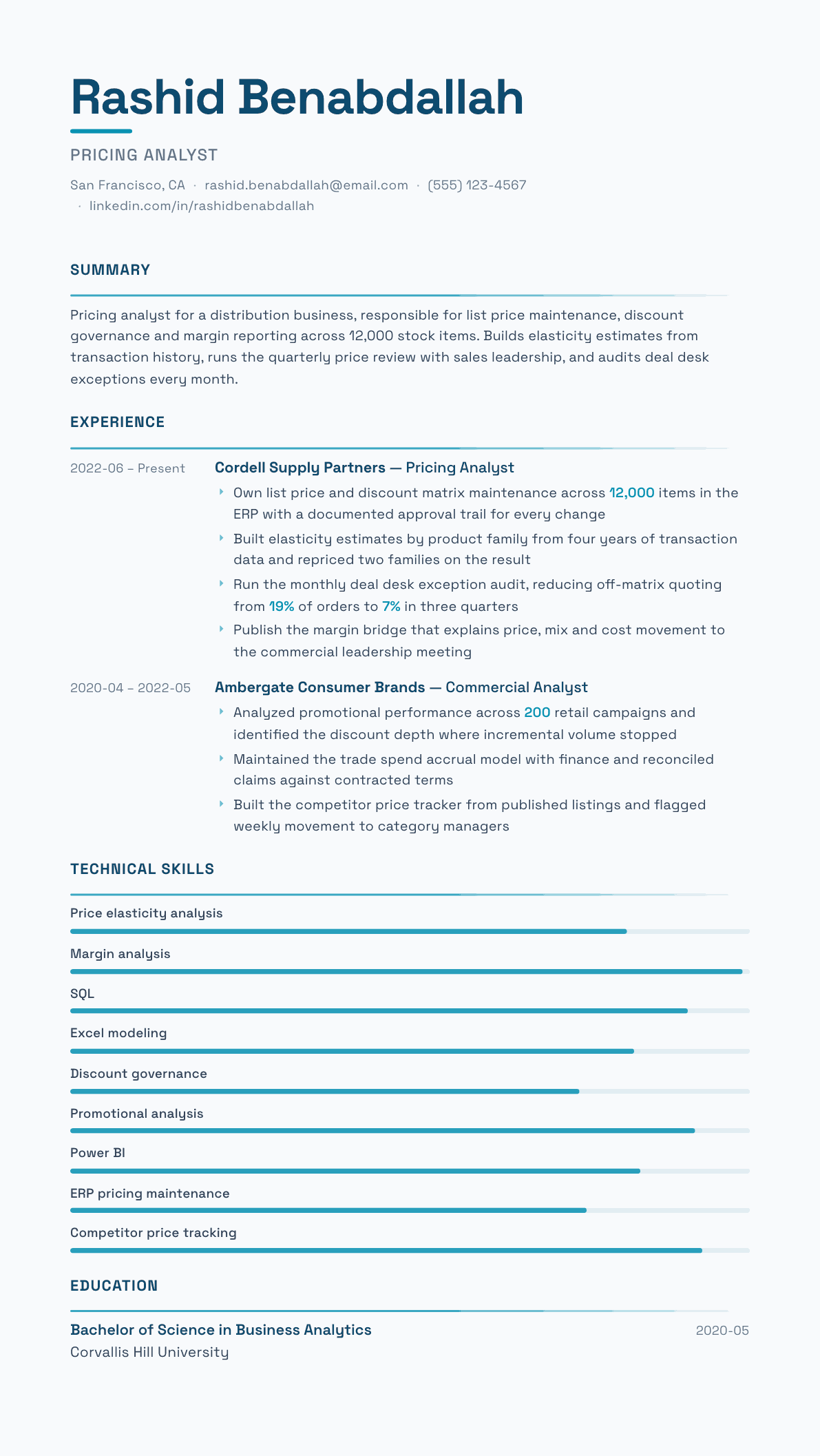
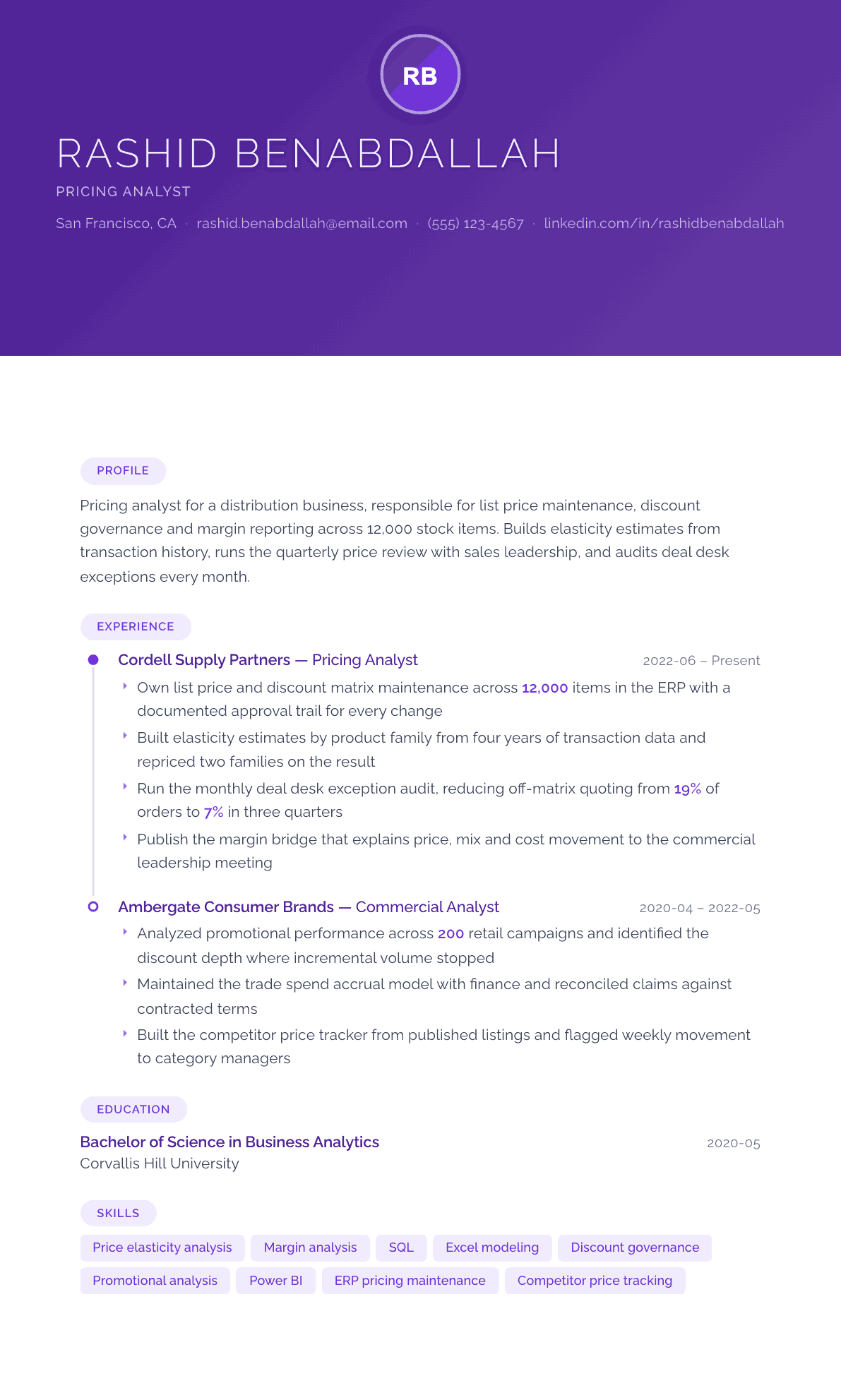
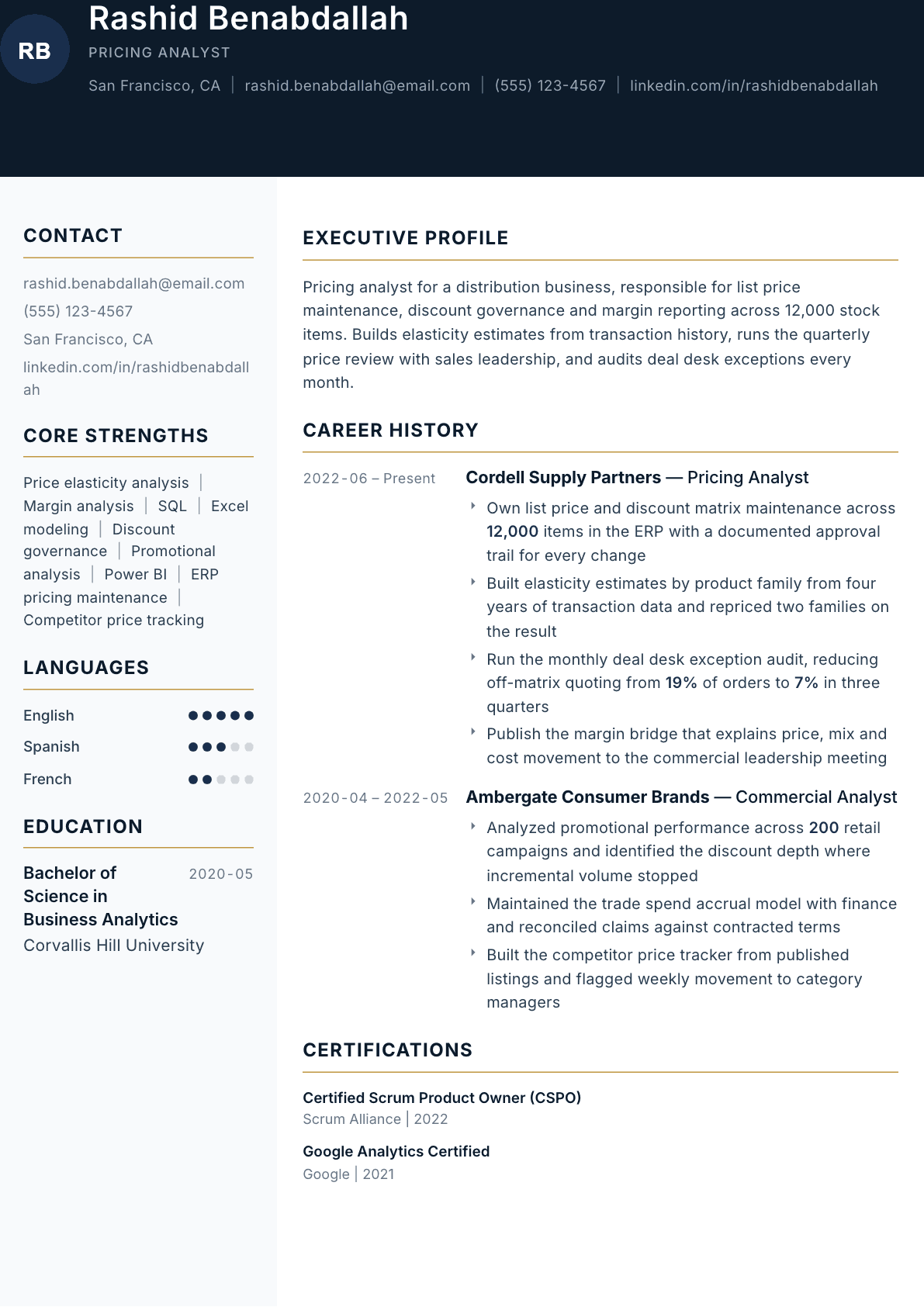
Example Pricing Analyst summary
Pricing analyst with five years across distribution and consumer brands. Owns list price and discount matrix maintenance on 12,000 items, builds elasticity estimates from transaction history, and publishes the margin bridge for commercial leadership. Cut off-matrix quoting from 19% to 7% of orders through a monthly exception audit. Works fluently in SQL, Excel and Power BI.
Skills to list on a Pricing Analyst resume
- Price elasticity analysis
- Margin and profitability analysis
- Price and mix bridge reporting
- Discount governance
- Deal desk support
- Promotional effectiveness analysis
- Competitor price benchmarking
- SQL
- Excel modeling
- Power BI
- ERP price maintenance
- Contract pricing
- Cost to serve analysis
- Scenario modeling
What actually gets this resume read
- State the pricing model you work inside, because list and discount pricing, subscription pricing and contract bidding need different evidence.
- Give catalog or customer scale in item counts and account counts so a reader can size the complexity you handled.
- Show a price change you recommended and what happened to volume or margin afterward, not only the analysis you produced.
- Include governance work such as discount matrices, approval thresholds and exception audits, which senior pricing roles are built on.
- Name your analysis stack, separating SQL and Python from Excel, and add the ERP or configure price quote tool you maintained.
- Use margin bridge language of price, volume, mix and cost, because pricing leaders read that vocabulary as a competence signal.
How to write a pricing analyst resume
Pricing sits between finance, sales and product, and the person hiring a pricing analyst is checking whether you can hold your ground in that middle. The analysis is the easy part. The hard part is telling a sales director that the discount she has been granting for two years destroys more margin than the volume returns, and having the numbers structured so the conversation ends in a decision rather than an argument.
The first thing a reader checks is your pricing model, because the work differs completely across them. List price with a discount matrix in distribution, subscription tiering in software, contract bidding in industrial sales, and promotional pricing in consumer goods each need different evidence, and a resume that stays generic gets filtered by all of them.
This guide covers the layout pricing leaders expect, three summaries across a pricing career, before and after bullets that fix the habit of describing analysis without decisions, and the questions that come up when moving between industries or from finance into pricing.
Format: one page, model and scale up front
Reverse chronological, single column, one page under seven years. Open each role with a scope line that names the pricing model, the catalog or customer scale, and the systems you worked in. Item counts, customer counts and channel structure are the fastest way to convey complexity, and they avoid the confidentiality problem that comes with quoting revenue.
Keep a tools block visible. Pricing teams are increasingly hired on analytical stack as much as on commercial judgment, and a reader wants to see the database, spreadsheet and visualization layers separated rather than mixed into one list.
- Header: name, city and state, phone, email, and the industry you have priced in.
- Sections: summary, experience with scope lines, analytical tools, pricing capabilities, education.
- Say who you reported to. Pricing under finance behaves differently from pricing under sales.
Summary: model, scale, methods, one decision
Three lines. The pricing model and industry, the scale of the catalog or account base, the analytical methods you use unaided, and one price decision you influenced with a measurable outcome. That last element is what separates a pricing analyst from a commercial reporting analyst, and most candidates omit it entirely.
If you are moving from financial analysis into pricing, name the bridge explicitly. Margin analysis, cost to serve work and variance decomposition all transfer directly, and saying so is more persuasive than hoping a recruiter makes the connection on your behalf.
Experience: analysis, governance, decision, outcome
Build bullets around the four things a pricing leader measures. Analysis comes first: elasticity estimation, price and volume decomposition, cost to serve, win and loss analysis on quotes. Name the data you used and the period, because an elasticity estimate from a few months of transactions is a very different claim from one built on years of history.
Governance comes second and is chronically underwritten. Discount matrix ownership, approval threshold design, deal desk support and exception auditing are the mechanisms that make pricing stick, and they are the reason companies promote analysts into pricing managers. Quantify the exception rate you inherited and where you moved it.
The decision is third. State the price change you recommended, whether it was implemented, and what happened to volume, mix or margin afterward. Even an unimplemented recommendation is worth writing if you can say what the objection was, because it shows you understand the commercial reality around your model.
Finally, reporting. The margin bridge that explains price, volume, mix and cost movement is the standard artifact of the role. Saying you produce it, and naming who reads it, tells a hiring manager you can be trusted in front of the commercial leadership meeting.
Tools: name the analysis layer and the system of record
Split your tooling into three layers and be honest about each. Data access, meaning SQL depth or the warehouse and reporting environment you query. Analysis, meaning your spreadsheet modeling and any statistical work in Python or R. Presentation, meaning the visualization tool your dashboards live in.
Then name the system of record where prices actually change: the enterprise resource planning system, a configure price quote tool, or a dedicated pricing platform. Maintaining a price file in a production system carries operational risk, and a company will want to know whether you have done it under change control before letting you near theirs.
- Query and warehouse experience, with the depth you can work at unaided.
- Modeling environment and any statistical or optimization work you have done yourself.
- The system where price changes are executed, plus the approval and audit trail you worked within.
Keywords pricing postings match on
Recurring terms include price elasticity, margin analysis, price and mix bridge, discount governance, deal desk, price optimization, promotional effectiveness, competitive benchmarking, cost to serve, contract pricing and scenario modeling. Use the ones you have real evidence for, positioned inside a bullet where the method and the result sit beside the phrase. Pricing readers are numerate and skeptical, and an unsupported term stands out immediately to them.
Pricing Analyst resume summary examples
First pricing seat
Business analytics graduate with two years in commercial analysis, building promotional performance reporting across 200 retail campaigns and maintaining a competitor price tracker. Works in SQL and Excel daily. Seeking a pricing analyst role where discount governance and elasticity work are part of the job.
Five years pricing
Pricing analyst owning list price and discount matrix maintenance across 12K stock items in a distribution business. Builds elasticity estimates from four years of transaction data, runs the monthly deal desk exception audit, and publishes the margin bridge for commercial leadership each period.
Pricing manager
Pricing manager with nine years across distribution and consumer brands, leading two analysts and owning the annual price review with sales and finance. Designed the current approval matrix, cut off-matrix quoting by more than half, and repriced three product families on elasticity evidence.
Work experience bullets: before and after
Before: Maintained pricing in the system and updated price lists.
After: Own list price and discount matrix maintenance across 12K items in the enterprise system, with a documented approval trail and effective date for every change.
Item scale plus change control turns routine maintenance into evidence you can be trusted in a production price file.
Before: Analyzed price elasticity for products.
After: Built elasticity estimates by product family from four years of transaction data, then repriced two families where the estimate showed volume was insensitive within the tested range.
Naming the data window and the resulting price action shows analysis that ended in a decision rather than a slide.
Before: Reviewed discounts given by the sales team.
After: Run the monthly deal desk exception audit against the approval matrix, reducing off-matrix quoting from 19% of orders to 7% across three quarters through case-by-case follow-up with each region.
A governance mechanism with a before and after rate proves you changed behavior, not just observed it.
Before: Prepared margin reports for management.
After: Publish the monthly margin bridge decomposing movement into price, volume, mix and cost, and present the two largest variances at the commercial leadership meeting.
The named decomposition and the presentation duty demonstrate the standard artifact and the standing to defend it.
Before: Looked at promotions and how they performed.
After: Analyzed promotional performance across 200 retail campaigns to identify the discount depth beyond which incremental volume stopped, and recommended a revised depth ceiling to category managers.
The campaign count, the specific finding and the recommendation give the analysis a purpose a reader can evaluate.
Hard skills
- Price elasticity estimation
- Margin and profitability analysis
- Price volume mix bridge reporting
- Discount matrix design
- Deal desk and exception auditing
- Promotional effectiveness analysis
- Competitive price benchmarking
- Cost to serve analysis
- Contract and tender pricing
- SQL
- Excel scenario modeling
- Power BI or Tableau dashboards
Soft skills
- Holding a position with sales leadership
- Explaining margin math simply
- Commercial curiosity
- Negotiation support under time pressure
- Structured recommendation writing
- Cross-functional facilitation
Certifications worth listing
- Certified Pricing Professional (CPP) (Professional Pricing Society)
- Certified Management Accountant (CMA) (Institute of Management Accountants)
- Chartered Financial Analyst (CFA) (CFA Institute)
Mistakes that cost pricing analyst candidates the interview
- Leaving the pricing model unnamed, so a subscription pricing team cannot tell whether you have ever seen a tier structure.
- Describing analysis with no decision attached, which reads as commercial reporting rather than pricing.
- Omitting governance work such as approval matrices and exception audits, the mechanisms that make pricing hold.
- Quoting revenue figures instead of item and account counts, which creates confidentiality risk and communicates less.
- Overstating statistical work, when an interviewer will ask precisely how the elasticity estimate was specified.
- Never mentioning the system where price changes execute, even though that operational risk is what worries employers.
Pricing Analyst resume questions
What is the difference between a pricing analyst and a financial analyst?
A financial analyst explains what happened to margin. A pricing analyst changes it by setting prices, designing discount rules and challenging deals before they close. The analytical toolkit overlaps heavily, but pricing work is forward looking and involves negotiation with the commercial side.
Do I need statistics or machine learning for pricing roles?
Regression and elasticity estimation are genuinely useful and appear in many postings. Optimization and machine learning matter mainly at large retailers, travel companies and software firms with dynamic pricing. Claim only what you can specify in detail, because the technical interview will probe it.
How do I show pricing impact without revealing confidential margins?
Use percentage point movements, exception rates, item counts and directional outcomes. Saying you cut off-matrix quoting from one rate to another communicates the achievement fully while keeping every commercially sensitive number off the page.
Can I move into pricing from sales operations?
Yes, and it is a common route. Quote analysis, discount approval workflow and deal desk support are all directly relevant. Strengthen the analytical side with a demonstrable SQL and modeling example, then rewrite your experience around margin outcomes rather than process throughput.
Is the Certified Pricing Professional credential worth having?
It is recognized in the discipline and appears as preferred in some senior postings, particularly in industrial and distribution businesses. It will not compensate for thin practical evidence, so treat it as a supplement to elasticity, governance and margin bridge experience rather than a substitute.
Related resume examples
- Financial Analyst Resume example
- Revenue Analyst Resume example
- Economist Resume example
- Marketing Analyst Resume example
- Risk Analyst Resume example
- Finance Manager Resume example