Advertising Account Executive Resume Examples: free score
Craft an Advertising Account Executive Resume Agencies Trust
By Mustafa Tarabya, founder of CVBooster · Published · Updated
Advertising account executive resume example with client and revenue bullets, the agency skills to list, keywords, and a step by step guide.
Sample resumes for a advertising account executive
The same advertising account executive content laid out in three CVBooster templates, so you can see what the finished document looks like before you write a word.
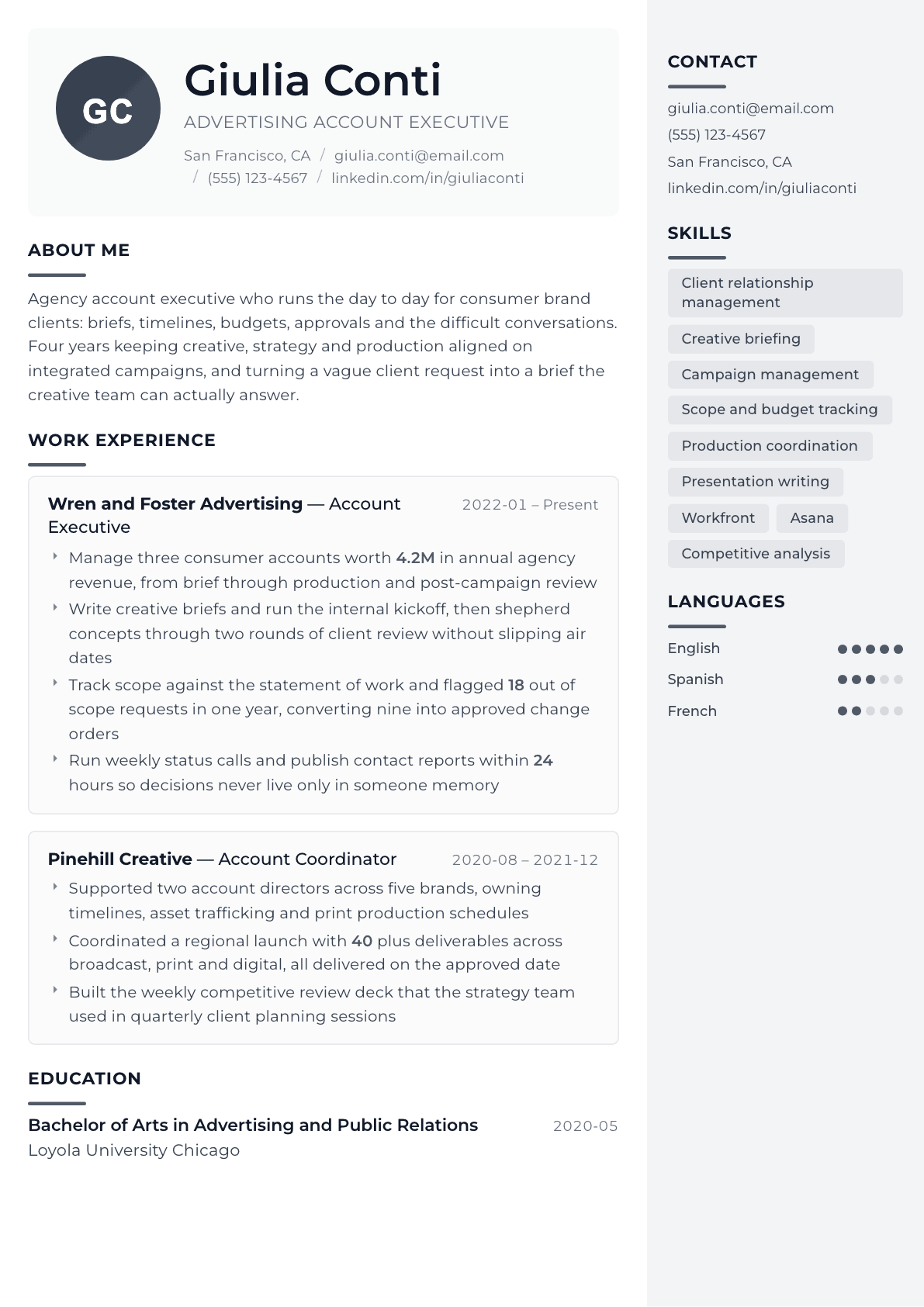
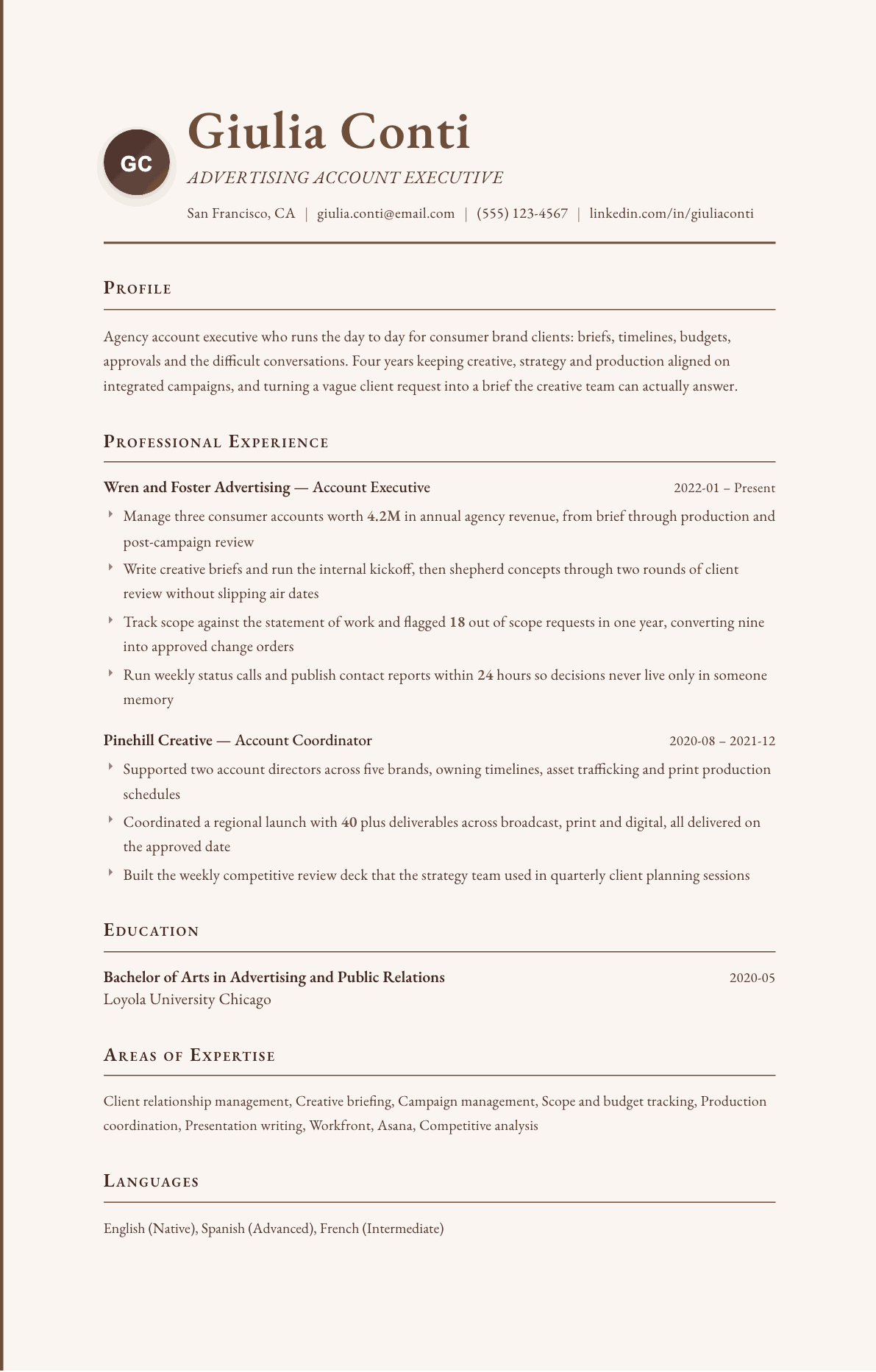
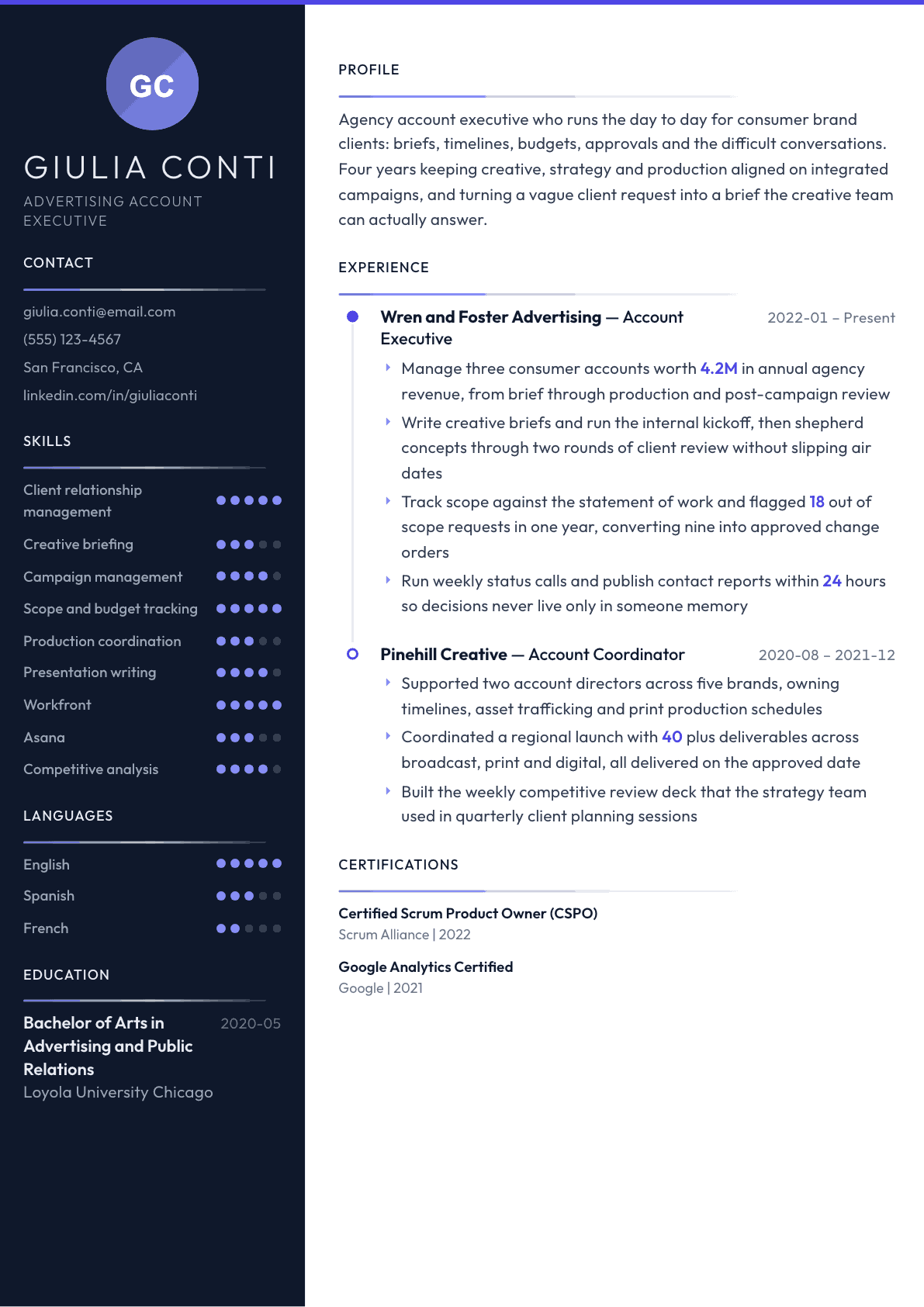
Example Advertising Account Executive summary
Advertising account executive with four years running consumer brand accounts inside an integrated agency, currently responsible for over four million in annual agency revenue. Writes the briefs, runs the kickoffs, protects scope against the statement of work, and keeps creative and production on the same air date. Known for contact reports that land within a day and for turning vague client asks into answerable briefs.
Skills to list on a Advertising Account Executive resume
- Client relationship management
- Creative briefing
- Integrated campaign management
- Scope management
- Budget tracking
- Statement of work
- Production coordination
- Presentation development
- Status reporting
- Competitive analysis
- Workfront
- Asana
- Media coordination
- Vendor management
What actually gets this resume read
- Name the client categories you handled, because agencies hire account people who already know the category rhythm.
- Give the agency revenue or working budget you were responsible for, not just the number of accounts on your desk.
- Show that you write briefs, since the brief is the account executive deliverable creative teams judge you on.
- Include scope management: change orders caught, out of scope requests flagged, hours protected against an approved estimate.
- Describe one campaign end to end with the channels and the delivery date, so the reader sees a full cycle.
- Mention the project systems you worked in, such as Workfront or Asana, because agencies run on those tools daily.
How to write a advertising account executive resume
An advertising account executive resume is read by an account director who has been burned before. She has hired people who could charm a client and not write a brief, and people who could write a brief and never hold a room. Your resume has to answer both worries: that you can run the operational spine of an account, and that a client will happily pick up the phone to you.
The confusing part is the title itself. In an agency, account executive means client service, not sales. Outside advertising the same words mean quota carrying. If your resume does not make the agency meaning obvious in the first two lines, it lands in the wrong pile at companies that run both kinds of role.
This guide sets out the agency-standard section order, how to write bullets about work that was collaborative by nature, what evidence of scope management looks like on paper, and the questions account people ask most when their resume stalls.
Format: one page, accounts up front, categories visible
Reverse chronological, one page for anyone below account supervisor. Under each agency, list the accounts and the categories you served and the annual agency revenue or working budget they represented. Account directors staff by category familiarity because a spirits account, a hospital system and a quick service restaurant run on completely different approval chains.
Do not organize the resume by campaign. Campaign-first layouts read like a creative portfolio and hide the thing being assessed, which is whether you held an account steady over time.
- Header: name, city and state, phone, email, portfolio or case link only if it is genuinely yours.
- Under each employer: accounts, categories, revenue or budget, and the team you sat inside.
- Sections: summary, experience, skills and systems, education.
- Keep any awards to one compact line unless you led the account behind the work.
Summary: category, scope, and the part of the process you own
Lead with the categories you have run and the revenue or budget in your care, then name the piece of the process you personally own. Briefs, scope, production timelines and client reporting are the four things account executives are trusted with, and different agencies weight them differently.
Say the word agency early so nobody confuses the role with a sales seat. An advertising account executive who writes I manage client relationships and drive growth will be read by a filter as a business development candidate and will lose the agency roles she actually wants.
Experience: prove you run the account, not just attend it
The strongest account executive bullets show the mechanism you installed or maintained. A brief that unlocked a stuck creative team. A status cadence that stopped decisions being lost. A scope tracker that caught out of scope requests before they became free work. These are the things that make an account director sleep, and they are the things almost nobody writes down.
Show one campaign end to end with real markers: the brief date, the channels, the number of deliverables, the air date it hit. Agencies live and die on dates, and an account executive who has never named one in writing tends to be the one who missed them.
Include money discipline. Change orders raised, hours protected against an approved estimate, the point at which you escalated an overrun. Account people rarely feel comfortable claiming financial responsibility, but scope custody is the difference between a coordinator and an executive.
- Name the deliverable count and channel mix for at least one integrated campaign.
- Show a brief you wrote and what the creative team produced from it.
- Quantify scope work: out of scope requests flagged, change orders approved, estimate accuracy.
- Include one difficult client conversation and how the account came out of it.
Skills and systems: agency tools, not generic software
List the project and finance systems agencies actually run on: Workfront, Asana, Monday, Smartsheet, Advantage or a similar agency management platform, and whichever timesheet and estimating tool you used. These names tell a director you understand that an agency is a machine for tracking hours.
Add the client-facing craft skills separately: brief writing, competitive reviews, status and contact reports, presentation building, production coordination. That split lets a screener see both halves of the job at a glance.
Keywords agencies filter on
Job descriptions for this seat repeat a narrow set of terms: account management, client service, creative brief, integrated campaign, statement of work, scope, change order, status report, contact report, production, trafficking, and the agency management system. Use them where they are true and attach a number wherever one exists, because the human reading after the filter is looking for evidence, not vocabulary.
Advertising Account Executive resume summary examples
Account coordinator moving up
Account coordinator supporting two account directors across five consumer brands, owning timelines, asset trafficking and print production schedules. Coordinated a regional launch with more than forty deliverables across broadcast, print and digital, all delivered on the approved date. Ready for a full account executive seat.
Four years in
Advertising account executive running three consumer accounts worth 4.2M in annual agency revenue, from brief through production and post-campaign review. Writes the creative briefs, guards scope against the statement of work, and turned nine out of scope requests into approved change orders in one year.
Account supervisor
Account supervisor leading a two-person team on a healthcare account worth 9M in annual agency revenue. Owns the annual scope negotiation, chairs the quarterly business review with client marketing leadership, and rebuilt the approval path so medical and legal review no longer costs the account two weeks per campaign.
Work experience bullets: before and after
Before: Served as the main point of contact for client accounts.
After: Ran day to day contact for three consumer accounts worth 4.2M in annual agency revenue, chairing weekly status calls and publishing contact reports within a day of every meeting.
Revenue scope plus a concrete cadence shows what being the contact actually involved in practice.
Before: Wrote creative briefs for the creative team.
After: Wrote the creative briefs for eleven campaigns in a year, ran the internal kickoff for each, and carried concepts through two rounds of client review without moving an air date.
Volume, the kickoff ownership and the schedule outcome prove the brief work landed rather than existed.
Before: Helped manage project budgets and timelines.
After: Tracked hours against an approved statement of work across three accounts, flagged eighteen out of scope requests in a year and converted nine into signed change orders.
The tracking mechanism and the conversion figure turn vague budget help into recovered agency revenue.
Before: Coordinated with vendors and production partners.
After: Coordinated a broadcast, print and digital launch with forty-two deliverables across four production partners, holding the schedule through a late client copy change.
Deliverable count, partner count and the disruption you absorbed show real production control.
Before: Presented campaign results to clients.
After: Built and presented quarterly reviews to client marketing leads, pairing campaign delivery with competitive activity and closing each session with two agreed next steps.
A review that ends in agreed actions demonstrates account leadership rather than reporting duty.
Hard skills
- Client relationship management
- Creative briefing
- Integrated campaign management
- Scope and statement of work management
- Change order process
- Budget and hours tracking
- Production coordination
- Status and contact reporting
- Competitive analysis
- Presentation development
- Workfront
- Asana
Soft skills
- Client communication
- Diplomacy under pressure
- Prioritization across accounts
- Written clarity
- Negotiation with internal teams
- Ownership without authority
Certifications worth listing
- Project Management Professional (PMP) (Project Management Institute)
- Google Ads Certification (Google)
- HubSpot Marketing Software Certification (HubSpot Academy)
Mistakes that cost advertising account executive candidates the interview
- Letting the title read as a sales role, which routes an agency resume into the wrong applicant pool.
- Listing campaigns instead of accounts, which hides whether you sustained a client relationship over time.
- Claiming credit for creative work rather than the account mechanism that let the creative work happen.
- Avoiding all financial detail, which makes a four-year executive look like a coordinator who took notes.
- Skipping the agency management system, one of the few concrete tool signals this role has.
- Describing yourself as detail oriented without a single date, deliverable count or approval path on the page.
Advertising Account Executive resume questions
What is the difference between an account executive in an agency and one in sales?
In advertising the seat is client service: you run existing accounts, write briefs, manage scope and keep campaigns on schedule. In most other industries the same title carries a revenue quota. Make the agency meaning explicit in your summary so filters route you correctly.
How do I show results when the creative team produced the work?
Claim the account mechanism, not the idea. Briefs written, deliverables managed, air dates held, scope protected, approvals compressed. Those are yours alone, and an account director values them more than a borrowed claim about a campaign concept she knows you did not create.
Should I include client names on an advertising account executive resume?
Name them unless your agreement forbids it, because category familiarity is a hiring criterion. If a client must stay anonymous, describe it precisely instead: a national quick service restaurant chain, a regional health system, a mid-size spirits brand.
Do I need agency experience to get an account executive role?
Not always, but you need agency-shaped evidence. Client-facing project work with briefs, approvals, external vendors and hard delivery dates translates well. Rewrite that experience using agency vocabulary and be candid in interviews about which parts of agency life are new to you.
How long should an advertising account executive resume be?
One page until account supervisor, two pages after that. Agencies read quickly and value editorial judgment, so a tight page reads as a professional signal. If you cannot fit ten years on two pages, compress your earliest roles into a single summary line.