Campaign Manager Resume Examples: the lines they read
Launch a Campaign Manager Resume That Delivers Results
By Mustafa Tarabya, founder of CVBooster · Published · Updated
Create a performance-driven campaign manager resume with multi-channel campaign expertise, ROI optimization, and project management skills that marketing teams need.
Sample resumes for a campaign manager
The same campaign manager content laid out in three CVBooster templates, so you can see what the finished document looks like before you write a word.
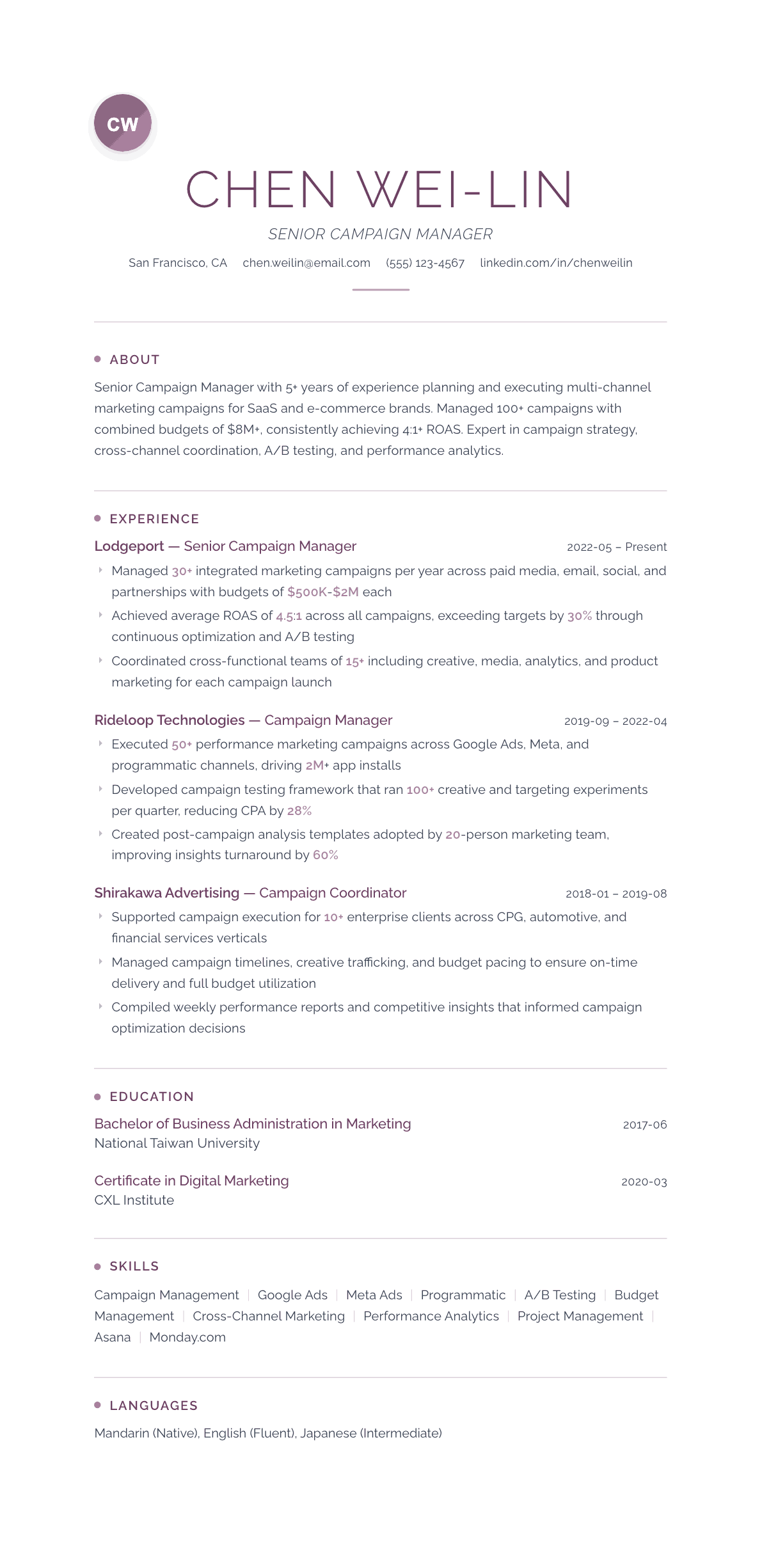
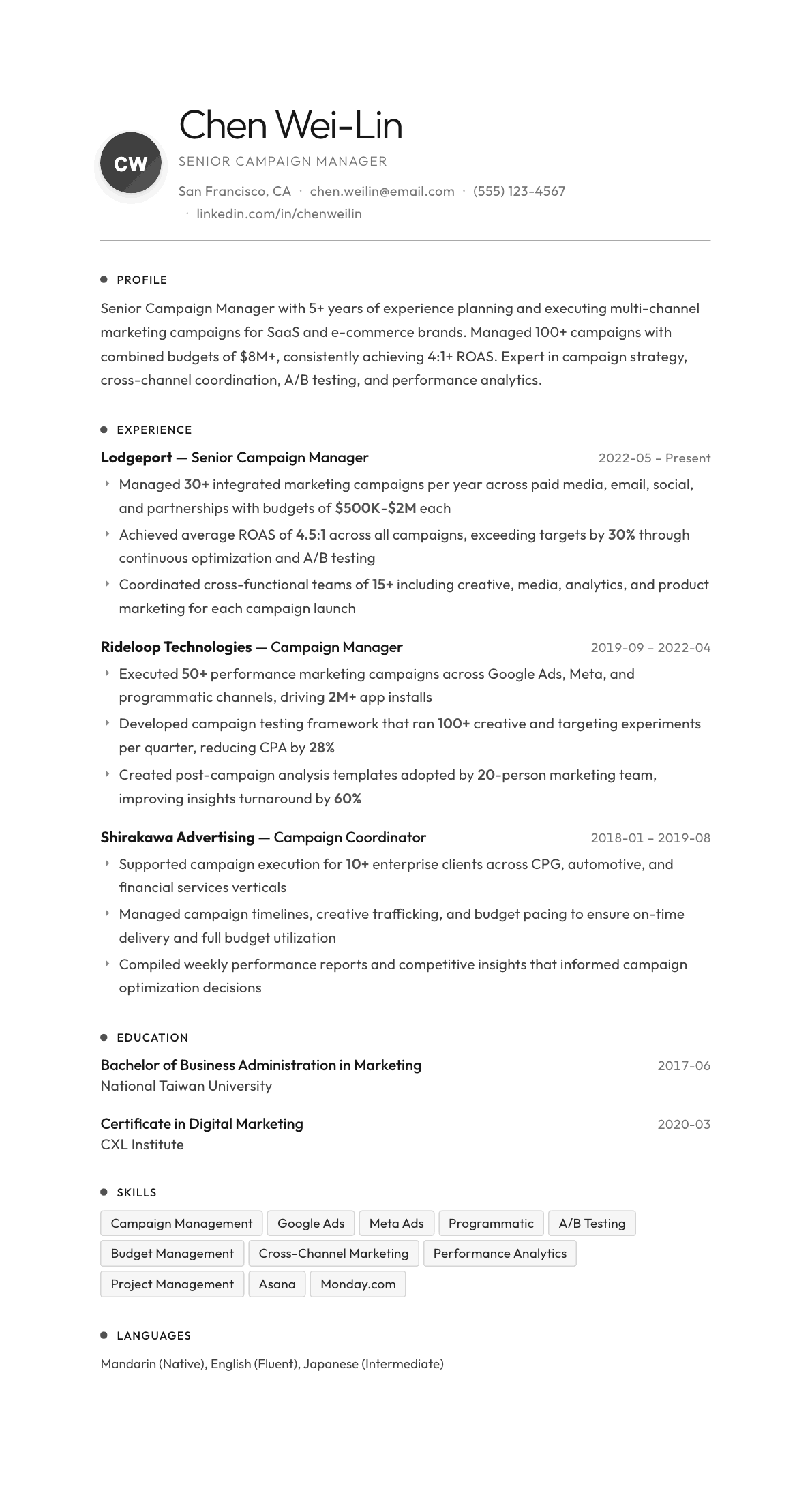
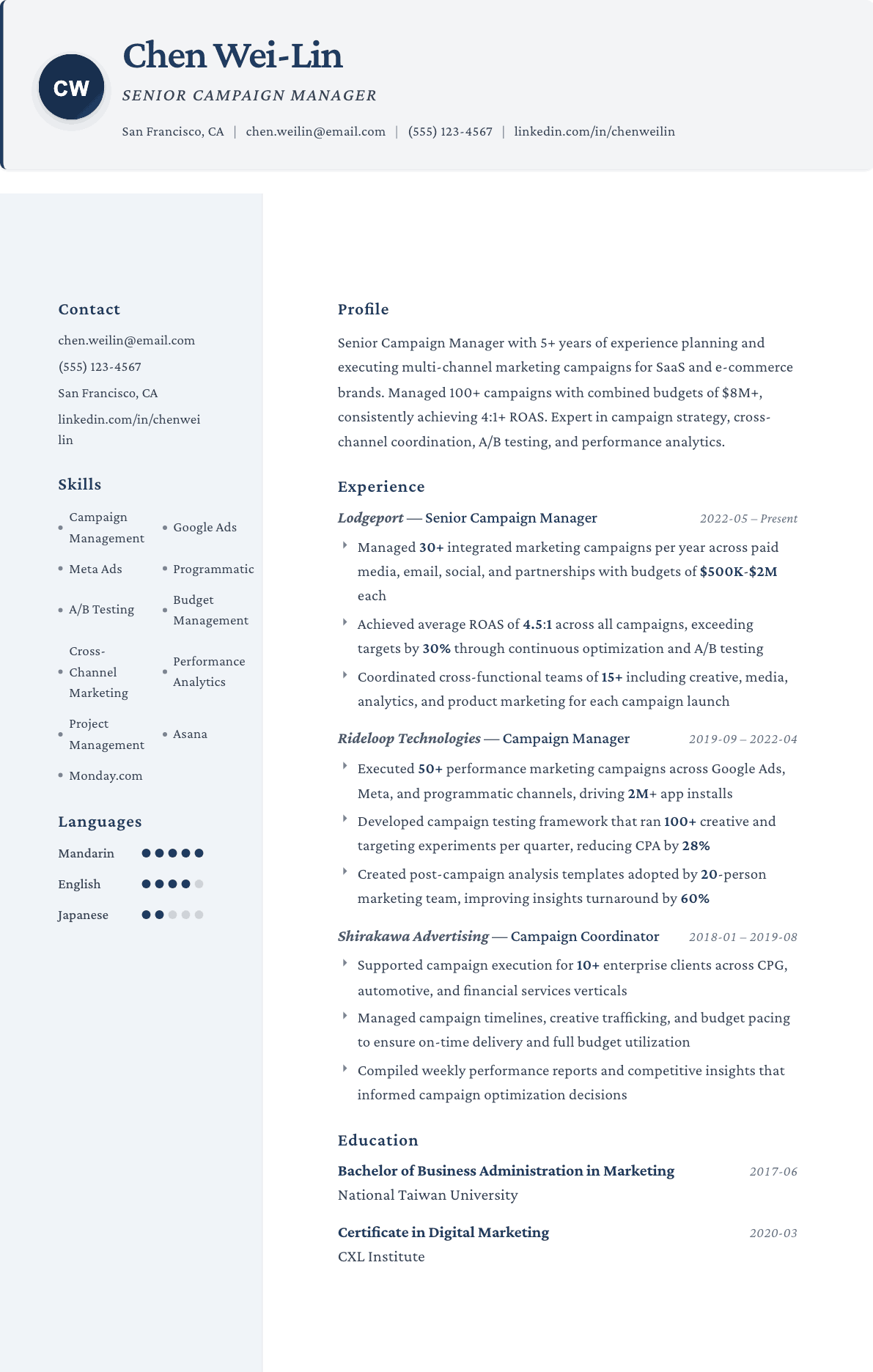
Example Campaign Manager summary
Campaign Manager with 5 years running 100+ multi-channel campaigns on $8M+ in combined budgets across paid media, email, social and partnerships. Holds 4.5:1 average ROAS and cut CPA 28% through a testing framework of 100+ creative and targeting experiments a quarter.
Skills to list on a Campaign Manager resume
- Campaign Management
- Multi-Channel Marketing
- Google Ads
- Meta Ads
- Programmatic Advertising
- A/B Testing
- Performance Analytics
- Budget Management
- Project Management
- Cross-Functional Coordination
- Campaign Optimization
- Creative Briefing
- Asana
- Monday.com
What actually gets this resume read
- Quantify campaign performance: ROAS, CPA, conversion rates, revenue generated, and impressions delivered.
- Showcase multi-channel expertise: paid search, paid social, programmatic, email, and offline channels.
- Highlight A/B testing and optimization methodology that demonstrates a data-driven approach.
- Include project management skills and tools: Asana, Monday.com, Jira, Wrike.
- Demonstrate cross-functional coordination: working with creative, analytics, product, and agency teams.
How to write a campaign manager resume
Campaign manager is the role that makes marketing actually happen on time. The person hiring reads your resume looking for a rare combination: someone who can hold a critical path across creative, media, product, legal and analytics, and who also understands enough about performance to know when a campaign is failing and needs to be changed rather than finished.
Because the title exists in agencies, in-house teams, nonprofits and political organizations, the first job of the resume is to say which kind of campaign manager you are. Someone coordinating an integrated product launch, someone trafficking and optimizing paid media, and someone running field organizing for an election share a title and almost no daily work.
This guide covers how to declare your type, how to write about launches and testing without sounding like a project checklist, three summaries at different stages, before and after bullets, and the mistakes that make an experienced campaign manager look junior.
Format: declare the type, then show the operating rhythm
One page early, two once you have run large integrated programs. Reverse chronological, single column, no graphics that a recruiting system can scramble. Directly under the header, write one line that names the campaign type, the channels and the scale: number of campaigns a year, budget range, and the size of the team you coordinate.
Follow with a channels and tools line. The paid platforms if you buy, the email or marketing automation platform if you run lifecycle, the project management tool your team lived in, and the analytics and reporting layer. Campaign managers are hired partly for the systems they already know.
- Header: name, city, phone, email, and a link to a portfolio only if it contains real campaign work.
- Order: summary, channels and tools, experience, certifications, education.
- For each role, say whether you owned strategy, execution or both. Reviewers assume execution unless told otherwise.
Summary: throughput, complexity, and the results you carried
Three lines. Years, campaign type, throughput such as campaigns per quarter, the complexity you handle measured in channels and stakeholders, and the performance measure you were accountable for. Throughput is unusual on a resume and it lands well, because it is the honest measure of a coordination job.
Be explicit about accountability. Some campaign managers own the number, some deliver the campaign and hand the number to someone else. Say which, because overclaiming is easy to expose and underclaiming leaves you looking like a coordinator.
Experience: the campaign lifecycle from brief to post-mortem
Write bullets that follow the lifecycle a reader recognizes. Intake and brief: how requests arrived, how you scoped them and what you refused. Planning: the timeline, the dependencies, the budget and the approval path. Build: creative production, copy and asset routing, audience and list preparation, tracking setup and quality assurance before launch.
Launch and in-flight: the checks you run on the first day, pacing against plan, and the optimizations or escalations you made mid-campaign. Then the part almost everyone omits, which is the post-mortem: what you measured, what you learned, and what changed in the next campaign because of it.
Quality assurance deserves a bullet of its own. Broken links, wrong audience, missing tracking parameters and unapproved claims are the failures that make a campaign manager memorable for the wrong reason, so a documented pre-launch checklist is genuine evidence of professionalism.
Testing, measurement and stakeholder management
Show the testing discipline. How many tests you ran in a period, what you tested such as creative, audience, offer, subject line or landing page, how you decided a result was real, and how the winners were documented so the team stopped relitigating settled questions. A campaign manager who maintains a test log is an asset the whole team compounds on.
Stakeholder work is the other half. Name the functions you coordinate: creative, media, product marketing, sales, legal or regulatory review, and analytics. Describe the rhythm you ran, such as a weekly status, a launch readiness review, or a single source of truth calendar that stopped conflicting sends going out.
Skills and the keywords campaign postings use
The recurring terms are: campaign strategy, campaign execution, cross-channel marketing, project management, budget management, audience segmentation, A/B testing, performance analysis, stakeholder management and reporting. Use the ones you can defend, once in the skills block and once in a bullet.
Name the tooling precisely: the marketing automation or email platform, the ad platforms, the customer data or audience tool, the project management system, the tag manager, and the dashboard tool. Also mention any campaign brief or intake template you created, since process artifacts are proof that you improved how the team works.
Campaign Manager resume summary examples
Campaign coordinator
Campaign coordinator with 2 years supporting cross-channel marketing programs, building emails and landing pages, preparing audience lists, trafficking creative and running pre-launch quality checks. Managed the shared campaign calendar for a team of ten and produced weekly performance summaries.
Five years, cross-channel
Campaign manager with 5 years running 25 to 30 integrated campaigns a year across paid media, email, in-product messaging and partnerships. Owns the brief, the timeline and the testing plan, and improved conversion on the core acquisition campaign by 22% through a structured offer and creative test sequence.
Senior campaign manager
Senior campaign manager with 9 years leading launch and lifecycle programs for software and consumer brands, coordinating creative, media, product marketing, legal and analytics. Built the intake and readiness process the marketing team now runs on, and manages two campaign specialists.
Work experience bullets: before and after
Before: Managed marketing campaigns from start to finish.
After: Ran 25 to 30 integrated campaigns a year from brief through post-mortem, coordinating creative, media, product marketing and legal review against a fixed launch calendar.
Throughput and the named stakeholder set show the actual load, which is what campaign hiring is about.
Before: Made sure campaigns launched without errors.
After: Built a pre-launch checklist covering tracking parameters, link testing, audience suppression and claim approval, and ran it on every campaign, which ended repeat send errors on the email program.
A named artifact with a concrete failure it prevented turns diligence into a system.
Before: Ran A/B tests to improve campaign performance.
After: Ran a structured test sequence on offer, subject line and landing page layout across a quarter, logged every result in a shared test document, and rolled the winning combination into the always-on acquisition campaign.
Sequencing and documentation prove testing was a program rather than a series of one-off experiments.
Before: Coordinated with different teams on campaign delivery.
After: Chaired a weekly readiness review with creative, media and analytics, tracking dependencies and blockers so campaigns entered launch week with assets approved and tracking already validated.
The meeting, the artifacts and the outcome make coordination visible instead of assumed.
Before: Reported on campaign results after each campaign.
After: Wrote a post-campaign review for every major program covering spend, performance against target, what the tests showed and one recommendation, and used the backlog of reviews to plan the next quarter.
Feeding learning forward is what separates a campaign manager from someone who closes tickets.
Hard skills
- Campaign planning and briefing
- Cross-channel execution
- Marketing automation and email builds
- Audience segmentation and list management
- Paid media coordination and trafficking
- A/B and multivariate testing
- Tracking setup and quality assurance
- Budget tracking and pacing
- Performance reporting
- Project management tooling
- Landing page and asset production
- Post-campaign analysis
Soft skills
- Holding a deadline politely
- Prioritizing competing requests
- Written clarity in briefs
- Escalating early rather than late
- Facilitating cross-functional reviews
- Staying organized under many parallel workstreams
Certifications worth listing
- Project Management Professional certification (Project Management Institute)
- Certified Associate in Project Management (Project Management Institute, PMI)
- Google Ads Measurement Certification (Skillshop)
- Marketo Certified Expert (Adobe)
- Salesforce Marketing Cloud Email Specialist (Salesforce)
Mistakes that cost campaign manager candidates the interview
- Not saying what kind of campaigns you run, so a paid media team and a lifecycle team both assume you are the other one.
- Listing tools without showing a single campaign you took from brief to result.
- Writing only about coordination, which makes an experienced manager read as a scheduler.
- Claiming performance results for campaigns where you did not control the media or the offer.
- Skipping quality assurance and process work, which is the part hiring managers have most often been burned on.
- Omitting throughput, the number that shows how much complexity you can carry at once.
Campaign Manager resume questions
What is the difference between a campaign manager and a project manager?
A project manager is measured on delivery, while a campaign manager is also expected to understand audience, offer and performance well enough to change the campaign in flight. Show both the delivery discipline and the marketing judgment on your resume.
How do I show results if another team owned the budget?
Report what you controlled. Delivery against the launch date, error rates before and after your process changes, test results you ran, and the campaign performance as context rather than as your personal outcome. Honest framing reads as senior, not modest.
Should I include campaign throughput numbers?
Yes. Campaigns per quarter or per year, with a note on their complexity, is the clearest way to communicate capacity. A manager running thirty multi-channel programs a year is doing something very different from one running four large launches.
Does political or nonprofit campaign experience transfer?
It transfers well if you translate the vocabulary. Volunteer coordination becomes stakeholder management, canvassing and phone programs become audience outreach at scale, and fundraising appeals map directly onto lifecycle messaging and testing.
How technical does a campaign manager need to be?
You should be able to build and quality check your own emails and landing pages, set up tracking parameters correctly, segment an audience without help, and read a performance report critically. Deeper engineering skill is a bonus rather than a requirement.