Advertising Manager Resume Examples: what gets the call
Build an Advertising Manager Resume That Wins the Pitch
By Mustafa Tarabya, founder of CVBooster · Published · Updated
Create a results-driven advertising manager resume with media planning, campaign performance, and budget optimization skills that ad agencies and brands seek.
Sample resumes for a advertising manager
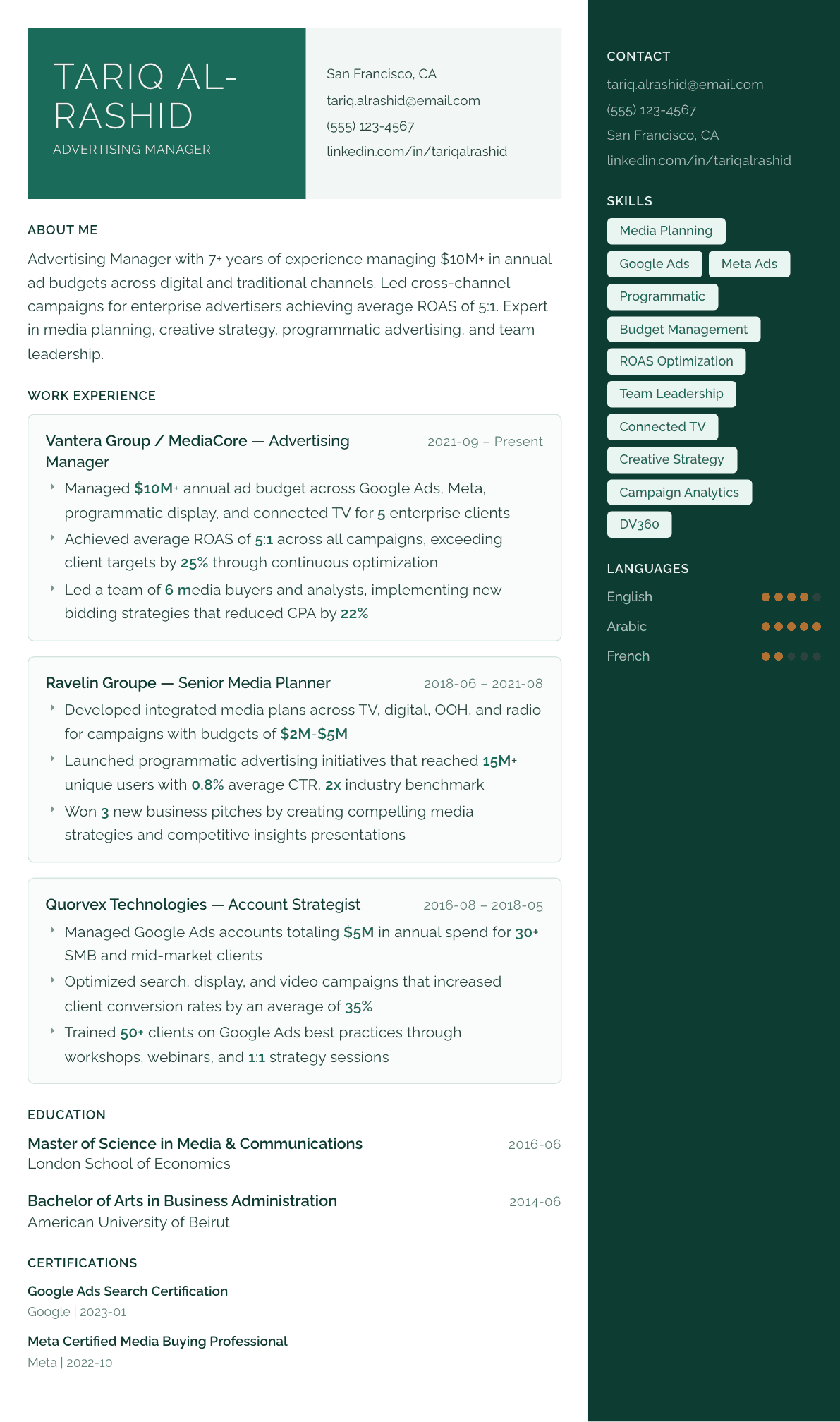
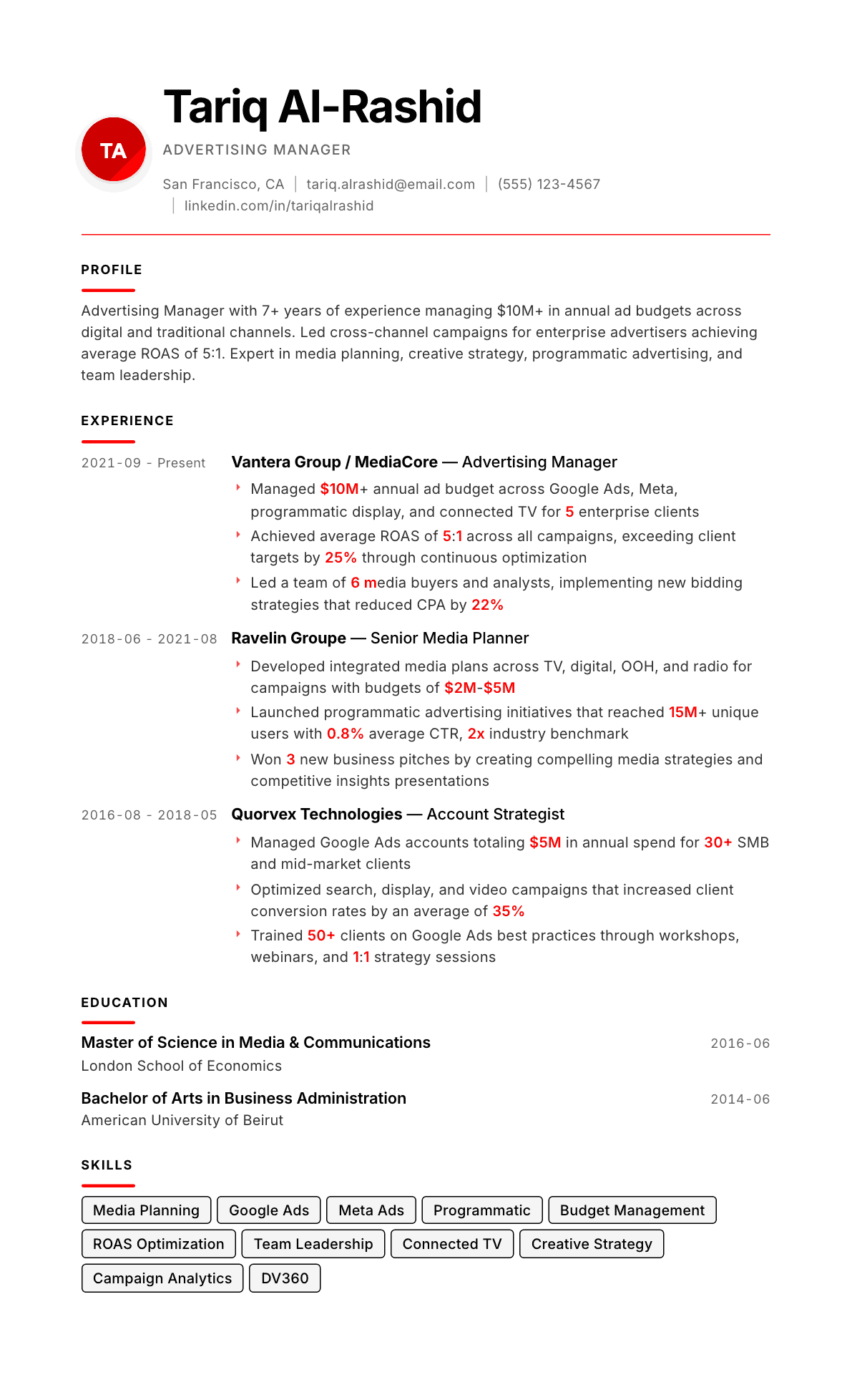
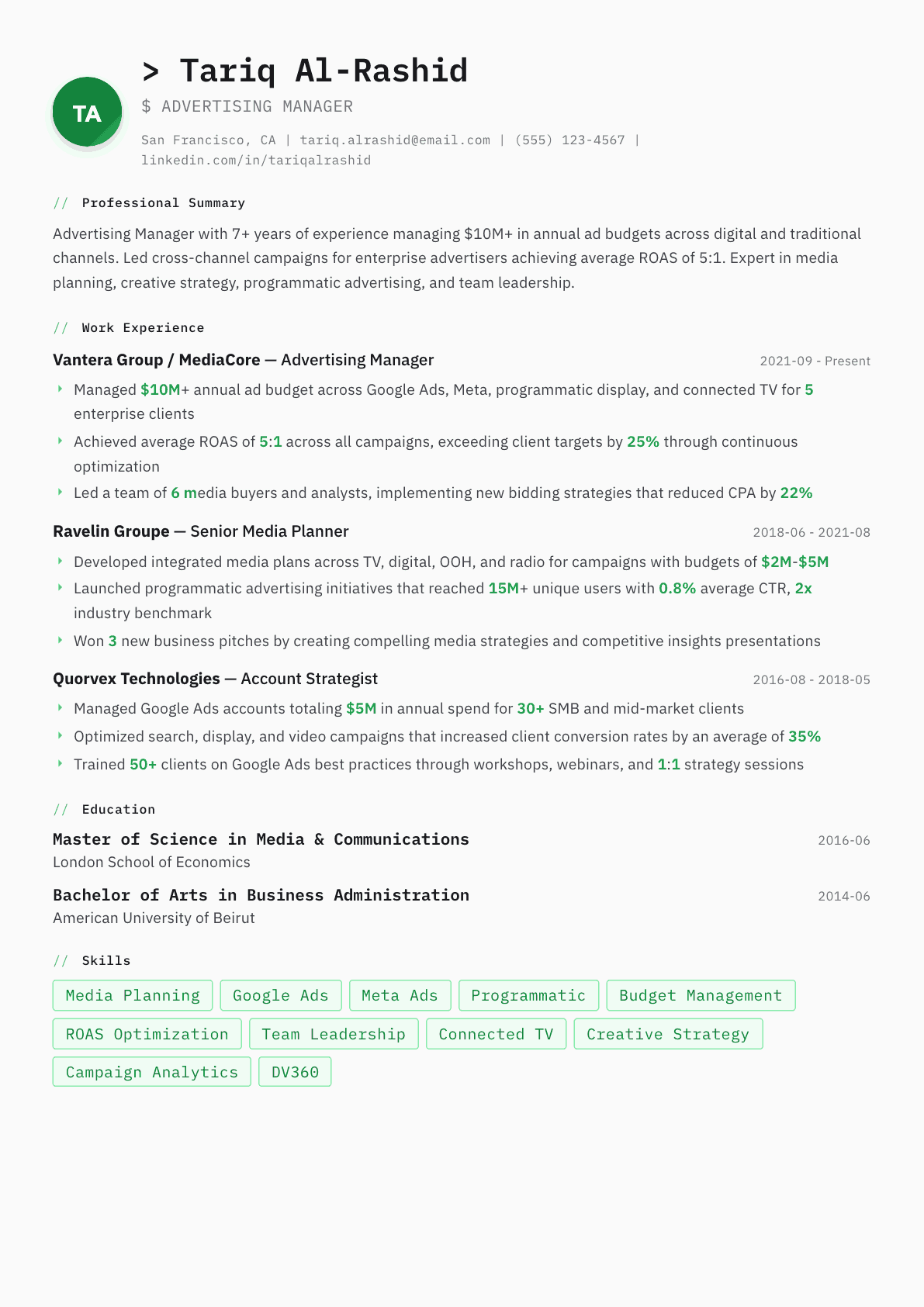
The same advertising manager content laid out in three CVBooster templates, so you can see what the finished document looks like before you write a word.
Example Advertising Manager summary
Advertising Manager with 7 years managing $10M+ in annual ad budgets for enterprise advertisers. Achieved 5:1 average ROAS through cross-channel campaign optimization across Google Ads, Meta, programmatic, and CTV. Leads media buying teams and owns planning and client relationships on the agency side.
Skills to list on a Advertising Manager resume
- Media Planning
- Media Buying
- Google Ads
- Meta Ads
- Programmatic Advertising
- DV360
- The Trade Desk
- Connected TV
- Budget Management
- ROAS Optimization
- Campaign Analytics
- Creative Strategy
- Team Leadership
- Client Management
What actually gets this resume read
- Lead with budget size managed, ROAS/ROI achieved, and revenue driven by your campaigns.
- List ad platforms and tools: Google Ads, Meta Ads, DV360, The Trade Desk, Amazon DSP.
- Highlight both digital and traditional media experience to show versatility.
- Showcase team leadership and cross-functional collaboration with creative, data, and account teams.
- Include new business or pitch experience -- this is highly valued at agencies.
- Mention certifications: Google Ads, Meta Blueprint, The Trade Desk Edge Academy.
How to write a advertising manager resume
An advertising manager resume is read by someone who has to hand over a media budget. Whether that reader sits at an agency or inside a brand, the question is the same: has this person been accountable for spend, did the spend produce a result they can defend in a review, and can they hold a channel mix together when a quarter goes badly.
The most common failure in these resumes is describing campaigns as activity. Launched a campaign across paid social and search tells the reader nothing. What the hiring manager wants is the budget scale, the channel mix, the objective the business set, the efficiency measure that was tracked, and what you changed when the numbers moved the wrong way.
This guide covers the structure agency and client-side reviewers expect, how to write media results without inventing them, three summaries from coordinator to head of advertising, before and after bullets, and the platform credentials that get checked.
Format: one page early, two once you own budget
Reverse chronological. One page up to about six years, two once you have managed teams and multi-channel budgets. Keep a single column for the experience section, since agency recruiting systems parse those files literally and a decorative sidebar can lose your dates.
Directly under the header, add a channels and platforms line. Search, paid social, programmatic display, connected television, audio, out of home, retail media, and the buying platforms you have sat in. Media leaders scan for platform fluency before they read a single achievement.
- Header: name, city, phone, email, portfolio or case study link if you have a real one.
- Order: summary, channels and platforms, experience, certifications, education.
- Say for each role whether you sat agency side or client side. The jobs are judged differently.
Summary: budget scale, channels, and the objective you served
Three lines. The years, whether you are agency or brand side, the annual budget scale you have been accountable for, the channels, and the business objective the advertising served. Acquisition, retention, launch support and brand awareness are different jobs and require different evidence.
Name the category too. Retail, subscription software, financial services, automotive and consumer packaged goods each have their own buying norms and compliance constraints, and category familiarity shortens the ramp for a new hire.
Experience: budget, mix, measurement, and the decision you made
Structure every entry the same way. One line of context: the client or brand, the category, the budget scale, the team you worked with. Then bullets that follow a shape a media director recognizes: what you were asked to achieve, how you allocated, what the efficiency measure did, and what you changed.
Use the measures the discipline actually uses. Return on ad spend, cost per acquisition, cost per thousand impressions, click-through rate, view-through and incremental reach are the working vocabulary. Pair an efficiency measure with a volume measure, because efficiency alone can be bought by shrinking a campaign until only the cheapest audience remains.
Show the decisions. Reallocating between prospecting and retargeting, cutting a placement that looked good on last-click but failed a holdout test, renegotiating a publisher rate, rebuilding the account structure, or moving creative production in house. Media buying is a series of judgment calls and the resume should contain some.
Team, budget governance and stakeholders
Advertising managers are usually the point where money, creative and reporting meet. Say who you managed and who you answered to: media buyers, analysts, creative teams, external agencies, and the finance partner who owns budget pacing. Give the number of accounts or brands you carried at once.
Governance is worth its own bullet. Monthly pacing against plan, invoice reconciliation with the agency or platform, brand safety and inventory quality controls, and the approval workflow for creative in a regulated category. Reviewers notice this because it is the part of the job that goes wrong quietly.
Skills, tools and the keywords in advertising postings
Postings repeat: media planning, media buying, campaign management, budget management, programmatic, paid search, paid social, audience targeting, creative strategy, attribution, testing and optimization. Use the exact terms once in the skills block and once in a bullet where the work is shown.
Name the platforms rather than the category. The search and social ad managers you have run, the demand side platform, the ad server, the analytics suite, the tag manager, and the reporting layer where you built dashboards. Add measurement approaches you have genuinely used, such as geo holdout tests or media mix modeling reviews, and never claim one you have only read about.
Advertising Manager resume summary examples
Advertising coordinator
Advertising coordinator with 2 years at a media agency supporting search and paid social for three retail accounts. Builds campaigns, traffics creative, checks budget pacing weekly and prepares performance reports. Certified on the main search and social buying platforms and ready to take direct ownership of accounts.
Six years, multi-channel
Advertising manager with 6 years running multi-channel budgets in the low millions across search, paid social, programmatic display and connected television. Rebuilt account structure and audience strategy on a subscription account, improving return on ad spend by 40% while holding volume flat.
Head of advertising
Advertising leader with 11 years across agency and brand side, accountable for an eight-figure annual media budget and a team of seven buyers and analysts. Owns channel strategy, agency selection, brand safety standards and the measurement framework the finance team accepts for reporting.
Work experience bullets: before and after
Before: Managed advertising campaigns across multiple channels.
After: Ran the full paid media mix for a retail brand across search, paid social, programmatic display and connected television, planning the quarterly allocation and reforecasting monthly against actual pacing.
The named mix plus the planning and reforecasting cycle shows ownership rather than task execution.
Before: Improved campaign performance through optimization.
After: Shifted budget from broad prospecting into retargeting and high-intent search after a holdout test showed weak incrementality, cutting cost per acquisition by 27% without losing new customer volume.
The reasoning, the test and the paired efficiency and volume numbers make the improvement credible.
Before: Worked with the creative team on ad assets.
After: Briefed the creative team on three audience segments each quarter and ran structured creative tests, retiring assets once frequency rose and performance decayed against the control.
A creative testing cadence with a retirement rule is a real process, unlike collaboration as a claim.
Before: Reported on campaign results to stakeholders.
After: Built a weekly pacing and performance dashboard used by marketing and finance, reconciling platform spend to invoices monthly so budget variance was caught inside the quarter.
The audience and the reconciliation step show reporting used for control, not decoration.
Before: Managed a team of media buyers.
After: Led four buyers and one analyst across six accounts, setting the optimization checklist each buyer ran weekly and reviewing every plan above a defined budget threshold before it went live.
Team size plus the operating rhythm you installed is what management evidence actually looks like.
Hard skills
- Media planning and allocation
- Paid search management
- Paid social buying
- Programmatic and demand side platforms
- Connected television and video buying
- Audience segmentation and targeting
- Budget pacing and forecasting
- Attribution and incrementality testing
- Creative testing frameworks
- Ad serving and tag management
- Brand safety and inventory quality
- Performance reporting and dashboards
Soft skills
- Defending a plan to a client
- Negotiating with publishers and vendors
- Clear briefing of creative teams
- Composure when performance drops
- Cross-functional coordination with finance
- Coaching junior buyers
Certifications worth listing
- Google Ads Search Certification (Google Skillshop)
- Google Ads Display Certification (Skillshop by Google)
- Meta Certified Media Buying Professional (Meta Blueprint)
- The Trade Desk Certification (The Trade Desk Edge Academy)
- IAB Digital Media Buying and Planning Certification (Interactive Advertising Bureau)
Mistakes that cost advertising manager candidates the interview
- Describing campaigns without ever naming the budget scale, which leaves the reader unable to place your level.
- Quoting an efficiency measure with no volume beside it, the oldest way to make a shrinking account look successful.
- Claiming attribution or incrementality work you did not personally run, since a media director will probe it in the interview.
- Failing to say whether the role was agency side or client side, when the two are evaluated on different things.
- Listing every platform ever touched instead of the ones you can be handed on day one.
- Omitting the governance work, meaning pacing, reconciliation and brand safety, which is what senior roles are really about.
Advertising Manager resume questions
Should I put budget figures on an advertising manager resume?
Give the scale rather than exact amounts, and only for budgets you were genuinely accountable for. Describing an annual media budget in the low millions is honest and useful, while claiming a number you merely reported on will not survive a reference check.
How do I move from agency side to brand side?
Reframe your bullets around business outcomes rather than client service. Lead with allocation decisions, forecasting, measurement and the internal stakeholders you worked with, since brand teams worry that agency hires are used to being handed the objective rather than setting it.
Which metrics should an advertising manager lead with?
Lead with the one your employer used to judge the program, usually return on ad spend or cost per acquisition, then support it with volume, reach or new customer counts. Always show the pair so a reader cannot suspect you optimized the ratio by shrinking the account.
Do platform certifications actually matter?
They matter most early on, where they prove baseline fluency and get a coordinator or buyer past a screen. At manager level they are table stakes, and the resume needs to carry planning, budget ownership and measurement judgment instead.
How do I show advertising results when I cannot share client data?
Use relative change rather than absolute figures, describe budget scale in ranges, and anonymize the client as the category. A reader understands confidentiality, but they still need to see direction, magnitude and the decision you made to produce it.