Marketing Director Resume Examples: the lines they read
Write a Marketing Director Resume That Proves Commercial Ownership
By Mustafa Tarabya, founder of CVBooster · Published · Updated
A marketing director resume example with pipeline and budget bullets, leadership keywords, and a guide to writing the executive summary.
Sample resumes for a marketing director
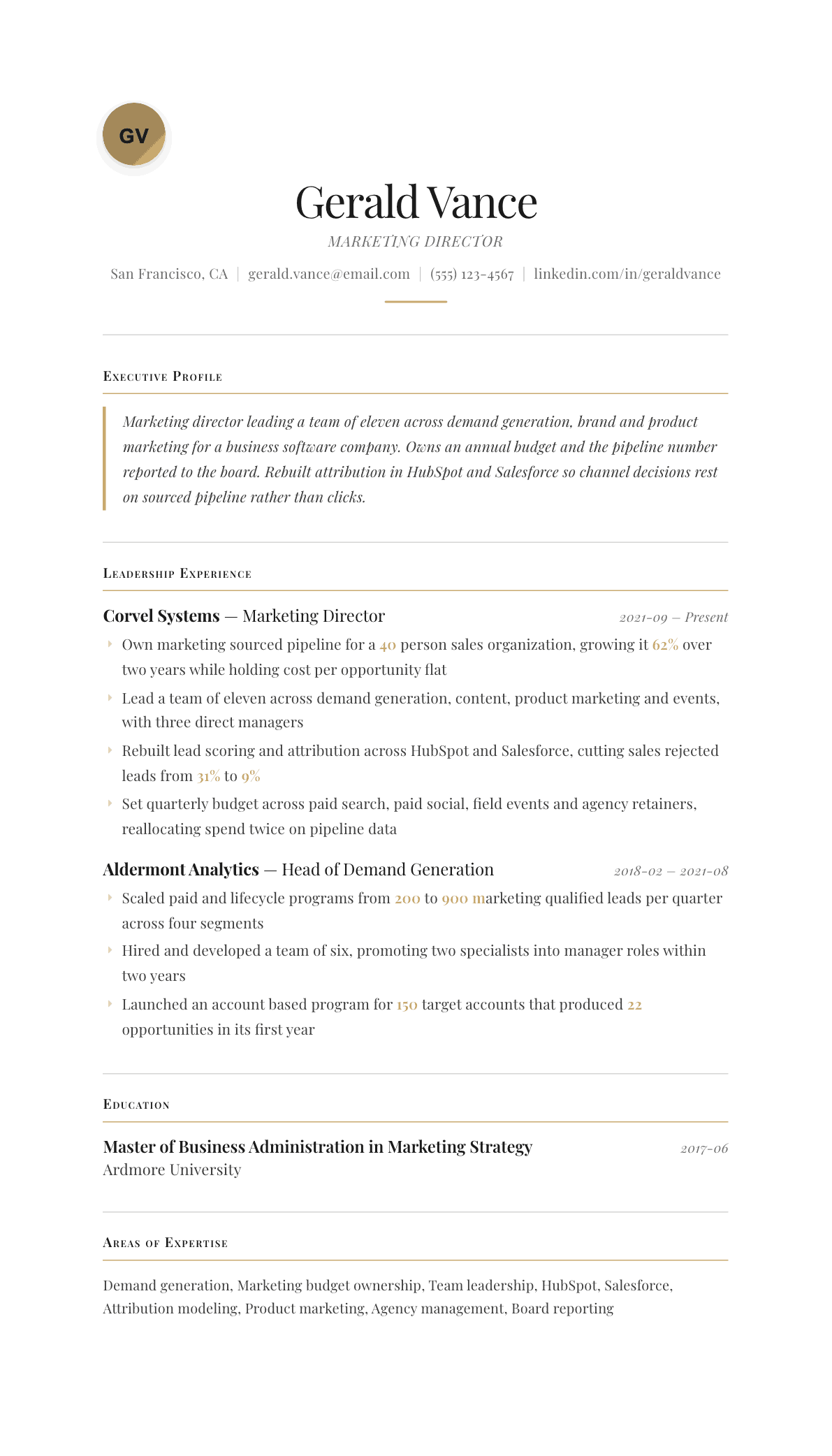
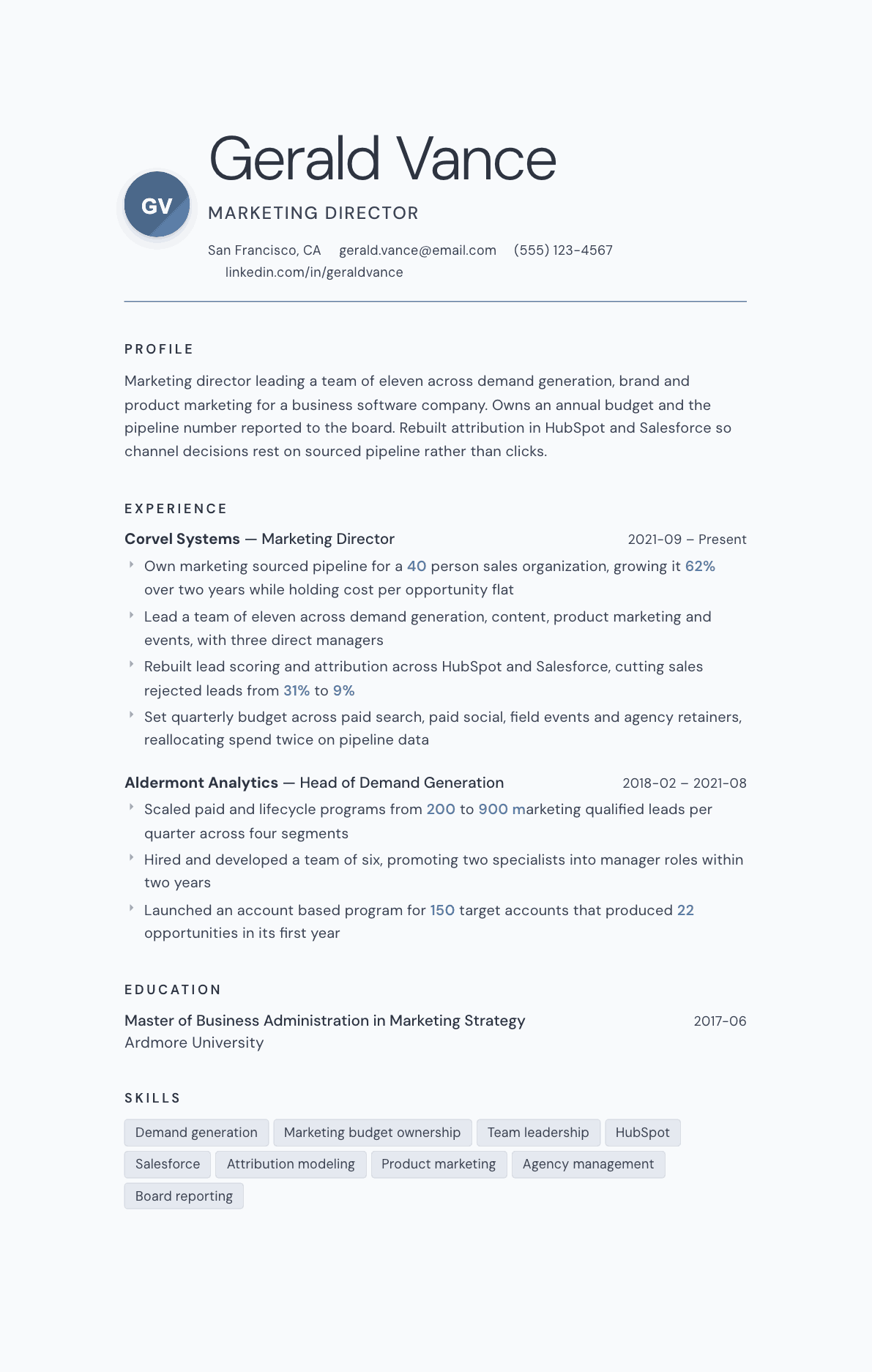
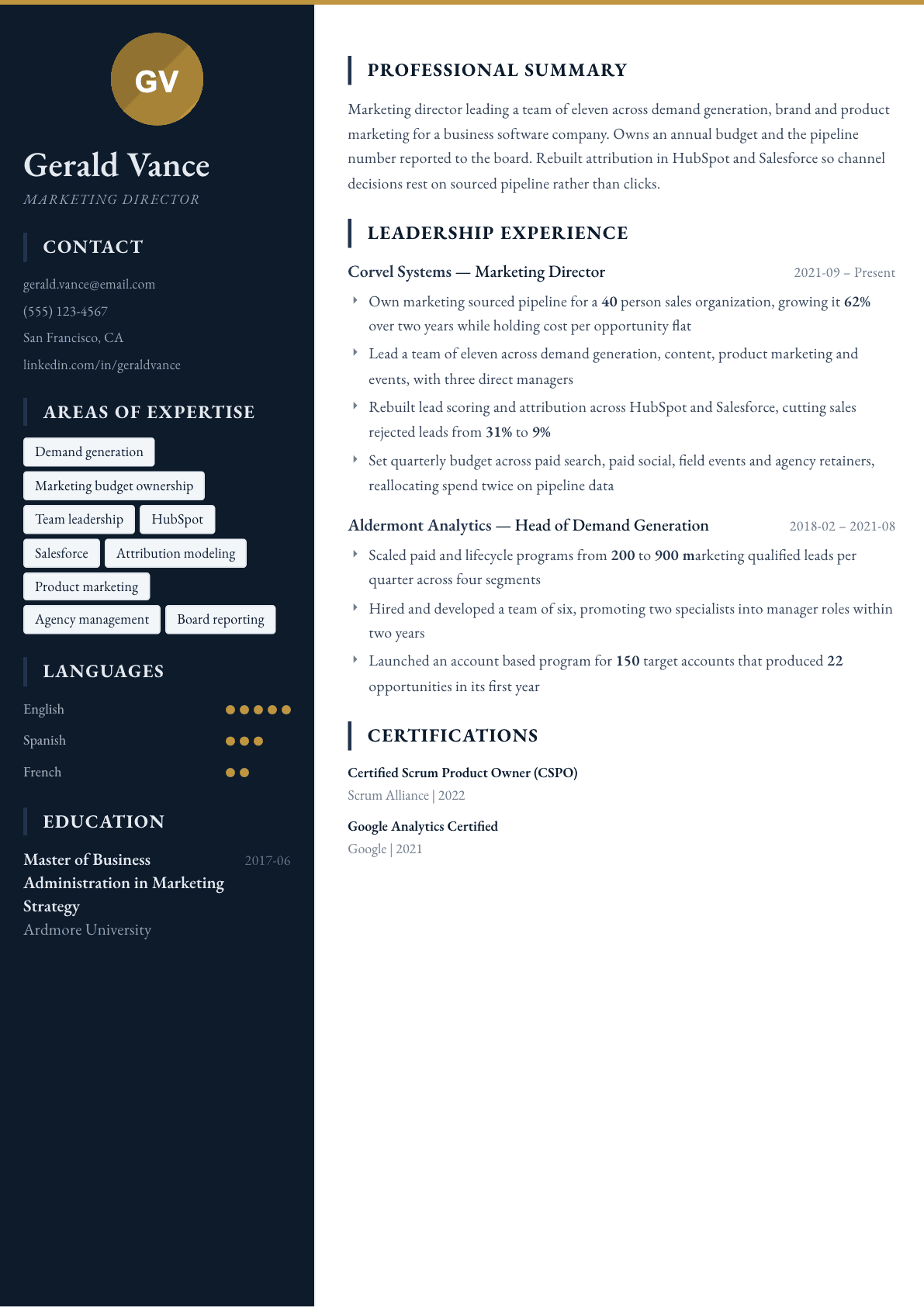
The same marketing director content laid out in three CVBooster templates, so you can see what the finished document looks like before you write a word.
Example Marketing Director summary
Marketing director with nine years in business software, leading a team of eleven across demand generation, content and product marketing. Owns the sourced pipeline number reported to the board and an annual budget spanning paid media, events and agency work. Grew sourced pipeline 62% in two years while holding cost per opportunity flat, and rebuilt attribution so channel spend follows revenue rather than clicks.
Skills to list on a Marketing Director resume
- Marketing strategy
- Demand generation
- Budget management
- Team leadership
- Pipeline forecasting
- Brand positioning
- Product marketing
- Attribution modeling
- HubSpot
- Salesforce
- Account based marketing
- Agency management
- Go to market planning
- Executive reporting
- Hiring and development
What actually gets this resume read
- Open with scope: team size, budget responsibility, the revenue number you own, and the segments you sell into.
- Separate what you led from what your team executed, because a director is hired for judgment and not for tool skills.
- Show at least one bullet where you moved money between channels and explain the evidence that drove the decision.
- Name the reporting relationship, since a director reporting to a founder runs a different job than one reporting to a chief marketing officer.
- Include hiring and promotion outcomes; leadership hires are judged on the people they developed as much as the campaigns.
- Keep it to two pages and push early individual contributor roles into a compact final section with titles and dates only.
How to write a marketing director resume
A marketing director resume is read by a chief executive, a chief marketing officer or a board level recruiter, and all three are asking the same question: what number did this person carry, and did it move. Below director level a resume can be a list of campaigns. At director level a campaign list is a warning sign, because it suggests the candidate is still doing the work rather than deciding which work gets funded.
The three things that decide the screen are scope, evidence and judgment. Scope is team size, budget and the revenue line you own. Evidence is the pipeline, retention or growth figure attached to your tenure. Judgment shows in the moments where you changed direction: a channel you cut, a segment you exited, a hire you made after a program failed. Directors are hired for the third one and screened on the first two.
What follows is the section order senior marketing resumes use, how to write a leadership summary that is not a mission statement, three example summaries from first director role to divisional lead, before and after bullets, and the questions experienced marketers ask when they move from doing to owning.
Format: two pages, scope before detail
Two pages is standard and expected. Use the first half of page one for the summary, a scope block and the current role. Push individual contributor roles from earlier in your career into a compact list of title, company and dates at the end of page two.
A scope block is the fastest upgrade available to a director resume. Three or four lines under the summary stating team size, budget responsibility, the revenue or pipeline number, the go to market motion and the segments you sell into. It answers in five seconds what a recruiter would otherwise dig through two pages to infer.
- Header: name, title, city and state, phone, email, professional profile link.
- Sections: summary, scope, experience, earlier roles, education, board or advisory work if any.
- Skip the skills grid of soft traits. At this level it reads as filler.
Summary: the business you ran, not the marketing you love
Four lines at most. Name the industry, the company stage, the team you led, the number you owned, and the single largest result of your tenure. A hiring committee comparing five director candidates is comparing exactly those five variables.
Cut every phrase that could belong to any marketer: passion for storytelling, data driven leader, customer obsessed. Replace them with the specific commercial context. Leading marketing for a business software company selling to hospital systems is a different job from leading marketing for a direct to consumer brand, and the summary should make the difference obvious.
Experience: decisions, budgets and the people you built
Open each director role with one context line: what the company sells, how big the marketing team was when you arrived, and what you were hired to fix. Then five or six bullets, and make at least two of them about decisions rather than campaigns.
Budget bullets should show reallocation, not just size. Anyone can spend a budget. A director earns the title by moving money away from something that was comfortable and toward something the data supported, then defending that call to a sales leader who liked the old plan. Write the decision, the evidence and the outcome in one sentence.
People bullets matter more than most candidates expect. Hires made, specialists promoted, managers developed, agency relationships renegotiated or ended. A director who cannot show a team growing is read as a senior manager with a better title.
- Name the reporting line: to the founder, the chief marketing officer, the general manager or the board.
- Give the marketing motion: product led, sales led, channel, retail, direct to consumer, or a mix.
- Show at least one cross functional result with sales, product or finance rather than a marketing only win.
Numbers a director resume is expected to carry
Pick the numbers your next employer manages against and stay consistent across the whole resume. Mixing sourced pipeline in one job with impressions in the next tells the reader you reached for whatever looked biggest.
For business to business roles: sourced and influenced pipeline, cost per opportunity, win rate contribution, lead to opportunity conversion, and the split between new logo and expansion. For consumer roles: contribution margin, blended acquisition cost, repeat purchase rate, channel mix and retention. Name the system the number comes from so it is verifiable.
Keywords and the recruiter screen
Executive postings are still parsed by software, and the phrases that recur are predictable: go to market strategy, demand generation, brand positioning, budget ownership, team leadership, product marketing, and the customer relationship platform in use. Place each one in the summary or scope block, then again inside a bullet where it is proven.
Recruiters also filter on industry and stage. Write the sector plainly, and state company size in employees or the marketing team size rather than leaving the reader to guess from a logo she may not recognize.
Marketing Director resume summary examples
First director role
Marketing leader stepping into a first director seat after four years running demand generation for a business software company. Built a team of six and scaled marketing qualified leads from 200 to 900 a quarter across four segments. Owns budget, forecasting and the pipeline number reported to the sales leadership team.
Established director
Marketing director leading eleven people across demand generation, content, product marketing and events for a business software company. Owns the sourced pipeline number reported to the board and an annual budget spanning paid media, field events and agency retainers. Grew sourced pipeline 62% in two years while holding cost per opportunity flat.
Divisional lead
Senior marketing director responsible for two business units and a team of twenty four, including three managers and an in house creative studio. Rebuilt attribution across the customer platform so channel spend follows revenue. Led the repositioning and rebrand that preceded the strongest new logo year in company history.
Work experience bullets: before and after
Before: Managed the marketing budget and team.
After: Owned an annual budget across paid media, field events and agency retainers for a team of eleven, reallocating spend twice a year based on sourced pipeline rather than channel tradition.
Budget ownership only reads as leadership when the reader sees what you moved and what you decided it on.
Before: Improved lead quality for the sales team.
After: Rebuilt lead scoring and attribution across HubSpot and Salesforce with the sales operations lead, cutting sales rejected leads from 31% to 9% and ending the weekly argument about lead quality.
It names the systems, the partner, the metric and the organizational problem the fix actually solved.
Before: Grew the marketing team.
After: Hired seven marketers in two years and promoted two specialists into manager roles, with no voluntary departures from the core team over that period.
Hiring plus promotion plus retention is the full leadership picture; headcount growth alone is not.
Before: Led the company rebrand.
After: Led a repositioning and rebrand across messaging, site and sales collateral in five months, aligning product, sales and support on one narrative before launch and retiring three conflicting product names.
Rebrands are common on resumes, so the timeline, the scope and the internal alignment are what distinguish yours.
Before: Ran account based marketing programs.
After: Launched an account based program covering 150 target accounts with sales, pairing a named account list with field events and paid targeting, which produced 22 opportunities in its first year.
The account count, the joint ownership with sales and the opportunity outcome make the program measurable.
Hard skills
- Go to market strategy
- Demand generation
- Budget ownership
- Pipeline forecasting
- Brand positioning
- Product marketing
- Attribution modeling
- Account based marketing
- Agency and vendor management
- Marketing operations
- Executive and board reporting
- Team hiring and development
Soft skills
- Commercial judgment
- Executive communication
- Cross functional influence
- Coaching managers
- Prioritization under budget pressure
- Comfort defending a call with data
Certifications worth listing
- Professional Certified Marketer (American Marketing Association)
- Pragmatic Institute Product Marketing Certification (Pragmatic Institute)
- Project Management Professional (Project Management Institute)
Mistakes that cost marketing director candidates the interview
- Listing campaigns you personally executed, which signals a senior manager rather than someone who allocates and decides.
- Omitting team size and budget scope, forcing a recruiter to guess whether you led three people or thirty.
- Reporting impressions, followers or website visits when the reader is looking for revenue, pipeline or margin.
- Writing a summary of marketing philosophy instead of the business you ran and the number you carried.
- Hiding the reporting line, so the reader cannot tell whether you owned strategy or executed somebody else's.
- Keeping four bullets on a job from a decade ago while the current role, the one being evaluated, gets three.
- Claiming a company result without naming your contribution, which invites a skeptical question in the first interview.
Marketing Director resume questions
How long should a marketing director resume be?
Two pages. One page cannot hold budget scope, team structure and multiple leadership roles without stripping the evidence a hiring committee needs. Three pages signals that older roles were never compressed into a summary list.
What metrics belong on a marketing director resume?
The ones your next employer runs the business on. Business to business leaders should carry sourced and influenced pipeline, cost per opportunity and conversion rates. Consumer leaders should carry acquisition cost, contribution margin, retention and channel mix, each tied to a named system.
Should I include agency experience on a director resume?
Yes, and treat it as scope. Name the number of accounts, the combined budget you directed and the industries. Agency leaders often manage more channels than in house directors, and that breadth is worth stating rather than leaving implied.
How do I show leadership without a large team?
Lead with what you controlled: budget, roadmap, agencies, contractors and cross functional programs. A director of three who owns the go to market plan and an outside agency roster is running more than a manager of ten executing someone else's plan.
Do I need an advanced degree to be a marketing director?
No. A business degree helps in some large organizations and matters very little in others, and no hiring committee will choose it over a documented revenue record. List the degree plainly and spend the space on scope and results instead.